Best Early Childhood Education Schools in Rhode Island
Compare 4 accredited Early Childhood Education programs in Rhode Island at 3 colleges, with net price after aid, graduation rates, earnings and debt from IPEDS and the U.S. College Scorecard.
In Rhode Island, students who want a bachelor's degree in early childhood education earn the Bachelor of Science (B.S.), the field's standard credential here. Rhode Island College says 70% of the state's teachers are its graduates.
Cost, admissions, online options and certification are compared side by side for each school. It is for students choosing a degree, not parents looking for pre-K lottery or enrollment details.
Price is the sharpest divide. Annual published tuition and fees run from $12,123 at Rhode Island College to $50,100 at Salve Regina University, for programs aimed at similar certification.
Key Points
- URI offers the only fully online early childhood degree-completion track here.
- Median program debt ranges from $21,875 to $27,000 across these schools.
- RIDE's Early Childhood Education Teacher certificate covers grades PK to 3.
Best Bachelor's in Early Childhood Education Schools in Rhode Island
Three Rhode Island institutions award a bachelor's degree in early childhood education, and each takes a different route to the same Pre-K to grade 3 classroom: a flagship research university with a matching online completion track, the state's dominant teacher preparation pipeline, and a private campus with a strong special education option. Every entry below is a bachelor's program, and every outcome figure is labeled with the window it covers.
University of Rhode Island
#1Kingston, RI · ~$21,000/yr (est.)
Best for: Working child care professionals
The University of Rhode Island in Kingston pairs a campus B.S. in Early Childhood Education, which leads to an initial Pre-K to 3 teaching certificate, with an accelerated online degree-completion track built for working early childhood professionals. Campus students complete three field experiences and a required student teaching semester while using the university's on-campus child development centers. The institution-wide graduation rate is 73%, and early childhood graduates earn a median of $56,999 four years after finishing.
- Initial Pre-K to 3 teaching certificate
- Fully accredited certification program
- Focus on children from birth to age 8
- Three separate field experiences
- Required student teaching semester
- On-campus child development centers
- Culturally relevant care and education coursework
- Partnerships among family, school, and community
- $654 per credit
- $0 application fee
- Seven-week accelerated online courses
- Pre K-3 teaching certificate eligibility
- Enrollment limited to seven Northeast states
- Coursework in early language and literacy development
- Assessment in early childhood
- Home, school, and community partnerships
Rhode Island College
#2Providence, RI · $9,000/yr (est. net price)
Best for: Cost-conscious in-state teacher candidates
Rhode Island College in Providence describes itself as the largest educator preparation program in the state and reports that 70% of Rhode Island teachers are RIC graduates. The B.S. in Early Childhood Education, with a birth to 5 teaching concentration leading to Pre K-2 certification, requires no secondary admission beyond the college's general application. Field work runs through every program and student teaching placements span schools across Rhode Island. The institution-wide graduation rate is 48%, and early childhood graduates earn a median of $49,069 four years after finishing.
- Birth to 5 teaching concentration
- Eligible for Pre K-2 certification
- No secondary admissions process
- Classes held in Horace Mann Hall
- Field work in every program plus student teaching
- Second bachelor's degree option available
- Largest educator preparation program in Rhode Island
- 70% of Rhode Island teachers are RIC graduates
Salve Regina University
#3Newport, RI · ~$37,000/yr (est.)
Best for: Special education double-major students
Salve Regina University in Newport is a private, Rhode Island Department of Education accredited route to Pre-K through grade 3 certification, with field experience beginning in sophomore year and a two-semester senior teaching residency paired with weekly seminars. Students can add a special education double major that extends certification from birth through grade 3, and faculty build science of reading instruction into the coursework. The institution-wide graduation rate is 77%, and early childhood graduates earn a median of $59,178 four years after finishing.
- Rhode Island Department of Education accredited
- Prepares for Pre-K through grade 3 certification
- Special education double major extends certification from birth to grade 3
- Field experience begins in sophomore year
- Two semesters of senior-year student teaching residency
- Science of reading instruction included
- Credential transfers to 45 states
- Study abroad in England, Ireland, and Italy
Cost & outcomes by school
Federal data for the highest-earning Early Childhood Education programs, independent of the ranking above. Earnings are this field's bachelor's graduates four years after completing where the Scorecard reports them, else the school's undergraduate median.
| School | Net price / yr | Grad rate | Earnings | Debt | Grads/yr | Format |
|---|---|---|---|---|---|---|
| Salve Regina University RI | $36,967 | 77% | $59,178 | $27,000 | 46 | Campus |
| University of Rhode Island RI | $21,440 | 73% | $56,999 | $21,875 | 135 | Campus |
| Rhode Island College RI | $9,478 | 48% | $49,069 | $24,481 | 27 | Campus |
Sources: U.S. Department of Education. Net price, graduation rate, earnings and debt: College Scorecard (earnings and debt for this field's bachelor's graduates where reported, else school-wide); graduates: IPEDS. A dash means no figure is reported.
Cost, debt & payoff
Median earnings of this field's bachelor's graduates (4 yrs after completing, else the school's undergraduate median) vs. their median federal loan debt · U.S. College Scorecard
Across these programs the median graduate earns about $56,999 and finishes with roughly $23,178 in debt — a ratio that clears a common rule of thumb (keep debt below first-year salary). Net price and debt vary widely school to school, so check the per-school figures in the table above before you shortlist.
How We Ranked Rhode Island Early Childhood Education Schools
A low price means little if students rarely finish, and a strong completion record means little if the bill is out of reach. The order here weighs both, using federal figures from the College Scorecard and the Integrated Postsecondary Education Data System (IPEDS) on cost, outcomes and completion.
What Is Included
Only bachelor's programs count, whether a Rhode Island school delivers them on campus or online. That means programs leading to a Bachelor of Science or comparable bachelor's credential in early childhood education. Nothing else is scored.
What Drives the Order
- Net price: What students typically pay once grants and scholarships are applied, not the sticker price.
- Completion: How many students finish their degree at the school.
- Graduate outcomes: Earnings and debt for graduates, where the federal data reports them.
- Program fit: Whether the school offers a dedicated early childhood bachelor's program, and in what format.
Limits Worth Knowing
Two of these figures need a careful read. Graduation rates and net price describe the whole institution, not the early childhood program alone. A school's overall completion rate may differ from what education majors experience.
Net price is also an average across students who received aid. It is not a quote. Your own cost depends on your family's income, your aid package and whether you live at home or on campus.
Use the ranking to build a shortlist, then confirm details with each school's admissions and financial aid offices. Ask for a personalized net price estimate before you decide.
Rhode Island College vs. URI vs. Salve Regina: Side-by-Side Comparison
These programs all prepare students for Rhode Island early childhood teacher certification, but they differ in grade coverage, how student teaching is structured, and how special education fits in. Cost differs too: Salve Regina's annual tuition is more than four times Rhode Island College's. The table below uses each school's program page for structure and federal data for cost. Where a program page does not say something, the table notes that.
| Feature | Rhode Island College | University of Rhode Island | Salve Regina University |
|---|---|---|---|
| Degree | Early Childhood Education B.S. | Early Childhood Education B.S. | Early Childhood Education bachelor's |
| Certification age range | Pre-K through Grade 2. The Birth to 5 Community Programs concentration is currently suspended. | Initial Pre-K to Grade 3 certificate, with a birth-to-age-8 focus | Pre-K through Grade 3 |
| Field experience | Field work in Rhode Island schools. The program page does not list required hours or placements. | Three field experiences, plus on-campus child development centers | Field experience begins sophomore year |
| Student teaching | Included as student teaching or internship. The program page does not specify credits. | One required student teaching semester | Two semesters of student teaching |
| Special education combination | Option to apply to a fifth-year master's in early childhood special education. A separate graduate certificate covers Preschool–Grade 2 plus special education certification and requires student teaching, including the 6-credit ECSE 639. | The program page does not list a special education dual-certification option. | Special education double major option and a combined bachelor's/master's in special education |
| In-state tuition and fees | $11,300 | $16,942 | $50,100 |
| Out-of-state tuition and fees | $27,299 | $37,146 | $50,100 |
| Average net price after aid | $9,478 | $21,440 | $36,967 |
| Best fit if you want… | The lowest net price and placements in Rhode Island schools, through what the college calls the state's largest educator prep program | Pre-K–3 certification with a birth-to-8 focus and on-campus child development centers, at a mid-range price | Special education built into the bachelor's and two full semesters of student teaching, if the private-school price works for you |
Online and Hybrid Bachelor's Options at Rhode Island Schools
Two paths exist here: a fully online degree-completion track and traditional campus programs. Only the University of Rhode Island offers the online route.
Where online is available
- University of Rhode Island: The Early Childhood Care and Education B.S. Degree Completion is fully online and built for working professionals. It totals 120 credits (2026-2027) and is eligible for Pre-K-3 teacher certification. URI's separate Early Childhood Education B.S. is campus-based.
- Salve Regina University: The Early Childhood Education B.S. is in-person. Salve Regina does not describe an online, hybrid or degree-completion bachelor's in this field.
- Rhode Island College: The Early Childhood Education B.S. is a campus program in our data. RIC's published materials do not describe a hybrid or degree-completion version, so confirm with the department before assuming one.
Who the online track suits
URI's degree-completion route fits working paraprofessionals and early educators who already hold credits and need flexibility around a job. Transfer students with prior coursework should ask URI how those credits apply toward the 120-credit total.
Fieldwork stays in the classroom
Online coursework does not remove classroom requirements. URI's degree-completion curriculum includes practicum courses (EDC 326 and EDC 336) and 12 residency credits. URI's published materials do not say whether an existing workplace can count or how placements are assigned, so ask before enrolling. At Salve Regina, field experience starts sophomore year and student teaching runs across two semesters, all in person.
No Rhode Island school here is shown to allow practicum or student teaching to be completed fully remotely.
Admissions Requirements for Rhode Island Early Childhood Bachelor's Programs
Admission to an early childhood education bachelor's program in Rhode Island works in two stages. First you get into the university, with one application, one transcript set and one deadline. Later, the education department decides whether you advance from major to teacher candidate, and that second step is where standardized tests and a higher GPA typically enter the picture.
What Each School Publishes
- Rhode Island College: The B.S. in Early Childhood Education has no secondary admission; applicants go through general admissions. Transfers use the RIC Transfer Application, pay a $50 fee, submit transcripts from every college attended, and need a 2.0 GPA when entering with 24 or more college credits. The fall deadline is July 15 and spring is November 15. No published policy sets an ECE-specific entry GPA. SAT, ACT or PRAXIS Core scores matter later, at teacher-candidate progression.
- University of Rhode Island: Applicants enter through URI's general undergraduate admission. No published policy states an ECE-specific GPA, test rule or deadline, so the university's own requirements govern.
- Salve Regina University: The early childhood education bachelor's admits through the university's general application. No published policy sets a program-level GPA or a separate deadline for the major.
Transferring from CCRI
The Joint Admissions Agreement gives CCRI students a guaranteed path into Rhode Island College or URI: enroll before you pass 30 college-level credits, complete the prescribed associate degree within five years of starting at CCRI, hold a 2.4 cumulative GPA and meet the receiving school's requirements. The agreement guarantees at least 32 CCRI credits toward general education. At RIC, up to 90 transfer credits are accepted for courses graded C or better, and 45 credits must be earned at RIC. CCRI associate holders who reach a 2.75 GPA are also exempt from the SAT, ACT or PRAXIS Core requirement at the teacher-candidate stage.
How Selectivity Differs
Rhode Island College publishes the most concrete numbers and admits transfers at 2.0, so its real gate is progression to teacher candidate at 2.75. Students between 2.50 and 2.749 can continue with a support plan but must reach 2.75 before student teaching. URI and Salve Regina filter earlier, through general university admission, and publish no separate program-level bar.
Related Articles
Cost of a Bachelor's Degree in Early Childhood Education in Rhode Island
Sticker price is the wrong number to compare. What matters is what a family actually pays after grants, and in Rhode Island the gap between published tuition and average net price is widest at the private option and narrowest at the public ones.
Published Tuition vs. Net Price
At Rhode Island College, published tuition and fees for in-state undergraduates run about $12,123 for the year, and the average net price after aid comes in near $9,478. That net figure is an institution-wide average, so it blends students who receive generous aid with those who receive very little. The University of Rhode Island publishes roughly $16,942 in tuition and fees for Rhode Island residents, with an average net price around $21,440. Net price can exceed tuition because it also captures housing and meals for students who live on campus. Salve Regina University, as a private institution, charges the same rate regardless of residency: about $50,100 in tuition and fees, with an average net price near $36,967.
Where the Aid Comes From
Pell eligibility is a reasonable proxy for how much need-based aid circulates on a campus. About 64 percent of Rhode Island College undergraduates receive Pell grants, compared with roughly 41 percent at URI and 32 percent at Salve Regina. A higher share generally means more institutional and state need-based money is flowing to students, which can soften the published price considerably.
State Aid, With Caveats
Rhode Island's need-based grants are administered through the Rhode Island Higher Education Assistance Authority and tied to the FAFSA. Award amounts depend on enrollment, demonstrated need and available funding, and terms shift from year to year. The state has also funded scholarships and loan-forgiveness programs aimed at future teachers, but eligibility rules and award sizes have changed repeatedly. Rhode Island Promise is narrower than it sounds: it is generally limited to recent high school graduates moving straight into full-time study, so it rarely reaches students already enrolled in a bachelor's program. Confirm current rules with the state aid agency and each financial aid office before you count on a figure.
Two Practical Moves
- Live at home if you can. Rhode Island College estimates a 2026-27 commuter cost of attendance near $22,663, against about $32,203 for students living on campus, a difference that dwarfs most small scholarships.
- File early. State and campus aid is finite, and priority deadlines tend to fall in winter and early spring.
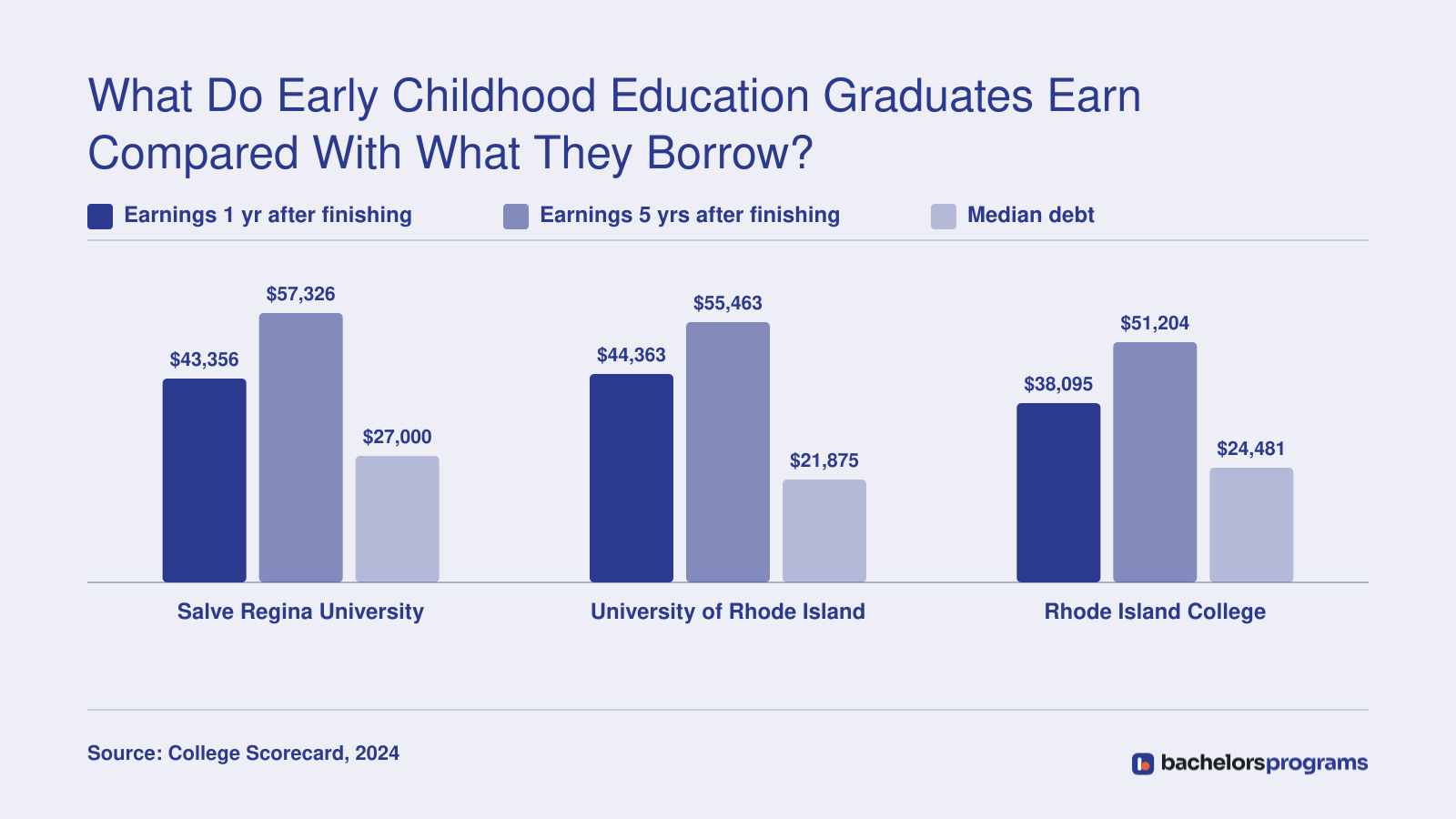
What Do Early Childhood Education Graduates Earn Compared With What They Borrow?
At each school here, median earnings for early childhood education bachelor's graduates climb noticeably between the first and fifth year after finishing, while median program debt ranges from $21,875 to $27,000. Salve Regina graduates post the highest five-year earnings but also carry the most debt, and URI pairs the lowest debt with the highest first-year pay. For a new early childhood educator, first-year earnings already exceed median debt at every school shown, and estimated 10-year monthly loan payments run $232-$286, a manageable share of a classroom salary.
Rhode Island Early Childhood Teacher Certification: Steps and Exams
The Rhode Island Department of Education (RIDE) issues the Early Childhood Education Teacher certificate for grades PK–3. The steps below follow RIDE's 2026 certificate-area, testing and residency guidance. Requirements are updated periodically, so confirm details with RIDE before you apply.
- 1. Complete a bachelor's degree and an approved programEarn a bachelor's degree from a regionally accredited institution and finish a RIDE-approved Early Childhood educator-preparation program. Pedagogy coursework must cover reading, mathematics and teaching differently-abled students.
- 2. Pass the required Praxis examRIDE accepts either of two options. The first is Praxis Early Childhood Education: Foundational Knowledge (5533) with a score of 156. The second is passing all four Praxis Elementary Multiple Subjects (7001) subtests: Teaching Reading 143, Mathematics 157, Social Studies 155 and Science 159.
- 3. Finish field hours and student teachingRIDE's certificate page lists 60 field hours plus 12 weeks of student teaching in early childhood. State regulations describe a one-year practical residency or equivalent, so ask your program which model it follows.
- 4. Submit your RIDE applicationSend official transcripts, an official program-completion letter naming the content area and grade range, and your official Praxis score report if it was not sent directly. RIDE estimates 8 to 10 weeks for processing. Candidates prepared in a language other than English must also show proficiency through a TOEFL iBT score of 79 or an ACTFL TEP rating of Advanced Low.
- Who needs this certificateThe PK–3 certificate is the credential for teaching in Rhode Island public school classrooms, including public pre-K. Many childcare centers hire under separate rules and may not require it. Check with the employer about the credentials it expects.
Early Childhood Education Careers and Pay in Rhode Island
Early childhood work in Rhode Island is split between two pay scales, and the setting you choose matters as much as the degree. A bachelor's degree in early childhood education from the University of Rhode Island, Rhode Island College, or Salve Regina University can lead to either one.
Where Graduates Work
- Public pre-K and elementary classrooms: Teaching in public schools requires Rhode Island certification on top of the degree, and these jobs follow district salary schedules.
- Head Start: Federal program rules set degree expectations for teaching staff, so a bachelor's keeps more roles open.
- BrightStars-rated centers: The state's quality rating system covers child care and preschool programs. Higher-rated centers often look for teachers with four-year degrees.
What the Wage Data Shows
The latest Rhode Island numbers come from the Bureau of Labor Statistics and date to May 2023, so treat them as a snapshot rather than today's pay. Preschool teachers in the state averaged $18.74 an hour, or about $41,600 a year.1 Kindergarten teachers averaged $83,080 a year, with employment of roughly 360.1 That is a gap of more than $40,000.
The pattern is not unique to Rhode Island. Nationally, May 2025 data put the average preschool teacher at $43,030 and the average kindergarten teacher at $69,370.2 Childcare and preschool pay trails K-12 teaching, and a degree alone does not close that gap. Certification puts you on a public-school salary schedule.
Demand figures are national, not Rhode Island-specific. BLS projects 4% growth for preschool teachers from 2025 to 2035.3 It also projects about 99,400 openings a year for kindergarten and elementary teachers.4
Weighing Pay Against Debt
Compare these wages with the earnings and debt figures described in the ranking criteria above. A school with higher debt makes more sense if you plan to teach in a public classroom. If you expect to start in a lower-paid center, a lower-cost path matters more.
Your Next Step
Before you commit, ask each school's education department two questions. Does the program lead to Rhode Island certification? Where do recent graduates take their first jobs? Their answers will show which path fits the pay you want.
Compare Early Childhood Education programs on the data that matters
Explore more Education & Teaching majors or browse every field of study.
All Education & Teaching programs Browse every field of study