Best Online Secondary Education Degree Programs
Compare 110+ accredited online Secondary Education programs, with net price after aid, graduation rates, earnings and debt from IPEDS and the U.S. College Scorecard.

A bachelor's degree in secondary education prepares you to teach one subject, such as English, math or science, in middle or high school. The most common credential is the Bachelor of Science (B.S.) in Secondary Education. You can earn it fully online, because the one in-person requirement, student teaching, happens through a local placement.
Costs vary widely: institution-wide average net price after aid spans $1,471 at St. Petersburg College to $20,723 at The Citadel.
Only undergraduate degrees appear here. The harder constraint is licensure, which states issue individually, so where you student teach often shapes where you're first hired.
Key Points
- Coursework runs online, but student teaching happens in a local school.
- Unfinished TEACH Grant service converts the grant into an unsubsidized loan.
- Licensure exams vary by state; New Jersey dropped the Praxis Core requirement.
Best Fully Online Secondary Education Degree Programs: Our Top 10
Every program below is delivered fully online; hybrid formats were set aside. The order reflects a blended quality composite that brings cost, completion and program depth together rather than leaning on a single number.
Daytona State College
#1Daytona Beach, FL · $7,000/yr (est. net price)
Best for: Florida math and science teacher candidates
Daytona State pairs an affordable Florida route into teaching with a B.S. in Education that leads to a five-year Professional Educator's Certificate in math or science. Average net price runs about $7,177 a year and the school's graduation rate is 43%. Program graduates reported median earnings of $44,869 one year after finishing and $50,619 four years out, and they have been hired across six Florida counties and 29 different schools.
- Concentrations in mathematics, biology, chemistry, earth/space science and physics
- Grades 6-12 track leading to a five-year Florida educator certificate
- Fully accredited, state-approved bachelor's program
- Education courses, professional competencies and practical classroom experience
- Graduates hired across six Florida counties and 29 different schools
- Teacher Apprenticeship Program and alternative certification options
St Petersburg College
#2St. Petersburg, FL · ~$1,500/yr (est.)
Best for: English majors adding reading and ESOL endorsements
St. Petersburg College built its secondary English degree around two credentials Florida districts ask for constantly: a reading endorsement and an ESOL endorsement. Average net price is about $1,471 a year and the school's graduation rate is 38%. Graduates reported median earnings of $49,672 one year after finishing and $52,047 four years out.
- Reading and ESOL endorsement built into the degree
- Prepares graduates for Florida secondary English certification
- Also a stepping stone toward graduate-level study and employment
Arizona State University
#3Tempe, AZ · ~$15,000/yr (est.)
Best for: Arizona residents seeking broad subject options
Arizona State offers the widest subject menu in this ranking, with 15 concentration options and a team-based teacher preparation model. Average net price is about $14,967 a year and the school's graduation rate is 68%. Graduates reported median earnings of $47,331 one year after finishing and $53,195 four years out.
- 15 concentration options, from biology and business to chemistry
- 120 credit hours with at least 24 in the chosen content area
- Semester-long, full-time student teaching placement
- Institutional recommendation for Arizona 6-12 certification
- Structured English Immersion endorsement for grades P-12
- Team-based teacher preparation model
- Live ASU Sync classes run over Zoom and require Arizona residency
Faith Baptist Bible College and Theological Seminary
#4Ankeny, IA · $15,000 – $20,000/yr (est.)
Faith Baptist is a small Iowa college whose secondary education degrees are approved by the Iowa Department of Education and available in a fully online format. Tuition is listed at $20,270 for in-state and out-of-state students alike, average net price is about $16,282 and the school's graduation rate is 68%. The 2022 graduating class posted a 100% pass rate on the Praxis exams for state licensure.
- 129 credit hours, about four years
- Approved by the Iowa Department of Education for licensure
- Endorsements in K-8 reading, K-8 English/language arts and middle school social studies
- K-12 coaching authorization and K-12 ESL endorsements available
- Coursework in teaching grammar, composition and literature
- Includes curriculum development and a 4-6 week teaching unit
- 130 credit hours, about four years
- Prepares graduates for Iowa teacher licensure
- Five endorsements earnable through online courses
- Careers include high school history teacher and middle school social studies
Turtle Mountain College
#5Belcourt, ND · ~$3,400/yr (est.)
Turtle Mountain College is a tribal college in Belcourt, North Dakota, and its secondary science degree runs as a cohort built on culturally responsive teaching. Tuition is $2,794 for in-state and out-of-state students, average net price is about $3,428 and the school's graduation rate is 43%. Students complete 141.5 credits, including six credits of Native language and 12 credits of student teaching.
- 141.5 credits: 69 prerequisites, 44.5 education and 28 science emphasis
- Biology and chemistry emphases available
- Cohort model built on culturally responsive teaching
- Six credits of Native language required
- Prepares for Praxis I and the Praxis Subject Assessment
- 12 credits of student teaching
- Admission requires a 2.5 GPA, three recommendations and an interview
Citadel Military College of South Carolina
#6Charleston, SC · $13,000 – $39,000/yr (est.)
The Citadel runs its secondary social studies degree as an online completion program with evening classes, designed for students who already hold at least 30 college credits. In-state tuition is about $12,570 and out-of-state tuition about $38,508, average net price is near $20,723 and the school's graduation rate is 75%. Graduates qualify for initial South Carolina certification in secondary social studies.
- Degree completion program taught in evening classes
- Social studies concentration leads to South Carolina initial certification
- Requires at least 30 completed college credits to enter
- Only evening secondary social studies completion program in the Lowcountry
- $40 nonrefundable application fee
Oklahoma State University
#7Stillwater, OK · ~$17,000/yr (est.)
Oklahoma State requires 800 hours of field experience in rural, suburban and urban schools across secondary options in English, math, science and social studies. In-state tuition is about $10,234 and out-of-state about $25,754; average net price is near $17,447 and the school's graduation rate is 68%. Graduates reported median earnings of $43,892 one year after finishing and $46,215 four years out.
- Options in English, mathematics, science and social studies, grades 6-12
- 800 hours of field experience in rural, suburban and urban schools
- English option available fully online
- Recommended for Oklahoma certification; exams accepted in other states
- OSUTeach pairs a STEM major with teaching certification at no added time
- Minors include special education and pre-counseling
University of Illinois Springfield
#8Springfield, IL · ~$10,000/yr (est.)
The University of Illinois Springfield offers three subject-specific secondary education bachelor's degrees, each leading to the Illinois 9-12 Professional Educator License and each available fully online. In-state tuition is about $12,252 and out-of-state about $22,017; average net price is near $9,833 and the school's graduation rate is 53%. Graduates reported median earnings of $44,458 one year after finishing.
- 120 credit hours, usually completed in four years
- Leads to the Illinois Secondary (9-12) Professional Educator License
- Online tuition estimated at $11,580 a year; on-campus $10,035
- $50 application fee for domestic undergraduates
- Includes a student teaching placement
- Leads to the Illinois PEL for grades 9-12
- Military benefits, financial aid and scholarships available
- Transfer credits accepted
- Leads to the Illinois Secondary Professional Educator License
- Multiple start dates each year
University of Wyoming
#9Laramie, WY · $14,000/yr (est. net price)
Wyoming pairs its secondary education degree with a concurrent content major, so graduates leave with deep subject preparation and licensure for grades 6-12. In-state tuition is about $7,768 and out-of-state about $24,178; average net price is near $13,599 and the school's graduation rate is 59%. Graduates reported median earnings of $45,901 one year after finishing and $51,967 four years out.
- Concurrent major in a content area such as English, math or secondary science
- AAQEP-accredited; Wyoming licensure for grades 6-12
- Semester-long student teaching residency with an international option
- Add endorsements in ESL and disability studies
- Available online as well as on the Laramie and Casper campuses
- About $300,000 in College of Education scholarships awarded each year
William Carey University
#10Hattiesburg, MS · ~$14,000/yr (est.)
William Carey takes a different route: students major in their subject field and minor in secondary education to earn a 7-12 license in English, math or social studies. Tuition runs about $15,480 for in-state and out-of-state students, average net price is near $14,258 and the school's graduation rate is 60%. Graduates reported median earnings of $39,520 one year after finishing and $42,389 four years out.
- Major in your subject field with a minor in secondary education
- Licensure tracks in English, mathematics and social studies/history
- License covers grades 7-12
- Housed in the College of Education, with Hattiesburg and Tradition campuses
Cost & outcomes by school
Federal data for the highest-earning Secondary Education programs, independent of the ranking above. Earnings are this field's bachelor's graduates four years after completing where the Scorecard reports them, else the school's undergraduate median.
| School | Net price / yr | Grad rate | Earnings | Debt | Grads/yr | Format |
|---|---|---|---|---|---|---|
| Western Governors University UT | $12,548 | 46% | $60,615 | $11,116 | 1,660 | Online |
| Arizona State University AZ | $14,967 | 68% | $53,195 | $16,238 | 540 | Online or campus |
Sources: U.S. Department of Education. Net price, graduation rate, earnings and debt: College Scorecard (earnings and debt for this field's bachelor's graduates where reported, else school-wide); graduates: IPEDS. A dash means no figure is reported.
Cost, debt & payoff
Median earnings of this field's bachelor's graduates (4 yrs after completing, else the school's undergraduate median) vs. their median federal loan debt · U.S. College Scorecard
Across these programs the median graduate earns about $48,647 and finishes with roughly $23,989 in debt — a ratio that clears a common rule of thumb (keep debt below first-year salary). Net price and debt vary widely school to school, so check the per-school figures in the table above before you shortlist.
What a Bachelor's Degree in Secondary Education Covers (B.S. vs. B.A.)
The Bachelor of Science in Secondary Education is the standard route into a high school classroom, but the label on the diploma matters less than what sits behind it. Some schools award a B.A. instead, and others attach licensure to a content major, such as a B.S. in Mathematics with a teaching license.
B.S. vs. B.A.
The practical difference is in the credit mix. B.S. versions lean toward education methods and subject-area depth. B.A. versions typically carry more liberal arts and language credits. The University of Illinois Springfield offers a B.A. in Secondary English Education that leads to the Illinois Professional Educator License, while Faith Baptist Bible College offers its English track as a B.S. Both end in a teaching credential. Compare the licensure outcome and the required credit hours, not the letters.
Subject Concentrations
You choose a teaching field, and that field shapes most of your upper-level coursework. The schools here cover math, English, science and social studies:
- Math: Daytona State College prepares students for Mathematics 6-12.
- English: William Carey University (7-12 licensure), Faith Baptist and UIS all offer English tracks.
- Science: Turtle Mountain College offers secondary science with biology and chemistry emphasis options.
- Social studies: The Citadel's online degree-completion program focuses here.
- Broader menus: Arizona State lists 15 concentration options, the University of Wyoming seven and Oklahoma State five.
Grade Bands
Programs prepare you for a band such as 5-12, 6-12 or 7-12. Your state's license sets the band you can actually teach, not the school. Wyoming's program, for example, leads to a license for grades 6-12. Check the band in your own state before you enroll.
Licensure vs. Non-Licensure Tracks
A licensure track includes the student teaching and state-required coursework that make you eligible for a classroom license. A non-licensure degree in education studies does not. It can suit corporate training, education nonprofits or a later certification route, but it will not put you in front of a class on its own. Confirm the track before you apply.
Bachelor's or Master's?
Every program here is a first degree. If you already hold a bachelor's in another field, you will usually pursue a Master of Arts in Teaching or a post-baccalaureate certification instead, which is a shorter path to the same license.
Student Teaching and Field Placements: What "Fully Online" Really Means
Online teacher preparation has shifted from an exception to a standard delivery model, but the clinical half of the degree has not moved with it.
Every licensure-track bachelor's degree in secondary education pairs remote coursework with supervised time in a real school building. The online part covers lectures, seminars, and exams. The in-person part covers two separate requirements: pre-student-teaching field hours spent observing and assisting, and a full-time student-teaching term near the end of the program.
The Numbers to Plan Around
State minimums for field hours before student teaching run from about 80 to 150 or more, and some programs require 150 to 300. Student teaching itself commonly runs about 12 to 16 weeks, with some programs specifying 12 to 20.6
- Minnesota: at least 100 field hours and at least 12 full-time weeks, split across no more than two placements.1
- Iowa: at least 80 field hours, including 10 before admission, and at least 14 weeks in the final year.2
- South Carolina: at least 100 field hours before clinical practice, then 12 weeks or 60 full days.3
- Alabama: 15 weeks of student teaching plus 150 hours of other clinical experience.4
- St. Cloud State University: 150 to 300 pre-student-teaching hours and 16 weeks of student teaching.5
Nationally, 41 states measure student teaching in weeks, while 15 also require other clinical experiences counted in hours.4 Your state sets the floor; your program may set it higher.
Who Finds the School
Most online programs arrange or approve a placement in a school near your home, pairing you with a local mentor teacher and a remote university supervisor who observes and grades. Western Governors University, for example, coordinates this through a Placement Specialist.6 Whether a placement can be secured depends on state authorization, licensure rules and district approval, so confirm your state is served before you enroll.
Budgeting a Semester Without a Paycheck
Student teaching is typically unpaid and happens during the school day. Plan on one semester with reduced work hours or none, and treat that lost income as part of the cost of the degree.
Three Questions to Ask Each Program
- Who finds the placement, the program or you?
- Which states does it place students in, and is yours on the list?
- How is supervision handled, and how often does a supervisor observe you in the classroom?
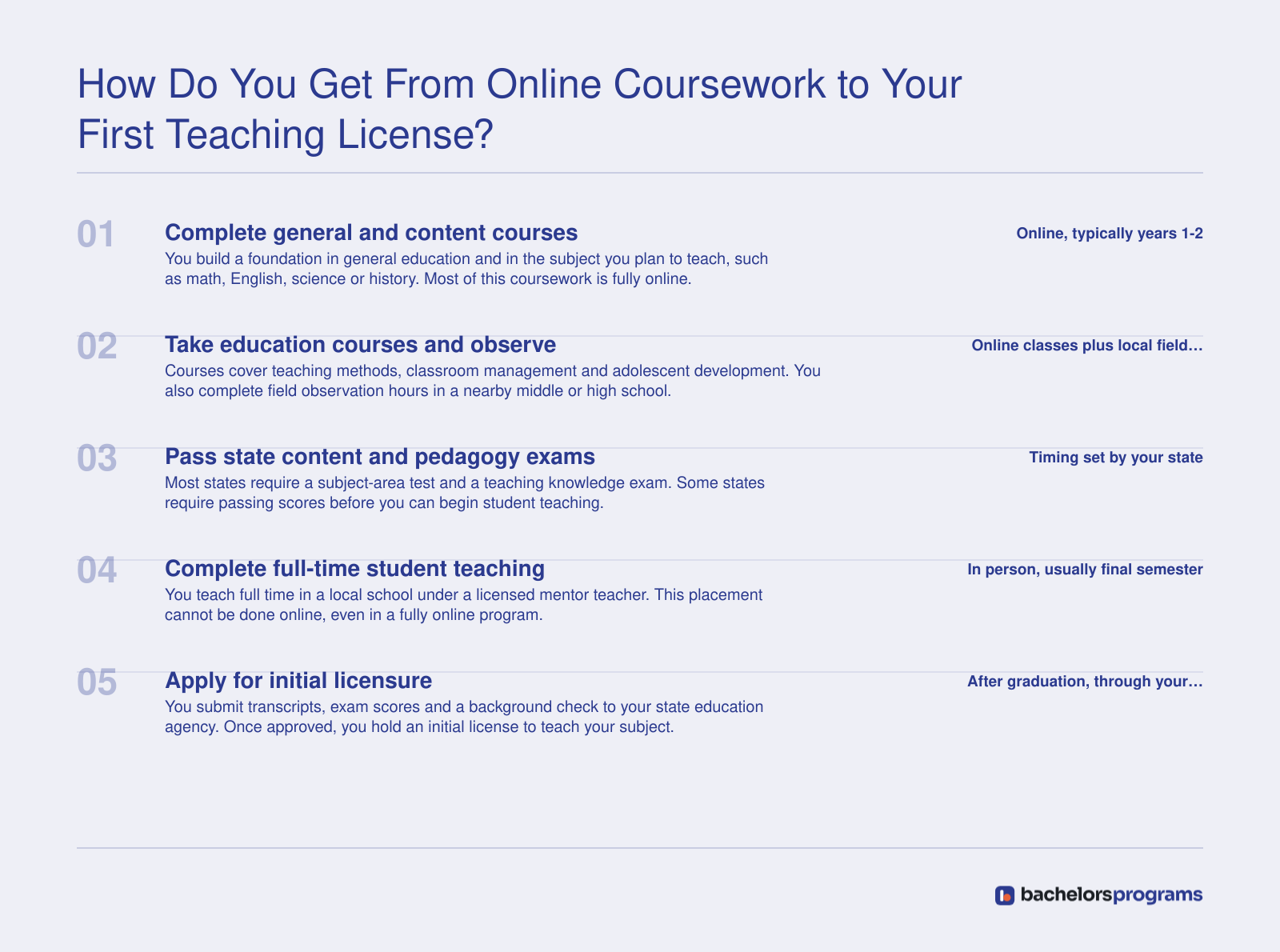
How Do You Get From Online Coursework to Your First Teaching License?
An online bachelor's degree in secondary education follows the same basic path to licensure as a campus program. Most of the coursework happens online, but the later steps take place in a local school and through your state. Exam timing and requirements vary by state, and some states require you to pass exams before student teaching, so check your state's rules early.
Praxis and Other Licensure Exams for Secondary Teachers
Most secondary teacher candidates take a mix of basic skills, subject content, pedagogy and performance assessments, but the exact combination depends on the state where you plan to teach. Requirements have loosened in recent years: New Jersey removed Praxis Core from its certification requirements, and Georgia, New Jersey, New York, Washington and Wisconsin have dropped an edTPA licensure requirement since 2022. Because exam rules change often, check your state education department's current list before you register for any test.
| Exam | What It Measures | Who Typically Requires It | Notes |
|---|---|---|---|
| Praxis Core Academic Skills for Educators | Basic academic skills in reading, writing and mathematics, used for entry-level teacher preparation | States or educator preparation programs, often as a condition of program admission | New Jersey removed Praxis Core from certification requirements, and Tennessee does not require it for licensure |
| Praxis Subject Assessments | Content knowledge in your subject or certification field, plus pedagogical knowledge on some assessments | States and licensing organizations set requirements; Mississippi requires the appropriate assessment for each certification area on both traditional and alternate routes | Tennessee requires qualifying scores on applicable content assessments for initial licensure or added endorsements, with some phase-in exceptions |
| Praxis Principles of Learning and Teaching (PLT): Grades 7-12 | Pedagogical knowledge aligned with professional education standards | States that require a professional teaching or pedagogy assessment; South Carolina lists it for high school certification fields | Mississippi requires the PLT matching the license grade span for traditional-route graduates but not for alternate-route candidates |
| edTPA | Teaching practice and pedagogical performance through a portfolio-based assessment with subject-specific areas | States or preparation programs that adopt it; Alabama requires it for teaching fields with an applicable edTPA handbook | Georgia, New Jersey, New York, Washington and Wisconsin have dropped an edTPA licensure requirement since 2022 |
| TExES (Texas Examinations of Educator Standards) | Knowledge and competency for Texas educator certification | Texas applicants seeking educator certification | Texas administers its own certification exams rather than relying only on Praxis |
| FTCE (Florida Teacher Certification Examinations) | General knowledge, professional education and subject-area knowledge | Florida teacher certification candidates | General Knowledge, Professional Education and Subject Area exams are mandatory, with no Praxis substitution |
| CSET (California Subject Examinations for Teachers) | Subject-matter knowledge for California credential candidates | California candidates seeking a secondary credential in a subject that requires CSET evidence | Candidates may take multiple subtests; CBEST basic skills testing is listed as suspended, and CalTPA serves as the performance assessment |
| NYSTCE (New York State Teacher Certification Examinations) | Certification knowledge and professional competencies through tests such as Educating All Students and Content Specialty Tests | New York State certification applicants, with required tests depending on the certificate title | Other pathway-specific assessments may apply; New York no longer requires edTPA for licensure |
Related Articles
What High School Teachers Earn Nationally
Before choosing an online bachelor's in secondary education, it helps to know what the job pays once you're licensed and in the classroom.
Secondary Education programs by state
Compare Secondary Education programs on the data that matters
Explore more Education & Teaching majors or browse every field of study.
All Education & Teaching programs Browse every field of study