Best Online Community Health Degree Programs
Compare 40+ accredited online Community Health programs, with net price after aid, graduation rates, earnings and debt from IPEDS and the U.S. College Scorecard.
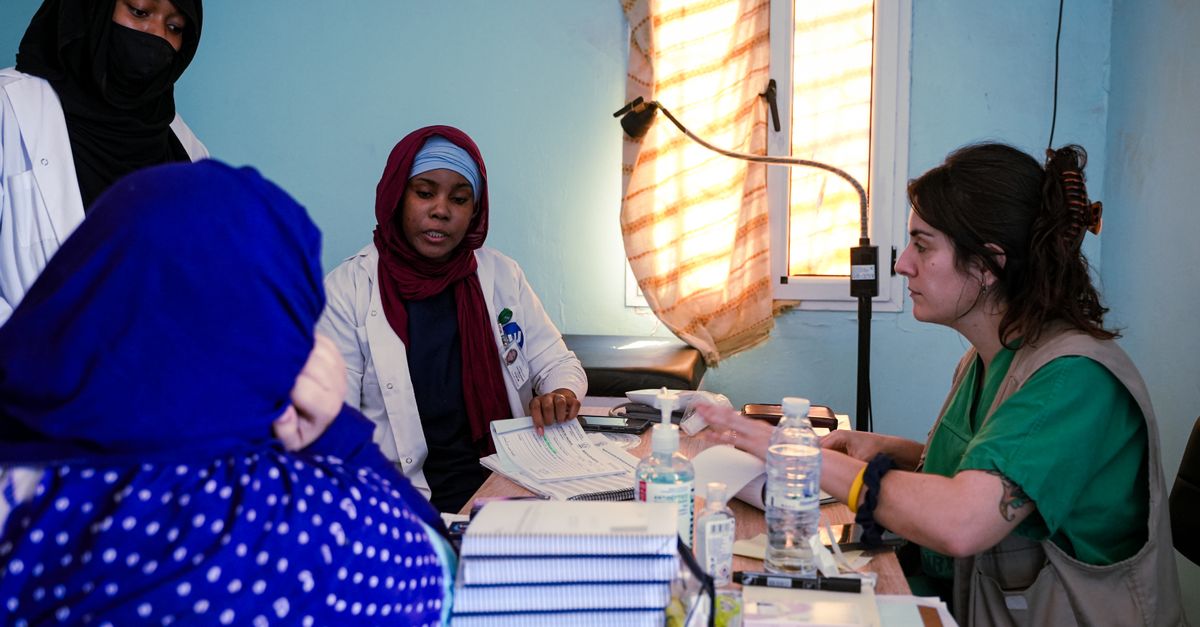
A bachelor's degree in community health trains the health educators and outreach workers who connect neighborhoods to clinics, screenings and prevention services. Programs award either a B.S. or a B.A. in Community Health, and every school ranked here can be finished 100% online, with no hybrid or on-campus sessions.
Price is the sharpest divide. Average net prices run from $4,456 to $30,434 a year, while debt, accreditation and transfer rules also differ from school to school.
CHES certification is voluntary, yet many health education employers list it in job postings.
Key Points
- Every ranked program runs 100% online, with hybrid formats excluded.
- CHES certification is voluntary, but many employers list it in job postings.
- Community health suits outreach work; public health suits population and policy roles.
Top 10 Fully Online Community Health Bachelor's Programs for 2027
Every program below can be completed 100% online, with no required campus visits for coursework; hybrid formats were excluded. The list is ordered by a blend of cost, outcomes, completions, and online delivery strength. Net prices are averages after aid, and graduation rates describe the whole institution rather than the community health major.
University of Florida
#1Gainesville, FL · ~$4,800/yr (est.)
Best for: Aspiring certified health education specialists
The University of Florida delivers its health education and behavior bachelor's degree through UF Online, with a community health promotion specialization and 18 credits of upper-level health courses. Average net price after aid is $4,815 a year, and the school graduates 85% of students, an institution-wide figure. First-time freshmen and lower-division transfers can apply, and applicants with 0 to 11 transferable credits complete freshman requirements; the final semester is a full-time internship, and graduates are eligible to sit for the CHES exam.
- 120 total credit hours
- 18 credits of HSC specialization courses
- Community health promotion specialization
- Full-time 12-credit internship or two part-time placements
- 2.5 GPA in critical-tracking courses and 2.0 UF GPA
- Prepares students for the CHES exam
- Fully online through UF Online
Arizona State University
#2Tempe, AZ · ~$15,000/yr (est.)
Best for: Students needing frequent online start dates
Arizona State University's community health bachelor's degree is taught through the Edson College of Nursing and Health Innovation, with emphasis areas in advocacy, health education and care coordination, and environmental health. Average net price after aid is $14,967 a year, and the school graduates 68% of students. First-year applicants are admitted through general university requirements, and ASU Online offers multiple start sessions each year, including a January 2027 start.
- 120 total credit hours
- Emphasis areas include advocacy and care coordination
- Environmental community health focus
- Internships with community agencies
- Bachelor's plus master's in five years
- Higher Learning Commission accredited
- Not eligible for STEM-OPT extension
University of the People
#3Pasadena, CA · ~$1,400/yr (est.)
Best for: Career changers entering community health
University of the People offers a fully online health science bachelor's degree with a community and public health concentration, covering epidemiology, biostatistics, nutrition, and health policy. The school graduates 34% of students, an institution-wide figure, and each student is assigned a personal program advisor from the start of study through graduation. Coursework emphasizes applying public health theory and models to disease prevention and community health.
- Concentration in community and public health
- Coursework in epidemiology, biostatistics, nutrition, and health policy
- Personal program advisor from start to graduation
- Fully online delivery
- Applies public health theory and models to practice
Murray State University
#4Murray, KY · $10,000 – $20,000/yr (est.)
Murray State University's public and community health bachelor's degree blends health care finance, policy, marketing, nutrition, and mental health coursework with a required semester-long internship. Average net price after aid is $9,096 a year, and the school graduates 61% of students. The program is available online, keeps average classes near 15 students, and prepares graduates for the CHES exam.
- Required semester-long internship
- Prepares students for the CHES exam
- Average class size of 15
- Coursework in health care finance, policy, nutrition, and mental health
- Student Health Educators Association
- Online option available
University of North Carolina at Greensboro
#5Greensboro, NC · $11,000/yr (est. net price)
UNC Greensboro houses community health education inside its public health education major, with core work in epidemiology, public health statistics, and health policy plus field placements in public and private agencies. Average net price after aid is $10,965 a year, and the school graduates 56% of students. An online option is available, and graduates are eligible for the CHES credential.
- Core areas include epidemiology and public health statistics
- Health policy and administration coursework
- Field experiences in public and private agencies
- Design and implementation of health promotion programs
- Eligible for CHES certification
- Online option available
University of Alabama at Birmingham
#6Birmingham, AL · $19,000/yr (est. net price)
UAB's community health and human services bachelor's degree includes a health promotion and education concentration, a capstone, and 24 credits of advisor-approved community health electives. Average net price after aid is $18,749 a year, and the school graduates 64% of students. The 122-credit program requires a C or better in every major course and honors Alabama's state articulation agreement for transferred coursework.
- 122 total credit hours
- 41 Blazer Core Curriculum hours
- Capstone through CHHS 499 or CHHS 428 and 24 advisor-approved electives
- C or better required in all major courses
- Health promotion and education concentration
- Honors Alabama state articulation agreement
CUNY York College
#7Jamaica, NY · $7,000 – $15,000/yr (est.)
York College, part of the City University of New York, offers a community health education bachelor's degree through its Department of Health and Human Performance. Average net price after aid is $4,456 a year, the lowest on this list, and the school graduates 32% of students, an institution-wide figure. The program is available online.
- Bachelor of Science in Community Health Education
- Department of Health and Human Performance
- Online option available
University of New Mexico
#8Albuquerque, NM · ~$15,000/yr (est.)
The University of New Mexico offers a fully online community health education bachelor's degree delivered in 8-week segments, with coursework in planning, implementing, and evaluating prevention programs. Average net price after aid is $15,489 a year, and the school graduates 55% of students. Admissions are rolling, and graduates can sit for the CHES exam, which is voluntary rather than a graduation requirement.
- 120 total credit hours
- Fully online in 8-week segments
- Rolling admissions
- Coursework in planning, implementing, and evaluating prevention programs
- Multicultural and multilevel health contexts
- CHES exam eligibility in all states, voluntary certification
University of Pittsburgh-Pittsburgh
#9Pittsburgh, PA · ~$30,000/yr (est.)
Pitt's health services bachelor's degree includes a community health assessment track that examines the social, cultural, and environmental factors shaping health. Average net price after aid is $30,434 a year, and the school graduates 85% of students. An online format is available, the program includes an internship, and students with a 3.5 GPA or higher can qualify for accelerated admission to Pitt's School of Public Health.
- Community health assessment track
- Internship in health care, community health, or health services
- Accelerated master's admission for GPA 3.5 or higher
- Double degree with Business Administration
- Online format available
Mississippi University for Women
#10Columbus, MS · ~$12,000/yr (est.)
Mississippi University for Women awards a public health education bachelor's degree with 33 hours of public health coursework, including epidemiology, biostatistics, and social determinants of health. Average net price after aid is $12,411 a year, and the school graduates 47% of students. The 120-hour program is fully online, requires an internship, and adds 12 hours of approved health electives.
- 120 total credit hours
- 33 semester hours of public health coursework
- Coursework in epidemiology, biostatistics, and social determinants of health
- Internship in public health education required
- 12 hours of approved health electives
- Fully online delivery
Cost & outcomes by school
Federal data for the highest-earning Community Health programs, independent of the ranking above. Earnings are this field's bachelor's graduates four years after completing where the Scorecard reports them, else the school's undergraduate median.
| School | Net price / yr | Grad rate | Earnings | Debt | Grads/yr | Format |
|---|---|---|---|---|---|---|
| Commonwealth University of Pennsylvania PA | $15,699 | 55% | $75,679 | $26,000 | — | Online or campus |
| University of Florida FL | $6,541 | 91% | $68,605 | $15,454 | 200 | Online |
| University of Florida FL | $4,815 | 85% | $68,605 | $15,454 | 22 | Online |
| University of Pittsburgh-Pittsburgh PA | $30,434 | 86% | $66,125 | $24,250 | 35 | Online or campus |
| Arizona State University AZ | $14,967 | 68% | $64,275 | $21,500 | 29 | Online or campus |
| University of the People CA | — | 34% | — | — | 351 | Online |
Sources: U.S. Department of Education. Net price, graduation rate, earnings and debt: College Scorecard (earnings and debt for this field's bachelor's graduates where reported, else school-wide); graduates: IPEDS. A dash means no figure is reported.
Cost, debt & payoff
Median earnings of this field's bachelor's graduates (4 yrs after completing, else the school's undergraduate median) vs. their median federal loan debt · U.S. College Scorecard
Across these programs the median graduate earns about $56,318 and finishes with roughly $21,601 in debt — a ratio that clears a common rule of thumb (keep debt below first-year salary). Net price and debt vary widely school to school, so check the per-school figures in the table above before you shortlist.
How We Ranked Online Bachelor's Programs in Community Health
Each program below is fully online and scored on public federal figures rather than opinion. Each program is measured on delivery format (fully online only, with hybrid programs excluded), average net price, institution-wide graduation rate, program completions, and program-level earnings and debt where College Scorecard publishes them. The figures come from IPEDS and the U.S. Department of Education College Scorecard, using the latest available snapshot.
The data has limits. Net price is a school-wide average after aid, not a quote for this specific major, and graduation rate reflects the whole institution. Some programs have no published earnings or debt, so those fields are left blank rather than estimated. Most competing lists publish no criteria at all, so you can check every figure here yourself on College Scorecard.
What You Can Do With a Bachelor's Degree in Community Health
Some graduates go straight into frontline work; others earn a credential first to qualify for health education roles. Most do both, and the entry-level options are broad.
- Health education specialist: Health departments, hospitals, and nonprofits employ these professionals to plan and run wellness programs.
- Community health worker: Clinics, health departments, and community organizations hire them to connect residents with care and resources.
- Community outreach coordinator: Nonprofits and public health agencies use them to build partnerships and promote services.
- Patient navigator: Hospitals and cancer centers place them with patients who need help moving through treatment and insurance.
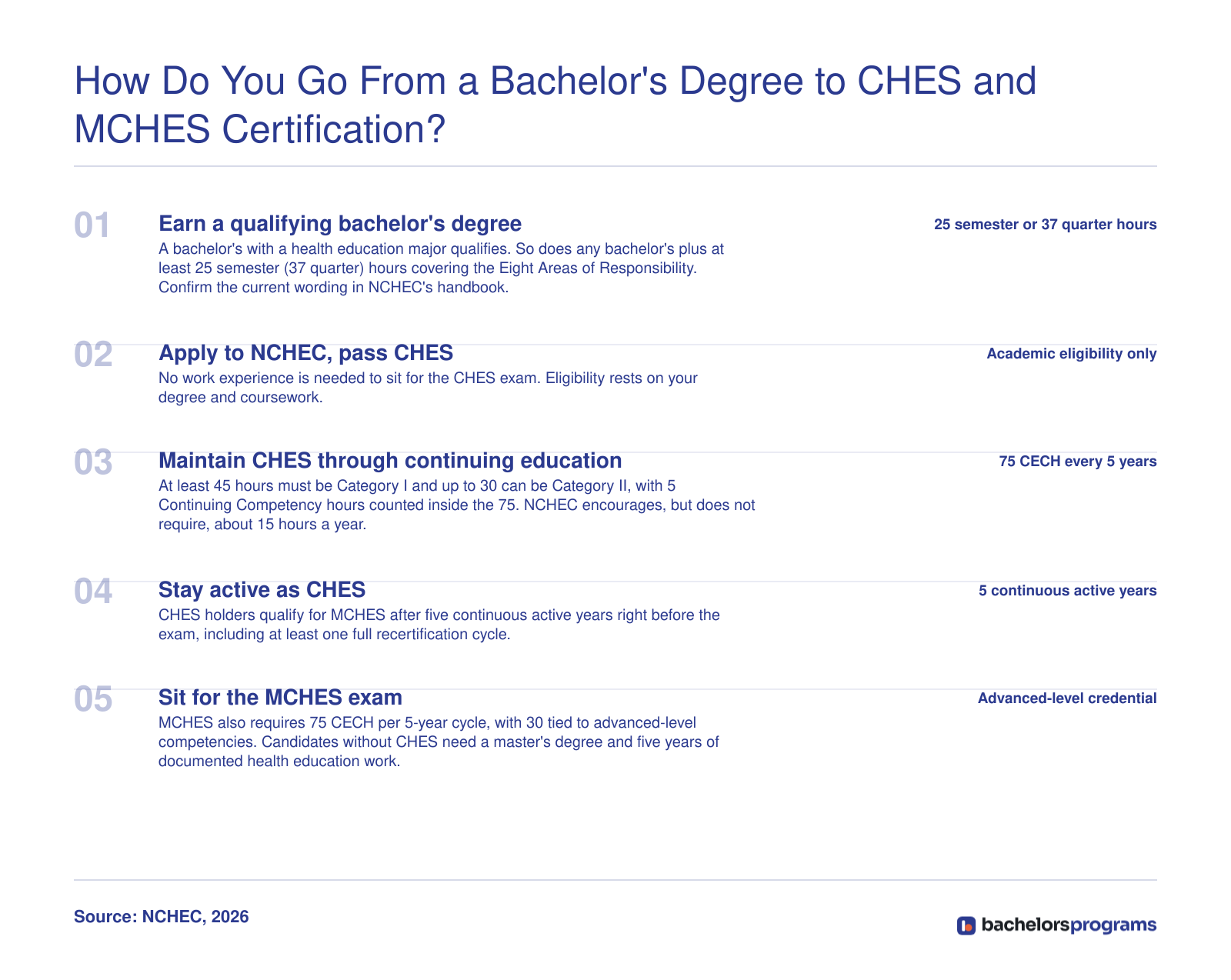
The CHES credential from NCHEC requires a bachelor's degree plus either a health education major or at least 25 semester credits (37 quarter hours) of coursework tied to the Eight Areas of Responsibility.1 Those credits must carry a grade of C or better.
MCHES is different. It is a mid-career credential requiring a master's degree or higher plus about five years of documented health education experience (or five years as an active CHES), so it is not an entry point.2
How Do You Go From a Bachelor's Degree to CHES and MCHES Certification?
CHES certification is voluntary, but many employers list it in health education job postings. The path below runs from your bachelor's degree to the advanced MCHES credential.
Health Education Specialist Pay
Cost, Debt, and Return on Investment: The Most Affordable Fully Online Options
Net price comes from federal College Scorecard data and covers the whole school, not the online community health program alone. Debt and earnings are medians for the community health program itself. Residency can still change your bill online: the University of Florida's 2026 online rates are $111.92 per credit for Florida residents and $500 per credit for out-of-state students, plus a $17.26 per-credit fee, so it does not charge one flat rate. Ask CUNY York College and Indiana University-Southeast whether they charge online students a separate e-tuition rate or bill by residency before you compare totals.
| School | In-State Tuition and Fees | Out-of-State Tuition and Fees | Average Net Price (School-Wide) | Median Program Debt | Program Median Earnings |
|---|---|---|---|---|---|
| CUNY York College (Jamaica, NY) | $7,358 | $15,308 | $4,456 | $12,800 | $43,000 one year after finishing; $52,679 four years after |
| University of Florida (Gainesville, FL) | $3,876 | $16,579 | $4,815 | $15,454 | $30,056 one year after finishing; $68,605 four years after |
| Indiana University-Southeast (New Albany, IN) | $8,424 | $22,811 | $7,888 |
Related Articles
Community Health vs. Public Health vs. Health Science Degrees
These three bachelor's degrees overlap, but each points toward a different kind of work. Choose community health for direct outreach and education work, public health for population and policy work, and health science as a broad pre-clinical path.
| Factor | Community Health | Public Health | Health Science |
|---|---|---|---|
| Core focus | Strong public-health foundation applied to community needs | Population health, disease prevention, and social factors in health outcomes | Broad health foundation with health promotion, behavioral science, and equity |
| Typical courses | Public health foundations, plus clinical science in some concentrations | Epidemiology, biostatistics, health policy, health communication, program planning | Health promotion, behavioral science, health informatics, advocacy |
| Common entry-level jobs | Entry-level community-focused roles (titles vary by program) | Local and state health agencies, community clinics, nonprofits | Often a stepping stone to professional programs rather than a set job track |
| CHES eligibility fit | Depends on health education coursework, so check the curriculum | Depends on health education coursework, so check the curriculum | Depends on health promotion coursework, so check the curriculum |
| MPH or graduate prep | Designed to support graduate study in public health | Preparation for advanced study, with some accelerated MPH pathways | MPH is one of several graduate options, alongside medicine, PT, PA, and OT |
| B.A. vs. B.S. emphasis | Typically a B.S.; a clinical science concentration can meet medical prerequisites | Offered as B.A. or B.S.; the B.S. adds biology and data science, the B.A. leans on social sciences | Typically a B.S. with an integrative health curriculum |
Accreditation, Transfer Credits, and First-Time Student Options
Accreditation is the first question with online community health degrees, because the credential students ask about most often does not apply to most programs.
Institutional vs. Programmatic Accreditation
Every legitimate program holds institutional accreditation from a regional agency recognized by the U.S. Department of Education, such as NECHE, which accredits Southern New Hampshire University1; that status is what qualifies students for federal aid and transfer credit. CEPH accredits standalone baccalaureate public health programs and schools of public health. LSU Health New Orleans and Liberty University hold it3, and Drexel's Dornsife School does too, though its online bachelor's is not separately reviewed. Most community health bachelor's programs carry no programmatic seal.
Entry Points and Transfer Limits
- First-time freshmen: Drexel admits students with 0 to 23 prior credits.2
- Degree completion: LSU requires 60 prior credits3; SUNY Brockport is transfers only.4
- Transfer caps: Excelsior accepts 113 of 120 credits5; SNHU takes 90 and requires 30 in residence.1
If you hold an associate degree, ask about guaranteed-transfer or 2+2 agreements before applying.
Community Health programs by state
Frequently Asked Questions
How long does it take to earn an online bachelor's degree in community health?
Can you get a bachelor's degree in community health online if you have no college credits?
What is the best online degree for community health if you plan to earn an MPH later?
Do online community health students have to complete in-person fieldwork?
Compare Community Health programs on the data that matters
Explore more Healthcare majors or browse every field of study.
All Healthcare programs Browse every field of study