Best Online Health Informatics Degree Programs
Compare 40+ accredited online Health Informatics programs, with net price after aid, graduation rates, earnings and debt from IPEDS and the U.S. College Scorecard.

Health informatics suits people who can connect clinical work to data, and the online bachelor's lets working adults make that move without relocating or commuting. Employers hiring for EHR configuration, clinical analytics, and health IT support increasingly want a degree, and CAHIIM accreditation often decides whether a credential carries weight.
All the programs in this ranking are 100 percent online. Hybrid and in-person formats are excluded, and the list includes bachelor's options that many competing lists skip in favor of master's degrees.
The real tension is fit. Some degrees lean toward analytics and IT, others toward records governance and the RHIA exam, and price and completion time vary widely.
Key Points
- Every ranked program is 100 percent online, with no campus residencies.
- Loma Linda University's CAHIIM-accredited online bachelor's prepares students for the RHIA exam.
- Informatics targets EHR systems and analytics; HIM targets coding and compliance.
Best Fully Online Health Informatics Schools at a Glance
Every school below offers a health informatics bachelor's degree that can be completed 100 percent online, with no hybrid cohorts, campus intensives, or in-person residencies required. Each entry notes the degree offered, any concentration, and the details that separate one program from another for students balancing school with work.
George Mason University
#1Fairfax, VA · $15,000 – $20,000/yr (est.)
Best for: Career changers eyeing an accelerated master's path
George Mason pairs its health informatics bachelor's with an accelerated path into a master's, so a graduate degree can follow in about one more year. The program sits in a department renamed Health Administration, Policy, and Informatics in 2026 and includes an internship plus faculty work in AI and healthcare. The school graduates 68% of students, and former students report median earnings of $76,343 ten years after entering.
- CAHIIM accredited health informatics bachelor's
- Average time to degree completion of 3.6 years
- Accelerated BS-MS path adds a master's in about one year
- Health informatics internship built into the curriculum
- STEM-designated degree for international students
- Coursework spans health information systems, analytics, project management
- Department reports 83% employed or pursuing further education
University of North Texas
#2Denton, TX · $11,000 – $21,000/yr (est.)
Best for: Self-directed learners wanting elective-heavy coursework
North Texas offers a STEM-designated health informatics bachelor's through its College of Information, with a fully online option and coursework in data management, privacy and security, and analytics. Students complete 33 required hours plus 45 elective hours, which leaves room to tilt the degree toward analytics, security, or operations. The school graduates 61% of students.
- Fully online option available
- STEM-designated undergraduate degree
- 33 credit hours of required courses plus 45 elective hours
- Minimum 2.5 GPA across all major courses
- Covers privacy and security in health information systems
- Analytics tools and techniques for improving care delivery
- Advising provided by the College of Information
University of Cincinnati
#3Cincinnati, OH · ~$26,000/yr (est.)
Best for: Working adults needing flexible start dates
Cincinnati's online health informatics bachelor's runs on a nine-semester, three-year calendar with two start dates a year and includes a capstone plus a professional practicum. Students work with a dedicated enrollment advisor and can draw on the university's healthcare network for applied projects. The school graduates 75% of students.
- 100 percent online with no campus visits required
- Completes in nine semesters (about three years)
- Two start dates per year, fall and spring
- Capstone and professional practicum required
- Holds CAHIIM candidacy status
- Low student-faculty ratios with personalized feedback
- Easy credit transfer and dedicated enrollment advisor
University of Southern Indiana
#4Evansville, IN · ~$13,000/yr (est.)
Southern Indiana's health informatics and information management degree is a completion program for students who already hold some college credit, and it can be finished in one to two years of fully online study. Prior learning credit and a partnership with Pollux Systems support the move into analytics and health IT roles. The school graduates 48% of students.
- Degree completion format for students with prior college credit
- 60 total credit hours; finish in one to two years
- Credit for prior learning accepted
- 100 percent online delivery with no campus visits
- Coursework includes clinical informatics and data analytics
- Partnership with Pollux Systems for career opportunities
- $40 application fee
University of South Carolina-Upstate
#5Spartanburg, SC · ~$14,000/yr (est.)
USC Upstate offers a Bachelor of Arts in Health Informatics that weighs communication and information systems design as heavily as the technology itself. The 122-credit degree is offered online and is built for first-time students, transfers, and working professionals aiming at health IT leadership. The school graduates 43% of students.
- 122 total credit hours
- Broad foundation in healthcare, IT, and leadership
- Emphasis on communication best practices
- Curriculum covers health IT and health information systems design
- Designed for first-time students, transfers, and working professionals
- Electives in analytics and artificial intelligence
- Prepares students for health IT leadership roles
Capella University
#6Minneapolis, MN · $15,000 – $20,000/yr (est.)
Capella runs its health information management bachelor's in two online formats: a guided weekly structure and a competency-based FlexPath that bills in 12-week subscription sessions. Transfer credit is generous, with up to 135 credits accepted, which suits adults returning with prior coursework. The school graduates 20% of students, and former students report median earnings of $42,189 ten years after entering.
- Health Information Management specialization within a health care administration BS
- GuidedPath or competency-based FlexPath formats
- 180 quarter credits in GuidedPath; 90 program points in FlexPath
- FlexPath allows completion in as little as 16 months
- Up to 135 transfer credits accepted
- Recommended minimum GPA of 2.8
- No SAT or ACT required and no application fee
- Eight core courses, nine specialization courses, and a capstone
University of Central Florida
#7Orlando, FL · ~$10,000/yr (est.)
UCF teaches its health informatics bachelor's fully online, with coursework in programming, data mining, health data standards, and artificial intelligence in healthcare. An internship is required, and students need a 2.75 major GPA before they can be placed. The school graduates 78% of students, and former students report median earnings of $58,308 ten years after entering.
- Fully online classes
- 60 credit hours in the major
- Internship required; 2.75 major GPA needed before placement
- Coursework includes programming, data mining, and AI in healthcare
- Prepares students for the Certified Health Data Analyst credential
- Health informatics roles projected to grow about 17% through 2031
- Entry-level paths include clinical informatics specialist and EHR analyst
Strayer University-Florida
#8Tampa, FL · ~$16,000/yr (est.)
Strayer's health services administration degree carries a health information management and analytics concentration and runs on 11-week courses built for working adults. Academic coaches and career advisors are assigned to students, and the school supports employer tuition reimbursement. Up to 28 classes can transfer in, and every three courses a student passes earns a free course.
- Concentration in Health Information Management and Analytics
- 40 courses delivered in 11-week terms
- Per-course tuition of $1,555
- Transfer up to 28 classes
- No-cost general education courses; free course after every three passed
- Coursework covers EHRs, health information exchange, and data visualization
- Health data privacy, security, and revenue cycle topics
- Employer tuition reimbursement supported
Louisiana Tech University
#9Ruston, LA · ~$12,000/yr (est.)
Louisiana Tech's health informatics and information management program is CAHIIM accredited and prepares students for the RHIA exam, with small classes and a curriculum tying health information management to data analysis and compliance. Students can study online, and graduates move into HIM leadership, medical coding, and EHR implementation work. The school graduates 64% of students.
- CAHIIM-accredited program
- Prepares students for the RHIA certification exam
- Online study with small class sizes
- Curriculum combines health information management, data analysis, IT, and compliance
- Career paths include HIM director, medical coding, and EHR implementation
- Program cites a 100 percent job placement rate
Loma Linda University
#10Loma Linda, CA
Loma Linda stacks microcredentials in data analytics, cybersecurity, and management into its health information and informatics bachelor's, and offers an EHR business internship with Epic for California residents. The program is CAHIIM accredited through 2029, prepares students for the RHIA exam, and runs at an 8:1 student-to-faculty ratio. Former students report median earnings of $89,816 ten years after entering.
- CAHIIM accredited through 2029
- 78 total credit hours; finish in as little as six terms
- Stackable microcredentials in data analytics, cybersecurity, and management
- EHR business internship with Epic for California residents
- 8:1 student-to-faculty ratio
- Prepares students for the RHIA certification exam
- Minimum 2.5 GPA with prerequisite courses required
- Multiple entry points available
Cost & outcomes by school
Federal data for the highest-earning Health Informatics programs, independent of the ranking above. Earnings are this field's bachelor's graduates four years after completing where the Scorecard reports them, else the school's undergraduate median.
| School | Net price / yr | Grad rate | Earnings | Debt | Grads/yr | Format |
|---|---|---|---|---|---|---|
| Loma Linda University CA | — | — | $89,816 | $20,854 | — | Online |
| George Mason University VA | $17,915 | 68% | $76,343 | $19,500 | 15 | Online |
| Oregon Institute of Technology OR | $15,706 | 54% | $72,273 | $22,500 | — | Online |
| California State University-Stanislaus CA | $6,067 | 54% | $63,188 | $13,540 | — | Hybrid |
| Mercer University GA | $23,847 | 70% | $58,354 | $24,199 | — | Hybrid |
| University of Central Florida FL | $10,411 | 78% | $58,308 | $18,190 | — | Online |
| University of North Texas TX | $15,649 | 61% | $57,010 | $19,250 | — | Hybrid |
| Texas Woman's University TX | $11,963 | 49% | $56,544 | $18,426 | 8 | Hybrid |
| Bellevue College WA | $11,430 | 36% | $56,310 | $12,375 | — | Online |
| West Virginia University WV | $15,634 | 65% | $55,939 | $22,500 | — | Hybrid |
| University of Cincinnati OH | $25,648 | 75% | $54,810 | $21,250 | — | Online |
| Louisiana Tech University LA | $11,864 | 64% | $52,279 | $22,135 | — | Online |
Sources: U.S. Department of Education. Net price, graduation rate, earnings and debt: College Scorecard (earnings and debt for this field's bachelor's graduates where reported, else school-wide); graduates: IPEDS. A dash means no figure is reported.
Cost, debt & payoff
Median earnings of this field's bachelor's graduates (4 yrs after completing, else the school's undergraduate median) vs. their median federal loan debt · U.S. College Scorecard
Across these programs the median graduate earns about $49,379 and finishes with roughly $22,500 in debt — a ratio that clears a common rule of thumb (keep debt below first-year salary). Net price and debt vary widely school to school, so check the per-school figures in the table above before you shortlist.
How We Ranked Fully Online Health Informatics Programs
A fully online health informatics program requires no campus visit at all, and that standard shaped the first cut of this ranking. Any program requiring campus visits, hybrid sessions, or in-person residencies was excluded, even if most of the coursework happened online.
What Went Into the Ranking
Programs that passed the filter were compared on a composite of five inputs:
- Published tuition: the price the school lists for the program.
- Average net price: what undergraduate students pay on average after grants and scholarships.
- Graduation rate: the share of students who finish at the institution overall.
- Program-level earnings: what graduates of the program earn, as reported through the College Scorecard.
- Median federal debt: what completers typically owe in federal loans.
Where the Data Falls Short
Read the results with a few limits in mind. Graduation rates measure the entire institution rather than the health informatics program, so a university with a strong overall rate may see different outcomes in this major. Net price averages many students rather than quoting yours, and your own aid package could land well above or below it. Some programs also lack published Scorecard earnings, so those schools were judged on the inputs that were available.
What the Ranking Leaves Out
Rank order says nothing about whether a program holds CAHIIM accreditation or how it handles practicum placements. Both can affect certification eligibility and hiring. The accreditation and practicum section covers those rules, and the tuition and total cost table breaks down what you would actually pay. Check both before you shortlist a school.
Online Health Informatics Degree Tuition and Total Cost
Every figure in the net price column is the average annual net price after grants and aid for undergraduates, drawn from IPEDS and College Scorecard (2024) and shown beside each school's published annual tuition and fees. That comparison shows why the lowest sticker price is not always the lowest net cost: Bellevue College lists the lowest in-state tuition here ($4,436), yet its net price ($11,430) runs above the University of North Georgia ($9,823) and UCF ($10,411), because net price folds in housing, books, and the aid each school actually awards. Flat-rate online models simplify the math, as with Winthrop University's published $17,500 total program tuition for its 60-credit, self-paced track, and at USC Upstate, health informatics graduates carry median federal debt of $27,625, or about $293 a month on a 10-year plan. If a master's comes next, published online graduate tuition before aid ranges from $502 per credit at Texas State University (about $15,060 total) and $619 per credit at Northern Kentucky University ($20,955 for 33 credits, the same rate in and out of state) to $1,090 per credit at private Adelphi University ($42,510 for 39 credits), so private and out-of-state sticker prices can far exceed an in-state public route.
| School (State) | Program | Average Annual Net Price After Aid (Undergraduate) | Published In-State Tuition and Fees (Annual) | Published Out-of-State Tuition and Fees (Annual) | Total Credits Required |
|---|---|---|---|---|---|
| University of North Georgia (GA) | Health Informatics and Administration (B.S.) | $9,823 | $5,285 | $16,503 | N/A |
| University of Central Florida (FL) | Health Informatics | $10,411 | $6,368 | $22,467 | 60 |
| Bellevue College (WA) | Healthcare Informatics | $11,430 | $4,436 | $10,502 | N/A |
| Louisiana Tech University (LA) | Health Informatics and Information Management | $11,864 | $10,125 | $16,866 | N/A |
| Fort Hays State University (KS) | Information Networking and Telecommunications (Health Informatics) | $12,569 | $5,923 | $17,741 | 120 |
| University of Southern Indiana (IN) | Health Informatics and Information Management (degree completion) | $12,923 | $10,066 | $22,907 | 60 |
| University of South Carolina-Upstate (SC) | Health Informatics | $13,557 | $11,588 | $23,090 | 122 |
| Winthrop University (SC) | Bachelor of Professional Studies (Health Informatics) | $15,343 | $14,678 | $28,676 | 60 |
| University of North Texas (TX) | Health Informatics, BS | $15,649 | $11,309 | $21,149 | N/A |
| Oregon Institute of Technology (OR) | Health Informatics | $15,706 | $13,260 | $37,196 | N/A |
Health Informatics vs. Health Information Management Degrees
The two majors overlap, but they point toward different careers and different credentials. Health informatics leans toward data analytics, EHR systems, interoperability, and IT. Health information management (HIM) leans toward records governance, coding, compliance, and privacy. The credential you want should drive the major you pick.
| Factor | Health Informatics | Health Information Management (HIM) |
|---|---|---|
| Core focus | Data analytics, EHR systems, interoperability, and health IT | Records governance, coding, compliance, and privacy |
| Typical coursework | Clinical data analysis, EHR implementation, database management, systems design, interoperability standards | Medical coding, health law and ethics, data governance, revenue cycle, privacy and security |
| Common job titles | Clinical informatics analyst, EHR implementation specialist, health data analyst, systems analyst | Health information manager, coding specialist, compliance analyst, privacy officer, records director |
| RHIA eligibility (AHIMA) | Not currently supported. AHIMA does not accept health informatics programs for the exam. | Qualifies with a CAHIIM-accredited HIM bachelor's, master's, or post-baccalaureate certificate |
| RHIT eligibility (AHIMA) | Not currently supported. AHIMA does not accept health informatics programs for the exam. | Qualifies with a CAHIIM-accredited HIM associate degree |
| CAHIMS eligibility (HIMSS) | Open to entry-level candidates. With a high school diploma, 45 hours of related continuing education or 150 hours of experience. With an associate degree or higher, 25 hours of continuing education or 75 hours of experience. | Same pathways apply. A high school diploma or any accredited associate, bachelor's, or advanced degree meets the education threshold. |
| CPHIMS eligibility (HIMSS) | Bachelor's plus five years of experience (three in healthcare), graduate degree plus three years (two in healthcare), or 10 years of experience with no degree | Same pathways apply. Either major satisfies the degree requirement, but experience requirements still apply. |
| Accreditation body | CAHIIM accredits some informatics programs, but those degrees do not lead to the RHIA or RHIT | CAHIIM accreditation is required for RHIA and RHIT eligibility |
| Best fit | Students drawn to analytics, systems, and technology roles | Students who want the RHIA or RHIT and work in records, coding, or compliance |
Related Articles
CAHIIM Accreditation and Practicum Requirements for Online Programs
CAHIIM, the Commission on Accreditation for Health Informatics and Information Management Education, is the body that accredits U.S. college programs in this field. It reviews health information management (HIM) programs at the associate, bachelor's, and master's levels2. It also accredits health informatics programs at the bachelor's, master's, and professional doctoral levels,1 and it oversees more than 340 programs in total3. That matters because a CAHIIM-accredited HIM program is the usual route to the RHIA at the bachelor's level and the RHIT at the associate level.
Which Schools Hold Accreditation
Among the schools ranked here, the program pages for the University of Cincinnati, Louisiana Tech University, and Loma Linda University describe their programs as CAHIIM accredited. Louisiana Tech and Loma Linda both say their programs prepare students for the RHIA. George Mason's page lists accreditation but also mentions candidacy status, so confirm its current standing directly. We have not confirmed accreditation for the other schools here, so do not assume it.
The CAHIIM directory also shows accredited online master's programs at Adelphi University, Johns Hopkins University, the University of Massachusetts Lowell, and the University of Illinois Chicago, plus an online HIM bachelor's at Indiana Institute of Technology. The directory's "online" label does not tell you whether a program is fully online or partly hybrid.
Practicum Requirements
CAHIIM-accredited HIM programs typically require a professional practice experience (PPE), a supervised stretch of real work in a health information setting. Online students usually arrange it close to home, often at a hospital, clinic, or health system. Some programs offer virtual placements instead. Several schools here build in a hands-on component:
- Cincinnati: a professional practicum.
- UCF: a required health informatics internship.
- Loma Linda: an EHR business internship with Epic.
Ask each program how placements are arranged and whether staff help you find a site.
Check Before You Apply
Look up the exact program in the CAHIIM directory before you apply. Accreditation is granted program by program, so a school's HIM degree can be accredited while its informatics degree, or a sister program, is not.
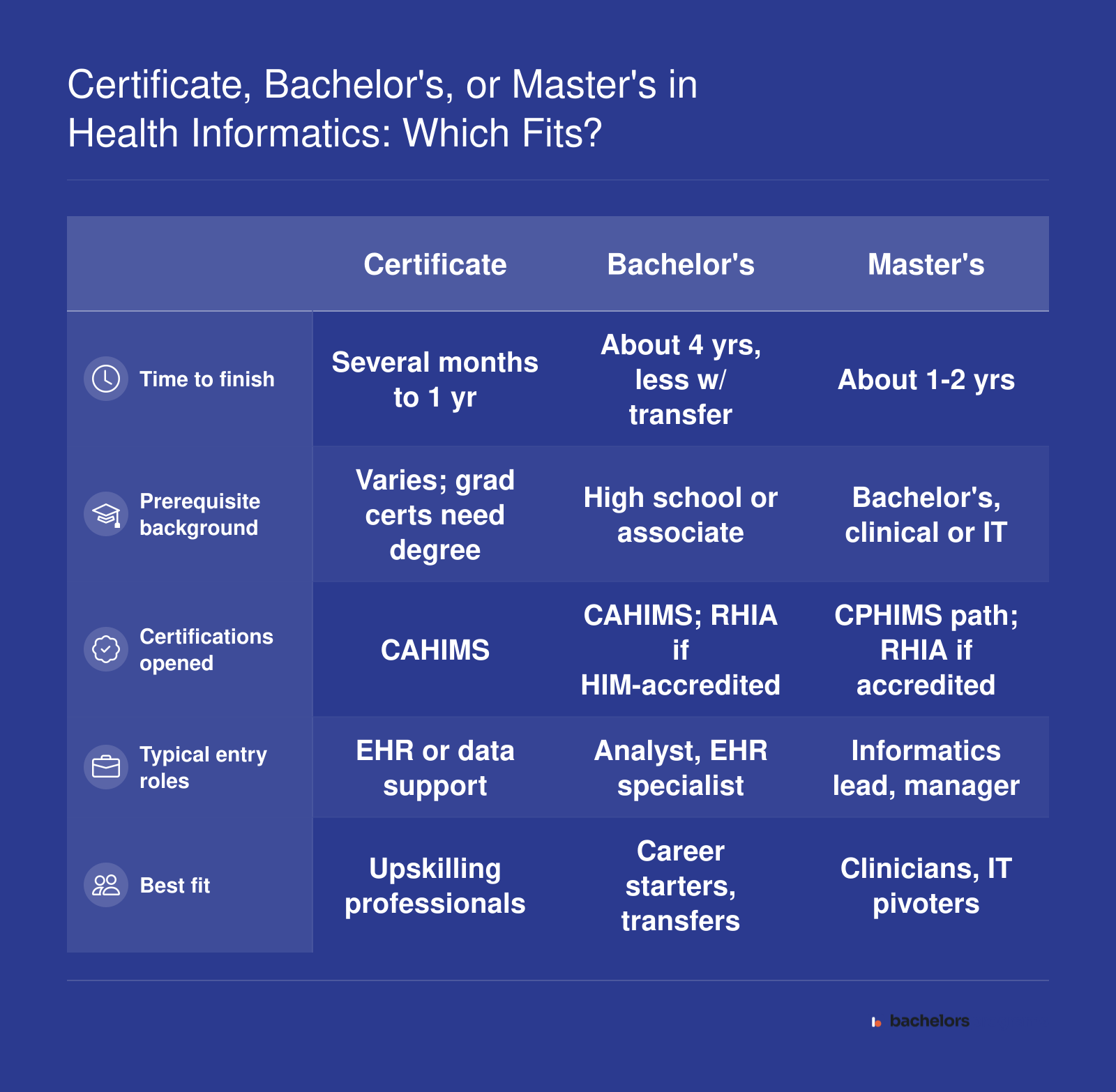
Certificate, Bachelor's, or Master's in Health Informatics: Which Fits?
The right credential depends on where you are starting. An online bachelor's is the natural choice if you are beginning your career or finishing an associate degree. A master's makes more sense for nurses, clinicians or IT professionals moving into informatics, and a certificate works best for adding targeted skills to experience you already have.
Questions to Ask Yourself
Do you want the RHIA credential, or are you aiming for analytics and systems roles?
Can you complete a professional practice experience at a healthcare employer near you?
How many of your existing credits will actually transfer?
Is your state on the school's authorization list for online enrollment?
Health Informatics programs by state
Online Health Informatics Degree FAQs
Quick answers to the questions prospective students ask most about online health informatics study. Program rules vary, so confirm details with each school's admissions office.
What is the best online health informatics degree program?
Can you get a bachelor's degree in health informatics online?
Do you need a nursing or IT background to study health informatics?
Can you earn the CAHIMS before finishing your degree?
Compare Health Informatics programs on the data that matters
Explore more Healthcare majors or browse every field of study.
All Healthcare programs Browse every field of study