Best Public Health Schools in Rhode Island
Compare 4 accredited Public Health programs in Rhode Island, with net price after aid, graduation rates, earnings and debt from IPEDS and the U.S. College Scorecard.

Only a handful of Rhode Island schools offer a public health bachelor's, and they sit within a short drive of each other: Providence, Kingston and Bristol. The common credential is the Bachelor of Science (B.S.) in Public Health.
Cost and selectivity pull in opposite directions here. In-state tuition at the University of Rhode Island runs $16,942, private sticker prices climb past $40,000, and Brown University admits roughly 5 percent of applicants.
Rhode Island identifies no licensure requirement for bachelor's-level public health work. That puts the weight on the degree itself: the concentration you pick, the field placement or capstone attached to it, and whether the program is built for graduate study or for hiring straight out.
Key Points
- Brown's $71,412 sticker price drops to a $25,184 average net price.
- Johnson & Wales University stands out for online public health study.
- No Rhode Island license applies; the CHES credential is voluntary.
Best Bachelor's Degree in Public Health Programs in Rhode Island, Ranked
Four Rhode Island institutions award a bachelor's degree in public health, and each takes a different approach: an Ivy League liberal arts concentration, a public research university with three career-facing tracks, a science-heavy degree built around epidemiology, and a private university that also runs a fully online version. Entries appear in ranked order, and the section below on how we ranked Rhode Island public health schools explains the factors behind that order. The net price and graduation rate shown on each card are institution-wide averages, not figures for the public health program alone.
Brown University
#1Providence, RI · $25,000 – $30,000/yr (est.)
Best for: Health equity focused liberal arts students
Brown University's public health degree sits inside a dedicated School of Public Health and is structured as an interdisciplinary concentration, so students pair epidemiology, biostatistics and health services with coursework from across the university. The curriculum leans hard on health equity, asking students to identify, reduce and eliminate disparities rather than simply describe them. Providence ties run through the school's work with Rhode Island Medicaid and community clinics, giving undergraduates a look at live state health policy questions.
- CEPH-accredited program in a dedicated School of Public Health
- Interdisciplinary concentration rather than a narrow major
- Core areas include biostatistics, epidemiology and health services
- Coursework in health services, policy and practice
- Attention to identifying and eliminating health inequities
- Trains students to design and evaluate improvement strategies
University of Rhode Island
#2Kingston, RI · ~$21,000/yr (est.)
Best for: In-state students seeking non-clinical health roles
The University of Rhode Island is the state's public research university and the most direct in-state route to a Bachelor of Science in Public Health. The degree is built for students who want to improve community health without becoming clinicians, and its three concentrations let them aim at environmental health, health promotion or health services work. Free elective credits can go toward an internship, and the major pairs easily with minors such as Gerontology, Hunger Studies or Leadership.
- Three concentrations: Global and Environmental Health, Health Promotion, Health Services
- Designed for non-clinical public health careers
- Internship can be completed using free elective credits
- Minors include Gerontology, Hunger Studies and Leadership
- Interdisciplinary coursework in ethics and scientific synthesis
- Career paths span patient education, worksite wellness and health policy
Roger Williams University
#3Bristol, RI · ~$38,000/yr (est.)
Best for: Science-minded students drawn to epidemiology
Roger Williams University in Bristol takes a science-first approach, building its public health major on biology, chemistry, calculus and biostatistics before students move into epidemiology, global health and health policy. The 59-credit degree includes a semester-long field experience and a senior capstone. It fits students who want laboratory or research-adjacent public health work, or who plan to continue into medicine or graduate study.
- 59-credit interdisciplinary major
- Foundation in biology, chemistry, calculus and biostatistics
- Semester-long field experience required
- Senior capstone completes the degree
- Electives in infectious disease and basic science
- Prepares graduates for biomedical lab research and preparedness work
Johnson & Wales University
#4Providence, RI · ~$31,000/yr (est.)
Johnson & Wales University offers its public health degree through the College of Health & Wellness, with a Providence campus and a fully online version of the same program. The 121-credit degree requires an internship or study abroad and closes with a year-long research project presented to researchers and the public. Coursework mixes public health core topics with nutrition, exercise science, psychology and economics, which suits students aiming at policy analysis, data or program coordination roles.
- 121-credit degree with a fully online option
- Required 6-credit internship or study abroad
- Full-year research project with a public presentation
- Core courses in epidemiology, health policy, ethics and law
- 15 credits of major electives plus 15 free electives
- Campuses in Rhode Island and North Carolina
Cost & outcomes by school
Federal data for the highest-earning Public Health programs, independent of the ranking above. Earnings are this field's bachelor's graduates four years after completing where the Scorecard reports them, else the school's undergraduate median.
| School | Net price / yr | Grad rate | Earnings | Debt | Grads/yr | Format |
|---|---|---|---|---|---|---|
| Brown University RI | $25,184 | 96% | $74,496 | $11,760 | — | Campus |
| Roger Williams University RI | $37,999 | 69% | $70,266 | $26,500 | 9 | Campus |
| University of Rhode Island RI | $21,440 | 73% | $69,743 | $22,250 | — | Campus |
| Johnson & Wales University RI | $31,027 | 55% | $43,418 | $26,000 | 12 | Hybrid |
Sources: U.S. Department of Education. Net price, graduation rate, earnings and debt: College Scorecard (earnings and debt for this field's bachelor's graduates where reported, else school-wide); graduates: IPEDS. A dash means no figure is reported.
Cost, debt & payoff
Median earnings of this field's bachelor's graduates (4 yrs after completing, else the school's undergraduate median) vs. their median federal loan debt · U.S. College Scorecard
Across these programs the median graduate earns about $70,005 and finishes with roughly $24,125 in debt — a ratio that clears a common rule of thumb (keep debt below first-year salary). Net price and debt vary widely school to school, so check the per-school figures in the table above before you shortlist.
How We Ranked Rhode Island Public Health Schools
Brown University, the University of Rhode Island, Roger Williams University and Johnson & Wales University are the schools evaluated here. Each earned its place by offering a bachelor's program in public health based in Rhode Island, on campus or online.
What we weighed
- Program outcomes: earnings and debt for graduates of the specific program, plus how many students complete it each year.
- Cost: net price after grants and scholarships, not just sticker tuition.
- Student success: graduation and first-year retention rates.
- Selectivity: how competitive admission is, which helps you gauge your odds.
- Format: whether the program runs on campus, online or in a hybrid arrangement.
What the numbers do and do not tell you
Treat them as school context, not as a public health program's own outcomes. Where a program-level figure exists, we use it. Where it does not, we say so rather than borrowing a campus-wide number and implying it describes this major.
Why the list is short
Few Rhode Island schools offer this bachelor's degree, so the list is not padded with unrelated majors or out-of-state online schools. Each school here has a verified public health program page. Use the list as a starting point, then confirm current requirements and costs with each school's admissions office.
Online and Hybrid Bachelor's in Public Health Options at Rhode Island Schools
Most public health bachelor's programs in Rhode Island are taught on campus. Johnson & Wales University is the exception.
Format by School
- Brown University: Campus-based. The undergraduate concentration is built around in-person study in Providence.
- University of Rhode Island: Campus-based. The 120-credit B.S. in Public Health is taught at the Kingston campus, with concentrations in Global and Environmental Health, Health Promotion, and Health Services.
- Roger Williams University: Campus-based. The B.S. is on-site in Bristol and requires a semester-long field experience.
- Johnson & Wales University: Listed as hybrid. Its program page describes a fully online option, along with a required internship and a capstone. Before you apply, confirm with admissions which courses the online route includes and through which campus it runs.
On the evidence from these program pages, Johnson & Wales is the only school here that lists a fully online public health bachelor's. The other three are traditional on-campus programs.
Degree-Completion Pathways
URI offers an online Bachelor of Interdisciplinary Studies completion program for students with 45 or more college credits. We could not verify that public health is a major within it, so ask URI directly whether it fits your goals. URI's online RN-to-B.S. is a nursing program, not a public health degree.
Who Each Format Suits
- Working adults: The online or hybrid route at Johnson & Wales gives the most scheduling flexibility.
- Commuters: Roger Williams and URI suit students who live nearby and want in-person labs, advising and internships.
- Transfer students: Those with existing credits should ask each school how they apply, and check whether a completion pathway exists for their major.
Online Options Outside Rhode Island
Fully online public health bachelor's programs exist at schools in other states. They fall outside this Rhode Island-based list, so compare them separately, especially on accreditation and in-state internship access.
Admissions for a Bachelor's Degree in Public Health in Rhode Island
Selectivity is the biggest divide among Rhode Island public health programs: Brown University admits roughly 5 percent of applicants, while the other schools here admit most of the students who apply.
How Selective Each School Is
Federal Scorecard data shows the spread clearly:
- Brown University (Providence): about 5 percent admitted, by far the most competitive.
- University of Rhode Island (Kingston): about 72 percent admitted.
- Roger Williams University (Bristol): about 88 percent admitted.
- Johnson & Wales University (Providence): about 88 percent admitted.
Brown weighs the whole application and expects strong academics. URI, Roger Williams and Johnson & Wales are far more accessible, though URI is the most selective of the three.
GPA, Testing and Transfer Credit
We could not verify current GPA minimums, SAT/ACT rules or transfer-credit terms for these schools, so treat any figure you see elsewhere as unconfirmed until you check it. Open each school's admissions page and look for three things: a stated minimum or recommended GPA, whether the test policy is required, optional or blind, and how transfer credit is evaluated. Many schools publish no fixed GPA cutoff and instead review the full application. If a page states no number, assume none exists and ask the admissions office directly.
Transfer Tips and Major Entry
Students starting at a Rhode Island community college should ask the four-year school for a written, course-by-course credit evaluation before enrolling.1 Also ask whether a formal articulation agreement or joint admissions plan covers public health or a related science track.2 Keep your grades strong, because transfer pathways often set a GPA floor, and finish general education and science prerequisites before you move.
Also confirm how each school treats the major. Brown's public health program is structured as a concentration, which students typically declare after arriving, so you do not apply to it directly. For URI, Roger Williams and Johnson & Wales, ask whether admission is direct to public health or the major is declared later, since that affects course sequencing and internship timing.
Cost of a Public Health Bachelor's Degree in Rhode Island
Last-dollar aid has made the first two years of college cheaper in Rhode Island, and that changes the math for a public health bachelor's.
Tuition vs. Net Price
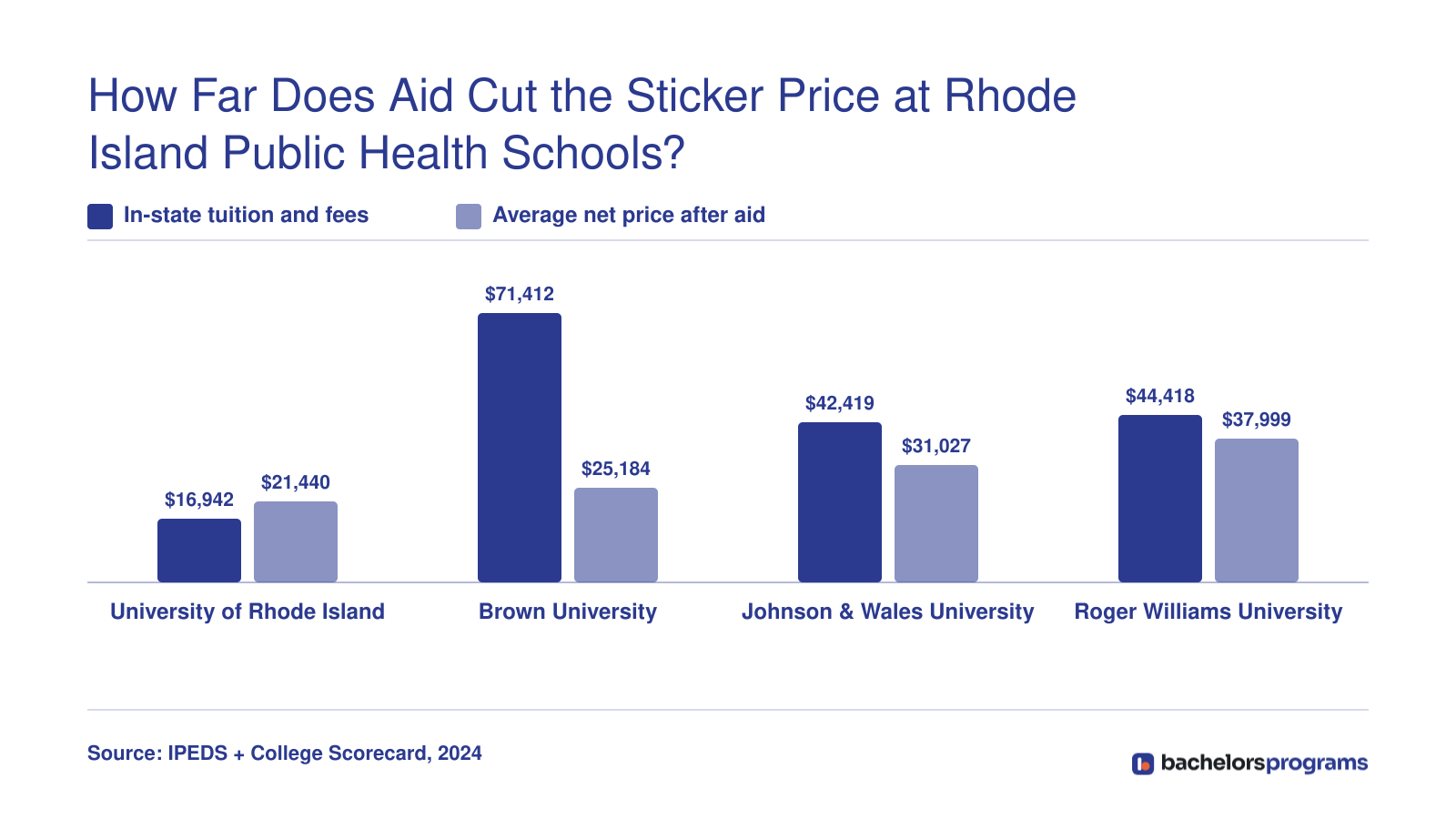
The public/private gap is wide. The University of Rhode Island lists in-state tuition and fees of $16,942 (out-of-state is $37,146), with an average net price of $21,440. The private schools charge more up front: Brown University at $71,412, Johnson & Wales University at $42,419 and Roger Williams University at $44,418. After aid, average net prices fall to $25,184 at Brown, $31,027 at Johnson & Wales and $37,999 at Roger Williams. Brown's drop is the steepest. Federal net price also folds in living costs, so it can run higher than tuition alone.
Debt After Graduation
Program-level median debt is available for two schools: $11,760 for Brown's public health graduates and $26,500 for Roger Williams'. For URI ($22,250) and Johnson & Wales ($26,000), only the school-wide figure for all graduates is available, so treat those as rough guides.
Rhode Island Aid
RI Promise pays what remains of tuition and mandatory fees at the state's community college after Pell and other aid, for up to two years.1 Key rules for 2026-2027:
- Residency: Rhode Island resident.2
- Age: Younger than 19 when completing high school or a GED, with limited appeals.
- Paperwork: A 2026-2027 FAFSA, with verification if selected.
- Renewal: A 2.5 GPA and 24 first-year credits.3 Public materials also cite a 30-credit recommendation, so confirm with the college.
It covers associate programs only, so it applies to the first half of a transfer route. The college's joint admissions agreement gives conditional acceptance to URI4 and may carry a tuition discount of up to 30 percent.5 URI's Transfer Merit Award looks for 24 transfer credits and a preferred 3.3 GPA, renewable for six semesters at a 3.0. URI's general merit scholarships require a 2.8 GPA and 12 credits, and run four years. Dollar amounts for the state grant vary by year, so check current figures with each financial aid office.
One Way to Save
Start at the community college with RI Promise, then transfer to URI at in-state rates. Remember that net price is an average, and your own aid offer may land well above or below it.
How Far Does Aid Cut the Sticker Price at Rhode Island Public Health Schools?
The gap between sticker price and net price is the main story here. Brown University lists $71,412 in tuition and fees, but its average net price after grants falls to $25,184. At the University of Rhode Island, net price runs higher than in-state tuition because it also counts housing, food and books before subtracting aid. Treat each net price as an approximate average for aided students, not a guaranteed bill.
Related Articles
B.S. vs. B.A. in Public Health: Credentials and CEPH Accreditation
A B.S. in public health tends to lean toward math, science and quantitative methods, while a B.A. often leaves more room for social science, policy and electives. Both can be legitimate paths. CEPH, under its 2024 criteria, recognizes bachelor's degrees in public health awarded as a Bachelor of Science, Bachelor of Science in Public Health, Bachelor of Public Health or Bachelor of Arts.1 The curriculum and accreditation behind the title matter more than the letters themselves.
Verify CEPH Accreditation
CEPH accredits three categories: schools of public health, public health programs and standalone baccalaureate programs. Its procedures allow a B.A. or B.S. with a public health major to qualify as a standalone baccalaureate program.2 To check a Rhode Island program:
- Search the directory: Look up the school in CEPH's accredited schools and programs listing.
- Match the details: Confirm the listing covers the bachelor's level and the campus you plan to attend, not only a graduate program.
- Ask when unclear: If the entry is ambiguous or shows a program in the accreditation process, contact the program directly for its current status.
Check NECHE Institutional Accreditation
NECHE and CEPH answer different questions. NECHE accredits the entire university and does not evaluate the curriculum of a specific public health program. CEPH is the specialized accreditor for public health. Confirm NECHE status through its directory or the school's accreditation office.
Compare Degree Options Directly
The University of Rhode Island offers a B.S. in Public Health, and Roger Williams University lists a Public Health B.S. If Roger Williams or any other school also lists a B.A., compare the two in the program pages and course catalog. Look at math and science requirements, research methods courses, internship expectations and stated career pathways, then confirm the differences with an admissions advisor.
Questions to Ask Admissions
- Is this bachelor's program CEPH-accredited, and since when?
- Which math, statistics and lab science courses are required?
- Is an internship or field experience mandatory?
- Does coursework prepare students for the optional CHES exam?
- Where do recent graduates work?
For job outlook and credential context, check BLS.gov and national public health professional associations.
Public Health Credentials in Rhode Island: No License, Optional CHES
Public Health Careers and Salaries in Rhode Island
In Rhode Island, a public health bachelor's rarely points to one obvious job title. The roles it opens tend to start at modest pay but hire steadily, so most graduates face a choice: take an entry-level community or program role now, or build toward a graduate credential that pays more later.
Where the Jobs Are
Typical titles include health education specialist, community health worker, program coordinator, patient navigator and outreach or care-coordination specialist. The largest employers are the Rhode Island Department of Health, the hospital systems (Lifespan and Brown University Health, plus Care New England and its hospitals), federally qualified community health centers, and nonprofits running chronic-disease, maternal-health and substance-use programs. Community health centers in particular hire steadily for outreach and coordination work.
What Rhode Island Pays
State wage data from May 2024 put the median for health education specialists at $36.65 an hour, with roughly 160 people employed and an entry-level 10th percentile of $17.96.1 Community health workers earn a median of $27.37 an hour across about 340 jobs, with the middle half of earners between $21.91 and $27.29.1 State projections run from 184 to 197 health education specialist jobs by 2032 and from 128 to 146 community health worker jobs, so openings come mostly from turnover rather than expansion.2
Nationally, the Bureau of Labor Statistics puts May 2025 median annual pay at $64,070 for health education specialists3 and $51,850 for community health workers, and projects 13% growth for community health workers between 2025 and 2035 against 6% for health educators.4
Earnings After Graduation
Federal outcome data shows Brown graduates at a median of $70,772 five years after finishing and Roger Williams graduates at $39,912 one year out. The windows differ, so treat them as separate snapshots. Some graduates extend into graduate study in public health, nursing or health administration before earning at that level.
What Public Health Graduates Earn After Finishing
Brown University posts the strongest program-level earnings figure among the schools here.
Compare Public Health programs on the data that matters
Explore more Healthcare majors or browse every field of study.
All Healthcare programs Browse every field of study