Best Public Health Schools in Virginia
Compare 13 accredited Public Health programs in Virginia, with net price after aid, graduation rates, earnings and debt from IPEDS and the U.S. College Scorecard.

A bachelor's degree in public health in Virginia can cost under $13,000 a year in tuition and fees at Radford University or Old Dominion University, or more than $43,000 at Hollins University. That spread is the first thing applicants have to weigh. The common credential is the Bachelor of Science (B.S.) in Public Health, though George Mason University and Marymount University name theirs Community Health and Health Sciences.
Options run from campus to hybrid to fully online, all at the bachelor's level and all at Virginia-based schools. Most graduates enter health education and community outreach roles, and CEPH accreditation and graduate pathways vary by school, so check each program's standing before you apply.
Key Points
- Radford's in-state tuition and fees run $12,548, versus $25,633 otherwise.
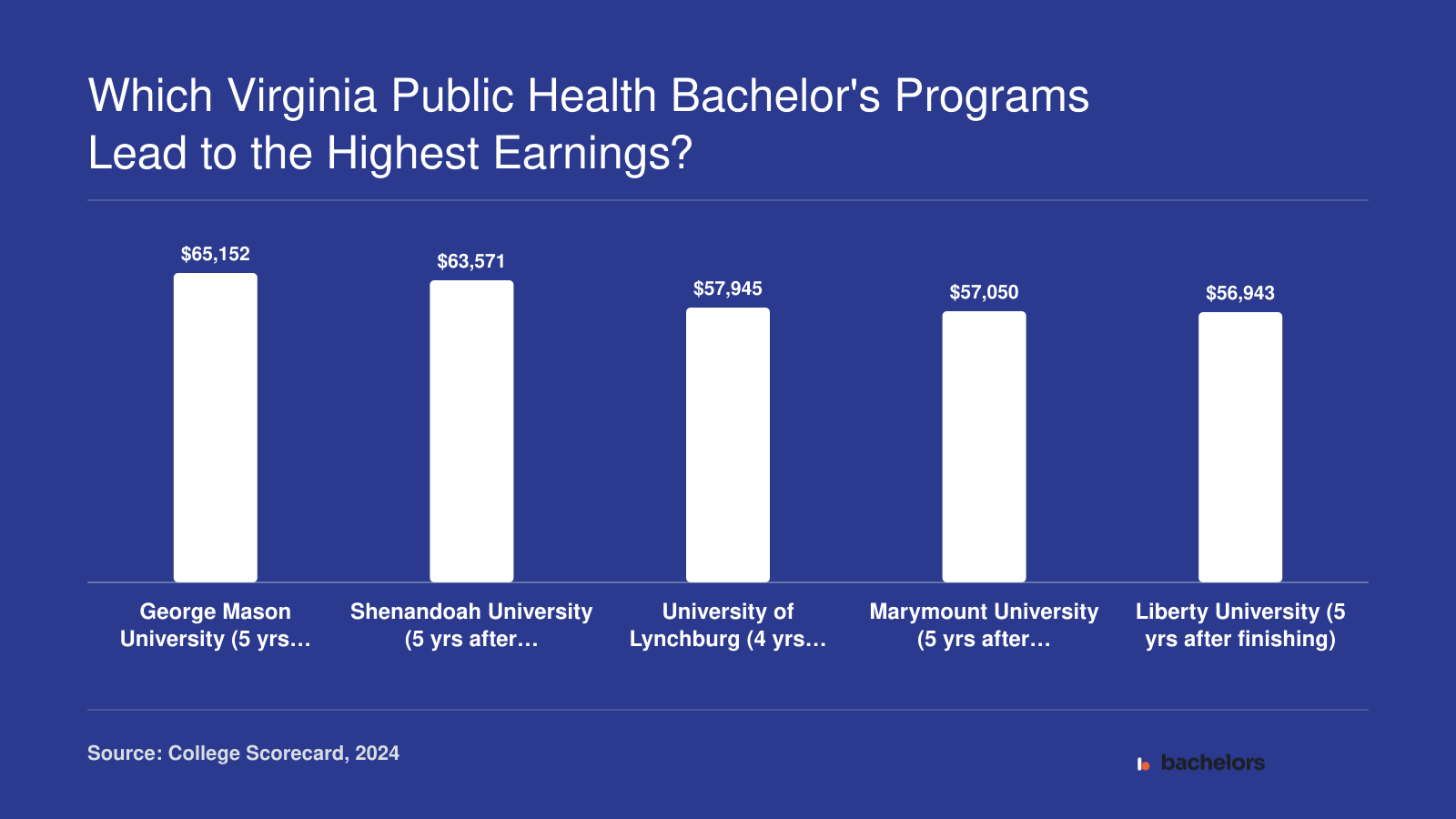
- Five years out, median earnings run from $56,943 (Liberty) to $65,152 (George Mason).
- University of Lynchburg admits about 43 percent; Liberty accepts about 99 percent.
Best Bachelor's in Public Health Schools in Virginia: Ranked
Virginia offers public health bachelor's programs in several very different settings: large public research universities, a women's liberal arts college, faith-based institutions, and one program taught almost entirely online. The ten entries below are ordered with an eye to what a prospective undergraduate actually gets from each one, including accreditation, required fieldwork, concentrations, and how the coursework is delivered.
Virginia Polytechnic Institute and State University
#1Blacksburg, VA · $25,000/yr (est. net price)
Best for: Students drawn to Appalachian and rural health
Virginia Tech is the state's largest public research university, and its public health major draws on the university's strength in the health and life sciences. Students complete a required 80-hour practicum and can shape the degree around rural and Appalachian communities or a One Health approach that connects human, animal, and environmental health. Pre-veterinary and pre-medical options, plus an accelerated route into the Master of Public Health, give strong students a fast track.
- CEPH accredited
- Required 80-hour practicum
- Two concentration options
- One Health focus on human, animal, and environmental health
- Accelerated Master of Public Health pathway
- Coursework on rural and Appalachian communities
- Pre-veterinary and pre-medical tracks
- Electives for a double major, minor, or study abroad
George Mason University
#2Fairfax, VA · $15,000 – $20,000/yr (est.)
Best for: Working adults near Washington, D.C.
George Mason University is a large public research university in Fairfax, close to the federal health agencies and hospital systems of Northern Virginia and Washington, D.C. Its public health degree runs 120 credit hours and splits into four concentrations: global health, clinical science, nutrition, and physical activity and public health. Graduates move into social service agencies, government and nonprofit health organizations, or use the degree as a foundation for medical school.
- CEPH accredited
- Four concentrations: global health, clinical science, nutrition, or physical activity and public health
- 120 total credit hours
- Coursework in epidemiology, program planning, and advocacy
- Prepares students for pre-medical study
- Pathways into health organizations and social service agencies
- Open to recent high school graduates and working adults
Liberty University
#3Lynchburg, VA · ~$29,000/yr (est.)
Best for: Online learners wanting a faith-based curriculum
Liberty University is a private Christian university in Lynchburg with a residential campus and one of the country's largest online enrollments. Its public health bachelor's is delivered online, with concentrations in community health promotion, nutrition, and pre-clinical study. Coursework covers health education, behavior change, environmental health, and program planning, and the program prepares students for the Certified Health Education Specialist credential.
- CEPH accredited
- Fully online format with a faith-based learning community
- Concentrations in community health promotion, nutrition, or pre-clinical study
- Coursework in health education, behavior change, environmental health, and program planning
- Preparation for the Certified Health Education Specialist credential
- Career paths include health educator, community health worker, and food safety inspector
- Pathway to graduate school
Old Dominion University
#4Norfolk, VA · $13,000 – $34,000/yr (est.)
Old Dominion University is a large public research university in Norfolk, and its public health bachelor's sits inside the Joint School of Public Health it operates with Norfolk State University. That school was established in 2024 and received accreditation covering its public health bachelor's programs in 2026, which makes ODU one of the state's strongest newer options. The curriculum runs from epidemiology and biostatistics to policy and environmental health, with practical experience in clinical, research, and community settings.
- CEPH accredited through the Joint School of Public Health with Norfolk State University
- Coursework in epidemiology, biostatistics, health policy, and environmental health
- Focus on social determinants of health
- Rolling admissions with a 2.0 GPA minimum
- Prerequisite courses required
- Military benefits and scholarship support available
- Practical experience in clinical, research, and community settings
- Foundation for a Master of Public Health or clinical graduate study
Radford University
#5Radford, VA · $15,000/yr (est. net price)
Radford University is a public university in southwest Virginia, and its public health major stands out for flexibility: major courses are available fully online through synchronous Zoom sessions, and the program has a transfer-friendly 2+2 plan. A 240-hour internship with a community health organization or a faculty-mentored research project caps the degree. Students get an assigned faculty advisor and a professional career coach, and the program aligns its plan of study with national public health competencies.
- Major courses available 100% online with synchronous Zoom sessions
- 240-hour internship or faculty-mentored capstone in place of it
- 2.5 GPA minimum for admission
- SAT or ACT scores required
- Member of the ASPPH Undergraduate Network
- Transfer-friendly 2+2 plan
- Assigned faculty advisor and a professional career coach
- Plan of study aligned with national public health competencies
Hollins University
#6Roanoke, VA · $20,000 – $25,000/yr (est.)
Hollins University is a small private liberal arts college for women in Roanoke, and its public health major is built on a broad liberal arts base rather than a pre-professional track. Courses are drawn from all four academic divisions, so students study the social, cultural, and economic forces that shape health alongside the science. Internships, undergraduate research, and a study abroad program in Kenya focused on reproductive health supply the hands-on side of the degree.
- Bachelor of Arts built on a liberal arts foundation
- Paths in a general track, socio-cultural perspective, or natural sciences focus
- Courses drawn from all four academic divisions
- Study abroad program in Kenya focused on reproductive health
- Internships and undergraduate research opportunities
- Social justice emphasis across the curriculum
- Preparation for graduate study in medicine, nursing, or public health
Roanoke College
#7Salem, VA · ~$25,000/yr (est.)
Roanoke College is a private liberal arts college in Salem with a public health studies major that leans on community partnerships. Students take courses such as Global Health and Culture and Introduction to Epidemiology, then apply the material through faculty-mentored research, hospital and nonprofit internships, and projects run through the college's Center for Community Health Innovation. About 90% of students complete an internship before they graduate, and an expedited admission arrangement with Tulane University's Master of Public Health gives graduates a defined next step.
- Coursework in global health, epidemiology, and community health
- Sample courses include Global Health and Culture and Introduction to Epidemiology
- Internships at hospitals and nonprofits
- Community projects through the Center for Community Health Innovation
- H2O health-focused living learning community
- About 90% of students complete an internship before graduating
- Expedited admission pathway to Tulane University's Master of Public Health
Shenandoah University
#8Winchester, VA · $30,000/yr (est. net price)
Shenandoah University is a private university in Winchester with a public health major that blends science, social science, and communication. The 38-credit major covers epidemiology, global health, statistics, and program planning, plus a required research methods elective that builds analytical skills. A published four-year course map keeps students on sequence, and electives in areas such as healthcare management and medical ethics let them tailor the degree.
- 38 credits of public health coursework
- Required research methods elective
- Coursework in epidemiology, global health, statistics, and program planning
- Examines health issues from historical, social, cultural, and scientific angles
- Electives in healthcare management and medical ethics
- Four-year course map keeps students on sequence
University of Lynchburg
#9Lynchburg, VA · ~$22,000/yr (est.)
The University of Lynchburg is a private university in Lynchburg whose public health major carries a Health Promotion concentration and emphasizes lifestyle coaching, health education, and violence prevention. Students choose an advising track in allied health or in public and community health, and internships supply experience before graduation. The program prepares students to sit for the Certified Health Education Specialist exam and offers a 3+1 arrangement that pairs the bachelor's with a master's in four years.
- Health Promotion concentration
- Advising tracks in allied health or public and community health
- Preparation for the Certified Health Education Specialist exam
- Internship experience before graduation
- 3+1 option: bachelor's in three years, master's in four
- Skills in lifestyle coaching, health education, and violence prevention
Marymount University
#10Arlington, VA · ~$29,000/yr (est.)
Marymount University is a private university in Arlington, minutes from the health agencies, hospitals, and nonprofits of the Washington, D.C. area. Its public health offering is a track inside the Bachelor of Science in Health Sciences, built around national public health education recommendations rather than a separately accredited degree. Coursework covers disease prevention, health behavior, and program planning, and an accelerated five-year pathway leads to a Master of Science in Public Health Education and Promotion.
- Public health track within the Bachelor of Science in Health Sciences
- Curriculum built around CEPH recommendations
- Coursework in disease prevention, health behavior, and program planning
- Accelerated five-year BS to MS pathway in Public Health Education and Promotion
- Advising support toward public health careers
- Preparation for roles in health agencies, nonprofits, hospitals, and community settings
Cost & outcomes by school
Federal data for the highest-earning Public Health programs, independent of the ranking above. Earnings are this field's bachelor's graduates four years after completing where the Scorecard reports them, else the school's undergraduate median.
| School | Net price / yr | Grad rate | Earnings | Debt | Grads/yr | Format |
|---|---|---|---|---|---|---|
| Virginia Polytechnic Institute and State University VA | $24,953 | 86% | $81,698 | $21,500 | 117 | Campus |
| George Mason University VA | $17,915 | 68% | $65,358 | $20,500 | 170 | Campus |
| Shenandoah University VA | $30,298 | 67% | $58,433 | $27,000 | 13 | Campus |
| Roanoke College VA | $24,503 | 67% | $58,047 | $27,000 | 11 | Campus |
| University of Lynchburg VA | $22,235 | 57% | $57,945 | $27,000 | 17 | Campus |
| Old Dominion University VA | $14,638 | 46% | $54,914 | $24,000 | 19 | Campus |
| Eastern Mennonite University VA | $24,588 | 67% | $54,869 | $24,813 | — | Campus |
| Radford University VA | $14,578 | 49% | $53,739 | $17,250 | 5 | Hybrid |
| Liberty University VA | $29,357 | 65% | $48,926 | $26,000 | 43 | Online |
| South University-Richmond VA | $30,442 | 42% | $45,993 | $38,888 | 3 | Hybrid |
| South University-Virginia Beach VA | $27,843 | 8% | $45,993 | $38,888 | 1 | Hybrid |
| Marymount University VA | $29,137 | 54% | $44,896 | $25,000 | — | Campus |
Sources: U.S. Department of Education. Net price, graduation rate, earnings and debt: College Scorecard (earnings and debt for this field's bachelor's graduates where reported, else school-wide); graduates: IPEDS. A dash means no figure is reported.
Cost, debt & payoff
Median earnings of this field's bachelor's graduates (4 yrs after completing, else the school's undergraduate median) vs. their median federal loan debt · U.S. College Scorecard
Across these programs the median graduate earns about $54,869 and finishes with roughly $26,000 in debt — a ratio that clears a common rule of thumb (keep debt below first-year salary). Net price and debt vary widely school to school, so check the per-school figures in the table above before you shortlist.
Most Affordable Bachelor's in Public Health Schools in Virginia
These Virginia schools offer the lowest average net price, meaning what students pay after grants and scholarships, according to 2024 IPEDS and College Scorecard data from the U.S. Department of Education. Radford University and Old Dominion University come in lowest, each under $15,000 a year. Private schools like Hollins University list sticker prices above $40,000, but aid brings the net price much closer to the public options.
| School | City | Average Net Price (per year) | In-State Tuition and Fees | Program Format |
|---|---|---|---|---|
| Radford University | Radford | $14,578 | $12,548 | Hybrid |
| Old Dominion University | Norfolk | $14,638 | $12,750 | On campus |
| George Mason University | Fairfax | $17,915 | $14,220 | On campus |
| Hollins University | Roanoke | $20,896 | $43,560 | On campus |
| University of Lynchburg | Lynchburg | $22,235 | $36,750 | On campus |
How We Ranked Virginia Public Health Schools
Program-level figures describe a single major, while institution-level figures describe the whole school. The ranking draws on both, and knowing which is which tells you how much weight each number deserves.
Where the data comes from
Rankings combine federal College Scorecard data, which reports program-level details such as graduate earnings and school-level details such as cost and completion, with the site's own ranking weights. Only schools with a verified bachelor's program in public health or a closely related health field are ranked. A school without one does not appear, however strong its other offerings. Think of the ranking as a starting shortlist, not a final verdict.
Read institution-wide figures with care
The graduation rate and the average net price describe the whole university, not the public health major. A school with a strong overall completion rate may still have a public health cohort that looks different. Net price is also an average across students who received aid, so your own cost could land higher or lower. Use it to compare schools, not to budget to the dollar.
Accreditation is verified separately
CEPH accreditation is not assumed from a school's place in the ranking. A high rank and an accredited program are two separate facts, and a school can have one without the other. Nothing in this ranking substitutes for accreditation, so confirm a program's CEPH status directly if employers or certification matter to your plans.
Which Virginia Schools Have CEPH-Accredited Bachelor's Programs?
The Council on Education for Public Health (CEPH) accredits public health schools and programs, and its List of Accredited Schools and Programs is the place to confirm a program's status. Virginia Tech has the clearest CEPH entry among the schools ranked here, while Old Dominion University's accreditation applies to its school of public health as a whole rather than to a separately listed bachelor's program. Before you enroll, check the current CEPH list and ask admissions how accreditation applies to the specific bachelor's degree you plan to earn.
| School | Bachelor's Program | CEPH Status at Bachelor's Level | Notes |
|---|---|---|---|
| Virginia Polytechnic Institute and State University | Bachelor of Science in Public Health | CEPH-accredited Public Health Program; the CEPH listing does not specify whether the accredited entry is bachelor's-level | CEPH lists the Public Health Program with accreditation beginning June 8, 2013 and continuing through December 31, 2033 |
| Old Dominion University | Public Health | Not listed by CEPH as a standalone accredited bachelor's program; accreditation is held at the school level | CEPH lists the university's Joint School of Public Health with accreditation beginning January 9, 2023 and continuing through December 31, 2031 |
| George Mason University | Bachelor of Science in Community Health | Not established from the CEPH listing reviewed | No bachelor's-program entry or accreditation year appears in the CEPH listing reviewed |
| Radford University | Public Health, B.S. | Not established from the CEPH listing reviewed | No bachelor's-program entry or accreditation year appears in the CEPH listing reviewed |
Which Virginia Public Health Bachelor's Programs Lead to the Highest Earnings?
Median earnings for public health bachelor's graduates at these Virginia schools fall in a fairly narrow band, from $56,943 at Liberty University to $65,152 at George Mason University. Both figures are measured five years after finishing, as are Shenandoah University ($63,571) and Marymount University ($57,050), while the University of Lynchburg's $57,945 is measured four years after finishing. With about $8,000 separating the highest and lowest medians, cost can matter more than earnings: George Mason pairs the top earnings figure with an average net price of $17,915, compared with $30,298 at Shenandoah.
Related Articles
Online and Hybrid Bachelor's in Public Health Options at Virginia Schools
A fully online public health bachelor's means every course, including the practicum, can be finished without setting foot on campus. A hybrid program blends the two, and a campus program assumes you are in a classroom most weeks. In Virginia that distinction narrows the field quickly: most public health bachelor's degrees assume you will show up in person, and the online routes that exist are usually degree-completion tracks for students who already hold college credit.
Fully Online: Old Dominion University
Old Dominion University's B.S. in Public Health can be completed fully online through ODUGlobal, and it is designed as a degree-completion program for students who arrive with prior college credit. The school accepts up to 90 transfer credits toward the 120 required and requires at least 30 credits earned at Old Dominion, with upper-division 300- and 400-level courses delivered online. The catalog also notes that some courses may be taken in person, so confirm your own course plan with an advisor before you commit.
Hybrid, and the Campus-First Majority
Radford University comes closest to a true hybrid: major courses are delivered online and students may mix online and on-campus classes, but the school does not state that the entire degree can be finished remotely. Virginia Tech, Hollins University, Roanoke College, Shenandoah University, and the University of Lynchburg list their public health bachelor's as campus programs. Check the degree title as well: George Mason University's undergraduate offering is a B.S. in Community Health, and Marymount University's public health path sits inside a B.S. in Health Sciences.
Who Online Suits, and What to Ask
Online study fits working adults, transfer students with a stack of credits already earned, and rural Virginians far from Norfolk or Blacksburg. Ask where the practicum takes place and whether you can complete it near home; Radford lists 240 clinical hours and Virginia Tech lists 80. Also ask about live class times, proctored exams, and whether any course still requires a campus visit.
Admissions: GPA, Test Policy, and Transfer Credit for Virginia Public Health Programs
The University of Lynchburg admits about 43 percent of applicants, the lowest rate in this group. Liberty University accepts about 99 percent. Where a school falls on that range shapes how much your GPA and test scores matter.
Selectivity at a Glance
- Most competitive: University of Lynchburg (43 percent) and Virginia Tech (55 percent).
- Moderately selective: Hollins University (68 percent), Shenandoah University (77 percent), Roanoke College (83 percent), and George Mason University (87 percent).
- Broad access: Radford University and Old Dominion University (about 90 percent each), Marymount University (93 percent), and Liberty (99 percent).
GPA and Test Policies
According to U.S. News, Virginia Tech's middle range of admitted students scored 1280 to 1450 on the SAT or 28 to 32 on the ACT.1 The university does not post a minimum high school GPA. Check its admissions page for the current testing policy before you decide whether to send scores.
Radford's public health program lists a 2.5 minimum GPA and names the SAT and ACT among its entry requirements. Old Dominion's program page lists a 2.0 GPA minimum, rolling admissions, and required prerequisite courses.
We found no published minimum GPA or program-specific test policy for George Mason, Liberty, Hollins, Shenandoah, Lynchburg, Marymount, Eastern Mennonite University, or South University-Virginia Beach. Call the admissions office rather than assuming a cutoff.
Transfer Credit and Guaranteed Admission
Several schools here offer guaranteed-admission agreements for graduates of the state's community colleges:
- Old Dominion: Requires a 2.5 cumulative GPA, at least a C in each applicable course, and an associate degree of at least 60 credits, with 30 earned at the college that awards it. No test scores are required, and up to 90 transfer credits can count toward the bachelor's.2
- Roanoke College: Requires a 2.5 GPA across all transferable courses and an AA, AS, or AA&S degree. No testing is required. You must complete at least half your major coursework, and the equivalent of 17 full courses, at Roanoke.3
- Virginia Tech: The general agreement for majors outside engineering and agriculture requires a transfer-focused associate degree, a 3.4 cumulative GPA, and a C or higher in major requirements.4
- Radford: The program advertises a transfer-friendly 2+2 plan.
A Tip for Community College Transfers
Finish the full associate degree before you transfer. The guarantees above are built around a completed AA, AS, or AA&S, and at Old Dominion a single grade below C in an applicable course can cost you eligibility. Compare your GPA against your target school's threshold every semester, not just in your final term.
Questions to Ask Yourself
Do you need a CEPH-accredited bachelor's program for the graduate programs or jobs you are aiming at?
Would an online or hybrid format fit your schedule better than living on campus in Virginia?
Are you starting at a Virginia community college and need a clear transfer pathway?
Does in-state tuition at a public school beat the net price at a private one for you?
Cost of a Public Health Bachelor's Degree in Virginia
Establishing Virginia domicile before you enroll can save more than any scholarship you are likely to win. Radford University charges $12,548 in tuition and fees to in-state students and $25,633 to everyone else; Old Dominion runs $12,750 against $33,780; George Mason runs $14,220 against $38,688.
Sticker Price Versus Net Price
Average net price after grant aid does not necessarily come in below those published rates: about $14,600 at Radford and Old Dominion, $17,915 at George Mason, and $24,953 at Virginia Tech. Private options like Hollins University, Roanoke College, University of Lynchburg and Marymount University charge the same tuition regardless of residence, and their net prices land between roughly $21,000 and $29,000. Read every net price as an institution-wide average for first-time, full-time students, not a figure specific to public health majors.
How Virginia Residency Works
Domicile must be your permanent legal home, held with the intent to remain, and it must be in place for the 12 months immediately before classes start.4 Physical presence alone does not qualify you. Students who completed at least two years of Virginia high school and meet the state's tax-filing conditions may qualify through the tuition equity provision instead.4
State Aid for Undergraduates
- Virginia Guaranteed Assistance Program: full-time students at public colleges who finished high school in Virginia with at least a 2.5 GPA. It covers tuition, fees and books, and needs no separate application beyond the FAFSA or VASA.3
- Virginia Commonwealth Award: need-based, at least half-time at a public college, also handled through the FAFSA or VASA.2
- Tuition Assistance Grant: for Virginia residents at eligible private colleges, worth $5,250 for 2026-27, with a September 15 application deadline.1
Pell share shows how much need-based money is moving through a campus: 64 percent of Old Dominion undergraduates, 58 percent at George Mason and 54 percent at Radford, against 38 percent at Virginia Tech.
The Four-Year Number
For an in-state student, four years at a public Virginia rate near $12,500 in tuition and fees comes to roughly $50,000 before aid, or about $58,000 at a net price near $14,600 if that figure held steady. Budget for annual increases.
Careers With a Bachelor's Degree in Public Health in Virginia
Public health hiring increasingly favors community-based and data-literate roles, and a bachelor's degree is the usual way in. Graduates of the programs here, from Liberty University to Marymount University, typically start in these jobs:
- Health educator: designs classes and outreach on topics like nutrition or chronic disease.
- Community health worker: connects residents to care and services.
- Program coordinator: runs grants, schedules and partnerships for a health initiative.
- Public health analyst: tracks program data and reports on outcomes.
Where Virginia Graduates Work
The Virginia Department of Health is the largest single public health employer in the state, with its Richmond headquarters and 35 local health districts. Hospital systems such as Inova, Sentara and Carilion hire for population health, navigation and education roles. Community health centers, nonprofits and insurers fill out the market, and federal agencies and contractors in Northern Virginia add more options near Marymount University and George Mason University.
Certification and Pay
Public health has no single license. The main credential is the Certified Health Education Specialist (CHES) from the National Commission for Health Education Credentialing (NCHEC). Eligibility requires an accredited bachelor's degree or higher, plus either a qualifying major or at least 25 semester hours in health education coursework. The exam has 165 questions (150 scored) over three hours. Recent fees ran $295 to $370, though they change. Recertification takes 75 contact hours every five years. The University of Lynchburg lists CHES preparation among its program highlights.
In Virginia, health education specialists earned a median of $64,070 a year as of May 2025. Nationally, May 2025 median pay was $30.80 an hour for health education specialists and $24.93 for community health workers. Federal Scorecard data show median earnings of about $65,152 five years after completion for George Mason University graduates and $56,943 for Liberty University graduates. These figures come from specific graduating cohorts, so treat them as rough benchmarks.
The Bachelor's Ceiling
Epidemiologist roles usually require a graduate degree. The national median for epidemiologists was $41.93 an hour in May 2025. A bachelor's degree can lead to entry-level surveillance or analyst work, but advancement into that title generally means further study.
What Health Education Specialists Earn in Virginia
Health education specialists in Virginia earned a median of $64,070 a year, a useful benchmark for a bachelor's degree in public health.
Compare Public Health programs on the data that matters
Explore more Healthcare majors or browse every field of study.
All Healthcare programs Browse every field of study