Best Public Health Schools in Washington
Compare 9 accredited Public Health programs in Washington, with net price after aid, graduation rates, earnings and debt from IPEDS and the U.S. College Scorecard.

Washington splits public health training two ways: a research university in Seattle that admits students to the major only after 60 college credits and a 2.5 GPA, and applied, online programs at community and technical colleges built for working adults. A bachelor's degree in public health carries the same name at both, most often the Bachelor of Science (B.S.) in Public Health, but the price and the schedule differ sharply.
In-state tuition at the technical colleges runs under $6,000 a year; the private option in Spokane costs several times that. Earnings after graduation, accreditation status, and whether the coursework is online matter more than the name on the diploma.
Key Points
- University of Washington-Seattle asks for a 2.5 GPA and 60 credits.
- Affordable community college programs charge under $6,000 in yearly in-state tuition.
- Tacoma Community College delivers its B.A.S. in Community Health online.
Best Bachelor's in Public Health Schools in Washington, Ranked
Washington's public health bachelor's programs run from a large research university in Seattle to applied, fully online degrees at technical and community colleges. All nine schools below award a bachelor's degree in public health or a closely related applied credential, and several hold accreditation from the Council on Education for Public Health. The list runs from the flagship program down to the most flexible, transfer-friendly options.
University of Washington-Seattle Campus
#1Seattle, WA · ~$14,000/yr (est.)
Best for: Future researchers drawn to global health
Washington's flagship public research university, based in Seattle, and the highest-profile public health program in the state. Undergraduates enter the school-wide Public Health-Global Health major and choose either a Bachelor of Arts or a Bachelor of Science on the way to four concentration options. The program is CEPH-accredited, sits inside a large research environment, and draws on faculty work spanning health equity, policy, and disease prevention. Graduates move into global health organizations, government agencies, nonprofits, and policy roles.
- Bachelor of Arts or Bachelor of Science track
- Four concentration options within the major
- CEPH-accredited public health program
- School-wide liberal education major
- New degree requirements effective autumn 2024
- In-person advising at a dedicated health center office
Western Washington University
#2Bellingham, WA · $10,000 – $29,000/yr (est.)
Best for: Hands-on learners seeking community internships
A public university in Bellingham with a longstanding health education tradition and a CEPH-accredited Bachelor of Science in Public Health. The program is cohort-based and built around a 10-week community internship, with placements that reach from Seattle Children's Hospital to service sites abroad. Two concentrations let students lean toward behavioral and community health or toward global and population health.
- Two CEPH-accredited concentrations
- Cohort-based structure for each entering class
- 10-week community-based internship required
- Preparation for the Certified Health Education Specialist credential
- Placements include Seattle Children's Hospital and sites abroad
- Behavioral and Community Health concentration
- Global and Population Health concentration
Central Washington University
#3Ellensburg, WA · ~$18,000/yr (est.)
Best for: Transfer students arriving through a partner college
A public university in Ellensburg whose public health bachelor's is built around a population health specialization. The program leans on research into rural health disparities and on partnerships with more than ten local health organizations, and students train in a new health sciences building with an ambulance simulator and environmental chamber. Classes are small and advising is personal. CWU also holds an articulation agreement with Edmonds College that lets eligible transfer students enter with junior standing.
- Population Health specialization
- Collaboration with more than 10 local health organizations
- Ambulance simulator and environmental chamber on campus
- Coursework in epidemiology, environmental health, and policy
- Faculty research on rural health disparities
- Small classes with personal mentoring
Lake Washington Institute of Technology
#4Kirkland, WA · $6,000 – $12,000/yr (est.)
A public technical college in Kirkland offering a fully online Bachelor of Applied Science in Public Health, aimed at students who already hold an associate degree. The applied degree covers social justice, health policy, environmental health, and data-driven prevention, and full-time students can finish in six quarters. Evening classes and rolling admission make it workable for people who stay employed while enrolled.
- 100% online coursework with evening classes
- Completes in six quarters at full-time enrollment
- Requires an associate degree, prerequisites, and a 2.0 GPA
- Rolling admissions with a fall start
- Coursework in health policy, environmental health, and prevention
Tacoma Community College
#5Tacoma, WA · $8,000/yr (est. net price)
A community college in Tacoma with a Bachelor of Applied Science in Community Health that runs 180 credits across population health, primary prevention, patient education, and health advocacy. Students can specialize in community health, advanced respiratory care, or paramedicine, and graduates go into public health agencies, hospitals, nonprofits, and government or insurance work. The curriculum emphasizes health equity and serving underserved communities.
- 180 total credit hours
- Tracks in Community Health Professional, Advanced Respiratory Care, and Paramedicine
- Coursework in population health and primary prevention
- Focus on reducing health disparities
- Skills in health policy and advocacy
Gonzaga University
#6Spokane, WA · ~$35,000/yr (est.)
A private, Jesuit university in Spokane with a Bachelor of Arts in Public Health that pairs core public health science with electives across biology, sociology, philosophy, and economics. A required practicum and internship anchor the degree, and students can prepare for the Certified Health Education Specialist exam. Classes are small, progression is advisor-guided, and the graduation rate is among the strongest in the state.
- Required practicum and internship
- Certified Health Education Specialist exam preparation
- Five elective courses for customization
- Electives across biology, sociology, philosophy, and economics
- Coursework in social determinants, epidemiology, and health policy
Bellevue College
#7Bellevue, WA · $11,000/yr (est. net price)
A public college in Bellevue offering a hybrid Bachelor of Applied Science in Health Promotion and Education with a strong social justice and health equity orientation. Coursework covers health literacy, disease prevention, environmental health, sustainability, and community advocacy, with an emphasis on culturally responsive program design. The hybrid format is built for working adults and career changers who need scheduling flexibility.
- Hybrid format designed for working adults
- Focus on health equity and social justice
- Covers environmental health and climate justice
- Skills in designing and managing health promotion programs
- Welcomes applicants from all backgrounds
Seattle Central College
#8Seattle, WA · ~$9,000/yr (est.)
A public college in Seattle whose Bachelor of Applied Science in Community Health and Education blends online coursework with evening in-person sessions. The 180-credit degree runs part-time or full-time and covers assessment, communication, leadership, and ethics, with graduates moving into health education specialist roles or on to graduate study. International students are eligible, and funding options are available.
- Hybrid format with online work and evening in-person sessions
- 180 total credits, full-time or part-time
- Prepares graduates for health education specialist roles
- International students eligible
- Skill building in ethics, leadership, and communication
Edmonds College
#9Lynnwood, WA · ~$11,000/yr (est.)
A community college in Lynnwood that delivers a public health bachelor's in partnership with Central Washington University, letting students earn a B.S. in public health online while staying in the Edmonds area. The pre-nursing specialization counts toward nursing prerequisites and opens a route into accelerated nursing programs or graduate study. Students can finish in three to four years and receive CWU advising support along the way.
- Earn a B.S. in public health online through Central Washington University
- Pre-nursing specialization counts toward nursing prerequisites
- Complete in three to four years
- Early Transfer Admissions Plus available before 60 credits
- CWU advisors available for support
Cost & outcomes by school
Federal data for the highest-earning Public Health programs, independent of the ranking above. Earnings are this field's bachelor's graduates four years after completing where the Scorecard reports them, else the school's undergraduate median.
| School | Net price / yr | Grad rate | Earnings | Debt | Grads/yr | Format |
|---|---|---|---|---|---|---|
| Gonzaga University WA | $35,119 | 86% | $78,892 | $24,454 | — | Campus |
| University of Washington-Seattle Campus WA | $14,091 | 85% | $63,666 | $15,500 | 305 | Campus |
| Western Washington University WA | $21,193 | 65% | $62,569 | $18,500 | 26 | Campus |
| Central Washington University WA | $18,476 | 54% | $62,435 | $20,326 | 27 | Campus |
| Bellevue College WA | $11,430 | 36% | $56,310 | $12,375 | — | Hybrid |
| Lake Washington Institute of Technology WA | $6,817 | 37% | $50,669 | $15,047 | 5 | Campus |
| Edmonds College WA | $11,010 | 29% | $48,144 | $11,855 | — | Online |
| Tacoma Community College WA | $8,376 | 32% | $47,168 | $13,000 | 23 | Online |
| Seattle Central College WA | $8,819 | 32% | $43,307 | $12,000 | — | Hybrid |
Sources: U.S. Department of Education. Net price, graduation rate, earnings and debt: College Scorecard (earnings and debt for this field's bachelor's graduates where reported, else school-wide); graduates: IPEDS. A dash means no figure is reported.
Cost, debt & payoff
Median earnings of this field's bachelor's graduates (4 yrs after completing, else the school's undergraduate median) vs. their median federal loan debt · U.S. College Scorecard
Across these programs the median graduate earns about $56,310 and finishes with roughly $15,047 in debt — a ratio that clears a common rule of thumb (keep debt below first-year salary). Net price and debt vary widely school to school, so check the per-school figures in the table above before you shortlist.
Most Affordable Bachelor's in Public Health Programs in Washington
Washington's community and technical colleges offer the lowest-cost routes to a bachelor's degree in public health, and every school below charges well under $6,000 a year in in-state tuition and fees. The schools are ordered by average annual net price, which is what students actually pay after grants and scholarships, according to 2024 IPEDS and College Scorecard data from the U.S. Department of Education. Bellevue College has the lowest sticker tuition here but a higher net price than the others, so compare both columns. Cost and debt figures cover each school as a whole, not the public health program alone.
| School | City | Program | Format | In-State Tuition and Fees | Average Annual Net Price | Median Debt at Graduation (School-Wide) |
|---|---|---|---|---|---|---|
| Lake Washington Institute of Technology | Kirkland | Public Health, BAS | Campus | $5,997 | $6,817 | $15,047 |
| Tacoma Community College | Tacoma | Bachelor of Applied Science in Community Health | Online | $5,507 | $8,376 | $13,000 |
| Seattle Central College | Seattle | Community Health and Education | Hybrid | $5,184 | $8,819 | $12,000 |
| Edmonds College | Lynnwood | Public Health w/ pre-nursing specialization program | Online | $4,810 | $11,010 | $11,855 |
| Bellevue College | Bellevue | Health Promotion and Education | Hybrid | $4,436 | $11,430 | $12,375 |
Online and Hybrid Bachelor's in Public Health Options at Washington Schools
Washington's flexible bachelor's options in public health come mainly from its community and technical colleges, while the large universities teach on campus.
Online Programs
Tacoma Community College delivers its Bachelor of Applied Science in Community Health online. Edmonds College offers a public health bachelor's with a pre-nursing specialization that can be earned online, in partnership with Central Washington University. Lake Washington Institute of Technology lists its Public Health BAS as a campus program, but its own program page describes 100% online coursework with evening classes taken from home.
Hybrid Programs
Bellevue College (Health Promotion and Education) and Seattle Central College (Community Health and Education) both run hybrid formats. Seattle Central describes its program as designed for working professionals, with full-time and part-time options.
Campus-Only Programs
The University of Washington-Seattle Campus, Western Washington University, Central Washington University and Gonzaga University deliver their public health bachelor's degrees on campus. No online version of these programs turned up in our research, so confirm with each school before assuming one exists. UW's Public Health-Global Health major also admits students on a capacity-constrained basis after enrollment, and Western's program is cohort-based.
Tuition for online students can differ from on-campus rates at some schools. Our research did not confirm how any of these programs price online study, so check each school's tuition page before budgeting.
Which Format Fits
- Working adults: Seattle Central's hybrid program, Lake Washington's online-style coursework and Tacoma's online degree suit people balancing jobs.
- Transfer students: Edmonds, Bellevue and Tacoma are built around community college credits and pathways into a bachelor's.
- On-campus students: UW, Western, Central and Gonzaga offer the traditional experience, including internships and faculty research.
Related Articles
Admission Requirements for a Bachelor's in Public Health in Washington
The University of Washington-Seattle Campus asks for a 2.5 cumulative GPA and 60 college credits before you can enter its Public Health-Global Health major.1 That makes it the clearest published example of competitive major admission among the schools here.
Competitive Entry at UW Seattle
Students typically enter UW as pre-majors and apply to the major later. The major is capacity-constrained and admits in autumn and winter, with holistic review of your academic record, grades in relevant courses, degree progress and the makeup of the cohort.1 Meeting the minimums does not guarantee a seat.
Prerequisites include English composition (2.0 minimum grade), an introductory public health course (2.5 minimum), and natural science coursework that varies by Bachelor of Arts or Bachelor of Science path.1 The university publishes no SAT or ACT policy for this specific major.
Other Schools' Published Requirements
Lake Washington Institute of Technology lists a 2.0 GPA minimum and required prerequisite courses for its online Public Health bachelor's of applied science, with rolling admissions and a fall start. Edmonds College offers its public health pathway in partnership with Central Washington University and advertises Early Transfer Admissions Plus.
Western Washington University, Central Washington University, Gonzaga University, Tacoma Community College, Bellevue College and Seattle Central College publish no minimum GPA or test policy for their public health programs that we could confirm. Check each admissions page before applying, since entry into a cohort-based major can differ from general university admission.
Transfer Credit
UW policy allows transfer applicants to be admitted under Washington community-college agreements, provided they satisfy the general-education requirements of a qualifying associate degree.2 A Direct Transfer Agreement degree does not guarantee a seat in the public health major, and UW publishes no major-specific transfer-credit policy.2 UW also does not say whether the 60 credits must be transferable, so ask an adviser early.
Selectivity in Context
Scorecard admission rates describe whole institutions, not public health programs. UW Seattle admits about 39 percent of applicants, while Western Washington (about 93 percent), Central Washington (about 91 percent) and Gonzaga (about 82 percent) admit most. Scorecard reports no admission rate for the community and technical colleges here. Pell Grant share, a rough sign of how many students come from lower-income households, runs from about 29 percent at Gonzaga to about 63 percent at UW Seattle. Use these figures as background only.
Are Public Health Bachelor's Programs in Washington Accredited?
Accreditation in public health splits into two separate questions, and only one of them tells you whether a program meets the field's professional standard.
Program-Level: CEPH
The Council on Education for Public Health (CEPH) accredits public health schools and programs specifically. The University of Washington's School of Public Health holds CEPH accreditation, current through July 1, 2028, covering its undergraduate pathways in environmental health, health informatics, food systems and Public Health-Global Health.1 Western Washington University's Community Health Program is CEPH-accredited through December 31, 2033; that designation applies to the named program, so confirm it covers the specific major you plan to declare.1
The bachelor's programs at Central Washington University, Gonzaga University, Lake Washington Institute of Technology, Tacoma Community College, Bellevue College, Seattle Central College and Edmonds College do not appear on CEPH's accredited-program list for undergraduate public health.1 That does not make them weak, but it is a difference worth knowing before you enroll.
Regional vs. Program Accreditation
Regional institutional accreditation covers the college as a whole and governs federal aid eligibility and transfer credit. CEPH is narrower and field-specific. A CEPH undergraduate record can smooth applications to CEPH-accredited Master of Public Health programs and reads clearly to public health employers. A regionally accredited but non-CEPH program still qualifies you for many jobs, though graduate admissions committees may ask for syllabi or additional coursework.
Cost of a Bachelor's Degree in Public Health in Washington
For Washington residents, state aid now shapes what a public health degree costs as much as sticker tuition does.
Public vs. Private Net Price
Net price is the average cost that remains after grants and scholarships are applied. The figures below are institution-wide averages, not public health-specific costs. The University of Washington-Seattle Campus averages $14,091, Central Washington University $18,476 and Western Washington University $21,193. Lake Washington Institute of Technology ($6,817) and Tacoma Community College ($8,376) sit far lower. Gonzaga University, the private option, averages $35,119.
In-State vs. Out-of-State Tuition
Residency matters most at the large public universities. Annual in-state tuition for the bachelor's degree in public health is $12,973 at UW, $9,417 at Central Washington and $9,582 at Western Washington. Out-of-state students pay $43,209, $27,526 and $28,707 respectively.2 The gap is narrower at Lake Washington Institute of Technology ($5,997 versus $12,062). Gonzaga charges $55,480 whatever your residency.
Washington College Grant and College Bound
The Washington College Grant (2026-27) goes to residents without a prior bachelor's degree who meet income limits.3 Families at or below 60% of median family income get the full award, which is a household income of $83,500 for a family of four.1 Partial aid reaches up to $139,500, and limits vary by household size.1 At UW the maximum grant is $13,203.1
The College Bound Scholarship is a promise made in middle school. Students who were income-eligible for free or reduced-price lunch in 7th or 8th grade qualify, provided family income is under 65% of median at enrollment and they file the FAFSA or WASFA each year.3 Combined with the Grant, it covers public-rate tuition, required fees and $500 a year for books, for up to six years or until a first bachelor's.4 Maximum combined amounts run $9,115 at Central Washington and $9,304 at Western Washington.3 These are ceilings, not guaranteed payments.
Reading Pell Share
Pell share shows how many students receive need-based federal aid. It is about 29% at Gonzaga, 63% at UW and 87% at Seattle Central College; the last two routinely serve students with limited means.
A Practical Tip
Start at a community college and transfer. Edmonds College offers a public health pathway in partnership with Central Washington, and Tacoma Community College and Lake Washington Institute of Technology award applied bachelor's degrees at much lower tuition.
Highest-Earning Bachelor's in Public Health Programs in Washington
Program-level earnings are not yet reported for Gonzaga University, Western Washington University or Bellevue College, so those schools appear in the other sections of this page rather than in this table.
| School | City | Median Earnings 1 Year After Graduation | Median Earnings 4 Years After Graduation | Median Earnings 5 Years After Graduation | Employed 1 Year After Graduation | Median Program Debt | In-State Tuition and Fees |
|---|---|---|---|---|---|---|---|
| University of Washington-Seattle Campus | Seattle | $46,016 | $63,666 | $65,780 | 95% | $15,500 | $12,973 |
| Central Washington University | Ellensburg | $42,137 | $62,435 | $55,484 | 100% | $20,326 | $9,417 |
Careers and Salaries With a Bachelor's in Public Health in Washington
Public health hiring in Washington has shifted toward community-based, prevention-focused work, and that is where the fastest growth sits. The wage figures below are national, from the Bureau of Labor Statistics' May 2025 estimates; Washington's own report draws on the spring 2024 survey, so treat them as a baseline.3
Entry-Level Roles and What They Pay
- Health education specialist: Bachelor's entry, with no prior work experience expected. National median pay was $64,070 a year ($30.80 an hour), with 6% projected growth from 2025 to 2035 and about 6,900 openings a year.1
- Community health worker: Often the entry point to program work, though many postings accept a high school diploma plus short-term training. National median pay was $51,850 ($24.93 an hour), with 13% projected growth over the same window and about 7,000 openings a year.2
- Public health program coordinator: A frequent county health department and nonprofit title for graduates who pair outreach work with scheduling, reporting, and grant tracking. Pay generally tracks the specialist band.
Median earnings reported for graduates of the programs on this page cover people working in any field, not only public health, so those figures and the occupational wages above are different measures.
No State License, but a Voluntary Credential
Washington does not license public health practitioners, so a bachelor's degree is enough to start. The Certified Health Education Specialist (CHES) credential from the National Commission for Health Education Credentialing is voluntary. Eligibility runs through Route 1, an accredited degree with a major, concentration, or substantial health-education coursework, or Route 2, an accredited degree plus at least 25 semester (37 quarter) hours of health-education coursework. The exam is competency-based and covers the Seven Areas of Responsibility. It suits graduates targeting school, clinic, or local health department education roles that list it as preferred.
Moving Up
Further study is one route to advancement; another is adding program management, data, and grant-writing experience to reach coordinator and supervisor roles.
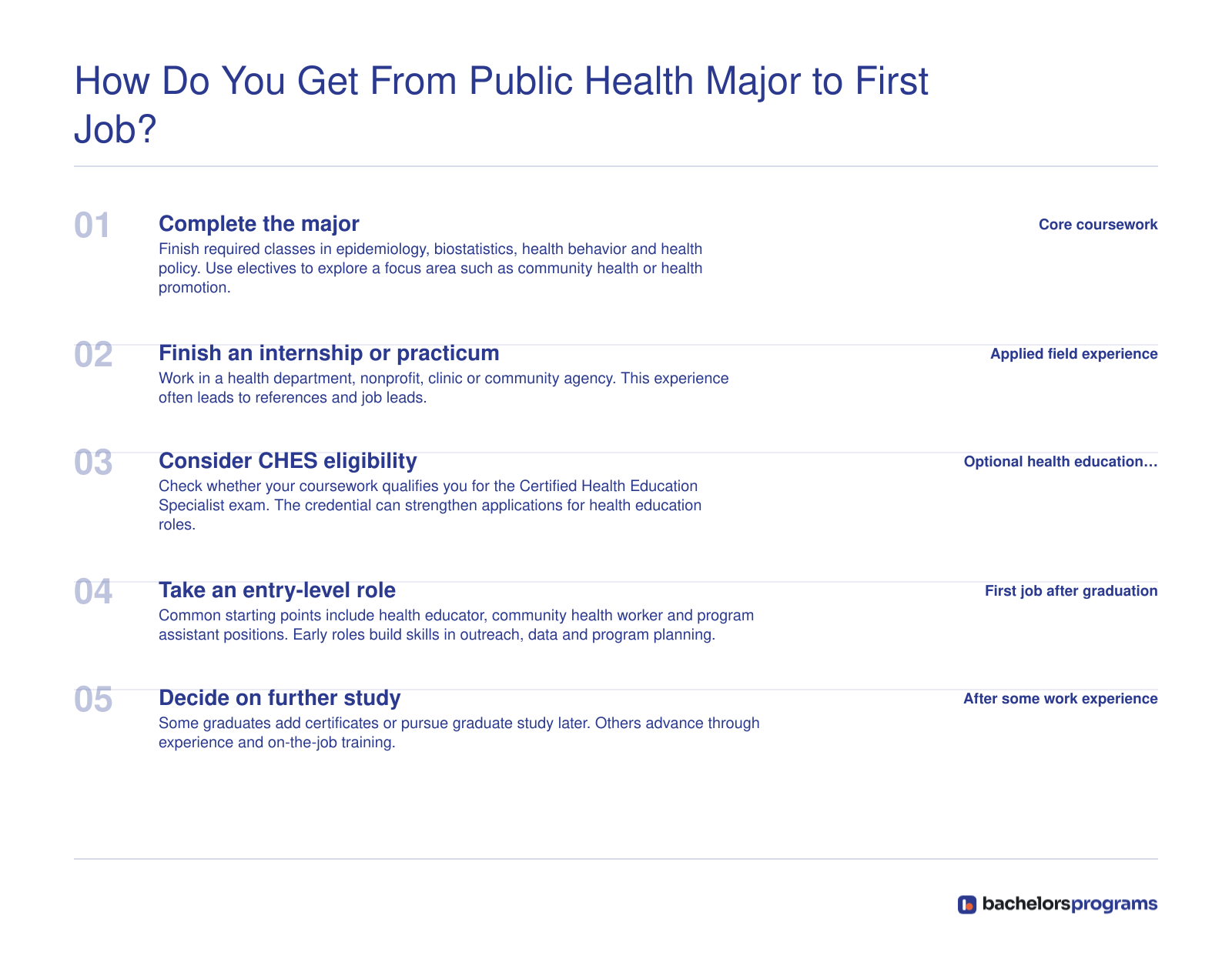
How Do You Get From Public Health Major to First Job?
Most graduates of a bachelor's degree in public health follow a similar route into the workforce. The steps below show the typical order, though timing varies by school and by the role you want.
How to Choose Among Washington's Bachelor's in Public Health Programs
The right fit comes down to a few practical questions. Work through them in order, and the options narrow quickly.
B.A. or B.S. Track
A Bachelor of Arts suits students drawn to communication, language, and social science, with coursework that leans toward community engagement and health equity. Gonzaga University offers its public health degree as a B.A. A Bachelor of Science, such as the one at Central Washington University, usually fits students who prefer biology, statistics, and other quantitative work, especially those eyeing epidemiology or a health-professions path. Lake Washington Institute of Technology and Tacoma Community College offer applied science (BAS) degrees, which emphasize workforce-ready skills.
The University of Washington-Seattle Campus offers research access, a large faculty, and a global health focus, but introductory courses tend to be bigger and advising can feel less personal. Central Washington University in Ellensburg is a smaller regional campus, where students often find closer faculty contact and a tighter cohort. Ask each school about typical class sizes and how advisors are assigned. Then consider whether you would rather live in a major city or a college town.
Accreditation, Internships, and Local Ties
Check whether a program holds CEPH accreditation, or whether the school's page explains its status. Look at internship or practicum requirements, and at whether the program has connections with county health departments, community clinics, or nonprofits. Those relationships often lead to placements and first jobs.
Match Emphasis to Your Goals
Students interested in international health, policy, or research may favor UW's Public Health-Global Health program. Those who want to run community programs or health education can look at Bellevue College's Health Promotion and Education, Seattle Central College's Community Health and Education, or Tacoma Community College's community health degree. Edmonds College pairs public health with a pre-nursing specialization for students who want a clinical route.
Your Next Step
Pick two or three schools that match your track and goals. Then read each admissions page directly for current GPA expectations, test policy, transfer credit rules, and deadlines before you apply.
Compare Public Health programs on the data that matters
Explore more Healthcare majors or browse every field of study.
All Healthcare programs Browse every field of study