Best Online Global Health Degree Programs
Compare 90+ accredited online Global Health programs, with net price after aid, graduation rates, earnings and debt from IPEDS and the U.S. College Scorecard.

An on-campus global health degree assumes you can relocate for four years. A fully online one does not. That difference explains who enrolls: community health workers in Texas, nurses abroad, and career changers who need the credential without moving.
The bachelor's degree in global health, usually a Bachelor of Science (B.S.), pairs epidemiology and biostatistics with policy and fieldwork. Institutional accreditation still governs federal aid eligibility, and practicum hours remain the requirement online programs cannot compress.
Key Points
- Median earnings five years out run roughly $52,000 to $86,000.
- Regional accreditation, such as ASU's HLC status, unlocks federal financial aid.
- Old Dominion pairs 8-week online courses with 16-week practicums.
Best Fully Online Global Health Bachelor's Programs for 2027
Every program listed here is fully online, with no hybrid or in-person components required. Entries are ordered by a blended quality composite built from College Scorecard outcomes, average net price after aid and graduation rate. Net prices are institution averages rather than quotes, and graduation rates describe the whole school, not one major.
Arizona State University
#1Tempe, AZ · ~$15,000/yr (est.)
Best for: Learners set on a global health major
Arizona State University awards both a BA and a BS in global health, a transdisciplinary degree covering the cultural, historical, biological and ecological drivers of disease, with an online route and research apprenticeships open to online majors. Average net price after aid is about $14,967 and the school's graduation rate is 68%. Graduates report median earnings of $57,244 four years in and median debt of $19,000.
- 120 total credit hours
- Fully online option available
- Faculty-led study abroad in an approved global health program
- Research Apprenticeship Program open to online majors
- Accelerated bachelor's plus master's in five years
- Higher Learning Commission accredited
- Not eligible for STEM-OPT extension
- 120 total credit hours
- Fully online option available
- Concurrent double major available
- Reduced nonresident tuition through the Western Undergraduate Exchange
- Research apprenticeships for undergraduates
- No extra requirements to change major
University of South Florida
#2Tampa, FL · ~$10,000/yr (est.)
Best for: Florida residents pursuing public health online
The University of South Florida's Bachelor of Science in Public Health is the first public health bachelor's housed in an accredited College of Public Health in Florida, and the whole degree can be finished online with a global health concentration. Undergraduates can also enter bachelor's-to-master's pathways. Average net price after aid is about $9,812 and the school's graduation rate is 77%; graduates report median earnings of $57,628 four years in and median debt of $19,503.
- 4 concentration options, including global health
- Fully online option available
- First bachelor's in public health in Florida
- Housed in an accredited College of Public Health
- Curriculum covers epidemiology and biostatistics
- Bachelor's to master's pathway available
- Prepares for entry-level public health jobs
University of Arizona
#3Tucson, AZ · ~$17,000/yr (est.)
Best for: Pre-health students needing science prerequisites
The University of Arizona offers a Bachelor of Science in Public Health with a Global Health emphasis, one of seven emphases in the major, available online or on campus. Pre-health prerequisites fit inside the degree and study abroad is an option. Average net price after aid is about $16,674 and the school's graduation rate is 68%; graduates report median earnings of $55,784 and median debt of $20,750.
- Global Health emphasis among 7 options
- Fully online option available
- Accredited program
- Pre-health prerequisites built into the degree
- Study abroad option
- Emphasis declared after admission
- Focus on health equity across communities
Florida Atlantic University
#4Boca Raton, FL · $4,900 – $17,000/yr (est.)
Florida Atlantic University's Charles E. Schmidt College of Science awards a Bachelor of Arts in Health Science with a Public, Global, and Environmental Health concentration, plus a combined bachelor's-to-master's option. Online courses here carry the university's High-Quality distinction, and students gain internship and research experience. Average net price after aid is about $8,752 and the school's graduation rate is 63%.
- 4 concentration options
- Public, Global, and Environmental Health concentration
- Combined bachelor's-to-master's program
- Fully online and in-person courses
- High-Quality online course distinction
- Internships and research experience
- Path to physical or occupational therapy
California State University-Sacramento
#5Sacramento, CA · $8,000 – $21,000/yr (est.)
California State University, Sacramento awards a Bachelor of Science in Health Science through Allied Health Sciences, asking for 57 to 61 units inside a 120-unit degree and building the prerequisites for nursing, physician assistant, occupational therapy and radiation therapy graduate study into the curriculum. A two-year roadmap is published for transfer students. Average net price after aid is about $9,338 and the school's graduation rate is 56%.
- 120 total credit hours
- Major requires 57-61 units
- Prerequisite courses built into the curriculum
- Exempt from the foreign language requirement
- Minimum grade of C- required in every course
- 2-year roadmap available for transfers
- Advising recommended every semester
- Credit by examination option
American Public University System
#6Charles Town, WV · $5,000 – $10,000/yr (est.)
American Public University System runs a 120-credit Bachelor of Applied Science in Health Sciences with monthly starts, asynchronous courses and no entrance exam, along with credit for military medical training and up to 90 transfer credits. Virtual lab activities cover microbiology, anatomy and genetics. Average net price after aid is about $9,597 and the school's graduation rate is 57%; graduates report median earnings of $86,599 four years in and median debt of $13,125.
- 120 total credit hours
- Monthly starts, 8- to 16-week courses
- Asynchronous classes with no set login times
- No SAT, ACT or entrance exams; free application
- Up to 90 transfer credits accepted
- Credit for military medical training
- Virtual lab activities in science courses
- Military and employer reimbursement benefits accepted
University of West Florida
#7Pensacola, FL · $5,000 – $10,000/yr (est.)
The University of West Florida awards a Bachelor of Science in Health Sciences through the Usha Kundu, MD College of Health, with a generalized track plus Healthcare Administration and Behavior Analysis specializations. The behavior analysis route meets the coursework requirements to apply for the BCaBA and QASP-S exams. Average net price after aid is about $9,364 and the school's graduation rate is 59%.
- 120 total credit hours, including 48 upper-division hours
- Healthcare Administration and Behavior Analysis specializations
- Behavior Analysis track meets BCaBA and QASP-S coursework requirements
- Undergraduate ABA Certificate available
- Capstone required in the general track
- Business subjects capped at 24% of requirements
- Military service credit accepted
University of Oklahoma
#8Norman, OK · $15,000 – $20,000/yr (est.)
The University of Oklahoma offers an online Bachelor of Arts in Community Health focused on promoting wellness and leading initiatives for healthier communities, grouped with the university's health and nursing offerings. Average net price after aid is about $15,300 and the school's graduation rate is 75%; graduates report median earnings of $61,165 four years in and median debt of $24,304.
- Bachelor of Arts degree offered online
- Focus on wellness and healthier communities
- Sits alongside online nursing and healthcare management degrees
University of Massachusetts-Amherst
#9Amherst, MA · $20,000 – $25,000/yr (est.)
UMass Amherst offers an online bachelor's in Interdisciplinary Studies with a Health Studies focus, letting students bring in or earn up to 105 credits for prior coursework, prior learning, and life and work experience. Most courses are asynchronous, and health studies topics include global health and health disparities. Average net price after aid is about $22,383 and the school's graduation rate is 83%; graduates report median earnings of $66,642 and median debt of $27,000.
- Fully online, with mostly asynchronous courses
- Optional blended and on-campus offerings
- Earn up to 105 credits for prior learning and work experience
- 10% discount for select employer partners
- Study with School of Public Health faculty
- Global health among the health studies topics
- Support for community college transfer students
Northern Arizona University
#10Flagstaff, AZ · ~$14,000/yr (est.)
Northern Arizona University awards a Bachelor of Science in Health Sciences: Public Health requiring 120 units, with 71 to 80 in the major and a choice of Occupational Therapy, Internship or Coursework tracks. The internship track places students for 6 units at a public health agency. Average net price after aid is about $14,158 and the school's graduation rate is 61%; graduates report median earnings of $58,491 and median debt of $24,000.
- 120 total credit hours, 71-80 in the major
- 3 tracks: Occupational Therapy, Internship or Coursework
- 6-unit internship at a public health agency
- Occupational Therapy track includes a guaranteed OTD interview
- Global Health and Human Rights electives
- 2.5 major GPA and C or better required
- Senior capstone required
Cost & outcomes by school
Federal data for the highest-earning Global Health programs, independent of the ranking above. Earnings are this field's bachelor's graduates four years after completing where the Scorecard reports them, else the school's undergraduate median.
| School | Net price / yr | Grad rate | Earnings | Debt | Grads/yr | Format |
|---|---|---|---|---|---|---|
| University of Washington-Bothell Campus WA | $12,319 | 65% | $78,466 | $14,615 | — | Hybrid |
| California State University-Sacramento CA | $9,338 | 56% | $64,876 | $15,000 | — | Online or campus |
| California State University-Stanislaus CA | $6,067 | 54% | $63,188 | $13,540 | — | Hybrid |
| CUNY Lehman College NY | $3,148 | 51% | $58,013 | $10,950 | — | Hybrid |
Sources: U.S. Department of Education. Net price, graduation rate, earnings and debt: College Scorecard (earnings and debt for this field's bachelor's graduates where reported, else school-wide); graduates: IPEDS. A dash means no figure is reported.
Cost, debt & payoff
Median earnings of this field's bachelor's graduates (4 yrs after completing, else the school's undergraduate median) vs. their median federal loan debt · U.S. College Scorecard
Across these programs the median graduate earns about $57,259 and finishes with roughly $23,250 in debt — a ratio that clears a common rule of thumb (keep debt below first-year salary). Net price and debt vary widely school to school, so check the per-school figures in the table above before you shortlist.
What a Bachelor's Degree in Global Health Covers: B.S. vs. B.A.
Global health education still argues over whether the field belongs to the sciences or the social sciences, and most universities answer by offering two separate degrees. A bachelor's degree in global health typically shares a core of epidemiology, global health systems, biostatistics, health policy, and the social determinants of health, then splits.
The B.S. leans quantitative and lab-based. USC's B.S. requires general biology, chemistry, and Calculus I1; UC San Diego requires a year of biology and a year of math plus statistics2; Cornell expects calculus, biology, and chemistry with lab3. The B.A. trades lab science for anthropology, policy, development, and language: Arizona State requires second-language proficiency through level 2024, and Miami requires precalculus plus 3 to 9 language credits5.
Neither degree is simply public health under a new name. Global health keeps a cross-border, low-resource-setting focus. Choose the B.S. for a data, lab, or research track; the B.A. for policy, advocacy, or NGO work.
Online Global Health Degree Tuition Comparison
The table below lists the most affordable fully online options, in ranking order, using 2024 federal data from IPEDS and the College Scorecard. Net price is each school's institution-wide average annual cost after grants and scholarships, not a program-specific sticker price. Debt and monthly payment figures are program-level medians for graduates, and cells are left blank where that program-level figure is not published. Net price runs from $8,376 a year at Tacoma Community College to $12,366 at Arkansas State University, a gap of about $4,000 per year.
| School | Program | Net Price After Aid (Institution-Wide, per Year) | Median Federal Debt at Completion (Program) | Median Monthly Payment (10-Year Plan) |
|---|---|---|---|---|
| Tacoma Community College (WA) | Bachelor of Applied Science in Community Health | $8,376 | ||
| American Public University System (WV) | Bachelor of Applied Science in Health Sciences | $9,597 | $22,282 | $236 |
| University of South Florida (FL) | Bachelor of Science in Public Health, Global Health concentration | $9,812 | $19,000 | $201 |
| University of North Carolina at Greensboro (NC) | Public Health Education, B.S., Health Studies Online Concentration | $10,965 | $24,966 | $265 |
| University of North Alabama (AL) | Bachelor of Science in Applied Health Science | $12,170 | ||
| Arkansas State University (AR) | Bachelor of Science in Health Studies | $12,366 |
Accreditation Checks for Online Global Health Degrees
Institutional (regional) accreditation is the non-negotiable. It determines federal aid eligibility, whether credits transfer, and how employers view your diploma. Arizona State University, for example, lists Higher Learning Commission (HLC) accreditation, and New Mexico State and Northwest Missouri State are also HLC.1 Azusa Pacific is accredited by WSCUC, reaffirmed in 2024.2
CEPH, the Council on Education for Public Health, accredits public health programs, including standalone baccalaureate programs. Many global health majors are not separately CEPH-accredited, so treat it as a bonus, not a dealbreaker. Some schools do hold it, such as the University of Arizona's Zuckerman College and Drexel's Dornsife School.
Verify It in Three Steps
- School page: Find the accreditation statement on the university's own site.
- Independent database: Confirm it in the U.S. Department of Education's DAPIP database or through CHEA.
- CEPH list: Check CEPH's accredited-schools list. Its applicant list is not accreditation.3
Practicums, Fieldwork, and Live-Class Requirements in 100% Online Programs
Old Dominion University runs its online undergraduate courses in 8-week asynchronous blocks, yet its practicums and internships follow a 16-week schedule.1 Experiential learning rarely compresses to match a short term.
How programs handle fieldwork
Most fully online global health degrees let you satisfy the requirement locally, at a clinic, nonprofit, or health department, or through a virtual internship or capstone research project; a few add optional study abroad. Residential programs sit at the other extreme: Georgetown's B.S. in Global Health sends seniors on a semester-long research practicum abroad.
Asynchronous or live?
Arizona State teaches global health in 7.5-week terms with multiple start dates a year; Grand Canyon requires no set meeting times and makes live sessions optional.2 San Diego State's online public health completion program is mostly asynchronous but expects live-session attendance, with some timed exams.3
Ask one question
Does the school find your practicum site, or must you secure one before you enroll?
Questions to Ask Yourself
Do you want the quantitative B.S. track or a policy-focused B.A.?
Can your schedule absorb required live sessions, or do you need fully asynchronous courses?
Can you secure a local practicum site, or do you need virtual or capstone alternatives?
Is a lower net price worth trading for a stronger graduation rate?
Is a Global Health Degree Worth It? Careers and Earnings
Global health has moved from volunteer work toward a credentialed career path, and earnings data now make that shift measurable.
Graduates of the programs ranked here report median earnings five years after finishing of roughly $52,000 to $86,000, with one program reporting at four years. Median monthly loan payments sit near $200 to $275, a workable but not effortless ratio against those early salaries.
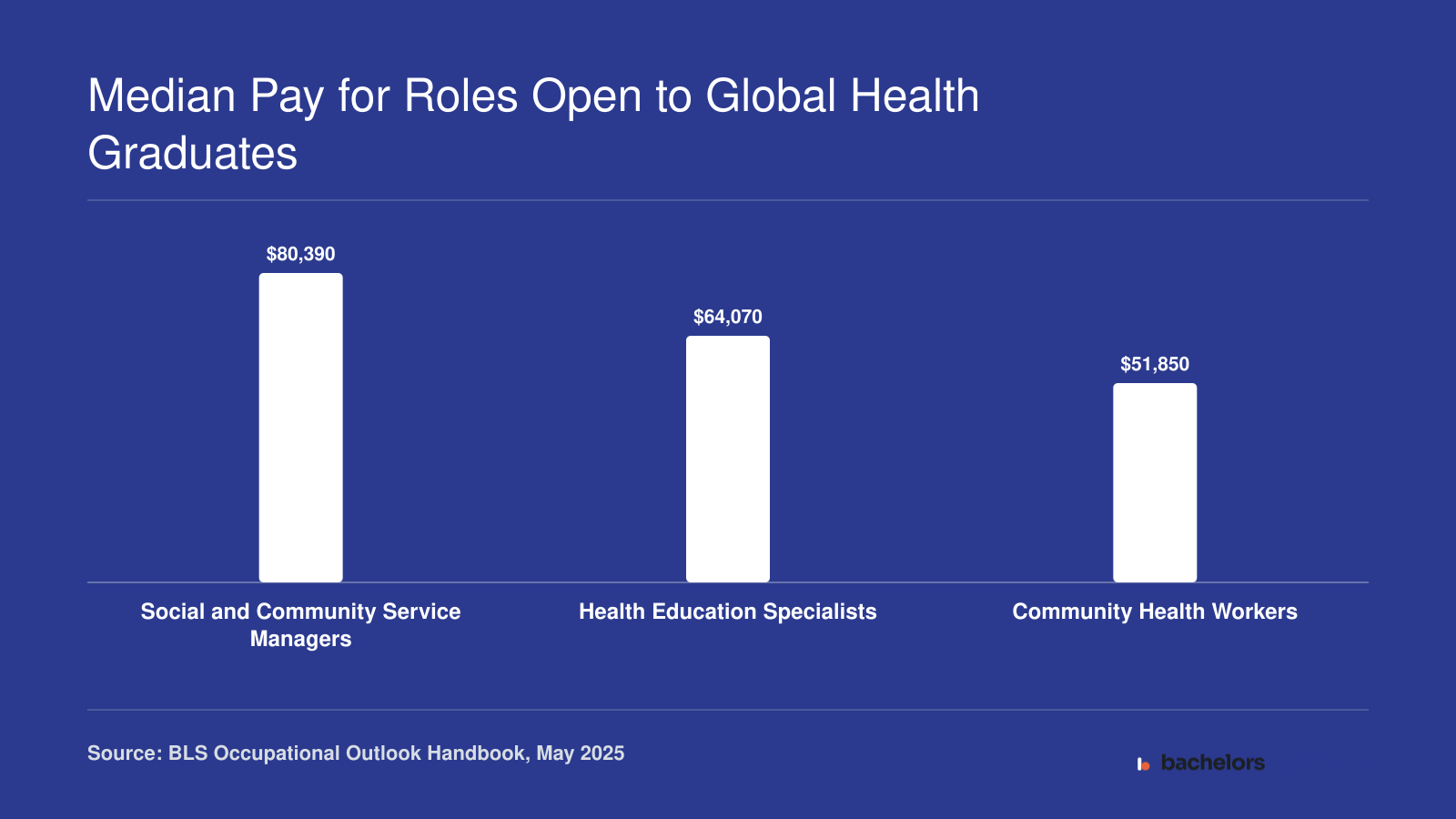
The Bureau of Labor Statistics gives May 2025 median wages of $64,070 for health education specialists (6% projected growth, 2025-2035)1, $51,850 for community health workers (13%)2, and $80,390 for social and community service managers (7%, with a bachelor's degree as the typical entry point).3
The verdict: strong value for mission-driven careers, especially when the degree is paired with a certification, a second language, or a later master's. Entry-level community health work on its own pays modestly.
Median Pay for Roles Open to Global Health Graduates
A bachelor's degree in global health leads into several community and public health roles that the Bureau of Labor Statistics tracks nationally. The chart compares the May 2025 national median annual wage for three of them. These are midpoints across all experience levels, so entry-level pay often starts below them, and manager roles usually require several years of experience first.
Related Articles
How to Choose and Apply: Tips for Working and International Students
Admissions rules for online bachelor's programs change often, so check each school's current page before you apply.
Start with transfer credit. An associate degree, AP or CLEP scores, and earlier coursework can trim both cost and time, though each school sets its own limits on grades, age of credits, and accreditation. Most programs ask for official transcripts and sometimes a minimum GPA; many are test-optional.
International applicants face more variables. Texas State, for example, accepts TOEFL iBT (78), IELTS Academic (6.5), or Duolingo (110) from applicants without a U.S. degree, and waives scores for U.S. credentials.2 Foreign transcripts often need a credential evaluation. Drexel's online public health program is closed to students outside the U.S.1, and other schools don't say whether out-of-state rates apply abroad. Fully online study also does not qualify you for an F-1 visa.
Request information from two or three shortlisted programs and ask about these points directly.
Global Health programs by state
Compare Global Health programs on the data that matters
Explore more Liberal Arts & Humanities majors or browse every field of study.
All Liberal Arts & Humanities programs Browse every field of study