Best Online Addiction Psychology Degree Programs
Compare 18 accredited online Addiction Psychology programs, with net price after aid, graduation rates, earnings and debt from IPEDS and the U.S. College Scorecard.

A bachelor's degree in addiction psychology can qualify graduates for entry-level counseling support work, yet state certification rules, not the diploma, decide who may counsel clients.
Every program in the ranking is 100% online; hybrid formats are excluded. Net price, where reported, runs from $7,770 to $36,708, so cost varies widely between schools.
Supervised work hours and an exam still follow graduation, whichever school you choose.
Key Points
- Every ranked school delivers fully online, with no campus residency required.
- CADC and NCAC require supervised hours and an exam beyond coursework.
- Look for institutional accreditation plus NAADAC or NASAC addiction-specific approval.
Top 10 Fully Online Schools for a Bachelor's Degree in Addiction Psychology
Every school below had to clear one gate first, fully online delivery, before cost and outcomes decided its spot. No hybrid or on-campus residency is built into the delivery format of any program here. Each entry is ordered by a mixed quality composite that weighs average net price after aid, the school's institution-wide graduation rate, and program earnings and debt where those figures are published.
Purdue University Global
#1West Lafayette, IN · $5,000 – $10,000/yr (est.)
Best for: Career changers with prior college credit
Purdue University Global is a large online institution built for adults returning to school, and its addiction degree sits inside a Bachelor of Science in Psychology in Addictions that the university describes as accredited by the National Addiction Studies Accreditation Commission. The curriculum covers addiction science, assessment, prevention, intervention and case management, with NASAC and NAADAC credentials attached to the offering. Students can add a business foundations concentration or a practicum track, and advanced start credit is available for a prior degree.
- 180 quarter credit hours across 34 courses
- Tracks: Business Foundations or Practicum Track
- Described as NASAC accredited and a NAADAC approved education provider
- $371 per credit
- Capstone required
- Advanced start credit for a prior degree
- Prepares for NCAC I and II certification
- Optional Peer Recovery Support Specialist micro-credential
University of New Hampshire
#2Durham, NH · $24,000/yr (est. net price)
Best for: New Englanders wanting a public university option
The University of New Hampshire is a public research university in Durham whose applied psychology degree carries an addictions studies option, delivered online through UNH College of Professional Studies. Coursework runs through the cognitive, biological and sociocultural theories behind addiction, moves into counseling foundations and special populations, and ends in an integrative capstone with internship or project options. It gives readers a familiar public university name on the diploma alongside a focused addiction curriculum.
- 120 total credit hours
- Capstone required, with internship or project options
- Covers cognitive, biological and sociocultural theories of addiction
- Coursework on special populations in addiction
- Delivered online through UNH College of Professional Studies
Columbia Southern University
#3Orange Beach, AL · $15,000/yr (est. net price)
Best for: Working adults needing frequent start dates
Columbia Southern University is a for-profit online institution in Orange Beach, Alabama, structured around frequent starts and generous transfer credit for working adults. Its human services degree with a substance abuse and addiction concentration covers counseling techniques, risk factors, physiological effects, intervention, prevention and public policy, with textbooks folded into tuition. New sessions open 11 times a year, so a reader can start within weeks rather than wait for a fall term.
- $278 per credit, textbooks included in tuition
- 120 total credit hours
- 11 start dates per year
- Up to 90 transfer credits accepted
- Covers risk factors, physiological effects, intervention and prevention
- SACSCOC accredited institution
Liberty University
#4Lynchburg, VA · ~$29,000/yr (est.)
Liberty University is a large private nonprofit Christian university in Lynchburg, Virginia, with more than 600 online degrees and a long-running online operation. Its psychology degree with an addictions and recovery focus blends addiction theory with a faith-integrated approach to counseling, and courses run in 8-week terms with no set login times. Students can transfer up to 75% of the degree, and electronic textbooks are provided.
- 120 total credit hours; 8-week courses with no set login times
- Transfer up to 75% of the degree
- 2.0 GPA minimum; no entrance exam required
- Covers psychological, biological and sociocultural factors in addiction
- Faith-integrated approach to counseling
- Electronic textbooks provided
Arizona State University
#5Scottsdale, AZ
Arizona State University offers a counseling and applied psychological science degree with a substance abuse and addictions concentration that the university describes as the first of its kind at a major research university. The program spans 120 credits across 40 classes in 7.5-week sessions, with clinical hours plus coursework in diagnosis, assessment and treatment planning. Faculty include licensed psychologists, and the same degree is taught on campus as well as online.
- 120 credit hours across 40 courses
- 7.5-week classes with full-time and part-time options
- 135 clinical hours
- Coursework in diagnosis, assessment and treatment planning
- Faculty include licensed psychologists
- Test optional admission with a 3.0 GPA minimum
- Earned Admission pathway with a 2.75 GPA
Southern New Hampshire University
#6Manchester, NH · $37,000/yr (est. net price)
Southern New Hampshire University has run online courses since 1995 and shapes its bachelor's degrees around 8-week terms, no application fee, no test scores and no essay. Its psychology degree offers five concentration options, one of them addiction studies, and every student completes an embedded 12-credit certificate in data literacy. The university is a NAADAC Approved Education Provider, though the degree itself does not lead directly to licensure.
- Five concentration options, including Addiction Studies
- 120 credit hours across 40 courses
- $354 per credit; $42,480 total program tuition
- Transfer up to 90 credits
- 8-week terms; next start January 4, 2027
- 12-credit embedded certificate in data literacy
- NAADAC Approved Education Provider
- $0 application fee, no test scores or essay
United States University
#7Sandy Springs, CA · ~$7,000/yr (est.)
United States University is a private institution based in San Diego that operates online and holds approval from California's Bureau for Private Postsecondary Education. It lists two addiction-focused psychology degrees, one in addiction studies and one in addiction counseling, both pairing general psychology foundations with substance use, treatment and recovery coursework. The school reports a 15-to-1 student-faculty ratio, which suits readers who want discussion-style classes rather than large lectures.
- Psychology foundation with an addiction studies focus
- Approved by California's Bureau for Private Postsecondary Education
- Degree program, not a certificate
- State-approved educational program, approved July 17, 2020
- Addiction counseling concentration
- Offered by a BPPE-approved institution
Walden University
#8Minneapolis, MN · $34,000/yr (est. net price)
Walden University is a large online institution in Minneapolis that serves working adults and builds its psychology degree around a 30-credit addiction concentration drawn from six addiction studies courses. Classes cover screening and assessment, treatment planning, case management, prevention and the ethics of addiction work, with micro-credentials embedded in concentration coursework. The school accepts up to 135 transfer credits and adds a graduation award for completers.
- 30-credit addiction concentration built from six courses
- $360 per credit; $47,810 total program tuition
- Accept up to 135 transfer credits
- Micro-credentials embedded in concentration courses
- Capstone required
- $1,500 graduation award
- No entrance exam required; test optional
- Accelerate Into Master's courses available
University of New Hampshire College of Professional Studies Online
#9Manchester, NH · ~$11,000/yr (est.)
UNH College of Professional Studies is the University of New Hampshire's online division in Manchester, and it runs the applied psychology addictions option with rolling admissions and 8-week terms. Students need 120 credits across roughly 24 courses, with addictions coursework in core principles, counseling foundations, the biology of addiction and special populations, ending in a capstone or internship. Conferral requires a 2.0 GPA and 30 credits in residence.
- 120 credit hours across about 24 courses
- 8-week terms with rolling admissions
- $0 application fee; no entrance exam
- Transfer up to 90 credits; credit for prior learning accepted
- Conferral requires a 2.0 GPA and 30 credits in residence
- Regionally accredited by NECHE
- Thesis or capstone option
- Coursework in addictions counseling and the biology of addiction
Indiana Institute of Technology
#10Fort Wayne, IN · ~$23,000/yr (est.)
Indiana Institute of Technology is a private university in Fort Wayne that offers its addictions counseling bachelor's degree online and on campus. The 120-credit curriculum covers state and federal regulations, ethics, client rights and recovery strategies, and the school states that graduates meet the undergraduate requirements for a licensed addictions counselor position in Indiana. Internships at treatment centers, mental health organizations and outpatient programs are part of the path, and faculty bring field experience to class.
- 120 to 121 total credit hours
- Meets undergraduate requirements for an Indiana licensed addictions counselor
- Internships at treatment centers, mental health organizations and outpatient programs
- Covers state and federal regulations, ethics and client rights
- Online and on-campus options
- Faculty bring field experience
Cost & outcomes by school
Federal data for the highest-earning Addiction Psychology programs, independent of the ranking above. Earnings are this field's bachelor's graduates four years after completing where the Scorecard reports them, else the school's undergraduate median.
| School | Net price / yr | Grad rate | Earnings | Debt | Grads/yr | Format |
|---|---|---|---|---|---|---|
| United States University CA | — | — | $80,980 | $15,244 | — | Online |
| University of New Hampshire NH | $23,805 | 76% | $66,479 | $26,814 | — | Online |
| University of New Hampshire College of Professional Studies Online NH | $10,864 | 30% | $66,479 | $26,814 | — | Online |
| Arizona State University AZ | $14,967 | 68% | $62,668 | $19,500 | — | Online or campus |
| Arizona State University AZ | — | — | $62,668 | $19,500 | — | Online or campus |
| Southern New Hampshire University NH | $36,708 | 43% | $57,701 | $21,584 | 39 | Online |
| Ottawa University-Ottawa KS | $27,963 | 28% | $55,552 | $21,500 | — | Online |
| Averett University VA | $22,925 | 48% | $51,516 | $25,000 | — | Online |
| Columbia Southern University AL | $14,580 | 33% | $49,618 | $25,000 | 129 | Online |
| Indiana Institute of Technology IN | $23,206 | 48% | $47,327 | $26,391 | — | Online |
| Liberty University VA | $29,357 | 65% | $44,813 | $24,500 | — | Online |
| Walden University MN | $33,817 | — | $42,810 | $20,834 | — | Online |
Sources: U.S. Department of Education. Net price, graduation rate, earnings and debt: College Scorecard (earnings and debt for this field's bachelor's graduates where reported, else school-wide); graduates: IPEDS. A dash means no figure is reported.
Cost, debt & payoff
Median earnings of this field's bachelor's graduates (4 yrs after completing, else the school's undergraduate median) vs. their median federal loan debt · U.S. College Scorecard
Across these programs the median graduate earns about $50,567 and finishes with roughly $24,750 in debt — a ratio that clears a common rule of thumb (keep debt below first-year salary). Net price and debt vary widely school to school, so check the per-school figures in the table above before you shortlist.
Tuition, Net Price, and Debt at the Three Lowest-Cost Online Options
According to federal IPEDS and College Scorecard data, these fully online programs sit at the low end on cost. Average net price is a school-wide figure after grants and scholarships, so treat it as an estimate rather than your actual bill. Many online schools charge one rate regardless of residency: Columbia Southern University charges the same $6,760 whether or not you live in Alabama, and a small in-state versus out-of-state gap is a real selling point. Before comparing schools, subtract the transfer credits you expect to bring from the 120-credit total (Purdue Global counts 180 quarter credits).
| School | In-State Tuition and Fees | Out-of-State Tuition and Fees | Average Net Price After Aid | Median Program Debt | Median 10-Year Monthly Payment |
|---|---|---|---|---|---|
| Purdue University Global | $10,101 | $14,412 | $7,770 | $34,836 | $369 |
| University of New Hampshire College of Professional Studies Online | $7,724 | $9,284 | $10,864 | N/A | N/A |
| Columbia Southern University | $6,760 | $6,760 | $14,580 | $25,000 | $265 |
Regional Accreditation vs. NASAC and NAADAC Approval: What to Check
Institutional accreditation protects your financial aid and transfer credits; addiction-specific recognition is what a state board examines when it counts your education hours. You want both, and they come from different places.
The two layers
Recognized institutional accreditation (regional or national) governs aid eligibility and whether credits move. NASAC accreditation applies to one named program and credential, not to every addiction course a school offers.1 NAADAC Approved Education Provider status covers the institution as a training provider, with hours accepted toward NCC AP credentialing and by many state licensing bodies.2
Among the schools here, Purdue University Global's BS in Psychology in Addictions carries NASAC accreditation through December 31, 20291, and Purdue Global is a NAADAC Approved Education Provider; the university notes the coursework meets educational requirements for the NCAC Level I and Level II exams but does not guarantee eligibility. Southern New Hampshire University lists NAADAC provider status. Treat any school not named here as unverified.
A three-step check
- Confirm the institution in the Department of Education or CHEA database.
- Search the NASAC directory (updated October 2026) and the NAADAC provider directory by city, state, or ZIP.
- Call your state certification board and ask what it accepts.
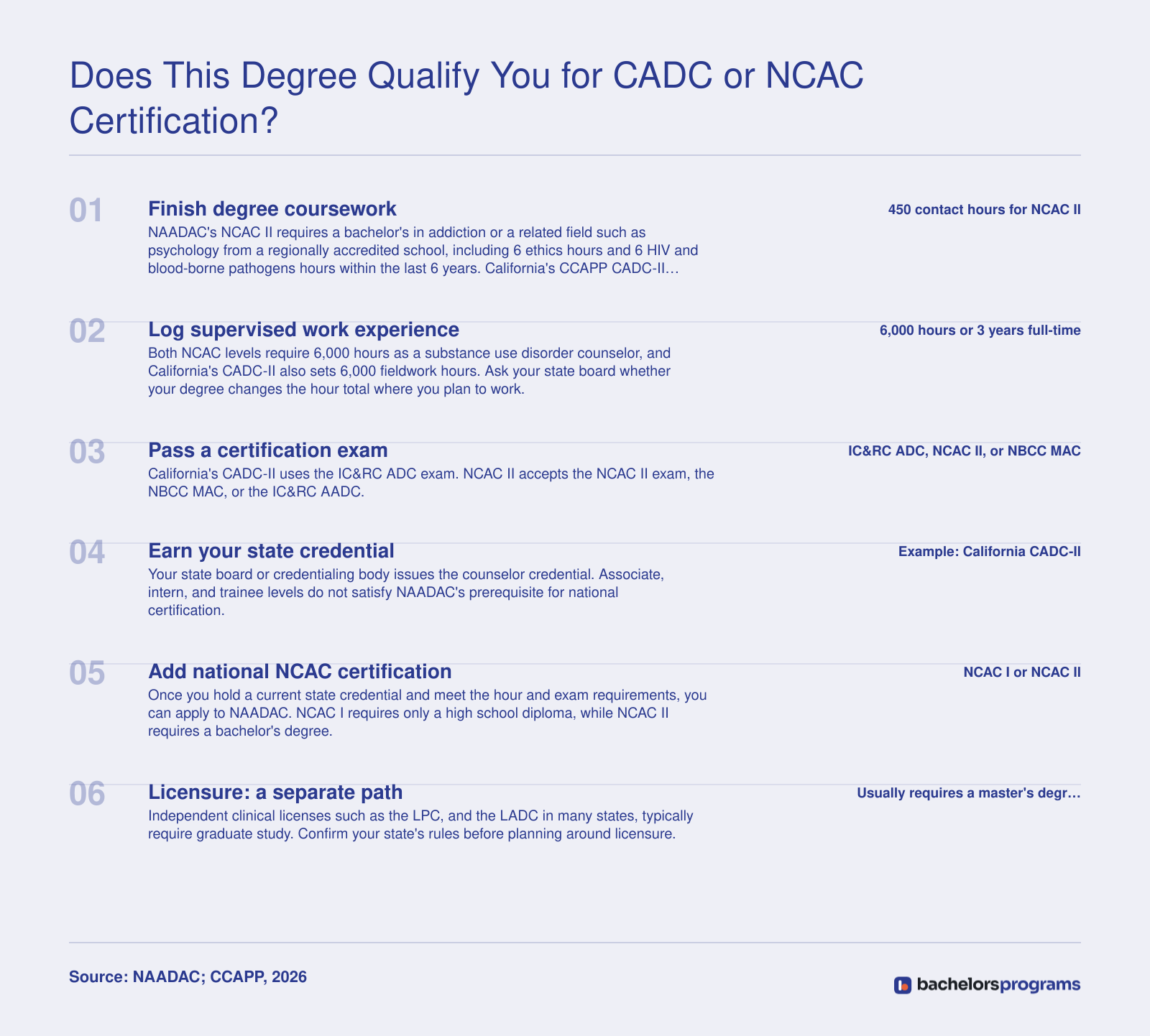
Does This Degree Qualify You for CADC or NCAC Certification?
A bachelor's degree in addiction psychology covers the education stage of counselor certification, but supervised work hours and an exam still come before any credential. Certification is not the same as licensure: independent clinical licenses such as the LPC usually require a master's degree, and every state sets its own rules.
Related Articles
Jobs and Earnings After a Bachelor's in Addiction Psychology
Support roles and certified counselor roles sit on the same career ladder, but they pay differently. A bachelor's degree qualifies you directly for the first group: substance abuse technician, case manager, recovery support specialist, and prevention specialist. Certified addiction counselor is also within reach in states that accept a bachelor's for certification.
What the Labor Data Shows
The Bureau of Labor Statistics puts the median annual wage for substance abuse, behavioral disorder, and mental health counselors at $59,350 as of May 2025. Employment is projected to grow 18% from 2025 to 2035, adding about 98,000 jobs. That wage covers every education level, and BLS lists a master's degree as typical entry for the broader group. Bachelor's-level pay often runs lower.
Graduate Earnings by Program
Scorecard program-level figures for the top-earning programs here, each tied to its stated window:
- Southern New Hampshire University: $57,701 median, four years after finishing.
- Columbia Southern University: $44,714 median, five years after finishing.
- Purdue University Global: $42,305 median, four years after finishing.
The windows differ, so compare them with care.
Pairing the degree with state certification is the fastest way to raise bachelor's-level earnings.
Questions to Ask Yourself
Does your state board let a bachelor's degree holder sit for its CADC credential?
Is the program's coursework NASAC-accredited or NAADAC-approved?
Can you secure a local practicum site near home for the field hours?
Would a broader psychology or social work bachelor's give you more options later?
Practicums, Start Dates, and Format: Picking Your Online Addiction Counseling Degree
A "fully online" addiction counseling degree puts your classes online. It does not always mean every requirement can be finished from home.
Practicums and Course Format
Some programs still require supervised field hours at an agency near you. Arizona State University's substance abuse and addictions track includes a 135-hour internship supervised by a licensed counselor. Indiana Tech lists internships at treatment centers. Purdue Global offers a practicum track that residents of Indiana, Minnesota, Nebraska, Texas, and Wyoming must enroll in for additional hours. Schools rarely publish who arranges placements, so ask before you apply.
Format matters too. Asynchronous courses, such as Liberty's with no set login times, suit shift workers and parents. Synchronous classes add scheduled live sessions and more structure. Online-focused schools also start often: Columbia Southern lists 11 start dates per year, and several schools here run 8-week terms.
Degree Type and Next Steps
An addiction-specific bachelor's lines up your coursework with certifications such as CADC or NCAC. A general psychology, social work (BSW), or human services degree gives up that focus but keeps more graduate-school paths open.
To decide, shortlist two or three schools from the ranking and request a transfer credit evaluation from each. Then confirm with your state certification board that it accepts the program before you enroll.
Addiction Psychology programs by state
Quick Answers on Program Length and Studying Substance Abuse Counseling Online
How many years does an online bachelor's in addiction psychology usually take?
Can you earn a bachelor's degree in substance abuse counseling entirely online?
Do 8-week terms mean the degree takes less time?
Compare Addiction Psychology programs on the data that matters
Explore more Psychology majors or browse every field of study.
All Psychology programs Browse every field of study