Best Animal Science Degree Programs
Compare 120+ accredited Animal Science programs at 90+ colleges, with net price after aid, graduation rates, earnings and debt from IPEDS and the U.S. College Scorecard.

Animal science has become a data-heavy field: genomic selection and precision feeding now sit alongside barn work, and employers expect graduates to read both.
An animal science bachelor's degree, usually a Bachelor of Science (B.S.), routes students into pre-vet coursework, livestock production, equine management, nutrition or agribusiness.
Those paths diverge quickly. Pre-vet students face a second gate, veterinary school admission, while production and agribusiness employers hire on farm experience and business fluency. Net price varies more than the curriculum does.
Key Points
- Rankings weigh net price, graduation rates and earnings from College Scorecard data.
- Fort Hays State's 3,825-acre farm gives campus students direct animal contact.
- Oregon State, Kansas State and Unity offer animal science degrees online.
Best Animal Science Schools Ranked: Top 10 Bachelor's Programs
This list spans campus, hybrid and online formats, and it is ordered by value and outcomes rather than name recognition. Each card shows what the school is known for in animal science, the concentration tracks a student can actually enroll in, and, where the data supports it, what graduates of the program earn four years after finishing.
University of Florida
#1Gainesville, FL · ~$7,000/yr (est.)
Best for: Animal science majors exploring multiple species tracks
Four concentration tracks (Animal Biology, Equine, Food Animal, Integrative Animal Sciences) sit inside one 120-credit degree, and the Animal Biology track feeds directly into veterinary and graduate applications. Critical-tracking courses require a 2.5 GPA, internships and field trips are built in, and an Animal Genetics Certificate can be added. Median earnings for program graduates four years after finishing are $47,724.
- Animal Biology specialization within the B.S. in Animal Sciences
- 120 credits spread across eight semesters
- Critical-tracking courses require a 2.5 GPA
- Prepares students for veterinary and graduate programs
- Animal Genetics Certificate available
- Equine nutrition, reproduction and genetics coursework
- Hands-on labs in department facilities
- Prepares students for equine industry careers
- Undergraduate research encouraged
- Livestock production and management focus
- Coursework in beef, dairy, swine and poultry
- Meat and food safety coursework included
- Labs held in department teaching facilities
- Customized degree plan built with an advisor
- Concentration options include nutrition and artificial insemination
- Not intended for pre-veterinary students
- Students maintain a 2.0 UF GPA
University of California-Davis
#2Davis, CA · $10,000 – $15,000/yr (est.)
Best for: Pre-veterinary students preparing for professional school
Twelve specialization areas, from aquatic animals and poultry to equine and livestock and dairy, make this one of the broadest animal science departments in the country. Advanced work covers behavior, welfare, genetics, nutrition and physiology, and graduates move into veterinary or medical school, research, ranch management and agricultural consulting. Median earnings for program graduates four years after finishing are $48,441.
- 12 specialization areas, including aquatic, avian, equine and poultry
- 116 unit minimum for the degree
- Coursework in behavior, welfare, genetics, nutrition and physiology
- Faculty advisor approves each student's study program
- Junior transfers may waive the introductory animal science course
Texas A&M University-College Station
#3College Station, TX · ~$21,000/yr (est.)
Best for: Ranch and livestock production career starters
Two distinct routes sit side by side: a Production/Industry option that adds accounting, economics and management to the animal science core, and a Science option built for veterinary, medical and graduate school. Every student completes an animal science experience, whether undergraduate research, study abroad, an internship or a competitive judging team. Median earnings for program graduates four years after finishing are $57,324.
- 120 semester credit hours across four years
- Emphasis areas: beef cattle, dairy, equine, meat, sheep or swine
- Animal science experience required: research, internship, study abroad or judging team
- C or better required in major coursework
- Labs at the University Beef Cattle Center and Rosenthal Meat Science Center
- Built for veterinary, medical, dental and pharmacy school
- Graduate study preparation in genetics and nutrition
- Two writing-intensive courses in the major
- Animal science experience required to graduate
University of Illinois Urbana-Champaign
#4Champaign, IL · ~$14,000/yr (est.)
Three concentrations, including a Companion Animal and Equine Science track aimed at shelters, zoos and humane education rather than meat and dairy production. Internships run through the Champaign County Humane Society and the ASPCA Poison Control Center, with about 25 students placed each semester. The pre-veterinary and food animal production tracks round out the major, and a business or leadership minor fits alongside the food animal course load.
- 126 credit hours, including 40 upper-division hours
- Choose the companion animal group or the horse management group
- Internships with the Champaign County Humane Society and ASPCA Poison Control Center
- About 25 students intern each semester
- Prepares students for zoos, kennels, shelters and humane education
- Focus studies on beef, swine or dairy production
- Four applied sciences courses plus room for a business or leadership minor
- Third level of a foreign language required
- Trains students to run animal production units
- Meets all pre-veterinary science requirements
- Chosen by roughly 75% of undergraduates in the major
- Department reports a 73% job placement rate
- Hands-on animal experience built into the track
California Polytechnic State University-San Luis Obispo
#5San Luis Obispo, CA · ~$17,000/yr (est.)
Learn by doing is the draw: students work with department production facilities and more than 6,000 acres of grazing land, and the 120-unit degree requires a senior project chosen from research, internship or current-issues options. Enterprise experience and animal management electives fill out the upper division, and competitive judging teams plus intercollegiate dressage and equestrian teams round out the experience. Median earnings for program graduates four years after finishing are $54,805.
- 120 units with a 2.0 GPA minimum
- Senior project chosen from research, internship or current-issues options
- 3 units of enterprise experience and 6 units of animal management electives
- Access to 6,000+ acres of grazing lands and production facilities
- Competitive judging teams plus dressage and equestrian teams
- 40 upper-division units required to graduate
Purdue University
#6West Lafayette, IN · ~$15,000/yr (est.)
Five concentrations cover agribusiness, behavior and well-being, biosciences, pre-veterinary medicine, and production and industry, with lab and farm work at the Animal Sciences Research and Education Center. Transfer applicants need a 2.5 GPA, and internship employers include Labcorp and Cargill. Median earnings for program graduates four years after finishing are $54,089.
- Agribusiness concentration within the B.S. in Animal Sciences
- Lab and farm work at the Animal Sciences Research and Education Center
- Agriculture program ranked third in the U.S. by QS for 2026
- Internship employers include Labcorp and Cargill
- Transfer applicants need a 2.5 GPA
- Production and industry concentration
- Leads to livestock production manager roles
- Bachelor of Science degree awarded through the College of Agriculture
- Behavior and well-being concentration
- Coursework spans animal welfare, nutrition and business
- Working farm used as a learning laboratory
North Carolina State University at Raleigh
#7Raleigh, NC · $9,000 – $33,000/yr (est.)
Three concentrations (Veterinary Bioscience, Science, Industry) share a 120-credit core built around physiology, reproductive physiology and nutrition, each paired with a lab. An accelerated track lets strong students earn the bachelor's and a Master of Animal Science in five years. The Science concentration is designed for future MS and PhD study, and the Industry track adds business, marketing and economics coursework.
- 120 total credit hours
- Focus areas: physiology, nutrition and genetics
- Built for MS and PhD study
- Undergraduate research with faculty
- Labs use live animals and specimens
- 3.0 GPA minimum
- DVM prerequisite courses built in
- Live animal activities are IACUC-approved
- Animal Science minor not allowed for majors
- Business, marketing and economics coursework
- Business and production focus
- Accelerated bachelor's to master's in five years
- Animal-related clubs and study abroad experiences
University of Maryland-College Park
#8College Park, MD · $16,000/yr (est. net price)
Two specializations split the major: Animal Care and Management adds a required internship plus management electives, while Sciences and Combined Ag and Vet Sci layers organic chemistry and physics on for veterinary, medical, pharmacy or graduate school. Core coursework runs 69 to 76 credits, a C- or better is required in every major course, and students must hold a 2.0 cumulative and major GPA to graduate. Median earnings for program graduates four years after finishing are $56,248.
- 69 to 76 credits of core coursework
- Specializations: Animal Care and Management, or Sciences and Combined Ag and Vet Sci
- Animal Care option requires a 3-to-6 credit internship
- C- or better required in all major courses; 2.0 GPA to graduate
- Laboratory courses carry a $50 per-course fee
- Prepares for veterinary, medical, pharmacy or graduate school
University of Georgia
#9Athens, GA · ~$14,000/yr (est.)
Coursework covers beef, dairy, horse, sheep and swine production, with labs held in the field and with live animals at the Animal Science Farm. Students can join the Food Animal Veterinary Incentive Program, intern with veterinary practices, breed associations or feed companies, and take part in undergraduate research. The College of Agricultural and Environmental Sciences awards scholarships to enrolled majors. Median earnings for program graduates four years after finishing are $61,176.
- Coursework covers beef, dairy, horse, sheep and swine production
- Labs held in the field and with live animals
- Food Animal Veterinary Incentive Program available
- Internships with veterinary practices, breed associations and feed companies
- Work on the Animal Science Farm plus undergraduate research
- College of Agricultural and Environmental Sciences scholarships for majors
Cornell University
#10Ithaca, NY · $29,000/yr (est. net price)
A 30-credit core plus a 30- to 42-credit concentration chosen from Pre-Veterinary Medicine, Dairy Management, Animal Ecology and Conservation, Applied Animal Biology and Management, or Integrative Physiology and Nutrition. Students declare the concentration by the end of sophomore year, and an accelerated seven-year BS/DVM Early Enrollment Pathway is available. Median earnings for program graduates four years after finishing are $52,967.
- 120 credits: 30-credit core plus a 30- to 42-credit concentration
- Five concentrations, including Pre-Veterinary Medicine and Dairy Management
- Accelerated seven-year BS/DVM Early Enrollment Pathway
- Pre-veterinary concentration requires a 2.8 GPA
- Concentration declared by the end of sophomore year
- Dairy Management Fellows Program available
Cost & outcomes by school
Federal data for the highest-earning Animal Science programs, independent of the ranking above. Earnings are this field's bachelor's graduates four years after completing where the Scorecard reports them, else the school's undergraduate median.
| School | Net price / yr | Grad rate | Earnings | Debt | Grads/yr | Format |
|---|---|---|---|---|---|---|
| University of New Hampshire NH | $23,805 | 76% | $66,479 | $25,997 | 32 | Campus |
| University of Georgia GA | $13,936 | 90% | $61,176 | $18,250 | 31 | Campus |
| University of Massachusetts-Amherst MA | $22,383 | 83% | $59,543 | $26,724 | 28 | Campus |
| University of Minnesota-Crookston MN | $12,212 | 50% | $58,056 | $21,500 | 21 | Campus |
| Texas A&M University-College Station TX | $21,315 | 84% | $57,324 | $17,592 | 333 | Campus |
| University of Maryland-College Park MD | $15,678 | 89% | $56,248 | $21,500 | 58 | Campus |
| University of Arkansas AR | $18,209 | 71% | $56,136 | $21,616 | 89 | Campus |
| Texas Tech University TX | $19,070 | 69% | $55,753 | $20,000 | 274 | Campus |
| Stephen F. Austin State University TX | $14,260 | 53% | $54,984 | $20,250 | — | Campus |
| California Polytechnic State University-San Luis Obispo CA | $16,665 | 86% | $54,805 | $20,500 | 158 | Campus |
| Michigan State University MI | $19,680 | 81% | $54,751 | $25,023 | 167 | Campus |
| Rutgers University NJ | $24,406 | 84% | $54,509 | $24,250 | 73 | Campus |
Sources: U.S. Department of Education. Net price, graduation rate, earnings and debt: College Scorecard (earnings and debt for this field's bachelor's graduates where reported, else school-wide); graduates: IPEDS. A dash means no figure is reported.
Cost, debt & payoff
Median earnings of this field's bachelor's graduates (4 yrs after completing, else the school's undergraduate median) vs. their median federal loan debt · U.S. College Scorecard
Across these programs the median graduate earns about $49,193 and finishes with roughly $20,810 in debt — a ratio that clears a common rule of thumb (keep debt below first-year salary). Net price and debt vary widely school to school, so check the per-school figures in the table above before you shortlist.
How We Ranked These Bachelor's Degree in Animal Science Programs
Many college rankings lean on reputation and prestige. This one weighs outcomes: what students pay, whether they finish and what graduates earn.
The Data Behind These Rankings
Every figure comes from the U.S. Department of Education's College Scorecard. Program-level outcomes for the bachelor's degree in animal science (median earnings, median debt and the number of graduates) reflect the 2022 Scorecard data year. School-wide measures, including average net price, graduation rate, admission rate and first-year retention, reflect the 2024 data year.
What the Ranking Rewards
- Affordability: Schools where students pay less after grant aid score higher.
- Completion: Strong graduation and retention rates signal that students get through the program.
- Return on investment: Graduates' earnings measured against their median debt, so programs that pay off relative to their cost rank higher.
Limits Worth Knowing
- Graduation rates cover the whole university, not animal science majors alone.
- Net price averages students at every income level. Your own cost may land higher or lower.
- When a graduating class is small, some earnings checkpoints go unreported, so later-career pay may be harder to judge.
Few competing lists explain how they rank schools. The factors above let you re-weight them yourself: if cost matters most, compare net price first; if pay matters most, start with earnings relative to debt.
Animal Science Degree Cost: Net Price, Debt and Return on Investment
Net price matters most: it is the average a first-year student pays in a year once grant aid and scholarships are applied, not the tuition figure printed in a brochure. Net price at the schools in this ranking runs from about $6,100 at College of the Ozarks, a private work college, to roughly $15,700 at the University of Maryland. The remaining schools fall between $6,541 at Florida and $14,741 at UC Davis, putting the gap between the cheapest and priciest option well over $9,000 a year.
Sticker Price Is Not the Bill
In-state tuition runs from $6,381 at Florida to $22,360 at College of the Ozarks, whose work-college model offsets charges with campus labor. Nonresidents pay far more, from $19,941 at Fresno State to $47,692 at UC Davis. At Maryland, UC Davis and Purdue, the nonresident rate lands close to three times the resident rate, so the rules on residency and state grant eligibility matter as much as the published figure.
Median Debt, Translated Into a Monthly Bill
Program-level median federal debt ranges from $13,000 at UC Davis to $21,500 at Maryland. Stretched over a standard 10-year plan, that is roughly $138 to $228 a month. Set that against early-career earnings: median pay a year after graduation runs from about $30,200 to $40,300 among the programs that report it. Borrowing at the top of the range costs around $2,700 a year, close to 7 percent of a $40,000 starting salary.
Comparing Bachelor's Degree in Animal Science Costs by Return
The comparison worth making is monthly payment against early-career pay, not sticker price against a ranking slot. A $47,692 nonresident year at a flagship can be the weaker deal next to a $7,000 net-price year at a regional public if the debt you carry claims a tenth of your first salary. Check each program's net price, borrow no more than the monthly payment can bear, and treat the list price as a starting point rather than a verdict.
Animal Scientist Pay at a Glance
Here is what animal scientists across the United States earn at the midpoint, according to federal wage data.
Related Articles
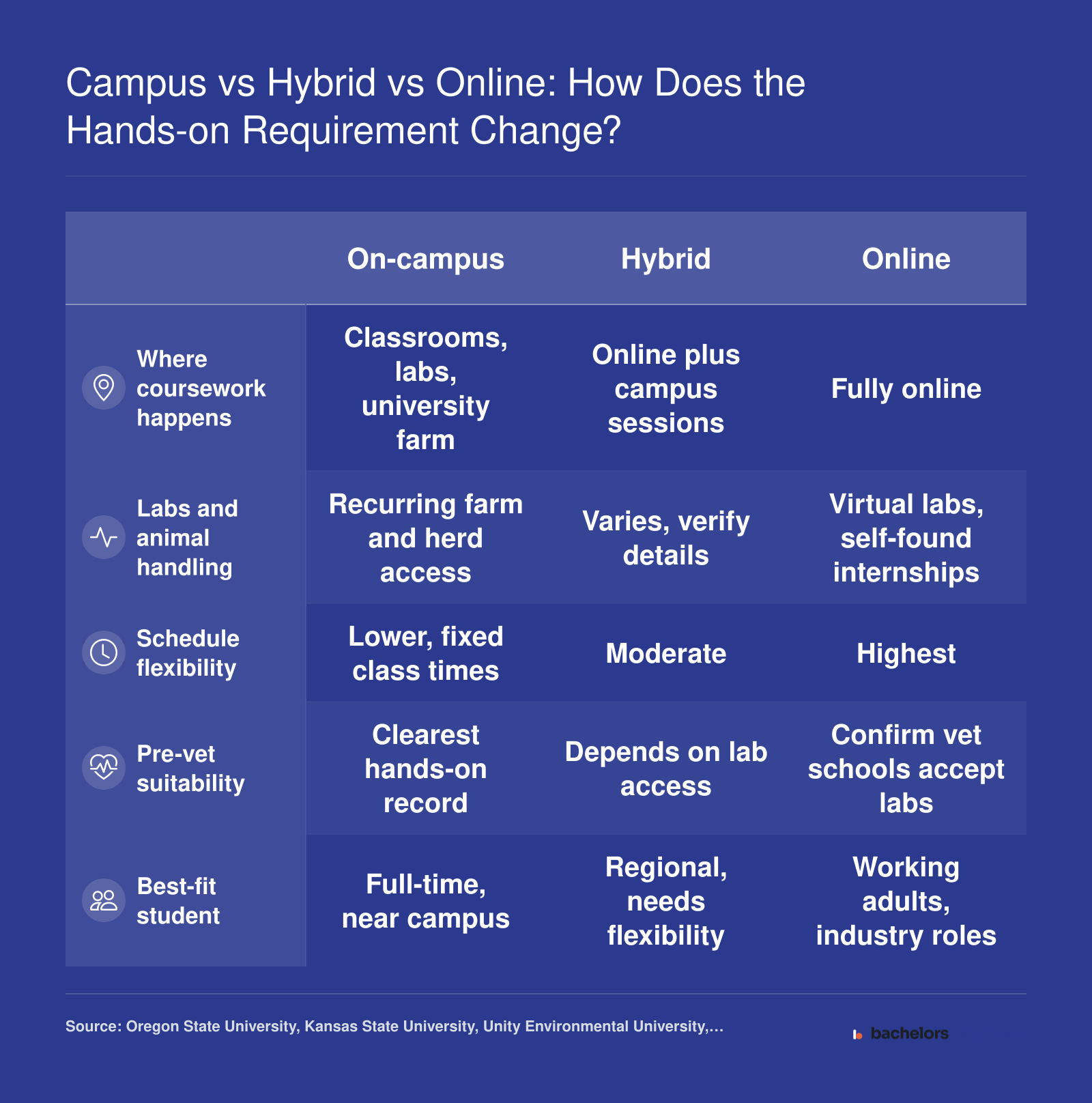
Campus vs Hybrid vs Online: How Does the Hands-on Requirement Change?
On-campus programs document the most direct animal contact. Fort Hays State runs a 3,825-acre farm, and Central Missouri builds practical experience into every semester. Online programs at Oregon State, Kansas State and Unity rely more on virtual formats and independent internships, and Oregon State caps internship credit at 3 electives. Hybrid formats vary by school, so confirm exactly where labs and animal handling take place.
Questions to Ask Yourself
Are you aiming for vet school, or for a career in livestock, nutrition or agribusiness?
Do you need daily access to a university farm or teaching herd?
Will you pay in-state tuition, or is an out-of-state land-grant school worth the higher cost?
Do you have community college credits in biology and chemistry?
Animal Science programs by state
Compare Animal Science programs on the data that matters
Explore more Science & Engineering majors or browse every field of study.
All Science & Engineering programs Browse every field of study