Best Online Animal Science Degree Programs
Compare 4 accredited online Animal Science programs, with net price after aid, graduation rates, earnings and debt from IPEDS and the U.S. College Scorecard.

Yes, you can complete an animal science bachelor's degree online, but very few schools offer it with no campus time at all. Most programs award a Bachelor of Science (B.S.) in Animal Science and run about 120 credits. Every program here is fully online; hybrid formats are excluded.
Hands-on training is the hard part. Animal science depends on nutrition, genetics, and reproduction coursework, plus handling experience that a screen cannot supply. Tuition also varies widely: Unity Environmental University charges $470 per credit, while public flagships price differently.
Vet schools and employers care most about completed prerequisites and documented animal experience, so the delivery format matters less than the record you build.
Key Points
- Oregon State's online Animal Sciences degree delivers labs through virtual field trips.
- Vet schools weigh completed prerequisites and experience hours, not your major's name.
- Rankings use federal College Scorecard and IPEDS data; hybrid programs were excluded.
Best Fully Online Bachelor's Degree in Animal Science Programs
Every program below leads to a fully online bachelor's degree in animal science, and no hybrid or in-person component is required to qualify. Because fully online animal science degrees remain uncommon, this list is short, and entries are ordered by a composite of quality measures.
Kansas State University
#1Manhattan, KS · $11,000 – $29,000/yr (est.)
Best for: Aspiring feedlot and livestock managers
Kansas State University is a land-grant institution in Manhattan, Kansas, with deep research ties to animal health, food systems, and agriculture. Its Bachelor of Science in animal sciences and industry splits into six specialty areas, including science/pre-vet and production/management, backed by coursework in nutrition, genetics, reproduction, and physiology. Departmental scholarships and facilitated internships support students heading into feedlot management, animal nutrition, or animal health pharmaceutical sales.
- Six specialty areas, including science/pre-vet and production/management
- Coursework in animal nutrition, genetics, reproduction, and physiology
- Hands-on training at 10 livestock, equine, and poultry units
- Nationally competitive judging teams and departmental clubs
- Facilitated internships and departmental scholarships available
- Career paths include animal nutritionist, feedlot manager, and genetics roles
Oregon State University
#2Corvallis, OR · $15,000 – $20,000/yr (est.)
Best for: Transfer students stacking community college credits
Oregon State University runs its animal sciences major as both a Bachelor of Science and an Honors Bachelor of Science, with five options that range from Animal Behavior to Rangeland Science. The 180-credit degree comes with a published four-year sample plan and is taught through OSU's Ecampus. Students can also stack credits with a participating community college through the university's Degree Partnership Program.
- Five options: Animal Behavior, BioHealth/Pre-Professional, Production, Equine, Rangeland Science
- 180 total credits with a published four-year sample plan
- Fully online option available through OSU Ecampus
- Prepares for veterinary medicine and USDA meat grading careers
- Degree Partnership Program combines credits with a community college
- At least 45 of the final 75 credits must be completed through Oregon State
Unity Environmental University
#3New Gloucester, ME · ~$19,000/yr (est.)
Best for: Working adults needing frequent start dates
Unity Environmental University in New Gloucester, Maine, focuses entirely on environmental and agricultural fields and delivers its degrees online. Its Bachelor of Science in Agricultural Animal Science runs on eight start dates a year, with a per-credit rate the university locks through 2030. Admission is open-access, with no application fee, essay, or test scores, and up to 90 transfer credits can count toward the degree.
- 120 credits, completable in 2.5 to 5 years
- Eight start dates per year
- $470 per credit with the rate locked through 2030
- Up to 90 transfer credits accepted
- No application fee, no essay, no test scores
- 39-credit core covers nutrition, husbandry, genetics, and sustainable livestock management
- Faculty hold animal science PhDs
Cost & outcomes by school
Federal data for the highest-earning Animal Science programs, independent of the ranking above. Earnings are this field's bachelor's graduates four years after completing where the Scorecard reports them, else the school's undergraduate median.
| School | Net price / yr | Grad rate | Earnings | Debt | Grads/yr | Format |
|---|---|---|---|---|---|---|
| Kansas State University KS | $19,406 | 71% | $50,941 | $20,500 | 201 | Online or campus |
Sources: U.S. Department of Education. Net price, graduation rate, earnings and debt: College Scorecard (earnings and debt for this field's bachelor's graduates where reported, else school-wide); graduates: IPEDS. A dash means no figure is reported.
Cost, debt & payoff
Median earnings of this field's bachelor's graduates (4 yrs after completing, else the school's undergraduate median) vs. their median federal loan debt · U.S. College Scorecard
Across these programs the median graduate earns about $49,193 and finishes with roughly $20,810 in debt — a ratio that clears a common rule of thumb (keep debt below first-year salary). Net price and debt vary widely school to school, so check the per-school figures in the table above before you shortlist.
Online Animal Science Degree Tuition, Debt, and Early Earnings Compared
The grid below pairs each school's published annual tuition and average net price with program-level debt and earnings for animal science graduates. Blank cells mean that program figure is not published. To estimate a full degree, use per-credit rates: Unity Environmental University lists $470 per credit with a locked rate across 120 total credit hours. Oregon State Ecampus charges $409 per credit (including a $15 distance education fee, excluding course materials) for a minimum of 180 quarter credits. K-State Online charges $435.71 per credit for 2026-2027, a rate that already includes a $14 online instructional support allocation and a $4 academic infrastructure fee, with separate fees on some courses. The practical takeaway: Oregon State and Kansas State bill online students the same per-credit rate regardless of where they live, so the out-of-state column reflects campus pricing, not what a fully online student from another state pays.
| School | Annual In-State Tuition | Annual Out-of-State Tuition | Average Net Price | Median Program Debt (10-Year Monthly Payment) | Median Program Earnings, One Year After Finishing |
|---|---|---|---|---|---|
| Unity Environmental University | $12,640 | $12,640 | $19,104 | ||
| Kansas State University | $11,221 | $28,568 | $19,406 | $20,500 ($217/month) | $38,868 |
| Oregon State University | $14,400 | $38,190 | $19,604 | $21,391 ($227/month) | $32,893 |
How Labs, Fieldwork, and Animal Handling Work in a 100% Online Program
Can you complete the lab and animal-handling requirements in an online animal science degree without ever setting foot on campus?
It depends on the program, and lab delivery varies widely. Oregon State's online Animal Sciences degree substitutes virtual field trips and industry video demonstrations for hands-on work, and students may apply up to 3 elective credits from an internship they complete independently, with project details settled during advisor planning. Kansas State's online Animal Sciences and Industry page outlines two curriculum options but does not spell out a lab format, so ask before you assume.
Where the hands-on work lands
Some schools build physical labs into the curriculum. Johnson & Wales lists a 1-credit Introduction to Animal Science Laboratory and a 1-credit Animal Husbandry and Management Laboratory, plus a required internship you should confirm can be done remotely.1 Others, such as the University of New Hampshire, tie live-animal experience to residency credits on campus.2
When a program has no built-in placement, build your own: a local farm, veterinary clinic, shelter, or your current employer can supply animal contact and, sometimes, internship credit.
One question to ask
Before you enroll, ask admissions directly whether internships can be completed near home.
Related Articles
Is an Online Animal Science Degree Good for Getting Into Vet School?
Admissions committees judge a campus pre-vet major and an online animal science bachelor's degree the same way: on completed prerequisites and documented experience hours, not on the name of the major. Animal science is a common pre-vet route, but no veterinary college admits you for the major alone.
Prerequisites you will need
AAVMC's 2026 guidance is explicit: every veterinary college sets its own prerequisite list, and the organization's published chart is a planning guide, not a universal rule.1 Requirements typically include general biology with lab (often 8 semester credits), general chemistry with lab (8), organic chemistry with lab, biochemistry, physics with lab, and mathematics and English composition.2 The University of Minnesota, for example, lists chemistry, biology, physics, mathematics, English, and liberal education coursework.5
Where online coursework gets complicated
Acceptance of online science courses varies by school, by subject, and by whether a lab is attached.3 The University of Georgia will not accept an online lab for a science prerequisite that requires one.1 Tufts requires labs in person and strongly recommends getting each online course pre-approved by admissions.4 Harvard's pre-vet guidance says requirements generally cannot be completed remotely.6 Get written confirmation from every target school before you enroll.
Experience hours are on you
Online students must arrange veterinary and animal-handling hours locally, through a clinic, farm, or shelter placement.
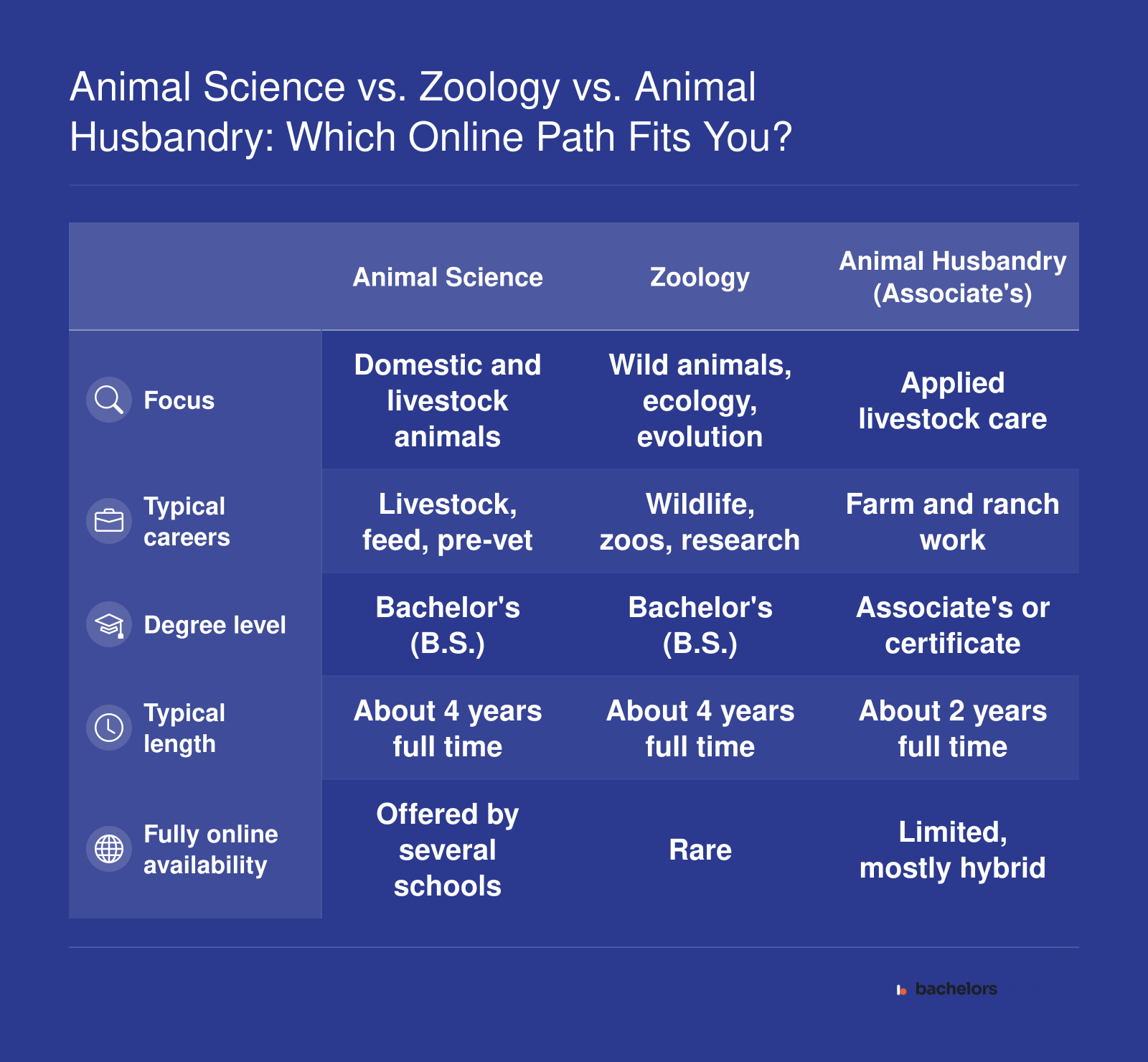
Animal Science vs. Zoology vs. Animal Husbandry: Which Online Path Fits You?
Animal science focuses on domestic and livestock animals, including their nutrition, breeding, and production, while zoology studies wild animals through ecology and evolution. Animal husbandry is the most hands-on of the three and is usually offered as an associate's degree. Those credits can often transfer into a bachelor's degree in animal science, depending on the receiving school's transfer policy.
Admission and Transfer Credit Checklist for Online Animal Science Programs
Use this checklist before you apply. If you already hold an associate's degree or college credit, focus on the last two items.
- High school diploma or GEDPurdue expects 4 math, 4 English, 3 lab science, 3 social studies and 2 world language courses. Arkansas State admits freshmen automatically with a 3.00 GPA or GED, a 19 ACT or 990 SAT, or a top-20% class rank.
- Minimum GPATransfer minimums vary: 2.0 at Arkansas State, 2.5 at Purdue (if the major is open) and 3.25 at Texas A&M for 2026-27. At Texas A&M, meeting the minimum does not guarantee admission.
- Test policyKentucky is test-optional through 2028-29. Arkansas State still requires the ACT or SAT.
- Transcripts and recordsKentucky requires an official high school transcript. Arkansas State requires transcripts from every college attended and two MMR immunizations.
- Transfer credit limitsTexas A&M requires at least 24 transferable hours, accepts no more than 85 and does not take upper-level animal science transfer coursework. Unity accepts up to 90 credits. Oregon State reviews credits after admission and requires 45 of your final 75 credits at OSU.
- Associate degree pathwaysKentucky and Murray State both have KCTCS pathways. Murray State's KCTCS agriculture track can be completed fully online, and transferring 30 or more hours waives its transition courses.
Animal Science Careers and Salary Outcomes After Graduation
National occupational pay and what a new graduate earns are two different numbers, and the gap is wide. A bachelor's in animal science leads to roles in livestock or farm management, animal nutrition or feed sales, agricultural and food science, animal welfare or shelter management, or preparation for veterinary school.
Bureau of Labor Statistics figures show the ceiling. Agricultural and food scientists, a group that includes animal scientists, had a May 2025 median wage of $81,970.1 Projected growth for 2025 to 2035 is 6%, with about 2,700 openings a year.1 BLS does not publish a separate wage for animal scientists.1 Farmers, ranchers, and other agricultural managers had a median of $89,900.2 Employment is projected to fall 3% over the decade, yet about 70,800 openings a year are expected as workers leave the field.2
Program-level earnings start lower. One year after finishing, median earnings were $32,893 for Oregon State University animal science graduates and $38,868 for Kansas State University graduates. Five years out, those figures rose to $54,287 and $51,573. Unity Environmental University has no published figure.
Expect modest entry pay. Specialization, hands-on experience hours, and veterinary or graduate pathways are what move earnings toward the national medians.
Animal Science programs by state
Compare Animal Science programs on the data that matters
Explore more Science & Engineering majors or browse every field of study.
All Science & Engineering programs Browse every field of study