Best Biomedical Engineering Degree Programs
Compare 230+ accredited Biomedical Engineering programs, with net price after aid, graduation rates, earnings and debt from IPEDS and the U.S. College Scorecard.

Getting admitted to a biomedical engineering program is only the first filter. The University of Florida, for example, admits freshmen to a pre-BME track and then limits access to the major itself. The credential at stake is usually the Bachelor of Science (B.S.) in Biomedical Engineering, so the practical question is which program is worth the investment.
Only bachelor's programs are ranked here. Graduate-focused rankings reward research spending and faculty reputation, which say little about what an undergraduate pays or earns.
ABET accreditation, net price, and debt separate programs that look alike on prestige. Early-career earnings also blend graduates who enter industry with those headed to medical school, so a single median can mislead.
Key Points
- ABET accredits individual programs, so verify the biomedical engineering major itself.
- Private universities often cost far less after aid than sticker price suggests.
- Early earnings medians mix industry hires with graduates heading to medical school.
The 10 Best Biomedical Engineering Degree Programs for 2027
Every program below awards a bachelor's degree in biomedical engineering or a close variant, and every one is delivered on campus. The order reflects what students actually pay after aid and how many finish, read alongside selectivity, early-career earnings, and typical borrowing. Each entry notes concentrations, credit loads, and the curriculum details that separate one BME program from the next.
Georgia Institute of Technology
#1Atlanta, GA · ~$12,000/yr (est.)
Best for: Hands-on learners seeking paid co-op terms
Georgia Tech's biomedical engineering department is a formal partnership with Emory University, which puts undergraduates close to a clinical and translational health ecosystem that few engineering schools can match. Coursework leans on problem-based learning in teams, and the optional five-year co-op alternates study with paid full-time work. The school has a graduation rate of 94%, and graduates of the BME program were earning a median of $102,755 four years after finishing.
- 128 credit hours, including Capstone Design
- Problem-based learning in team settings
- 9 credits of BMED depth electives plus 15 breadth credits
- Optional five-year co-op with paid full-time work
- Research Option requires nine credits and a thesis
- International Plan: two terms abroad, at least 26 weeks
- BS/MS option shares up to six graduate credits
- At least 39 upper-division credit hours required
University of California-Berkeley
#2Berkeley, CA · ~$13,000/yr (est.)
Best for: Aspiring researchers wanting faculty lab experience
Berkeley's bioengineering major sits inside one of the strongest public engineering colleges in the country and asks students to pick a lane early: biomedical devices, imaging, cell and tissue engineering, or synthetic and computational biology. Upper-division classes are small and specialized, and every student finishes with a capstone or independent research in a faculty lab. The school has a graduation rate of 93%, and graduates were earning a median of $110,597 four years after finishing.
- Four concentrations, including Biomedical Devices and Biomedical Imaging
- Cell & Tissue Engineering and Synthetic & Computational Biology tracks
- Senior capstone or independent research in faculty laboratories
- Small, specialized upper-division courses
- Joint major with Materials Science and Engineering available
- Bioengineering minor available
Johns Hopkins University
#3Baltimore, MD · $19,000/yr (est. net price)
Best for: Aspiring medical device designers
Johns Hopkins runs its biomedical engineering degree through the Whiting School of Engineering, and the program is built around design work that starts early and ends in a two-semester capstone. Seven subspecialties let students go deep in areas such as immunoengineering, neuroengineering, or translational cell and tissue engineering. The school has a graduation rate of 94%, and graduates were earning a median of $114,673 four years after finishing.
- Accredited by ABET's Engineering Accreditation Commission
- 129 credits, including a two-credit Design Cornerstone course
- Seven subspecialties, from Immunoengineering to Neuroengineering
- 18-credit Focus Area plus a two-semester design sequence
- Departmental Honors at a 3.50 cumulative GPA
- BS/MSE option; apply by fall of senior year
- At least 20 math credits and 18 basic science credits
University of Florida
#4Gainesville, FL · ~$7,000/yr (est.)
Florida's biomedical engineering department sits in the Herbert Wertheim College of Engineering and admits students into the upper-division major through a competitive review in the fall of sophomore year. The payoff is one of the lowest net prices in this group, backed by a full senior design sequence and a required exit interview. The school has a graduation rate of 91%, and graduates were earning a median of $88,078 four years after finishing.
- ABET accredited, 128 total credit hours
- Limited access: apply in fall of sophomore year
- 2.8 GPA minimum in critical tracking courses
- Grade of C or better, no more than two attempts per course
- 12 credits of 3000/4000-level BME electives
- Two-course Senior Design sequence
- 24,000-word writing requirement and exit interview
University of Michigan
#5Ann Arbor, MI · $18,000 – $61,000/yr (est.)
Michigan's BME department is jointly run by Michigan Medicine and the College of Engineering, a structure that lets undergraduates work inside a hospital while they study. Nine tracks cover everything from biocomputation to pre-health, and the SUGS path compresses a bachelor's and master's into five years. The school has a graduation rate of 93%, and graduates were earning a median of $102,342 four years after finishing.
- Nine tracks, including Neural Engineering and Pre-Health
- Joint department shared by Michigan Medicine and Engineering
- Students can work within the hospital
- Five-year bachelor's and master's through SUGS
- Biocomputation, Biomechanics, and Tissue Engineering tracks
- SURE summer research program and BMES student chapter
University of California-Los Angeles
#6Los Angeles, CA · $13,000/yr (est. net price)
UCLA's bioengineering major sits inside a large public research university with a major health system in the same city, and it is selective even by University of California standards. Students complete a full engineering and life sciences core before moving into upper-division work, and the general catalog lays out requirements in detail each year. The school has a graduation rate of 93%, and graduates were earning a median of $116,525 four years after finishing.
- Bioengineering BS major
- Degree requirements, courses and fees published each year in the UCLA General Catalog
University of North Carolina at Chapel Hill
#7Chapel Hill, NC · ~$12,000/yr (est.)
Carolina's biomedical engineering degree is run through a joint department shared with NC State, so students can take courses on either campus while staying enrolled at Chapel Hill. The curriculum pairs a biomedical core with electives in five areas, from regenerative medicine to medical microdevices, and every student completes a two-course capstone. The school has a graduation rate of 91%, and graduates were earning a median of $97,992 four years after finishing.
- 124 credit hours across an eight-semester sample plan
- Joint UNC and NC State department; courses available on both campuses
- Five elective areas, from regenerative medicine to medical microdevices
- Two-course senior capstone design sequence
- $750 per semester program enhancement fee
- Admission separate from University admission
- Honors graduation requires a 3.3 GPA
- Co-op program available through NC State
Rice University
#8Houston, TX · ~$13,000/yr (est.)
Rice keeps its bioengineering classes small and puts design work in front of students from the first year through the senior capstone. The campus sits next to the Texas Medical Center, which supports research placements and an industry mentorship program. The school has a graduation rate of 95%, and graduates were earning a median of $121,099 four years after finishing, the highest figure among the ranked programs.
- ABET-accredited bioengineering degree
- Design coursework every year, freshman through senior
- Campus adjacent to the Texas Medical Center
- Industry Mentorship Program for undergraduates
- Small classes with laboratory access
- Of 2020 graduates, 53% planned on medical or graduate school
- 45% of 2020 graduates entered industry directly
Harvard University
#9Cambridge, MA · $15,000 – $20,000/yr (est.)
Harvard awards an A.B. in biomedical engineering rather than a B.S., and the concentration lives inside Harvard College's liberal arts framework rather than a standalone engineering school. The work is quantitative, using mathematical modeling to explain how living systems function from the subcellular to the organism scale. The school has a graduation rate of 98%, and admission is the most selective in this group.
- Awards the A.B. degree, not a B.S.
- Undergraduate concentration within Harvard College
- Quantitative modeling from subcellular to organism scales
- Engineering principles applied to the life sciences in a liberal arts setting
Yale University
#10New Haven, CT · ~$24,000/yr (est.)
Yale's B.S. in biomedical engineering asks students to choose one of four concentrations while completing a shared core, so the cohort moves through the foundational courses together. A senior project and optional pass/fail research credit give students room to work in labs, and the curriculum can be shaped around medical school prerequisites. The school has a graduation rate of 96%.
- Four concentrations, including Bioimaging and Systems Biology
- 13 term courses, at least 11 course credits beyond prerequisites
- Senior requirement: BENG 4080 plus a one- or two-term project
- Pass/fail research credit available
- Curriculum adaptable to medical school requirements
- Study abroad credit with DUS approval
- Course substitutions allowed with DUS permission
Cost & outcomes by school
Federal data for the highest-earning Biomedical Engineering programs, independent of the ranking above. Earnings are this field's bachelor's graduates four years after completing where the Scorecard reports them, else the school's undergraduate median.
| School | Net price / yr | Grad rate | Earnings | Debt | Grads/yr | Format |
|---|---|---|---|---|---|---|
| Franklin W Olin College of Engineering MA | $25,171 | 96% | $129,455 | $19,500 | — | Campus |
| University of Pennsylvania PA | $28,699 | 97% | $126,419 | $15,593 | 51 | Campus |
| Rice University TX | $13,370 | 95% | $121,099 | $11,000 | 42 | Campus |
| Vanderbilt University TN | $15,846 | 94% | $116,662 | $15,000 | 52 | Campus |
| University of California-Los Angeles CA | $12,548 | 93% | $116,525 | $14,500 | 78 | Campus |
| Johns Hopkins University MD | $18,809 | 94% | $114,673 | $11,207 | 115 | Campus |
| Tulane University of Louisiana LA | $39,949 | 86% | $112,914 | $22,500 | 16 | Campus |
| University of California-Berkeley CA | $13,481 | 93% | $110,597 | $14,896 | 110 | Campus |
| Carnegie Mellon University PA | $31,944 | 94% | $109,648 | $21,750 | 59 | Campus |
| University of Virginia VA | $21,565 | 96% | $109,551 | $18,400 | 109 | Campus |
| California Polytechnic State University-San Luis Obispo CA | $16,665 | 86% | $109,232 | $20,500 | 108 | Campus |
| California State University-Long Beach CA | $10,440 | 69% | $106,540 | $15,500 | 58 | Campus |
Sources: U.S. Department of Education. Net price, graduation rate, earnings and debt: College Scorecard (earnings and debt for this field's bachelor's graduates where reported, else school-wide); graduates: IPEDS. A dash means no figure is reported.
Cost, debt & payoff
Median earnings of this field's bachelor's graduates (4 yrs after completing, else the school's undergraduate median) vs. their median federal loan debt · U.S. College Scorecard
Across these programs the median graduate earns about $80,933 and finishes with roughly $22,725 in debt — a ratio that clears a common rule of thumb (keep debt below first-year salary). Net price and debt vary widely school to school, so check the per-school figures in the table above before you shortlist.
How We Ranked Bachelor's Biomedical Engineering Programs
A reputation survey and an outcomes-driven comparison answer different questions. U.S. News ranks biomedical engineering largely at the graduate level, where faculty reputation and research spending carry weight. This ranking starts with the bachelor's degree instead, so a strong graduate school does not automatically lift a weak undergraduate program.
What Goes Into the Ranking
Every entry is a regionally accredited institution that awards a bachelor's degree in biomedical engineering. Five federal measures drive the order: - Net price: average yearly cost after grant aid, across all undergraduates. - Graduation rate: the share of first-time, full-time students who finish. - Admission rate: how selective the institution is overall. - Median earnings: program-level pay after completion. - Median federal debt: what borrowers owe when they graduate.
The figures come from College Scorecard and IPEDS. Programs that appear on master's-oriented lists but do not award an undergraduate degree in the field are left out.
Where the Numbers Stop
Net price is an average, not the bill you will personally receive. Graduation rates and 10-year earnings describe the whole institution, not biomedical engineering majors alone. A university with a strong overall record can still run a thin BME department, and a modest one can run an excellent program with close faculty contact.
How to Use It
Treat the ranking as a shortlist, not a verdict. Pair it with the accreditation, co-op, and research checks covered later, then compare financial aid offers side by side. The school that fits your budget and career goals may sit lower on this list than a famous name that costs far more.
What a Bachelor's Degree in Biomedical Engineering Involves
A bachelor's degree in biomedical engineering is an engineering degree aimed at the human body: students build the analytical toolkit of a mechanical or electrical engineer, then apply it to tissue, implants, imaging systems, and diagnostic devices.
The foundation arrives before the biomedical material does. Expect calculus through differential equations, calculus-based physics, general chemistry and organic chemistry, biology, and usually programming.1 Engineering mechanics, circuits, and materials science follow. This is not a biology degree with a few engineering courses attached; the math and physics load is heavy and starts in the first semester.
The Upper-Division Core
Most programs then require a shared BME core: biomechanics (force and motion in bones, joints, tissues, and cells), biomaterials (synthetic and natural materials, tissue interactions, implants, drug delivery), bioinstrumentation (sensors, physiological measurement, signal acquisition, diagnostic and therapeutic devices), and physiology, often taught as medical physiology for engineers.2 Biomedical transport and modeling or systems courses appear at many schools. Nearly all programs end in a capstone senior design project, either one course or a multi-quarter sequence: UC Davis runs BIM 110A, 110B, and 110C1, and Cal Poly splits it into Design I and Design II.3
Concentrations, and What Students Actually Do
- Medical devices: designing, testing, and regulatory planning for instruments, sensors, and implantable hardware.
- Tissue engineering: cell culture, scaffolds, and biomaterials work aimed at repairing or replacing tissue.
- Biomechanics: measuring and modeling how force moves through bone, cartilage, and soft tissue.
- Bioinformatics or computational BME: programming and simulation against physiological and genomic data.
Structure varies by school. Cornell requires a formal concentration chosen in junior year, among them Biomaterials and Drug Delivery and Biomechanics and Mechanobiology2; Hartford offers standard, health professions, and electrical engineering tracks.4
Biomedical Engineering vs. Bioengineering
The names are often variants rather than different degrees. Biomedical engineering usually signals engineering for human medicine, while bioengineering is frequently broader, folding in biotechnology, synthetic biology, molecular and cellular engineering, or agricultural and environmental systems. Not every bioengineering program is broader, so compare course lists, not titles.
The Realistic Workload
Four years is standard, but lab sections, multi-course design sequences, and an optional co-op can stretch the timeline. Students adding a pre-med track on top of the engineering sequence often take longer.
ABET Accreditation for Biomedical Engineering Programs: Why It Matters and How to Check
A prestigious engineering college can still award a biomedical engineering degree that is not ABET accredited, and that distinction matters more than many applicants expect. ABET's Engineering Accreditation Commission accredits programs, not institutions, at the bachelor's and master's levels. The reputation of the university does not automatically transfer to a new or revised BME program.
What EAC Accreditation Covers
ABET's 2026-2027 engineering criteria explicitly cover programs titled bioengineering, biomedical, or similarly named.1 The criteria address living and non-living systems and the analysis, modeling, design, and realization of devices, systems, components, and processes.1 The program name on your diploma and the program name in ABET's database therefore need to match.
Why It Matters for the FE and PE
ABET states that graduates of ABET-accredited bachelor's engineering programs are eligible to become registered professional engineers in all U.S. states and territories.2 The typical sequence is the accredited degree, the FE exam for Engineer-in-Training status, qualifying work experience, the PE exam, and any remaining state board requirements. ABET does not administer licensure, and state boards set their own rules, so accreditation is a foundation rather than a guarantee.2
How to Check a Program
Use ABET's accredited program search, then work through three checks:
- Search by school: enter the institution, not the department or college.
- Confirm the exact program and level: distinguish biomedical from bioengineering, and bachelor's from master's.
- Check the date range: confirm accreditation is current, not a historical record.
In the program descriptions for this ranking, Johns Hopkins University and the University of Florida identify their biomedical engineering bachelor's programs as ABET accredited. UC Berkeley, UCLA, and Rice award bioengineering-titled degrees, so verify those under the bioengineering program record. A newer BME program at a well-known engineering school may still be completing its accreditation review.
Biomedical Engineering Degree Cost, Net Price, and Debt
Once financial aid is counted, a biomedical engineering degree at many of the schools ranked here costs far less than the sticker price suggests. The gap is widest at private universities.
Sticker Price vs. Net Price
Published tuition and fees at the private schools on this list run from $65,230 a year at Johns Hopkins University to $69,314 at Cornell University. Average net price tells a different story. That figure subtracts grants and scholarships from what students are charged. Johns Hopkins drops to $18,809. Vanderbilt University, listed at $67,498, falls to $15,846. Duke University ($29,612), the University of Pennsylvania ($28,699) and Cornell ($28,690) land higher but still well below sticker.
Public flagships start lower. The University of North Carolina at Chapel Hill charges in-state students $8,994 in tuition and fees and posts the lowest average net price here at $11,655. UCLA ($12,548), UC Berkeley ($13,481), the University of Washington-Seattle ($14,091) and UC Davis ($14,741) follow.
Out-of-state students pay far more at these publics. UNC's nonresident tuition is $41,203, and the UC campuses top $49,000. For a student without in-state residency, a generous private aid offer can match or beat a public school's bill.
Debt at Graduation
Median federal debt for biomedical engineering bachelor's graduates is modest across these programs. The lowest-debt programs are:
- Johns Hopkins University: $11,207 median debt, about $119 a month on a 10-year plan
- Duke University: $13,894, about $147 a month
- University of Washington-Seattle: $14,000, about $148 a month
- UCLA: $14,500, about $154 a month
Even the highest figure here, $15,979 at UC Davis, works out to roughly $169 a month over 10 years.
Your Price Will Differ
The average covers only students who receive aid. What you pay turns on your family income, your assets and the aid package each school offers. Every college posts a net price calculator that uses your financial details to produce a personal estimate. Run it for each program on your shortlist before you rule out a private school on sticker price alone.
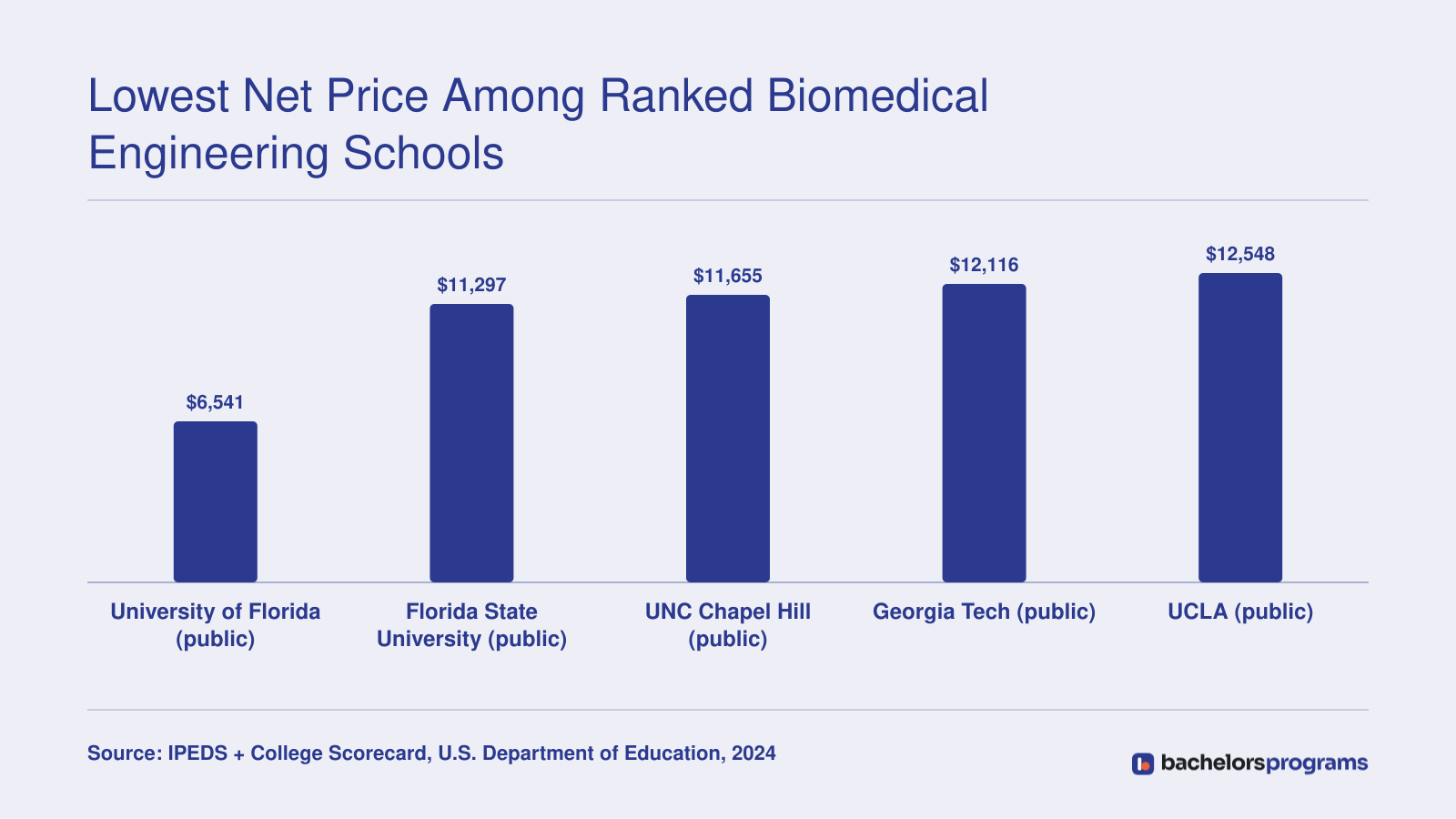
Lowest Net Price Among Ranked Biomedical Engineering Schools
These are the lowest-cost schools on this list, measured by average annual net price after grants and scholarships. Net price is an institution-wide average for all undergraduates, not a figure specific to the biomedical engineering major, and it is not the same as sticker tuition. Every school shown here is a public university, so in-state students tend to see the lowest costs, and the University of Florida is about half the price of the others.
Related Articles
Earnings and ROI: What Biomedical Engineering Graduates Actually Make
Program-level medians blend graduates who go straight into industry with those headed to medical or graduate school, and the two groups earn very different amounts early on. Keep that blend in mind when you compare programs.
Top Earners and the Window Behind Each Number
Among the highest-earning programs here, median earnings five years after completion are:
- Northwestern University: $129,919
- University of Pennsylvania: $121,488
- Johns Hopkins University: $118,167
- Duke University: $115,268
Earlier windows run lower. Penn graduates reported $93,310 one year after completion, and Northwestern's four-year figure was $102,994. UCLA's one-year median was $57,874, against $114,571 at five years.
Earnings Against Debt
Median debt among completers is modest at several schools. Johns Hopkins graduates borrowed a median of $11,207 against $118,167 in five-year earnings, which is about ten times debt and the fastest payback among these four. Northwestern ($16,833 in debt) and Penn ($15,593) also pay back quickly. Cal Poly San Luis Obispo shows $111,260 at five years against $20,500 in debt. That is still a strong return, but a thinner cushion than the private leaders.
Why Early Medians Can Look Low
Many BME graduates enter medical school, a master's program, or a PhD soon after finishing. Students in training report little or no wage income, which pulls down one-year and two-year medians. A low early figure does not necessarily mean weak job prospects. Check the later windows before judging a program.
Demand Beyond Graduation
The Bureau of Labor Statistics projects employment for bioengineers and biomedical engineers to grow 8% from 2025 to 2035, which it classifies as much faster than average. Employment is expected to rise from 23,800 jobs in 2025 to 25,700 in 2035, with about 1,200 openings a year.1 It is a small occupation, so openings are limited. Internships, co-ops, and research experience matter when you compete for those openings.
Median Pay for Biomedical Engineers
Federal wage data offers a clear benchmark for what a bachelor's degree in biomedical engineering can lead to once you are working in the field.
Questions to Ask Yourself
If medical school is the goal, does the program offer pre-health advising?
Are you drawn to hands-on device design or to lab-based tissue and molecular work?
Would a co-op that stretches your degree past four years pay off for you?
Have you confirmed that the specific BME program is ABET-accredited, not just the engineering college?
Biomedical Engineering programs by state
Compare Biomedical Engineering programs on the data that matters
Explore more Science & Engineering majors or browse every field of study.
All Science & Engineering programs Browse every field of study