Best Data Science Degree Programs in Massachusetts
Compare 7 accredited Data Science programs in Massachusetts, with net price after aid, graduation rates, earnings and debt from IPEDS and the U.S. College Scorecard.

What does a bachelor's degree in data science in Massachusetts actually get you? Mostly proximity: the Boston-Cambridge corridor concentrates biotech, health care, finance and software employers who hire analysts and data scientists, and students can reach them through public-facing co-ops, internships and alumni networks. The usual credential is a Bachelor of Science (B.S.) in Data Science, though some schools use a statistics-based title.
The tension is fit. Curricula range from small liberal arts majors to engineering degrees with long capstones, and private tuition is the rule among the schools here.
Still, the state's employers and its range of program styles mean most students can find a degree that matches both their math background and their career target.
Key Points
- Majors range from 10 courses to a 38-course degree with capstone.
- Every school here is private, so Massachusetts residents get no tuition discount.
- Expect on-campus study: every program on this list is delivered on campus.
Best Bachelor's Degree in Data Science Programs in Massachusetts
Massachusetts data science bachelor's programs range from a 10-course major at a small liberal arts college to a 38-course engineering degree with a two-semester capstone. The seven below all award a bachelor's degree in data science or a closely named equivalent, and each pairs computing and statistics coursework with a required applied project, internship or co-op. They are listed in the order our review placed them.
Smith College
#1Northampton, MA · $25,000 – $30,000/yr (est.)
Best for: Liberal arts students wanting statistics depth
Smith College is a private women's liberal arts college in Northampton that houses data science inside its Statistical and Data Sciences program. The major is compact by design, and its capstone enrolls no more than 20 students who work in teams on projects sponsored by academia, government or industry. Coursework from the Five College consortium can count toward the major, and graduates have interned with the National Institute of Standards and Technology and worked at Google, MIT's Lincoln Laboratory and MassMutual's data science development program.
- 10 courses: 5 foundation and core, plus programming and statistics depth
- Capstone SDS 410 capped at 20 students on sponsored team projects
- AP Statistics score of 4 or 5 replaces SDS 210
- Five College statistics and computer science courses may count as electives
- Capstone sponsors come from academia, government and industry
- Class time emphasizes problem-solving; DataFest hosted at UMass
Tufts University
#2Medford, MA · ~$40,000/yr (est.)
Best for: Engineering students wanting a computing-adjacent major
Tufts University is a private research university in Medford whose data science degree sits inside the School of Engineering and is run jointly by computer science and electrical and computer engineering. The program is course-heavy: 38 courses spanning math, science, humanities and 14 major courses, closed out by a two-semester senior capstone. It fits students who want an engineering credential with a strong analytics core rather than a standalone statistics major, and only School of Engineering students may enroll.
- 38 courses total: 11 math and science, 14 in the major
- Jointly run by Computer Science and Electrical and Computer Engineering
- Senior capstone in Data Science 97 and 98 required
- Seven data science electives across infrastructure, analytics and theory
- Stand-alone major or double major, but not with the BS in Computer Science
- A senior thesis can cover part of the elective requirement
- Open only to students enrolled in the School of Engineering
Mount Holyoke College
#3South Hadley, MA · $25,000 – $30,000/yr (est.)
Best for: Students pairing data with a second field
Mount Holyoke College is a private women's college in South Hadley that awards a Bachelor of Arts in data science rather than a B.S. The 40-credit major pairs mathematics and statistics with a domain area such as English, economics or chemistry, and every student completes a capstone. It suits readers who want data skills embedded in a liberal arts education, and the major automatically satisfies the college's outside-the-major requirement.
- Minimum 40 credits, including 20 credits of approved electives
- At least 12 elective credits at the 300 level drawn from two departments
- Choose COMSC-335 Machine Learning or STAT-340 Applied Regression Methods
- DATA-390 Data Science Capstone required of all majors
- Includes a data ethics course; coursework uses Python
- Automatically fulfills the college's outside-the-major requirement
- Course substitutions need Data Science Program Committee approval
Worcester Polytechnic Institute
#4Worcester, MA · $40,000 – $45,000/yr (est.)
Worcester Polytechnic Institute is a private, project-based university in Worcester that runs its data science bachelor's on seven-week terms. Every student completes a year-long major project for a live sponsor and builds a portfolio through one of more than 50 project centers worldwide. A five-year BS/MS option, a STEM designation that supports extended work authorization for international students, and a graduating class that reported an average starting salary of $85,019 make it a strong pick for students aiming at industry or graduate study.
- Seven-week terms; BS/MS option awards both degrees in five years
- Year-long major project for a live sponsor
- Portfolio built at one of more than 50 project centers worldwide
- STEM-designated degree for extended OPT work authorization
- Coursework blends computer science, math, statistics and business
- Covers machine learning, data mining and predictive modeling
- Class of 2025 graduates reported an average starting salary of $85,019
Wentworth Institute of Technology
#5Boston, MA · $30,000 – $35,000/yr (est.)
Wentworth Institute of Technology is a private, applied-technology institution in Boston with co-op semesters built directly into its data science bachelor's. Two required work terms give students paid industry experience before graduation, and the 120-credit degree can be finished in three years on an accelerated track. A senior design project and 16 credits of technical electives round out a curriculum centered on data structures, databases and machine learning.
- 120 credits over four years, with a three-year accelerated option
- Two required co-op semesters; average co-op pay of $22.88 an hour
- 16 credit hours of technical electives plus a senior design project
- ABET accreditation to be sought after the first graduating cohort
- Coursework covers data mining, database systems and machine learning
- Median starting salary reported at $72,500
Western New England University
#6Springfield, MA · ~$27,000/yr (est.)
Western New England University is a private university in Springfield that offers data science and statistics through its College of Arts and Sciences. Students build a base in programming, calculus and probability, then specialize in either a statistics track or a data science track. An internship network of more than 1,000 businesses and organizations, plus faculty-led summer seminars abroad, gives the degree a practical and international dimension.
- Two tracks: Statistics or Data Science after shared core courses
- Core includes Programming, Calculus and Probability and Statistics
- Internship network exceeds 1,000 businesses and organizations
- Study abroad through faculty-led summer seminars or a semester away
- Combined degree options available
- Math and problem-solving clubs for majors
Emmanuel College
#7Boston, MA · ~$27,000/yr (est.)
Emmanuel College is a small private college in Boston that offers data science as a bachelor's major with an internship built into the requirements. Coursework mixes mathematics, computer science and ethics, spans coding in R, SQL, Python, SAS and JavaScript, and closes with a capstone in advanced statistics that ends in a professional-style paper and presentation. Its Boston location puts students inside the city's technology and innovation market, and the major can be paired with a second field.
- Core includes Statistics with R, Data Analytics, Databases and Ethics
- Data science or research internship required within the major
- Final-semester capstone in advanced statistics using R
- One depth elective: Probability or Algorithms
- Coding taught in R, SQL, Python, SAS and JavaScript
- Can be paired with another major
Cost & outcomes by school
Federal data for the highest-earning Data Science programs, independent of the ranking above. Earnings are this field's bachelor's graduates four years after completing where the Scorecard reports them, else the school's undergraduate median.
| School | Net price / yr | Grad rate | Earnings | Debt | Grads/yr | Format |
|---|---|---|---|---|---|---|
| Worcester Polytechnic Institute MA | $43,071 | 90% | $103,470 | $27,000 | 59 | Campus |
| Tufts University MA | $39,998 | 94% | $83,214 | $16,250 | 9 | Campus |
| Wentworth Institute of Technology MA | $34,170 | 68% | $82,721 | $25,028 | — | Campus |
| Western New England University MA | $27,290 | 64% | $73,157 | $25,500 | 1 | Campus |
| Emmanuel College MA | $26,706 | 68% | $68,245 | $27,000 | — | Campus |
| Smith College MA | $27,579 | 89% | $64,027 | $17,550 | 52 | Campus |
| Mount Holyoke College MA | $26,441 | 84% | $58,418 | $22,902 | 20 | Campus |
Sources: U.S. Department of Education. Net price, graduation rate, earnings and debt: College Scorecard (earnings and debt for this field's bachelor's graduates where reported, else school-wide); graduates: IPEDS. A dash means no figure is reported.
Cost, debt & payoff
Median earnings of this field's bachelor's graduates (4 yrs after completing, else the school's undergraduate median) vs. their median federal loan debt · U.S. College Scorecard
Across these programs the median graduate earns about $73,157 and finishes with roughly $25,028 in debt — a ratio that clears a common rule of thumb (keep debt below first-year salary). Net price and debt vary widely school to school, so check the per-school figures in the table above before you shortlist.
How We Ranked Massachusetts Data Science Bachelor's Programs
The figures behind this ranking come from College Scorecard, the U.S. Department of Education's public database, at both the institution and the program level. We pair that federal data with each school's own program listings, so the degree names match what the college publishes.
What Counts as a Data Science Bachelor's Program
Only true bachelor's majors in data science are ranked. A minor, a concentration inside another major, or a certificate does not qualify. Neither do related degrees such as computer science or business analytics, even when their courses overlap heavily with data science.
Some schools name the major a little differently. Smith College offers a Statistical and Data Sciences Major, and Western New England University offers Data Science and Statistics. Tufts University awards a Bachelor of Science in Data Science. We included majors like these because data science sits at the center of the degree itself.
Reading the Numbers Fairly
Graduation rate and net price are institution-wide figures. They describe the whole college, not the data science program alone, so a program's own cost or completion experience may differ. Use them as a guide to the school's overall record, then confirm details with the department.
Where a figure is not available for a program, we leave it out rather than estimate. That keeps the comparisons below limited to what can be checked. Treat the ranking as a starting point for your shortlist, and verify current requirements and costs directly with each school before you apply.
Online and Hybrid Data Science Bachelor's Options at Massachusetts Schools
What the Programs List
Every bachelor's program on this list is delivered on campus. Smith College's Statistical and Data Sciences major runs in Northampton, Tufts offers its B.S. in Data Science in Medford, and Mount Holyoke's program meets in South Hadley. Worcester Polytechnic Institute teaches its Data Science B.S. in Worcester, Wentworth Institute of Technology and Emmanuel College both run theirs in Boston, and Western New England University's Data Science and Statistics degree is based in Springfield. Each is listed as a campus program rather than an online one, so check the department's page for the current format.
Where the In-Person Format Pays Off
A campus schedule is not just a delivery detail at these schools; it is built into the degree. Wentworth requires two co-op work semesters, WPI pairs students with a sponsor for a year-long project through its global project centers, and Emmanuel requires a professional internship inside the major. Those placements depend on being near an employer, a lab or a faculty advisor.
Cost and Flexibility
With no separate online section to price, the tuition and net price figures published by each school apply to these programs as listed. If you need to work full time or stay close to home, ask the department directly whether any coursework runs in a hybrid format or on an evening schedule. Delivery formats change, and the program page is the version that counts.
Admission Requirements for Data Science Bachelor's Programs in Massachusetts
What puts you on solid footing in a Massachusetts data science bachelor's degree is math readiness, not a separate departmental admissions hurdle.
Where the real bar sits
At the schools in this group you are admitted to the college or university first, then declare or enter the data science major from there. Several of the schools here publish no separate GPA cutoff or standardized test rule for the major itself, which means the institution's general undergraduate standards are the ones that apply to you.2 A university-level test-optional policy carries through to the major, so a missing SAT or ACT score is usually not disqualifying by itself. Where a program page lists no test or GPA policy at all, treat the general first-year requirements as the standard and confirm with the department before you apply.4
The math to arrive with
Data science coursework assumes calculus from day one. Expect the first two semesters of differential and integral calculus, then multivariable calculus and linear algebra, plus an introductory programming course.1 A grade of C or better in the second calculus course can act as a gate: without it you can be blocked from upper-level statistics and machine learning classes.1 If your high school offers AP Calculus BC, take it. If not, plan to place into calculus as a first-year student rather than beginning in precalculus.
Transfer credit and what to ask
Transfer policies differ enough that you should read each one closely. Some programs place you directly into the second year once you have a dozen or more completed college credits, provided the courses come from a regionally accredited institution and carry a C or better.4 Others evaluate coursework one course at a time. Two questions belong in every conversation with an admissions office: how old can a math or science credit be before it stops counting, and does the major accept a passing grade of P for a required course or does it require a letter grade? At least one program states that required courses must be completed with a D or higher, but not with a P.3
Related Articles
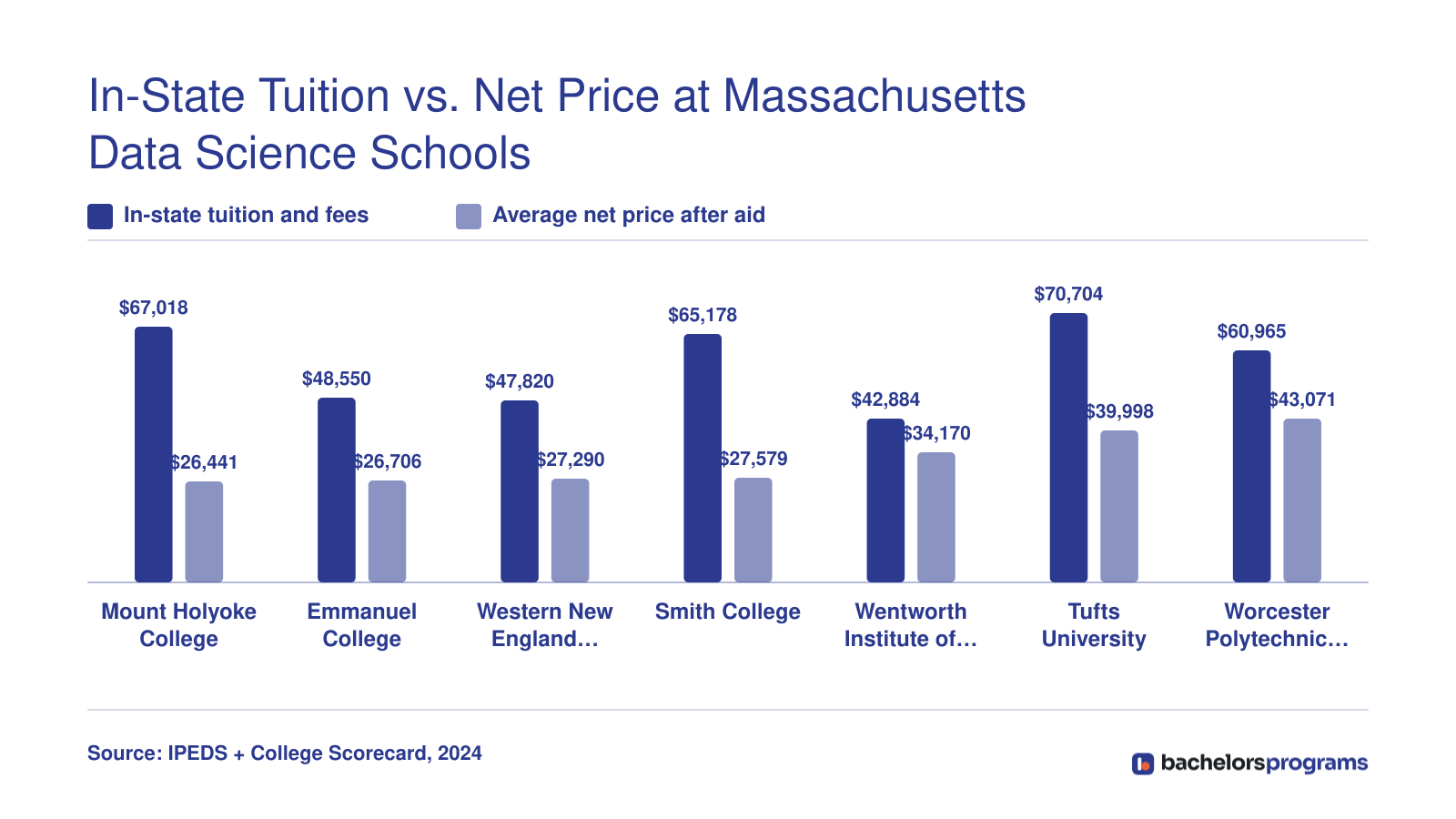
In-State Tuition vs. Net Price at Massachusetts Data Science Schools
The sticker price and what students actually pay can differ by tens of thousands of dollars. Every school ranked here is private, so in-state and out-of-state tuition are the same, and none offers a lower rate for Massachusetts residents. Mount Holyoke College lists $67,018 in tuition and fees but has the lowest average net price, $26,441. Wentworth Institute of Technology has the lowest sticker price, $42,884, but a net price of $34,170. Net price is an average across the whole institution after grants and scholarships, so your own cost will depend on your financial aid package.
Massachusetts Grants and Scholarships That Lower the Cost of a Data Science Bachelor's Degree
The MASSGrant deadline for the 2026-2027 academic year is June 30, 2026, and missing it means missing the state's largest need-based undergraduate award.1 Massachusetts runs several aid programs that apply to a data science bachelor's degree, and each has its own rules.
MASSGrant and MASSGrant Plus
MASSGrant serves Massachusetts residents who are citizens or otherwise Title IV eligible, have lived in the state for at least a year with intent to stay, and are enrolled full time at 12 or more credits in a matriculated program. Applicants need a completed FAFSA with a Student Aid Index at or below 14,790, must make satisfactory academic progress, and cannot already hold a bachelor's degree.1 Awards vary by year, need, and institution, and are capped by remaining need and cost of attendance; funding covers a maximum of eight semesters.1 MASSGrant Plus is a separate last-dollar program for full- and part-time undergraduates at Massachusetts public four-year colleges and universities that applies toward tuition and fees after other aid, with an Allowance and Support Award of up to $1,200 a year.4
MassTransfer and Tuition Waivers
MassTransfer rewards the community college route: earn an eligible associate degree with at least a 3.0 GPA, enroll within one calendar year at a state university or UMass campus, and you receive 100 percent of resident tuition for two years.2 The second year requires a 3.0 cumulative GPA.3 This is a tuition waiver, not a fixed dollar check, and it does not establish coverage of fees, housing, or books.
Who Qualifies and How to Apply
File the FAFSA (or the MASFA if you are FAFSA-ineligible) as early as possible in the year before enrollment. Massachusetts also lists a Need Based Tuition Waiver and a Valedictorian Program Tuition Waiver; confirm current rules with the Massachusetts Department of Higher Education, Office of Student Financial Assistance, which is the source of record for all of these programs.2
These programs exist to narrow the gap between public and private college costs. State aid and tuition waivers reach their full value at public institutions, where in-state tuition starts low; at the private colleges on this list, MASSGrant reduces need but does not close the sticker-price difference.
Data Science Careers in Massachusetts: Employers, Roles and Wages
Boston-Cambridge Employers
Greater Boston is one of the country's deepest markets for data work. Biotech and pharmaceutical firms such as Biogen, Moderna and Vertex hire data scientists, as do hospital systems like Massachusetts General Brigham. Finance and insurance employers include State Street, Fidelity Investments and Liberty Mutual. Tech and consumer companies such as HubSpot, Wayfair and DraftKings recruit locally, and universities including MIT and Harvard employ analysts and researchers. This is a sample of well-known employers, not a ranked or complete list, and openings change often.
Typical Entry Roles
Graduates of the programs at Tufts, Worcester Polytechnic Institute, Wentworth and the other schools here commonly start in these jobs:
- Data analyst: cleaning data, building dashboards and reporting trends to business or clinical teams.
- Data scientist: building statistical and predictive models, sometimes after a few years in an analyst role.
- Machine learning engineer: putting models into production, which usually calls for strong programming skills.
Boston-Area Wages
The Bureau of Labor Statistics (May 2025) reports a median annual wage of $132,040 for data scientists in the Boston-Cambridge-Newton metro area.1 The statewide median is $131,750.1 In the metro, the 25th percentile is $102,720 and the 75th is $166,120. The lowest tenth earn about $82,030 or less, while the top tenth earn $206,220 or more. For comparison, the national median is $120,230. Entry-level pay typically sits toward the lower part of this range, and experience, industry and degree level move it upward.
Licensure
Massachusetts has no state licensure requirement for data scientists. Employers instead look at your coursework, projects, internships and technical skills, so portfolio work and hands-on experience matter more than any credential on paper.
Questions to Ask Yourself
Do you want a dedicated data science major, or would computer science or statistics with a data focus fit better?
Would a required capstone or co-op in the Boston area matter to you?
Do you want a path into an accelerated bachelor's-to-master's option at the same school?
How to Choose the Right Massachusetts Data Science Program
Data science has moved from a niche specialty to a standard undergraduate major, and the label now covers very different curricula. Reading the course list matters more than reading the major's name.
Data Science vs. Related Majors
Computer science leans toward software engineering, systems and algorithms. Statistics centers on probability, inference and modeling. Analytics programs tend to be applied and business-facing. Data science sits between them: programming, statistical modeling, machine learning and domain application, usually in one sequence.
The schools here show the range. Smith College frames its major as Statistical and Data Sciences, so expect a strong statistics core. Western New England University pairs data science with statistics. Tufts University, Mount Holyoke College, Worcester Polytechnic Institute, Wentworth Institute of Technology and Emmanuel College each offer a data science major. Compare required math, programming and electives on each department page before deciding.
Weighing Public vs. Private
Every school on this list is private, so the useful comparison is net price after aid rather than sticker price. Compare each school's net price figure with its published tuition, since the gap can be large. Class size and selectivity also vary. Smith and Mount Holyoke are small liberal arts colleges, Tufts and WPI are larger research-oriented universities, and admit rates differ widely. A smaller, less selective school can mean more faculty attention, while a highly selective one may offer broader research access.
Look for Hands-On Experience
In a Boston-area market full of health care, biotech, finance and technology employers, applied experience separates programs. Ask each school about:
- Co-ops and internships: Wentworth is known for its co-op model, and Boston-based schools can draw on nearby employers.
- Project work: WPI is known for project-based learning built into its curriculum.
- Capstones: Look for a senior project with real data and an outside partner.
Think Ahead to a Master's
If graduate study is on your radar, ask whether a school offers a combined bachelor's-to-master's option or advises students toward one. Treat that as a tiebreaker, not the main reason to choose a program.
Data Science Bachelor's Degrees in Massachusetts: Common Questions
These quick answers cover the questions students ask most when comparing a bachelor's degree in data science in Massachusetts. For details on any single school, check its program page before you apply.
What is the best college for data science in Massachusetts?
Which Massachusetts schools offer a bachelor's degree in data science?
Can you get a bachelor's degree in data science online from a Massachusetts school?
Are Massachusetts data science degrees STEM-designated?
Compare Data Science programs on the data that matters
Explore more Science & Engineering majors or browse every field of study.
All Science & Engineering programs Browse every field of study