Best Online Environmental Science Degree Programs
Compare 20+ accredited online Environmental Science programs, with net price after aid, graduation rates, earnings and debt from IPEDS and the U.S. College Scorecard.

Flexibility versus field time is the real tradeoff in an online bachelor's degree in environmental science. The discipline runs on water sampling, soil work and lab chemistry, yet distance students may never visit campus. The usual credential is the Bachelor of Science (B.S.) in Environmental Science, typically 120 semester credits.
Each program on this list is a fully online undergraduate degree. Hybrid formats and graduate study are excluded. Cost and debt figures, lab requirements, B.S. versus B.A. tracks, accreditation and career outcomes matter as much as the ranking order.
Utah Valley University's average net price is about $6,376 a year, but low cost does not remove hands-on work. Oregon State University's major still requires 3 credits of experiential learning, so online rarely means hands-off.
Key Points
- Utah Valley University posts the lowest net price, about $6,376 yearly.
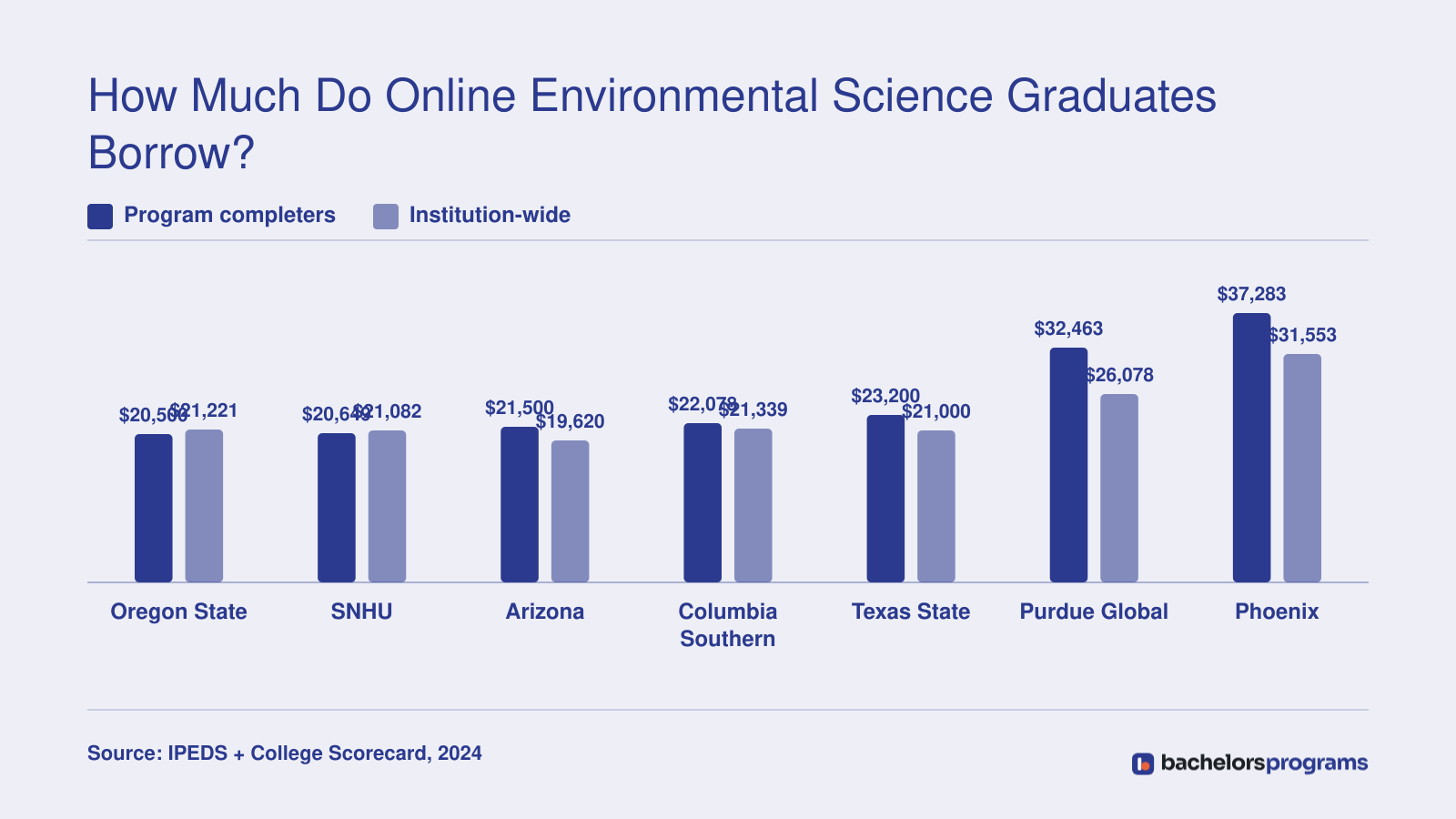
- Median program debt ranges from $20,500 (Oregon State) to $37,283 (Phoenix).
- Oregon State's online B.S. requires 180 quarter credits, equal to 120 semester.
Best Fully Online Environmental Science Bachelor's Programs Ranked
Every program below is delivered fully online; hybrid and campus-based options were excluded. The list is ordered by a mixed quality composite that weighs completion and cost alongside program breadth and student support, so it is not a pure price ranking or a pure salary ranking. Each entry names the concentration options and the institution-wide graduation rate, so you can compare programs on the same terms.
Oregon State University
#1Corvallis, OR · $15,000 – $20,000/yr (est.)
Best for: Students who want maximum choice of specialization
Oregon State runs one of the largest environmental sciences programs in the country and delivers the full degree through its Ecampus, so online students take the same core as campus students. The curriculum stacks biology, chemistry, calculus and statistics under an environmental sciences core in earth systems, ecology, contaminants, environmental law and management. The school graduates about 70% of its students, and the online operation is long established, with employer tuition partnerships and two related graduate certificates. It is the broadest concentration menu on this list.
- Eight option areas, including Applied Ecology, Aquatic Biology and Earth Systems
- 180 total credits, available fully online through Ecampus
- At least 3 credits of experiential learning (internship, research or field course)
- Each specialization carries 14 unique credits
- Environmental Justice and Climate Change Solutions certificate options
- Core covers earth systems, ecology, contaminants, law and management
- At least 45 of the final 75 credits must be completed through OSU
University of Arizona
#2Tucson, AZ · ~$17,000/yr (est.)
Best for: Sustainability and communication focused students
The University of Arizona builds its B.S. in Environmental Science from a 120-unit plan with four emphasis areas and three entry terms a year, offered at the Tucson campus and fully online. Coursework leans on soil, air and water science, environmental microbiology, and ecosystem health and justice, with classroom, lab and field components. U.S. News placed the online bachelor's program in the top 3% nationally in 2024. The school graduates about 68% of its students.
- 120 units, including 40 to 43 in the environmental science core
- Four emphasis areas, including Soil, Air and Water and The Biosphere
- Fall, spring and summer entry terms
- Coursework in ecosystem health and justice, soil ecology and environmental microbiology
- Classroom, lab and field experience built into the degree
- A 27 to 29 unit subplan shapes the specialty
Louisiana State University and Agricultural & Mechanical College
#3Baton Rouge, LA · $15,000 – $20,000/yr (est.)
Best for: Coastal and wetland science career seekers
LSU organizes its Coastal & Environmental Sciences degree around six concentrations, from Applied Coastal Environmental Science and Coastal Meteorology to Deltaic Sciences, Environmental Health and Environmental Law. Accelerated tracks let students pair the bachelor's with a public health master's in five years or a law degree in six, and undergraduates can join faculty research from the first year. The school graduates about 69% of its students. Small classes and one-on-one advising are part of the pitch.
- Six concentrations, from Applied Coastal Environmental Science to Environmental Law
- 3+2 track awards a bachelor's and an MPH in five years instead of six
- 3+3 track awards a bachelor's and a JD in six years instead of seven
- Each concentration publishes an 8-semester recommended path
- First-year students may assist faculty and graduate research
- Juniors and seniors may pursue independent research
- CCC&E scholarships and Academic Common Market access
Utah Valley University
#4Orem, UT · $5,000 – $10,000/yr (est.)
Utah Valley University's Environmental Science and Management degree is unusually prescriptive for an online bachelor's: 120 credits with a 55-credit discipline core and paired options in water and pollution management, land and environmental management, weather and climate, biological sciences, geological sciences or integrated sciences. Required coursework runs through soils, hydrology, environmental microbiology, environmental policy and law, and GIS. The department publishes both an on-campus and an online graduation plan, which makes it easier to see how transfer credits land. The school graduates about 45% of its students, so self-direction matters here.
- 120 credits: 55-credit discipline core plus 22 interdisciplinary credits
- Six option sets, including water and pollution management and weather and climate
- Required courses include soils, hydrology, environmental microbiology and GIS
- 2.0 overall GPA minimum for admission
- C- or better required in all ENVT, GEO, GEOG and BIOL courses
- 30 residency hours at UVU and 40 upper-division credits
- Exit interview with the department chair required
Texas State University
#5San Marcos, TX · ~$17,000/yr (est.)
Texas State delivers its Geography and Environmental Studies bachelor's 100% online in eight-week terms with six starts a year, and it accepts up to 90 transfer credits, which makes it a practical finish-line option for students arriving with prior coursework. The 120-credit plan pairs a 17-credit core with electives in remote sensing, advanced GIS, climatology and energy resource management. The school graduates about 55% of its students. Courses are billed on a pay-by-the-course model rather than by residency.
- 120 credits, with 17 in the major core and 42 in general education
- Eight-week terms with six start dates per year
- Transfer up to 90 credits
- Electives include remote sensing, advanced GIS, climatology and energy resource management
- Optional minor of 18 to 24 credits
- Courses are completed 100% online
Purdue University Global
#6West Lafayette, IN · $5,000 – $10,000/yr (est.)
Purdue University Global's online B.S. in Sustainability carries an Environmental Science concentration covering natural resource conservation, climate risk reduction, the biology of pollution and environmental risk assessment. The 180-quarter-credit, 34-course program is built for working adults: no application fee, a three-week trial period, credit for military training and prior work experience, and support for employer tuition reimbursement. The school graduates about 50% of its students. Purdue Global is a separately accredited online institution, distinct from the West Lafayette campus.
- Environmental Science concentration within a B.S. in Sustainability
- 180 quarter credits across 34 courses, about four years full time
- Concentration covers conservation, climate risk, pollution biology and risk assessment
- No application fee and a three-week trial period at no cost
- Credit for military training and prior work experience
- Employer tuition reimbursement and military benefits supported
- HLC accredited institution
North Carolina Central University
#7Durham, NC · $15,000 – $20,000/yr (est.)
North Carolina Central University's Environmental and Geographic Sciences degree is an interdisciplinary program with a dedicated Environmental Science concentration focused on pollution and human alteration of earth systems. The four-year curriculum runs through general and organic chemistry with labs, physical geography, geology, oceanography, GIS, environmental health, U.S. environmental policy and regulation, and a required internship. Classes are small, with a 16-to-1 student-faculty ratio, and the school graduates about 42% of its students. It is a historically Black university in Durham.
- Environmental Science concentration inside an interdisciplinary B.S.
- Concentration focuses on pollution and human alteration of earth systems
- General and organic chemistry with labs required
- Coursework in GIS, environmental health and U.S. environmental policy and regulation
- Environmental science internship required
- Course credits range from 1 to 4, including a 1 to 3 credit research introduction
- Four-year curriculum plan published
Columbia Southern University
#8Orange Beach, AL · $15,000/yr (est. net price)
Columbia Southern's online B.S. in Emergency Management pairs the emergency management core with an Environmental Science concentration covering hazardous waste management, energy concerns and the social dimensions of environmental issues. The degree is 120 credits with 11 start dates a year, up to 90 transfer credits accepted, textbooks included in tuition, and reduced pricing for active-duty military. It suits adults already working in safety, fire, crisis response or homeland security roles. The school graduates about a third of its students, so a clear completion plan matters.
- Environmental Science concentration within a B.S. in Emergency Management
- 120 credits with up to 90 transfer credits accepted
- 11 start dates per year, with courses available around the clock
- Concentration includes hazardous waste management and current and future energy concerns
- Textbooks included in tuition
- SACSCOC institutional accreditation
- Active-duty military tuition assistance accepted
- Weekly, biweekly and monthly payment plans
Columbia College
#9Columbia, MO · ~$23,000/yr (est.)
Columbia College offers environmental science as both a B.A. and a B.S., with the B.S. carrying more major coursework and the B.A. more humanities and language study. The curriculum covers biology, ecology, zoology, botany, environmental chemistry, taxonomy and natural resource management, with lab and field work plus research methods and statistics for the natural sciences. Classes run online or in seat at the Columbia, Missouri day campus and at nationwide locations. The school graduates about 42% of its students.
- B.S. and B.A. options; the B.S. carries more courses in the major
- Coursework in biology, ecology, zoology, botany and environmental chemistry
- Lab and field work plus research methods and statistics
- Classes 100% online or in seat at the Columbia, Missouri day campus
- Nationwide locations for in-seat classes
- Prepares students for graduate study or work in conservation and wildlife management
The New School
#10New York, NY · ~$59,000/yr (est.)
The New School awards a B.A. in Environmental Studies through Eugene Lang College, and it is the most seminar-driven option on this list. Students take a short introductory sequence in Environment and Society, build advanced work across two of four modules (humanities, natural science, social science and praxis approaches), then finish a senior capstone or thesis. The degree is 120 credits and carries a STEM-eligible classification. The school graduates about 69% of its students. Expect a liberal arts frame rather than a technical science sequence.
- 120 credits, beginning with 3 to 4 credits in Environment and Society
- Advanced work of 18 to 24 credits across two of four modules
- Modules span humanities, natural science, social science and praxis approaches
- Senior capstone or thesis of 7 to 8 credits
- 9 to 12 elective credits
- Program carries a STEM-eligible CIP code
- Taught through Eugene Lang College of Liberal Arts
Cost & outcomes by school
Federal data for the highest-earning Environmental Science programs, independent of the ranking above. Earnings are this field's bachelor's graduates four years after completing where the Scorecard reports them, else the school's undergraduate median.
| School | Net price / yr | Grad rate | Earnings | Debt | Grads/yr | Format |
|---|---|---|---|---|---|---|
| American Public University System WV | $9,597 | 57% | $57,618 | $24,306 | 304 | Online |
Sources: U.S. Department of Education. Net price, graduation rate, earnings and debt: College Scorecard (earnings and debt for this field's bachelor's graduates where reported, else school-wide); graduates: IPEDS. A dash means no figure is reported.
Cost, debt & payoff
Median earnings of this field's bachelor's graduates (4 yrs after completing, else the school's undergraduate median) vs. their median federal loan debt · U.S. College Scorecard
Across these programs the median graduate earns about $55,465 and finishes with roughly $22,902 in debt — a ratio that clears a common rule of thumb (keep debt below first-year salary). Net price and debt vary widely school to school, so check the per-school figures in the table above before you shortlist.
How We Ranked Online Environmental Science Programs
Who Made the List
Only bachelor's programs delivered fully online were considered. We excluded hybrid formats, including programs that require recurring campus residencies or on-site labs for most coursework. That keeps the comparison fair for readers who need to study from anywhere.
What Went Into the Score
Each school received a composite score built from four inputs:
- Affordability: average net price, what a student actually pays after grants and scholarships, not the sticker tuition.
- Institutional outcomes: graduation and retention rates, which show whether students tend to finish and stay enrolled.
- Earnings and debt results: College Scorecard outcomes, used only where the federal government publishes them for a school.
- Concentration breadth: how many specializations a program offers, such as sustainability, conservation, or environmental policy.
Where the Data Comes From
The figures come from two federal sources: IPEDS, the Education Department's annual survey of colleges, and the College Scorecard. Both are public, which means you can check our numbers yourself.
They have limits. Net price averages across all students, so your own cost depends on your aid package and transfer credits. Graduation and retention rates describe the whole institution, not the online environmental science program alone. Treat them as signals of institutional health rather than guarantees.
Why We Show Our Work
Many online degree rankings list schools without saying how they were chosen, which leaves you guessing at what drove the order. We would rather you see the inputs and judge for yourself.
Before you apply, confirm current tuition, fees, concentrations, accreditation, and online delivery details directly with each school. Programs change, and the admissions office has the final word.
What a Bachelor's Degree in Environmental Science Online Involves
Oregon State University Ecampus requires 180 quarter credits for its online B.S. in Environmental Sciences, the equivalent of 120 semester credits1 and the standard load for a bachelor's degree. The B.S. is the standard credential in this field, built on lab science, math and data analysis. Full-time students typically finish 120 semester credits in about four years. Transfer students with an associate degree or prior coursework can often finish sooner, but schools differ on how many credits they accept, so request an official evaluation before you enroll.
Core Coursework
Expect a science-heavy foundation before upper-level work. Core areas usually include:
- Biology and ecology: how organisms, populations and ecosystems interact.
- Chemistry: the basis for studying pollutants, soils and water quality.
- Earth systems: geology, climate, hydrology and atmospheric processes.
- Statistics: analyzing field and lab data.
- Environmental policy: regulation, economics and resource management.
At OSU, requirements fall into general education, basic science and math, an environmental sciences and humanities core, and a specialization. At least 60 quarter credits must be upper-division, and students complete at least 3 credits of experiential learning through an internship, research, study abroad or a field course.1
Concentrations
Most programs ask you to choose a focus. Common options include sustainability, conservation, GIS and environmental policy. OSU's specializations show the range: Applied Ecology; Aquatic Biology; Conservation, Resources and Sustainability; Earth Systems; Environmental Agriculture; Environmental Policy and Economics; and Environmental Water Resources.1 Match the concentration to your target job, since a GIS track and a policy track lead to different first roles.
How Online Delivery Works
Many online courses are asynchronous: you complete lectures and assignments on your own schedule within weekly deadlines. Some add synchronous sessions or live labs, so ask before enrolling. Term length varies. Many online programs use accelerated 7- or 8-week terms, while OSU runs 11-week quarters with four start terms a year, including January 4, 2027, and March 29, 2027. OSU says the degree can be completed "all or nearly all" online, so confirm whether any field or experiential requirement needs in-person time.
Online Environmental Science Degree Cost: Net Price, Tuition and Fees Compared
Utah Valley University has the lowest average net price among the schools ranked here, about $6,376 a year after grants and scholarships. Louisiana State University sits at the top of the range at about $19,151. Treat net price as an approximate annual average for aided students, not a quote. Your own figure depends on income, residency and aid. Advertised online rates add useful detail. The University of Arizona lists $525 per credit with no separate online, technology or lab fee identified, which works out to about $63,000 for 120 credits. The University of Phoenix charges $426 per credit for enrollments on or after November 2, 2026, plus a mandatory $180 resource fee per course. A typical 3-credit course costs $1,458, or roughly $58,320 across 40 courses. Columbia Southern University advertises $278 per credit with textbooks included, about $33,360 for 120 credits. Texas State's online program lists $407 per credit, roughly $48,840 before fees. Purdue Global's $371 rate applies to a 180-credit quarter-hour plan. Technology fees vary by school. Arizona State's online campus, for example, adds an advanced technology fee of $50 to $100 depending on credit load. Lab-kit prices are often left out of tuition estimates, so ask admissions before you enroll. Many online programs charge one flat rate regardless of residency, as the identical in-state and out-of-state figures for Phoenix, Columbia Southern, Voorhees and Wilmington show. For a personal estimate, use the net price calculator that every school taking federal aid must post, usually on its financial aid or tuition page.
| School | Average Net Price (After Aid) | In-State Tuition and Fees | Out-of-State Tuition and Fees | Pell Grant Recipients |
|---|---|---|---|---|
| Utah Valley University | $6,376 | $6,507 | $18,489 | 74% |
| Purdue University Global | $7,770 | $10,101 | $14,412 | 86% |
| Voorhees University | $13,335 | $12,630 | $12,630 | 94% |
| University of Phoenix | $13,520 | $9,552 | $9,552 | 86% |
| Columbia Southern University | $14,580 | $6,760 | $6,760 | 72% |
| North Carolina Central University | $15,359 | $6,699 | $19,735 | 77% |
| Wilmington University | $15,644 | $12,630 | $12,630 | 70% |
| University of Arizona | $16,674 | $13,926 | $42,278 | 62% |
| Texas State University | $16,805 | $11,450 | $22,930 | 60% |
| Louisiana State University | $19,151 | $11,954 | $28,631 | 51% |
How Much Do Online Environmental Science Graduates Borrow?
Median federal debt for environmental science program completers runs from $20,500 at Oregon State University to $37,283 at University of Phoenix. Each school shows two bars: the program's own completers and the institution-wide median for all borrowers, so you can see whether the major runs above or below the campus norm. On a standard 10-year repayment plan, the program medians work out to $217-$395 per month.
Related Articles
B.S. vs. B.A. in Environmental Science Online
The two degrees share a core of biology and chemistry, but the B.S. goes deeper into math and lab science, while the B.A. leaves room for policy and social science. Course details below come from the catalogs at the University of Florida, UMass Boston, and DePaul, so requirements at other schools will vary. Most fully online offerings are B.S. degrees, so readers who want a B.A. will have fewer online choices to compare.
| Feature | B.S. in Environmental Science | B.A. in Environmental Science |
|---|---|---|
| Math | Introduction to calculus required | College algebra level, with no calculus requirement |
| Biology | Two courses with labs, 8 credits | Same two courses with labs, 8 credits |
| Chemistry | Two courses with labs, 8 credits | One course with lab, 4 credits |
| Physics | Physics with a laboratory, 4 or 5 credits | One 3-credit course, no lab designation |
| Lab science | Biology, two chemistry, and physics labs | Biology and chemistry labs only |
| Electives and breadth | Geology, oceanography, global environmental change, and upper-level science electives (UMass Boston); university-wide electives (DePaul) | Environmental policy and management, plus social-science and history choices such as Cities and the Environment and American Environmental History (UMass Boston) |
| Career fit | Consulting, field science, and federal scientist roles | Policy, advocacy, education, and communications |
| Graduate school | Stronger preparation for STEM master's programs that expect calculus and lab-based chemistry and physics | Can be less aligned with quantitatively intensive graduate programs |
Questions to Ask Yourself
Do you want field and lab work, or policy and planning work?
Might a STEM master's or a federal scientist job be in your future?
Would a GIS or conservation concentration map to jobs where you live?
Can you complete lab kits or a local field project from home?
Transfer Credit and State Authorization Checklist
Before you apply, confirm these points with each school's admissions or transfer office. Policies differ sharply, even among top online programs.
- Maximum transfer creditsSNHU accepts up to 90 credits, or 75% of a bachelor's degree. Oregon State Ecampus publishes no overall cap, so its residency rule is the real limit. Ask every school for its ceiling in writing.
- Minimum residency creditsSNHU requires at least 30 credits earned at SNHU, including 12 credits (four courses) in the major. Oregon State requires 45 of your last 75 credits at OSU, online or on campus.
- Alternative credit sourcesSNHU accepts AP and CLEP, and transferred courses generally need a C- or better. Oregon State accepts AP, CLEP and IB, plus up to 45 military credits based on ACE recommendations. Ask directly about Sophia or StraighterLine credit.
- Associate degrees and articulationOregon State reviews transfer work for articulation after admission. ASU Online treats you as a transfer student once you have 12 or more transferable college credits. Ask whether your community college has a formal agreement with the school.
- State authorizationOregon State has participated in NC-SARA since 2014, which covers 49 states, D.C. and the territories. It also reports an exemption for California and coverage for supervised out-of-state placements. Confirm your state with any other school.
- Lab science creditsSNHU ships lab kits only within the contiguous U.S. Students outside the lower 48 may transfer accredited lab credits instead. Ask whether transferred labs must include an in-person component.
Environmental Scientist Pay at a Glance
A bachelor's degree in environmental science is the typical entry point for environmental scientist roles, and national pay data shows what that work earns.
Environmental Science programs by state
Online Environmental Science Degree FAQs
These answers cover the questions prospective students ask most about online bachelor's degrees in environmental science. Details such as labs, transfer credit and federal hiring rules vary by school and by job announcement, so confirm specifics before you enroll.
What is the best online environmental science degree program?
Can you get an environmental science degree completely online?
Are online environmental science degrees respected by employers?
Can I qualify for federal environmental scientist jobs with an online degree?
How fast can I finish if I already have an associate degree?
Compare Environmental Science programs on the data that matters
Explore more Science & Engineering majors or browse every field of study.
All Science & Engineering programs Browse every field of study