Best Online Mathematics Degree Programs
Compare 60+ accredited online Mathematics programs, with net price after aid, graduation rates, earnings and debt from IPEDS and the U.S. College Scorecard.

The tradeoff in an online bachelor's degree in mathematics is rarely flexibility versus rigor. It is price. Average net price at the schools here runs from about $1,300 to $29,627 a year, and the credential most programs award is the Bachelor of Science (B.S.) in Mathematics, typically 120 credits.
You can earn one fully online. Every entry on this list is 100% online, and hybrid formats were excluded. Proctored exams and scheduled class times still vary by school.
The payoff holds up in the labor market. Actuaries, statisticians and data analysts are hired on exam passes and demonstrated skill; no employer asks where the calculus was taught.
Key Points
- Texas A&M University-Central Texas posts the lowest average net price: $1,300 yearly.
- Indiana University Online accepts up to 90 transfer credits from four-year schools.
- Among ranked programs, Indiana University-East reports the highest first-year graduate earnings.
Best Fully Online Bachelor's Degree in Mathematics Programs: Our Top 10
Every program on this list can be completed fully online, with no hybrid or in-person component required. The order reflects a mixed composite of cost, student outcomes and completion rather than any single metric, and each entry explains what makes the school a strong fit for a mathematics major.
Texas A&M University-Central Texas
#1Killeen, TX · under $5,000/yr (est.)
Best for: Community college transfers finishing a math degree
Texas A&M University-Central Texas builds its mathematics bachelor's degree around a community college partnership: the first 60 credits come from a partner campus and the final 60 are taken through A&M-Central Texas, fully online with optional synchronous evening sessions. Students can carry as few as one or as many as six courses per semester, and the 120-credit plan is mapped to finish in 48 months. Estimated tuition for the upper half is $14,768 at 2026 pricing, and the school graduates about 82% of students.
- 120 total credit hours, mapped to finish in 48 months
- First 60 credits at a community college partner, final 60 here
- Estimated $14,768 for the A&M-Central Texas portion at 2026 pricing
- Optional synchronous evening sessions and summer courses
- Course loads from one to six courses per semester
- Linear algebra, probability, abstract algebra, machine learning electives
- Employer tuition reimbursement supported
- Graduates work as actuaries, data analysts and statisticians
University of Massachusetts-Lowell
#2Lowell, MA · ~$17,000/yr (est.)
Best for: Working adults mixing evening and online classes
UMass Lowell's mathematics department sits inside the Kennedy College of Sciences and runs a 120-credit B.S. with General Mathematics and STEM Teaching options. Mathematics courses appear in online, live online evening and on-campus formats, which lets students assemble a schedule around work. Undergraduates have interned at NASA, MITRE and Lincoln Laboratories, and the school graduates about 65% of students, with an average net price near $17,200 after aid.
- Minimum 120 credits with a sample four-year plan
- Two options: General Mathematics or STEM Teaching
- Part-time and full-time enrollment available
- Internships at NASA, MITRE, Lincoln Laboratories and John Hancock
- Two-part senior seminar
- STEM Teaching minor leads to teaching certification
Touro University
#3New York, NY · $30,000/yr (est. net price)
Best for: Women aiming at actuarial careers
Touro University runs its mathematics and actuarial studies program through the Lander College for Women in Manhattan, with daytime classes students can attend in person or online. The 120-credit STEM degree adds a Judaic Studies requirement and points students toward actuarial exams. The school graduates about 72% of students, and the average net price after aid is roughly $29,600.
- 120-credit STEM-designated program with an actuarial studies concentration
- Daytime classes, taken online or at the Manhattan campus
- Judaic Studies requirement applies
- $1,010 per credit for part-time or overload enrollment
- Full-time tuition $11,455 per semester for 12 to 18 credits
- Admission requires a high school diploma; housing available
University of Illinois Springfield
#4Springfield, IL · ~$10,000/yr (est.)
The University of Illinois Springfield offers a 120-credit mathematical sciences degree with 61 upper-level hours, available on campus or fully online. Online students pay about $11,580 a year before fees, and the program runs multiple start dates, including a January 2027 term with a December 28, 2026 application deadline. The degree is STEM designated, and the school graduates about 53% of students at an average net price near $9,800 after aid.
- 120 credits, including 61 upper-level semester hours
- Fully online or on-campus; STEM-designated degree
- Online tuition about $11,580 per year before fees
- $50 application fee
- Apply by Dec. 28, 2026 for a Jan. 11, 2027 start
- Multiple start dates each year
- Military and veterans education benefits accepted
- Coursework in algorithms, statistical reasoning and mathematical models
University of North Dakota
#5Grand Forks, ND · ~$19,000/yr (est.)
The University of North Dakota grants a 120-credit B.S. in Mathematics in an online format that is asynchronous but deadline-driven rather than self-paced. An actuarial science emphasis layers in exam-preparation courses in statistical theory and the mathematics of finance, and students can add a double major in secondary education. The school graduates about 60% of students, with an average net price around $18,600 after aid.
- 120-credit major with a four-year plan
- Asynchronous online classes with set deadlines, not self-paced
- Actuarial science emphasis with exam-preparation courses
- Courses include Theory of Numbers and Cryptological Mathematics
- Deadlines: Aug. 15 fall, Dec. 15 spring, May 1 summer
- Online programs accredited by the Higher Learning Commission
- Free tutoring at the Math Learning Center
- Double major option in Secondary Education
Eastern New Mexico University
#6Portales, NM · ~$4,900/yr (est.)
Eastern New Mexico University awards either a B.S. or a B.A. in Mathematics with five concentrations spanning theoretical math, applied math, statistics, industrial math and statistics, and teaching. Mathematics classes stay small, the department reserves scholarships for math majors, and job placement help is free. The school graduates about 45% of students at an average net price near $4,900 after aid.
- Five concentrations, including applied math, statistics and teaching
- Small mathematics class sizes
- Scholarships reserved for mathematics majors
- Free job placement assistance
- Actuarial path requires at least five certification exams
- Statistics or computer science minor or double major recommended
- Admission scholarships based on SAT or ACT scores
Maryville University
#7Saint Louis, MO · ~$22,000/yr (est.)
Maryville University delivers its 120-credit mathematics B.S. entirely online with no campus visits, built around a 34-credit math core and a built-in 18-credit data science minor. Students code in R, Python and SQL and can start in fall, spring or summer. The school graduates about 66% of students, with an average net price near $22,100 after aid.
- 120 credits, 100% online with no campus visits required
- 34-credit mathematics core, 18-credit data science minor
- Coding in R, Python and SQL
- Three start dates: fall, spring and summer
- Transfer eligible credits; optional internship
- Early access to master's degree programs
- Electives in optimization, financial mathematics and predictive modeling
Valley City State University
#8Valley City, ND · $12,000/yr (est. net price)
Valley City State University keeps its online mathematics degree inexpensive and practical, with free digital textbooks, free graphing calculator use, and classes that run either on a student's own schedule or live online. The four-year plan covers the full calculus sequence plus real analysis, abstract algebra and a capstone. The school graduates about 53% of students, and the average net price after aid is roughly $11,900.
- Four-year plan with a required math capstone
- Calculus I through III, real analysis, abstract algebra, differential equations
- Synchronous or asynchronous online classes
- Free digital math textbooks and free graphing calculator use
- Minors in business, computer science or physics
- Separate mathematics education degree offered
Ottawa University-Online
#9Overland Park, KS · ~$13,000/yr (est.)
Ottawa University's online B.A. in Mathematics is an accelerated program with concentrations in actuarial science and secondary education. Every major finishes a 4-credit integrative seminar that asks for original mathematics research, and online students take Complex Analysis as their advanced topic. The school graduates about 43% of students, and median debt among graduates who borrowed is about $21,500.
- Accelerated online format with two concentration options
- Tracks in actuarial science or secondary education
- 4-credit integrative seminar capstone with original research
- Coursework through calculus III, abstract algebra and numerical methods
- Online students take Complex Analysis as the advanced topic
- Computer programming and statistical modeling included
- Accredited by the Higher Learning Commission
Chadron State College
#10Chadron, NE · ~$13,000/yr (est.)
Chadron State College awards a B.S. with a subject major in mathematics, built around proof construction, modelling and applied statistics rather than a single narrow track. Students present a formal paper in a 1-credit seminar, can earn up to 12 internship credits, and can add a mathematics field endorsement for grades 6 through 12. The school graduates about 50% of students, and the average net price after aid is roughly $12,550.
- Coursework in proof construction, modern algebra and number theory
- 1-credit mathematics seminar requiring a formal paper
- Internship in mathematics for 1 to 12 credits
- Independent study and research options
- Mathematics field endorsement for grades 6 through 12
- Minors in applied statistics and data analytics
- Calculus I and II carry 5 credits each
None of the ranked Mathematics programs match the online lens yet. The full ranking is at the link above.
Cost, debt & payoff
Median earnings of this field's bachelor's graduates (4 yrs after completing, else the school's undergraduate median) vs. their median federal loan debt · U.S. College Scorecard
Across these programs the median graduate earns about $57,944 and finishes with roughly $23,000 in debt — a ratio that clears a common rule of thumb (keep debt below first-year salary). Net price and debt vary widely school to school, so check the per-school figures in the table above before you shortlist.
How We Ranked Fully Online Math Degree Programs
The online-only filter
Only programs offered fully online qualified. Hybrid formats and programs that require time on campus were excluded, so each school here lets you complete a bachelor's degree in mathematics without relocating or commuting.
What went into the composite
Each program's position reflects a composite built from federal figures:
- Average net price: what students typically pay after grants and scholarships, not the sticker price.
- Graduation and retention rates: school-wide figures for how many students finish and how many come back for a second year.
- Program earnings and debt: College Scorecard figures for math graduates, included where published.
Why federal data
Many rankings lean on reputation surveys or student star ratings, which can reward name recognition or reflect a handful of vocal reviewers. This composite relies on government-collected numbers that apply the same definitions to every school, so a small private college and a large public university are measured the same way.
Limits to keep in mind
- Net price is a school-wide average once aid is applied. Your own cost depends on your aid package and how many credits you transfer.
- Completion and retention figures cover the whole institution, not the math program or online students specifically.
- Some programs have no published Scorecard earnings or debt, so those schools are judged on the remaining inputs.
Treat the ranking as a starting point, then confirm current costs, formats and outcomes with each school's admissions office before you apply.
Cheapest Online Math Degree Programs: Cost and Debt Compared
Texas A&M University-Central Texas posts the lowest average net price among the schools ranked here, at $1,300 a year, and the school lists $14,768 in total program tuition for its 120-credit online B.S. in Mathematics. Net price is the average students actually paid after grants and scholarships, not a guaranteed bill, and the tuition columns show published campus tuition and fees, so online rates and distance-learning fees can differ. Residency rules also vary: Mayville State University charges $315 per credit at one rate for all students, and the University of North Dakota sets the same tuition regardless of state, while Oregon State University Ecampus lists $409 per credit for 2026-27 (including a mandatory $15-per-credit distance-education fee), adds a one-time $450 matriculation fee for new degree-seeking students, and notes that rates can vary by residency.
| School | Location | Average net price (after aid) | In-state tuition and fees | Out-of-state tuition and fees | Median graduate debt |
|---|---|---|---|---|---|
| Texas A&M University-Central Texas | Killeen, TX | $1,300 | $7,363 | $17,154 | $17,750 |
| Eastern New Mexico University | Portales, NM | $4,904 | $7,194 | $9,174 | $16,500 |
| Louisiana State University at Alexandria | Alexandria, LA | $7,065 | $7,050 | $14,650 | $19,000 |
What Does an Online Math Degree Really Cost Beyond Tuition?
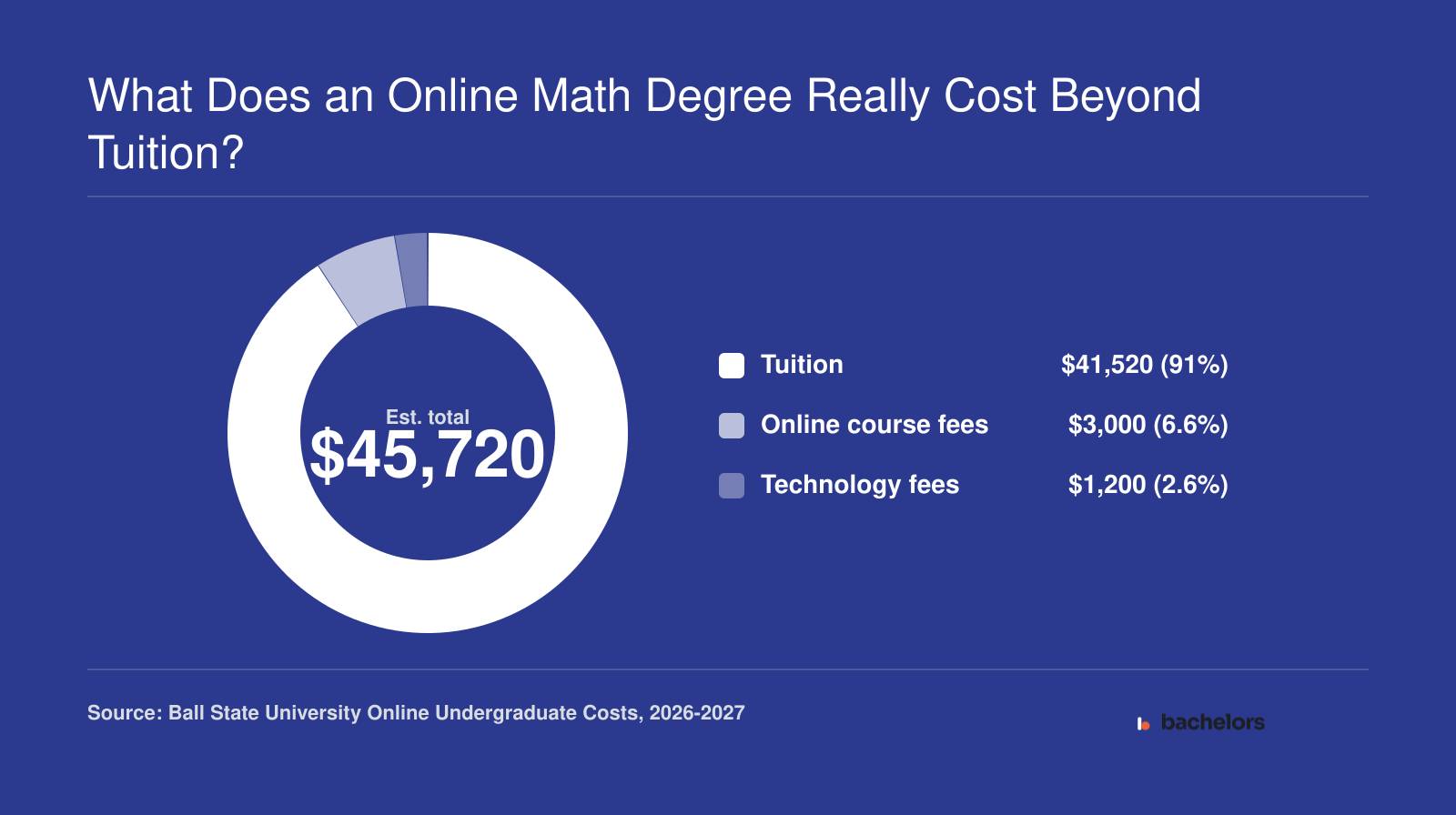
At Ball State University's 2026-2027 online rates, an Indiana resident completing 120 credits would pay about $41,520 in tuition plus $3,000 in per-credit online course fees. Technology fees add roughly $1,200 if the $150 full-time charge applies across eight terms, and nonresident tuition runs $578 per credit, or $69,360. That estimate still excludes textbooks, as well as two costs many cost pages overlook: online proctoring services and graphing calculator or computer algebra system (CAS) software. LSU Online notes that course-specific proctoring and book fees may apply, and APUS lists $0 for books but leaves required software to the student.
B.S. vs. B.A. and Pure vs. Applied Math: Which Track Fits You?
The track you pick inside a mathematics major shapes your transcript more than the delivery format does.
B.S. or B.A.: Two Different Workloads
A Bachelor of Science in Mathematics usually carries more required math and science credits and is the safer choice if you are aiming at graduate study in math, statistics, engineering, or the quantitative side of finance and technology. A Bachelor of Arts typically requires fewer technical credits and leaves room for a minor or a second major, which suits students pairing math with economics, computer science, or education. Neither is inherently stronger. They simply load the same core differently.
The Curriculum Spine
Most programs build the same foundation: Calculus I through III (precalculus first if your placement calls for it), then linear algebra, differential equations, and an introduction to mathematical reasoning or proof writing.1 That proof course is the prerequisite for the upper level, where real analysis and abstract algebra are taught. Real analysis can cover sequences, continuity, completeness, and metric spaces; abstract algebra moves through groups, cosets, homomorphisms, and isomorphisms.1 A capstone or senior seminar usually sits on top.
Concentrations and the Applied Track
An applied math degree online typically trades some pure-theory electives for modeling, numerical methods, statistics, and programming. Look for named tracks such as applied mathematics, actuarial science, statistics or data analytics, and financial mathematics. Bellevue University's math foundation, for instance, includes applied statistics and programming; Indiana University offers an applied mathematics concentration; Southern New Hampshire University lists financial and pure mathematics tracks.2
Teaching Tracks
If you want a classroom, confirm the program leads to licensure where you plan to teach. State requirements differ, and a program approved in one state may not satisfy another. Ask about state authorization and the specific licensure pathway in writing.
Transfer Credits, Prior Learning and Time to Completion
Indiana University Online's B.S. in Mathematics, which is 100% online and requires 120 credits, accepts up to 64 transfer credits from a regionally accredited two-year college or up to 90 from a four-year institution. Online math degrees do accept transfer credits, and caps in the 60 to 90 range are common. Texas A&M University-Central Texas lays out a similar path: 60 credits at a community college, then 60 at the university.
Residency and Grade Rules
A transfer cap is only one of the rules that applies. Residency rules set a minimum number of credits you must earn at the degree-granting school, and online colleges commonly set that figure at 24 to 30 credits. Some also expect your final credits to be earned there. Indiana University Online does not publish a minimum in the material we reviewed, so confirm it with an adviser. Transferred calculus often needs a minimum grade, frequently a C or better, to count toward the major. Ask for that policy in writing before you send transcripts.
Credit for Prior Learning
AP, CLEP and ACE-evaluated credit can replace introductory courses, and calculus and statistics exams are the usual candidates. Policies vary widely by school, including which scores are accepted. Prior-learning credit is commonly capped at 15 to 30 credits, and it often does not count toward residency. Whether it shares the overall transfer cap also differs by school, so ask.
How Long It Takes
The standard timeline is about four years and 120 credits. You can shorten it in three ways:
- Transfer credits: Arriving with an associate degree can cut the remaining work roughly in half.
- Accelerated terms: Indiana University Online offers 8-week and 16-week courses with mid-term entry, so you can finish more courses per year.
- Year-round enrollment: Summer terms, offered at Texas A&M-Central Texas among others, add credits that a traditional calendar skips.
The calculus sequence limits how far you can compress. Calculus I, II and III, then linear algebra and differential equations, are prerequisite-gated, so each course must be passed before the next begins. Starting that sequence early, or testing out of its first course, saves more time than loading up on electives.
Related Articles
What to Check Before Enrolling: Proctored Exams, Live Classes and Accreditation
"Fully online" doesn't always mean unsupervised exams or a schedule that is entirely your own. Before you enroll in an online bachelor's degree in mathematics, confirm these details with an admissions or program advisor.
- Institutional accreditationConfirm the school holds regional (institutional) accreditation. Check the accreditor's own directory or the U.S. Department of Education's accreditation database rather than relying only on the school's marketing pages.
- Proctored examsAsk how calculus and other math exams are proctored. The University of Arizona uses Honorlock online proctoring in its asynchronous courses. Purdue's primarily online math courses require exams in person, either on campus or at an approved testing location, with no remote option. You may also owe testing-center fees there. LSU notes that fees can vary by course because of proctoring costs. Ask what webcam setup you need and who pays.
- Live class requirementsSNHU describes its online math bachelor's as fully asynchronous, but some courses may still schedule lectures or exams. Ask whether any course requires set login times for lectures or recitations.
- Residencies and orientationsVerify that no on-campus visits are required. UMass Lowell lists university residency requirements for its online B.S., so ask whether that means credits earned at the school or time spent on campus.
- State authorizationConfirm the school is authorized to enroll online students in your state. If you plan to teach, ask whether the program leads to licensure where you live.
- Math placementFind out whether you need a placement exam or precalculus before Calculus I. Extra prerequisites can lengthen your path to the degree.
Top First-Year Earnings Among Ranked Online Math Programs
Among the fully online math programs ranked here, Indiana University-East reports the highest program-level earnings in the first year after graduation.
What Graduates of Ranked Online Math Programs Earn and Owe
A high median paycheck and a light loan balance do not always come from the same program. Comparing both, with the time window attached, shows which degrees pay off fastest.
Earnings by Program
Among the programs here with published figures, graduates of the University of Massachusetts-Lowell mathematics major (B.S.) earn a median of $72,826 four years after finishing, rising to $73,307 at five years. At the University of North Dakota, the median is $71,665 four years after finishing. Indiana University-East graduates report $71,223 at four years, and $58,764 one year after finishing.
Pennsylvania Western University's mathematics graduates earn a median of $56,401 five years out, a lower figure that sits alongside a more modest price of admission.
Debt and Monthly Payments
The two programs with published debt figures show a clear gap:
- UMass Lowell: Median debt is $23,735, which works out to about $252 a month on a 10-year repayment plan. That is roughly 4 percent of the four-year median salary each year.
- Indiana University-East: Median debt is $17,250, or about $183 a month. That is closer to 3 percent of the four-year median salary.
Both ratios are manageable, and Indiana University-East's lower payment leaves slightly more room despite similar four-year earnings.
Employment Signals
Where employment rates are published, they are strong. At UMass Lowell, about 95.7 percent of graduates were working one year after completion. At Indiana University-East, the figure is 87.5 percent.
These are program-level outcomes for recent graduating classes, so treat them as a guide rather than a guarantee. Run your own numbers against the tuition you would actually pay.
Mathematics programs by state
Compare Mathematics programs on the data that matters
Explore more Science & Engineering majors or browse every field of study.
All Science & Engineering programs Browse every field of study