Best Early Childhood Education Schools in Texas
Compare 31 accredited Early Childhood Education programs in Texas at 25 colleges, with net price after aid, graduation rates, earnings and debt from IPEDS and the U.S. College Scorecard.
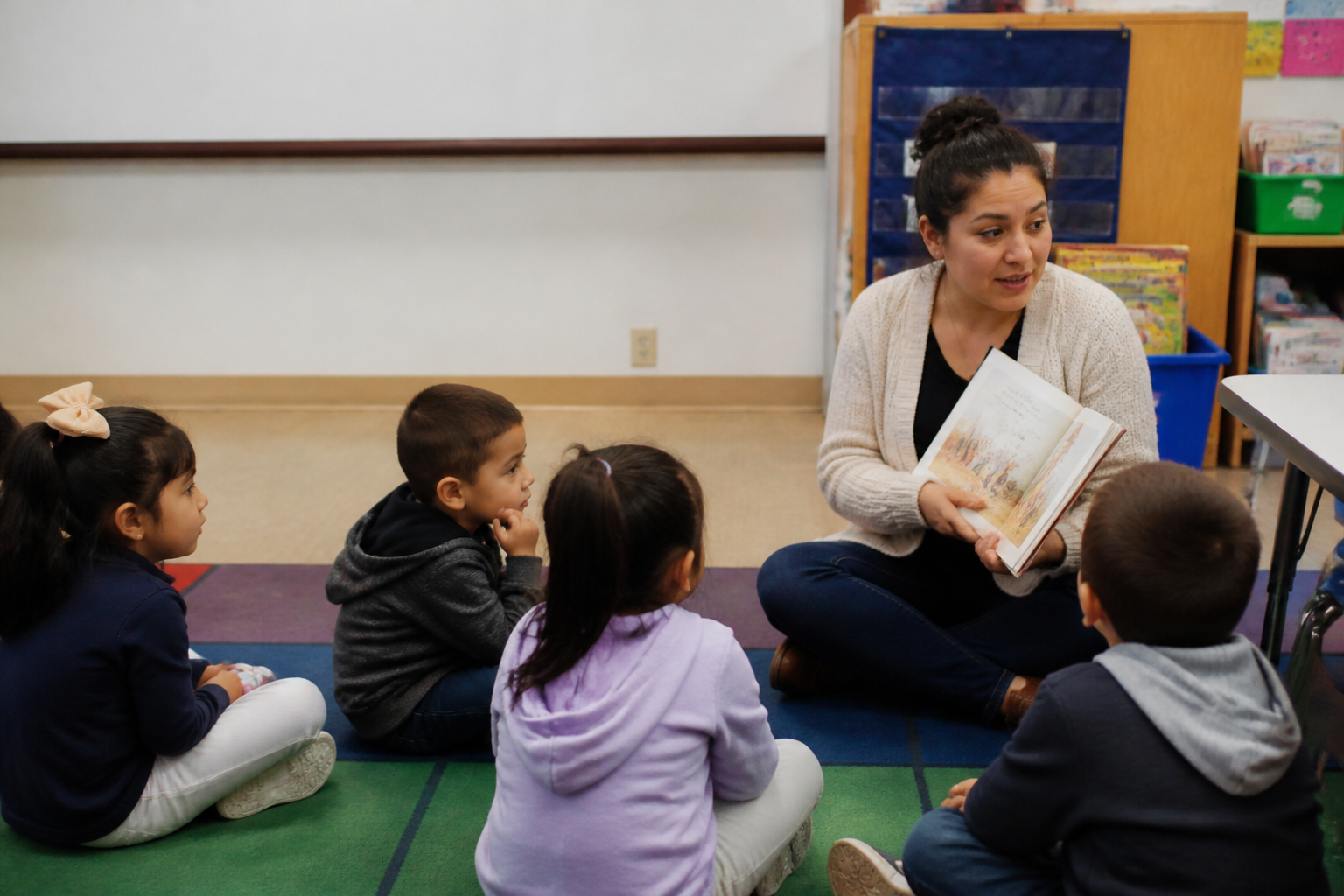
What does a bachelor's degree in early childhood education in Texas actually qualify you to do? Often less than the title suggests. Public school teaching requires a Texas certificate, earned through either the EC-6 or the PK-3 credential path, yet several degrees, including those at Odessa College and Midwestern State University, are built for child care leadership and do not lead to a teaching certificate.
Most schools award the Bachelor of Science (B.S.) in Early Childhood Education, though applied science, arts and child development degrees also appear. Prices run from about $99 per credit at Dallas College to more than $58,000 a year in tuition at Baylor University.
That spread makes the certification question worth settling before the price.
Key Points
- Texas certification requires a bachelor's, a TEA-approved EPP, and three TExES exams.
- Dallas College awards a bachelor's in early childhood at community college prices.
- In Texas, TEA approval, not CAEP accreditation, unlocks classroom certification.
The 10 Best Bachelor's Programs in Early Childhood Education in Texas
Texas offers early childhood bachelor's degrees in nearly every format: fully online community college degrees, Hyflex certification programs, and campus-based majors with lab schools attached. The ten programs below span that range, from a Dallas College degree priced by the credit hour to private university options with child life and developmental trauma concentrations.
Dallas College
#1Dallas, TX · $3,200/yr (est. net price)
Best for: Budget-minded students needing fully online classes
Dallas College was among the first Texas community colleges to award its own early childhood teaching bachelor's, and it remains the lowest-priced route on this list. The Bachelor of Applied Science in Early Childhood Education and Teaching runs online, charges by the credit hour with textbooks included, and pairs upper-level coursework with a year-long teacher residency. Dallas College is an approved Texas teacher-residency preparation provider, and paid senior apprenticeships help offset tuition for students who qualify.
- $99 per credit hour for Dallas County residents, textbooks included
- Fully online asynchronous classes with day, evening and weekend options
- 42-hour Texas Core Curriculum completed before upper-level courses
- Lab courses add about 32 hours a semester in an early childhood setting
- Year-long teacher residency in the senior year
- Paid apprenticeship of roughly $30,000 with tuition assistance
- 2.5 GPA to enter, 2.75 GPA required for degree conferral
- Prepares for EC-6, ESL, bilingual or special education certification
The University of Texas at Tyler
#2Tyler, TX · ~$13,000/yr (est.)
Best for: East Texas students pursuing EC-6 certification
The University of Texas at Tyler prepares teachers through its School of Education, and its early childhood route leads to a Texas certificate covering preschool through sixth grade. Students combine a Bachelor of Science in Interdisciplinary Studies with TExES preparation, and sample degree plans can add ESL and EC-12 special education certification. Advising runs through a dedicated education advisor in the School of Education, and the university is recognized by the state as a teacher-residency preparation provider.
- Prepares students for the TExES EC-6 teaching certificate
- Covers preschool through grade six
- Required courses offered every fall and spring semester
- Sample degree plan with ESL and EC-12 special education certification
- Advising appointments through a School of Education education advisor
- Publishes a certification complaint policy for students
The University of Texas Rio Grande Valley
#3Edinburg, TX · under $5,000/yr (est.)
Best for: Rio Grande Valley students needing income-based aid
The University of Texas Rio Grande Valley runs two distinct early childhood routes: one that leads to Texas teacher certification and one built for child care and preschool leadership. Both sit in the College of Education and P-16 Integration and focus on children from birth through age eight. The university's Tuition Advantage program covers tuition and mandatory fees for families earning $125,000 or less, which makes this one of the lowest-cost entries here.
- Non-teacher-certification track for child care and preschool roles
- Focus on children from birth to age eight
- Prepares for Head Start, community preschool and child development centers
- Career paths include center director, teacher assistant and family support specialist
- Tuition Advantage covers tuition and mandatory fees under the income cap
Texas Tech University
#4Lubbock, TX · $15,000 – $20,000/yr (est.)
Texas Tech University offers both a campus certification degree and a fully online completion degree in early childhood. The on-campus Bachelor of Science runs 123 credits with two semesters of supervised lab work at NAEYC-accredited lab schools and a full year of student teaching through TechTeach, which the Texas Education Agency lists as an approved teacher-residency route. The online Bachelor of Applied Arts and Sciences serves students who already hold an associate degree in child development.
- 123 credits over four years, leading to Texas EC-6 teaching certification
- Two semesters of supervised lab experience with children
- Lab placements at two NAEYC-accredited child development centers
- Full year of student teaching through TechTeach across Texas
- Minimum 2.75 GPA for competitive admission to teacher certification
- Add supplemental ESL and special education certifications
- Incoming students considered for merit and Dean's Scholar scholarships
- 120 credits, fully online and asynchronous
- Designed for holders of an AAS in child development
- No teacher certification awarded
- Practicum completed in community settings
- Tuition $415 to $500 per credit hour; out-of-state rate matches in-state
Baylor University
#5Waco, TX · ~$41,000/yr (est.)
Baylor University's early childhood work sits inside the Child and Family Studies major in Health and Human Sciences rather than in a teacher-preparation department. Four concentrations let students focus on child development, child life, marriage and family, or pre-occupational therapy, and every major completes a summer practicum. It is the strongest fit for students aiming at hospitals, clinics and family services rather than a classroom certificate.
- Four concentrations, including Child Development and Child Life
- Summer practicum required of all majors
- Coursework spans prenatal development through late adulthood
- Path to Child Life Specialist or Certified Family Life Educator credential
- Careers in hospitals, clinics, adoption agencies and social services
- Minor in child and family studies also available
The University of Texas at San Antonio
#6San Antonio, TX · $9,000 – $22,000/yr (est.)
The University of Texas at San Antonio awards a Bachelor of Arts in Education with an early childhood through grade six concentration and a built-in ESL supplemental certificate, a combination that fits the bilingual classrooms common across San Antonio. The 122-credit plan includes preclinical field experiences and a yearlong clinical teaching placement split across two semesters. Admission to the Teacher Certification Program is separate, and the department accepts up to 63 transfer credit hours.
- 122 credit hours, including 42 hours of core curriculum
- 42 hours of EC-6 ESL certification coursework plus 24 in professional education
- Preclinical field experiences followed by yearlong clinical teaching I and II
- Separate admission to the Teacher Certification Program required
- Accepts up to 63 transfer credit hours
- Department honors available with a 3.0 GPA
Texas Christian University
#7Fort Worth, TX · $35,000 – $40,000/yr (est.)
Texas Christian University runs two early childhood paths: a Bachelor of Science in Child Development in the College of Science and Engineering, and an early childhood education degree in the College of Education with ESL and special education options. Child Development majors take trauma-informed coursework, complete a capstone, and can apply to a five-year BS/MS track in developmental trauma. Requirements are compact, with 45 hours in the major inside a 120-hour degree.
- 45 hours in the major within a 120-hour degree
- 30 required hours plus 15 elective hours
- Capstone required; trauma-informed interventions coursework included
- Internship and study abroad options available
- BS/MS in Developmental Trauma possible in five years
- Apply after 60 hours with a 3.0 GPA for the accelerated track
- Early childhood education degree awarded by the College of Education
- Coursework through the Teaching and Learning Sciences department
- Separate ESL and special education options available
Texas Woman's University
#8Denton, TX · ~$12,000/yr (est.)
Texas Woman's University offers a Bachelor of Science in Early Childhood Education that leads to full Texas certification to teach prekindergarten through third grade, plus a separate Bachelor of Science in Child Development whose child life track is endorsed by the Association of Child Life Professionals. The education degree is taught Hyflex, with students attending face to face in Denton, over Zoom, or online, in 7-week and 15-week terms. The university awards more than $21.6 million in scholarships each year.
- 120 credit hours leading to pre-K through grade three certification
- Concentrations in special education, bilingual education or ESL
- 40 hours of embedded field experience
- Hyflex delivery: face to face, Zoom or online
- 7-week and 15-week course terms
- Educator Preparation Program admission needs a 2.75 GPA and an interview
- Spanish proficiency required for bilingual certification
- Four concentration options, including a child life track
- Child life track is ACLP endorsed, one of eight nationwide
- Fully online completion available for transfer students
- Pre-occupational and pre-physical therapy tracks offered
- Mental health emphasis prepares students for counseling graduate study
Odessa College
#9Odessa, TX · $2,700 – $4,900/yr (est.)
Odessa College awards a Bachelor of Applied Science in Early Childhood Education and Teaching with a child development concentration, built for people already working in child care. Students stack a Child Development Associate credential, certificates or an associate degree into upper-level coursework in program administration, family engagement and curriculum planning. The degree does not lead to Texas teacher certification, so graduates who want a classroom certificate pursue an educator preparation program separately. Coursework runs online and hybrid, and the college participates in Texas work-based learning initiatives for early educators.
- Stackable pathway from a CDA, certificates or an AAS in child development
- Upper-level work in leadership, program management and child development theory
- Internships in full-time instructional roles with partnering school districts
- Does not lead to Texas teacher certification
- Online and hybrid coursework
- Career outcomes include center director, Head Start coordinator and curriculum specialist
Midwestern State University
#10Wichita Falls, TX · $12,000/yr (est. net price)
Midwestern State University's Early Childhood Studies and Early Care program is a non-certification degree inside the Gordon T. and Ellen West College of Education and Professional Studies. Students who want a teaching certificate take one of the department's other bachelor's programs, which lead to elementary or middle school certification. It suits readers headed for child care administration, early intervention or related roles that do not require a state teaching certificate.
- Non-certification early childhood program
- Housed in the Department of Undergraduate Education
- Other department bachelor's programs lead to elementary or middle school certification
Cost & outcomes by school
Federal data for the highest-earning Early Childhood Education programs, independent of the ranking above. Earnings are this field's bachelor's graduates four years after completing where the Scorecard reports them, else the school's undergraduate median.
| School | Net price / yr | Grad rate | Earnings | Debt | Grads/yr | Format |
|---|---|---|---|---|---|---|
| Texas Tech University TX | $19,070 | 69% | $62,454 | $21,500 | — | Campus |
| Texas Christian University TX | $36,660 | 86% | $60,125 | $22,287 | 48 | Campus |
| The University of Texas at San Antonio TX | $10,836 | 53% | $57,131 | $20,500 | — | Campus |
| The University of Texas at Tyler TX | $13,323 | 54% | $57,053 | $17,137 | 81 | Campus |
| Texas Woman's University TX | $11,963 | 49% | $56,544 | $19,218 | 3 | Hybrid |
| Baylor University TX | $41,104 | 80% | $56,476 | $22,250 | 55 | Campus |
| The University of Texas Permian Basin TX | $12,723 | 40% | $56,073 | $17,750 | — | Campus |
| Midwestern State University TX | $11,656 | 43% | $55,747 | $21,030 | 46 | Campus |
| Texas A&M University-San Antonio TX | $11,196 | 40% | $54,338 | $18,401 | — | Campus |
| Tarleton State University TX | $20,783 | 48% | $53,040 | $19,606 | 86 | Online |
| East Texas Baptist University TX | $23,911 | 47% | $52,788 | $26,000 | 13 | Campus |
| Schreiner University TX | $21,507 | 43% | $52,228 | $23,250 | 2 | Campus |
Sources: U.S. Department of Education. Net price, graduation rate, earnings and debt: College Scorecard (earnings and debt for this field's bachelor's graduates where reported, else school-wide); graduates: IPEDS. A dash means no figure is reported.
Cost, debt & payoff
Median earnings of this field's bachelor's graduates (4 yrs after completing, else the school's undergraduate median) vs. their median federal loan debt · U.S. College Scorecard
Across these programs the median graduate earns about $52,508 and finishes with roughly $20,500 in debt — a ratio that clears a common rule of thumb (keep debt below first-year salary). Net price and debt vary widely school to school, so check the per-school figures in the table above before you shortlist.
How We Ranked Texas Bachelor's Programs in Early Childhood Education
Cost, student outcomes and program format are the figures that place one school ahead of another.
What the Figures Measure
Cost comes from published in-state tuition and net price, which is what students pay after grants and scholarships are applied. Outcomes include graduation rate and, where available, the earnings of graduates. Format covers whether the bachelor's degree can be finished on campus, online or in a hybrid arrangement.
What the Figures Cannot Tell You
Both figures are institution-wide averages. They describe the whole university, not only students in early childhood education, so the experience in a given program may run higher or lower. Earnings are used at the program level only where the federal data publishes them for that specific bachelor's program. Where they are not published, earnings are left out rather than replaced with a school-wide estimate.
Scope and Independence
The review covers Texas bachelor's programs only, on campus and online, including online programs from schools based in Texas. Graduate degrees and certificate-only options are outside the scope. There is no paid placement: no school pays to be included, and none can buy a higher position.
Treat the numbers as a starting point, then check each school's program page for current tuition, certification pathways and format details before you apply.
Most Affordable Early Childhood Education Bachelor's Programs in Texas
Sticker tuition shows what a school charges, but average net price shows what students actually pay after grants and scholarships, so it is the better number for comparing costs. The figures below come from U.S. Department of Education IPEDS and College Scorecard data (2024). The biggest takeaway is that the lowest sticker price does not always mean the lowest real cost: UT Rio Grande Valley charges more than three times Odessa College's in-state tuition and fees, yet its average net price is about $1,500 lower, and Dallas College posts the lowest net price at $3,214.
| School | City | Program | Format | Sector | In-State Tuition and Fees (per year) | Average Net Price (per year) |
|---|---|---|---|---|---|---|
| Dallas College | Dallas | Bachelor of Applied Science in Early Childhood Education and Teaching | Online | Public | $2,730 | $3,214 |
| The University of Texas Rio Grande Valley | Edinburg | Bachelor of Science in Early Care and Early Childhood Studies | Campus | Public | $9,987 | $4,831 |
| Odessa College | Odessa | Bachelor's in Early Childhood Education & Teaching - Child Development | Hybrid | Public | $2,688 | $6,368 |
| University of North Texas at Dallas | Dallas | Child Development and Family Studies, BS | Campus | Public | $9,595 | $6,420 |
| Wiley University | Marshall | Bachelor of Science in Early Childhood Education | Campus | Private nonprofit | $12,500 | $7,092 |
Online and Hybrid Bachelor's Options at Texas Schools
For most working adults, format is the first filter to apply to an early childhood education bachelor's, because it decides whether you can keep your job while you earn the degree.
Fully Online, Hybrid and Campus
Dallas College delivers its Bachelor of Applied Science in Early Childhood Education and Teaching online, with classes scheduled days, evenings and weekends and a hybrid structure for the educator preparation sequence.1 Odessa College runs its early childhood and child development bachelor's with online and hybrid coursework as well. Texas Woman's University uses a Hyflex model: courses are designed for the Denton campus but can be attended by Zoom or online. Several strong options remain campus-based, including Texas Tech University, The University of Texas at Tyler, The University of Texas Rio Grande Valley, The University of Texas at San Antonio, Baylor University, Texas Christian University and Midwestern State University, so check the format before you fall in love with a program.
Term Length and Multiple Locations
Texas Woman's splits its catalog into 7-week and 15-week course options, letting you take a heavy load in short bursts or spread work across a full semester. East Texas A&M University teaches its hybrid Bachelor of Science in Early Childhood Education at Commerce plus extended sites in Dallas and Corsicana, with courses in fall, spring and summer terms.
Clinical Work Still Happens in a Classroom
Online coursework does not remove the in-person requirement. Texas Tech places candidates in real classrooms across Texas for a full year of student teaching through TechTeach.2 Texas Woman's embeds 40 hours of field experience. Dallas College expects roughly two hours a week, about 32 hours a semester, of work-based learning in an elementary or early childhood setting, then a year-long residency in which candidates serve as full-time teacher of record on a state-issued intern certificate at full teacher pay.3
Online and hybrid formats fit paraprofessionals, assistant teachers and child care staff already working in a classroom, plus career changers who need evening and weekend scheduling.
Admission Requirements: GPA, Test Policy and Transfer Credit
Admission to an early childhood bachelor's program in Texas is usually the uncomplicated part; the gate that decides who actually reaches a classroom sits further in, at the educator preparation program.
Published GPA Minimums and Test Policy
The figures on program pages vary by campus and by which stage they describe. At Texas Woman's University, admission to the early childhood education preparation program requires at least 12 semester hours and a 2.75 GPA both at TWU and overall; candidates then maintain both averages while finishing 12 to 15 semester hours of subject content. Texas Tech describes certification admission as competitive, keyed to a 2.75 overall GPA. Dallas College admits to its Bachelor of Applied Science in Early Childhood Education on rolling admission with a 2.5 GPA minimum. East Texas A&M takes transfer applicants with 12 transferable, non-developmental hours and a 2.0 GPA, treats SAT and ACT scores as optional, and expects 60 upper-division hours. Midwestern State wants transcripts from every college attended, whatever credit was earned, and its usual 69-credit community college cap does not apply to Early Childhood Studies and Early Care; its 1070 SAT and 21 ACT minimums cover international applicants who submit a score, not domestic freshmen.1
Where an education page states no program-level GPA or testing rule, general university admission governs. Get that confirmed in writing.
The Core and the EC-3 Field of Study
Texas public institutions share a 42-semester-hour core that transfers as a block, and the EC-3 core subject area field of study adds 18 to 22 lower-division hours that are fully transferable to Texas public institutions for 2025-2026.2 Transferable is not the same as applicable, though: a course can satisfy admission and still miss a requirement in the major.
One Tip for Transfer Students
Request a written degree audit from the four-year school before your last community college semester, and ask which early childhood courses will count toward the major rather than toward elective credit.
Related Articles
Texas Teacher Certification With an Early Childhood Bachelor's
Texas early childhood teacher certification rests on three TExES exams, a bachelor's degree, and a TEA-approved educator preparation program (EPP). The Texas Education Agency (TEA) and the State Board for Educator Certification (SBEC) set the rules, and the details below follow their current published requirements.
Choosing a Grade Band
Texas offers two main credentials for this field:
- Core Subjects with Science of Teaching Reading: EC-6: Covers early childhood through sixth grade. It suits graduates who want flexibility across kindergarten through upper elementary classrooms. Programs such as the one at Sul Ross State University and the Schreiner University certification track are built around this band.
- Early Childhood: PK-3: Covers prekindergarten through third grade. It fits graduates committed to pre-K, kindergarten, and early elementary. Texas A&M University-Corpus Christi lists an EC-3 degree. This credential cannot be added later by exam, so it requires an approved EPP.
Required TExES Exams
EC-6 candidates need the 391 Core Subjects EC-6 exam, the 293 Science of Teaching Reading exam, and the 160 Pedagogy and Professional Responsibilities (PPR) EC-12 exam. EC-3 candidates take the 292 Early Childhood: PK-3 exam in place of the 391, plus the 293 and the 160. SBEC rules allow an approved performance assessment as an alternative to the PPR.
Timing matters for the EC-6 content exam. The 391 is last offered August 31, 2027, and can be used for certification until September 1, 2028. A replacement Core EC-6 exam with four subtests (English language arts and reading, math, science, and social studies) begins phasing in no earlier than September 1, 2027. Ask your program which exam it will register you for. Registration fees are set by TEA and its testing vendor and can change, so confirm current amounts on the TEA Educator Testing page before you pay.
Clinical Teaching and Recommendation
Every route requires clinical experience, usually supervised student teaching or a paid internship under an intern certificate. Hours and length vary by EPP, so compare programs before you commit. Candidates also complete fingerprinting and a background check. Once you finish coursework, clinical work, and exam requirements, your EPP recommends you to TEA, and you submit the state certification application and fee.
Where the Certificate Leads
The certificate qualifies you for pre-K, kindergarten, and early elementary classrooms in Texas public schools. Graduates also move into Head Start teaching roles and childcare director positions, though those jobs do not always hinge on a teaching certificate. Child development degrees at schools like Baylor University or Tarleton State University lead into similar settings. Check whether a specific program includes a certification track.
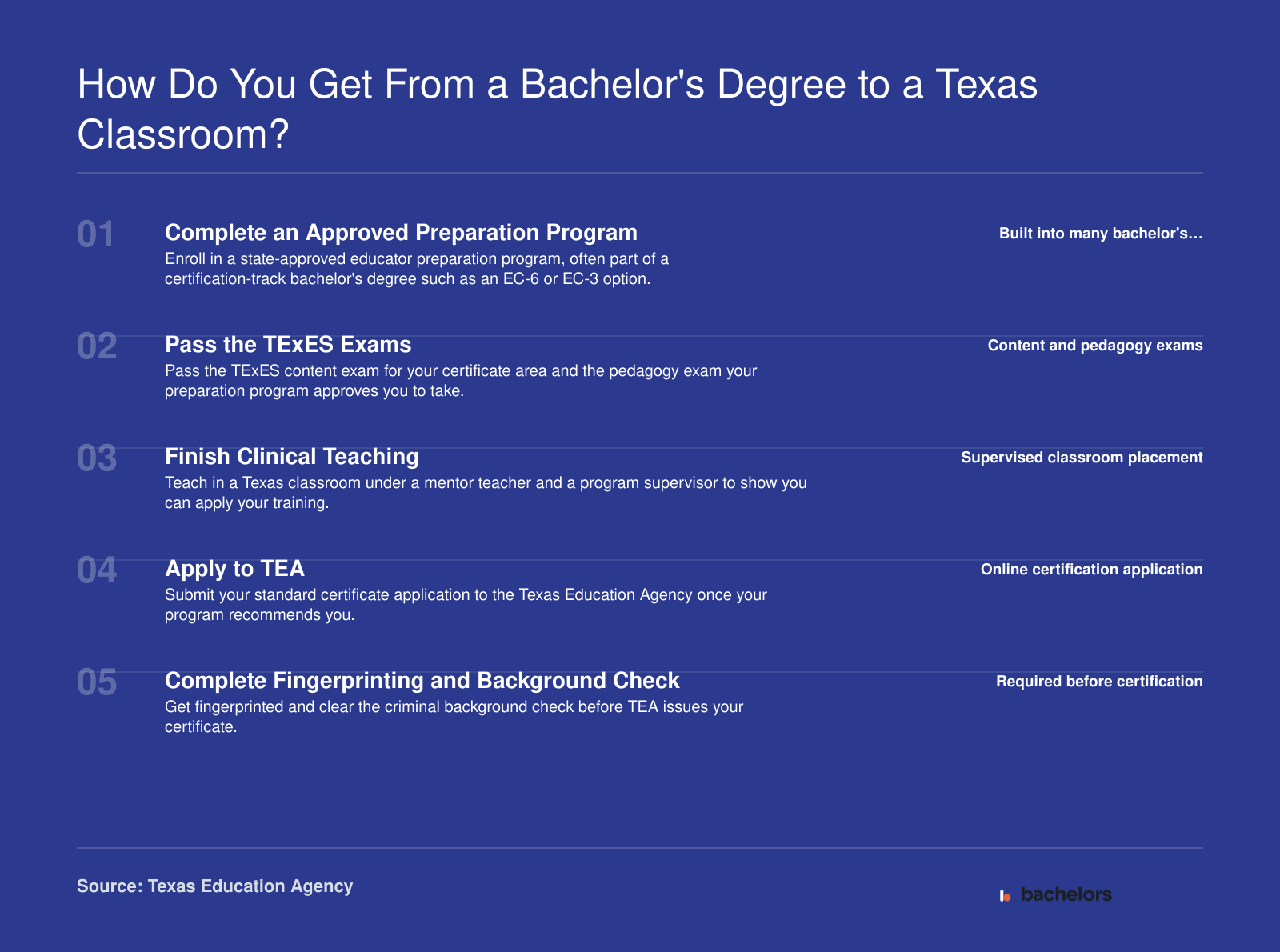
How Do You Get From a Bachelor's Degree to a Texas Classroom?
Earning a bachelor's degree in early childhood education is the starting point, not the finish line, for teaching in a Texas public school. Standard certification follows an ordered sequence set by the Texas Education Agency, and each step depends on the one before it.
What Early Childhood Teachers Earn in Texas Metro Areas
Pay for early childhood teachers in Texas turns on two things: the grade band you teach and the district that hires you. A preschool teacher in a private child care center and a kindergarten teacher in a public school district can hold similar degrees and earn very different salaries, so look up the number for the specific role and metro area you are targeting rather than a statewide average.
Start With the Federal Wage Tool
Go to BLS.gov and open the Occupational Employment and Wage Statistics (OEWS) tool. It breaks out median annual wages by occupation and by metro area, including Dallas, Houston, Austin and San Antonio. For scale, the May 2025 national medians were $38,140 for preschool teachers (except special education)1, $62,680 for kindergarten teachers and $63,970 for elementary school teachers.2 Texas metro figures sit in the same tables, and they move by region, so pull the number for the city where you plan to work.
Read District Salary Schedules Directly
Texas school districts publish their own salary schedules on their HR pages. These are usually the most current and specific source for public school pay, and they show exactly how a campus role pays at each step of the scale. Compare two or three districts in the area you want.
Use Associations and State Data
- Professional associations: The Texas Association for the Education of Young Children (TAEYC), Texas Classroom Teachers Association (TCTA) and Texas State Teachers Association (TSTA) publish salary surveys and pay guidance.
- State outlook: The Texas Workforce Commission (TWC) tracks employment and job growth for early childhood roles across the state.
- National demand: BLS projects 4% growth for preschool teachers from 2025 to 2035, with about 66,700 openings a year1, and little or no change for kindergarten and elementary teachers combined, with about 99,400 openings a year.2
Which Texas Early Childhood Programs Are CAEP-Accredited?
National accreditation looks impressive on a program page, but in Texas it is not the credential that puts you in front of a classroom. CAEP, the Council for the Accreditation of Educator Preparation, reviews educator preparation providers as a whole against national standards for clinical practice, candidate quality and program outcomes.1 It is voluntary, it applies to the provider rather than to a single early childhood major, and a school can prepare certified Texas teachers without it.
Verified CAEP status among these schools
CAEP's published decisions list Midwestern State University with full accreditation at both the initial licensure and advanced levels, and The University of Texas Rio Grande Valley with accreditation at both levels.1 Texas Tech University also appears with full accreditation at both levels, though the same source separately lists a Texas Tech education unit under stipulation and probation, and the record does not make clear which decision is current. For the other schools here, including Dallas College, UT Tyler, Baylor, UTSA, TCU, Texas Woman's University and Odessa College, we found no verified CAEP decision, which is not a mark against program quality.
What actually matters for certification
Approval by the Texas Education Agency and the State Board for Educator Certification is the requirement. Approved programs are reviewed on a five-year cycle under Chapter 229 standards and are rated through the state's educator preparation accountability system, whose current dashboard reflects data through February 2026.2 Confirm a specific program's approval and rating before you enroll.
Compare Early Childhood Education programs on the data that matters
Explore more Education & Teaching majors or browse every field of study.
All Education & Teaching programs Browse every field of study