Best Criminal Justice Schools in New York
Compare 45 accredited Criminal Justice programs in New York at 42 colleges, with net price after aid, graduation rates, earnings and debt from IPEDS and the U.S. College Scorecard.
A bachelor's degree in criminal justice in New York can cost anywhere from about $3,200 a year in net price at CUNY John Jay College of Criminal Justice to roughly $41,500 at Marist University. That gap in price, more than differences in curriculum, often decides which program a student can actually afford.
The degree is usually a Bachelor of Science (B.S.) in Criminal Justice. CUNY and SUNY campuses award it, as do private colleges, and several New York-based schools offer it online. Comparing these programs means weighing price, delivery format and outcomes, not just the degree name.
A degree helps with hiring, but police academy training and civil service testing still apply.
Key Points
- John Jay and St. John's both award a B.S. in Criminal Justice.
- Net price after grants, not sticker price, reveals what students actually pay.
- Municipal officers must complete the Basic Course within a year of hiring.
Best Bachelor's in Criminal Justice Schools in New York: Our Ranked List
New York's criminal justice bachelor's programs range from a dedicated CUNY justice college to small private programs built around required internships, plus fully online options at larger public universities. The ten listed here are the schools we would shortlist first for a bachelor's degree in criminal justice, with details on what makes each program distinct.
CUNY John Jay College of Criminal Justice
#1New York, NY · ~$3,200/yr (est.)
Best for: Aspiring officers drawn to a justice-focused curriculum
John Jay is CUNY's dedicated criminal justice college, carrying 31 undergraduate majors and a justice department that treats crime as a social problem rather than only a legal procedure. Students build analytical skills, ethical reasoning and policy judgment, and can continue into a combined bachelor's and master's track. The CUNY Justice Academy adds a structured dual-admission route for students who begin at a partner community college and transfer in after 60 credits.
- One of 31 undergraduate majors at the college
- Treats crime as a social problem, not only a legal one
- Builds analytical skills, ethical reasoning and problem solving
- Students assess the structure of the existing justice system
- Department of Criminal Justice also offers a BA/MA option
Farmingdale State College
#2Farmingdale, NY · $11,000/yr (est. net price)
Best for: Hands-on learners wanting police and corrections tracks
Farmingdale runs two distinct Bachelor of Science tracks in criminal justice: Police, Courts and Corrections at 121 to 122 credits, and Law Enforcement Technology with 33 free electives and a senior capstone. Coursework reaches into intelligence operations and analysis, homeland security and counterterrorism, privacy law, and civil rights and liberties. Students can take internships, do one-on-one faculty research, and join the Criminal Justice Club or the Pre-Law Club.
- 121 to 122 credits to graduate
- Coursework in patrol operations and homeland security
- Covers courts, probation, parole and civil rights law
- Leadership, ethics and intelligence analysis courses
- Internships and one-on-one faculty research available
- Criminal Justice Club and Pre-Law Club
- 122 total credit hours with 33 free electives
- Senior project capstone course
- Computer forensics, crime mapping and prevention technology
- Prepares for police, transit police and corrections roles
- Alpha Phi Sigma and Sword & Shield honor societies
St. Joseph's University-New York
#3Brooklyn, NY · ~$19,000/yr (est.)
Best for: Private-college seekers wanting a capstone and internship
St. Joseph's awards a Bachelor of Science in Criminal Justice on its Brooklyn and Long Island campuses, pairing core courses in corrections, courts, policing and criminal procedure with a required internship and capstone seminar. Every major also completes an 18-credit minor, and cybersecurity is the recommended pairing for students eyeing the accelerated five-year BS/MS in Cyber Security. The curriculum draws on political science and criminology alongside the justice sequence.
- Bachelor of Science offered in Brooklyn and on Long Island
- Includes a required internship and capstone seminar
- All majors complete an 18-credit minor
- Core covers corrections, courts, policing and criminal procedure
- Accelerated five-year BS/MS in Cyber Security option
- Cybersecurity recommended as the minor pairing
Canisius University
#4Buffalo, NY · ~$18,000/yr (est.)
Canisius offers a Bachelor of Science in Criminal Justice with four interdisciplinary concentrations: Law Enforcement; Law and Justice; Corrections; and Environmental Justice and Regulation. Coursework pulls from criminology, psychology, sociology and anthropology, and students often add a second major in psychology or political science or a minor in forensic psychology or computer forensics. Faculty include judges, lawyers and police officers, and juniors and seniors take internships at sites such as the Erie County Department of Probation and Child Protective Services.
- Four concentrations, including Law Enforcement and Corrections
- Environmental Justice and Regulation concentration also offered
- Coursework draws on criminology, psychology and sociology
- Faculty include judges, lawyers and police officers
- Internships at Erie County Probation and Child Protective Services
- Program reports 100% post-graduation job placement
- Students can declare the major immediately
Monroe University
#5Bronx, NY · $15,000/yr (est. net price)
Monroe awards a Bachelor of Science in Criminal Justice that students can complete online or on campus, with most classes running 7.5 weeks. The curriculum builds decision-making skills for law enforcement, social work and emergency response, and internships have placed students with the New York City Police Department, New York State Courts and Legal Aid. A separate Police Academy ScholarS program meets over six semesters and adds physical training and off-campus trips.
- Fully online or on-campus study options
- Most classes run 7.5 weeks
- Internships with NYPD, New York State Courts and Legal Aid
- Separate Police Academy ScholarS (PASS) prep program
- PASS spans six semesters with physical training
- Fall deadline August 31; winter deadline December 31
- Criminal Justice Honor Society chapter and campus clubs
Roberts Wesleyan University
#6Rochester, NY · ~$23,000/yr (est.)
Roberts Wesleyan builds its criminal justice bachelor's around restorative justice, adding social work and communication courses to the usual sequence in law, investigations, courts and corrections. Students complete an internship placement at sites such as the Monroe County District Attorney's Office, county courts, probation, and state, local and federal agencies. The application is free, and every full-time freshman who applied for a scholarship received one.
- Restorative justice focus across the curriculum
- Adds social work and communication coursework
- Internship placement included in the program
- Sites include Monroe County DA's Office and county courts
- Criminal justice minor requires 18 hours
- Free application
- CSI and forensics summer camp held on campus
- Scholarships available; average freshman award $23,345
University at Albany
#7Albany, NY · ~$17,000/yr (est.)
Albany offers a Bachelor of Arts in Criminal Justice that students can finish on campus or fully online in four years, anchored by a writing-intensive capstone seminar and 20 elective credits at the 300 and 400 level. Current UAlbany students gain guaranteed admission to the major with a 3.2 GPA after 56 credits and a B or better in two of the three introductory courses. A combined bachelor's and master's path runs five years and 144 credits.
- On campus or fully online; four-year completion
- Writing-intensive 400-level capstone seminar required
- 20 elective credits at the 300 or 400 level
- Guaranteed admission with a 3.2 GPA after 56 credits
- Combined BA/MA in five years, 144 credits
- Up to 12 credits double-counted toward the master's
- Fall application deadline is the last Friday in February
Marist University
#8Poughkeepsie, NY · ~$42,000/yr (est.)
Marist awards a Bachelor of Science in Criminal Justice built on 30 credits of criminal justice coursework plus a 36-credit distribution that includes ethics or religious studies, fine arts, history, literature and the natural and social sciences. A 12-credit interdisciplinary Pathway lets students shape part of the degree around a second interest. Breadth and pathway courses may overlap, and Special Topics courses can substitute with the chairperson's approval.
- 30 credits of criminal justice coursework
- 36 distribution credits, including ethics or religious studies
- 12-credit interdisciplinary Pathway component
- Special Topics courses may substitute with chair approval
- Breadth and pathway courses may overlap
SUNY Oneonta
#9Oneonta, NY · ~$19,000/yr (est.)
SUNY Oneonta's Bachelor of Science in Criminal Justice takes a criminological approach, examining the causes and consequences of crime, community relations, and the analysis of criminal justice policy. Every student completes a capstone, either a designated course, a senior thesis or an internship, with placements available locally, in New York City or in Washington, D.C. Students aiming at policing can add the LEAP microcredential in law enforcement academy preparation.
- Criminological focus on causes and consequences of crime
- Capstone options: designated course, thesis or internship
- Internships available locally, in NYC or Washington, D.C.
- LEAP law enforcement academy prep microcredential
- In-person delivery with a four-year degree map
- Housed in Sociology, Human Services, and Crime Studies
Utica University
#10Utica, NY · $15,000 – $20,000/yr (est.)
Utica's Bachelor of Science in Criminal Justice requires 120 credit hours and a senior-year internship, taught by faculty who have worked in law enforcement and corrections. Students practice evidence collection and crime scene analysis in a 1,200 square foot Crime Scene Lab that can stage several simulations at once. Federal and state agencies recruit on campus before graduation, and internships often turn into staff positions.
- 120 credit hours, on-campus delivery
- Senior-year internship required for all students
- 1,200 square foot Crime Scene Lab in Bull Hall
- Lab can stage multiple simultaneous simulations
- Faculty have law enforcement and corrections experience
- FBI, Secret Service and State Police recruit before graduation
- Faculty customize the study plan to a career path
Cost & outcomes by school
Federal data for the highest-earning Criminal Justice programs, independent of the ranking above. Earnings are this field's bachelor's graduates four years after completing where the Scorecard reports them, else the school's undergraduate median.
| School | Net price / yr | Grad rate | Earnings | Debt | Grads/yr | Format |
|---|---|---|---|---|---|---|
| Excelsior University NY | — | — | $75,828 | $14,583 | 26 | Online |
| Utica University NY | $19,108 | 56% | $69,898 | $24,345 | 35 | Campus |
| Farmingdale State College NY | $10,867 | 53% | $69,781 | $14,718 | — | Campus |
| University at Albany NY | $17,167 | 62% | $67,979 | $19,500 | 150 | Online or campus |
| Marist University NY | $41,544 | 80% | $65,881 | $25,954 | 70 | Campus |
| St. John's University-New York NY | $29,999 | 66% | $63,978 | $25,552 | 159 | Campus |
| Pace University NY | $30,892 | 60% | $63,514 | $24,098 | 47 | Campus |
| Hartwick College NY | $31,320 | 53% | $61,107 | $27,000 | 22 | Campus |
| Canisius University NY | $17,940 | 66% | $60,674 | $27,000 | 16 | Campus |
| St. Joseph's University-New York NY | $19,035 | 69% | $60,471 | $18,750 | 40 | Campus |
| State University of New York at Oswego NY | $16,236 | 60% | $59,563 | $22,036 | 89 | Online or campus |
| CUNY John Jay College of Criminal Justice NY | $3,203 | 56% | $59,343 | $10,350 | 1,127 | Online or campus |
Sources: U.S. Department of Education. Net price, graduation rate, earnings and debt: College Scorecard (earnings and debt for this field's bachelor's graduates where reported, else school-wide); graduates: IPEDS. A dash means no figure is reported.
Cost, debt & payoff
Median earnings of this field's bachelor's graduates (4 yrs after completing, else the school's undergraduate median) vs. their median federal loan debt · U.S. College Scorecard
Across these programs the median graduate earns about $57,161 and finishes with roughly $23,250 in debt — a ratio that clears a common rule of thumb (keep debt below first-year salary). Net price and debt vary widely school to school, so check the per-school figures in the table above before you shortlist.
How We Ranked These Schools and What Accreditation Means
The ranking rests on four inputs: net price (what students pay after grants and scholarships), graduation rate, selectivity (how hard admission is) and delivery format (campus, online or hybrid). Graduation rates and net price are institution-wide averages, not figures for the criminal justice major itself, so treat them as a signal about the school overall.
What Regional Accreditation Covers
Accreditation is an outside review confirming that a college meets academic and financial standards. The Middle States Commission on Higher Education is the regional accreditor for New York schools, and it is recognized by the U.S. Secretary of Education and the Council for Higher Education Accreditation. CUNY John Jay College of Criminal Justice and St. John's University-New York are both accredited by it, at the bachelor's level.1
This matters in three ways:
- Credit transfer: Accredited schools generally accept each other's credits.
- Financial aid: Federal aid requires attending an accredited institution.
- Employer recognition: Civil service agencies and employers commonly expect a degree from an accredited school.
Program-Specific Recognition
Middle States accredits the whole institution, not the criminal justice major. Program-level recognition is separate: the Academy of Criminal Justice Sciences (ACJS) offers Program Endorsement, and Mercy University's B.S. in Criminal Justice earned it in April 2025.2 We found no ACJS endorsement listed for the John Jay or St. John's programs. Endorsement is a useful extra signal, not a requirement.
Most Affordable Bachelor's in Criminal Justice Programs in New York
Ranked by average annual net price (what students pay after grants and scholarships), these New York schools offer a bachelor's degree in criminal justice at the lowest cost, based on 2024 IPEDS and College Scorecard data from the U.S. Department of Education. CUNY John Jay College of Criminal Justice has the lowest net price in this comparison at $3,203 a year, and Farmingdale State College pairs a low in-state tuition with the highest median earnings shown here. Private schools such as Mercy University and Monroe University charge the same tuition to every student, while SUNY College of Technology at Alfred and the other public campuses charge New York residents far less than out-of-state students.
| School | Location | Sector | In-State Tuition and Fees | Out-of-State Tuition and Fees | Average Net Price | Graduation Rate | Median Debt at Graduation | Median Earnings 10 Years After Entry (All Programs) |
|---|---|---|---|---|---|---|---|---|
| CUNY John Jay College of Criminal Justice | New York, NY | Public | $7,470 | $15,420 | $3,203 | 56% | $11,000 | $56,195 |
| Farmingdale State College | Farmingdale, NY | Public | $8,626 | $18,536 | $10,867 | 53% | $14,718 | $69,781 |
| Mercy University | Dobbs Ferry, NY | Private nonprofit | $22,880 | $22,880 | $14,072 | 46% | $19,637 | $52,055 |
| Monroe University | Bronx, NY | Private for-profit | $18,464 | $18,464 | $14,522 | 57% | $18,818 | $41,236 |
| SUNY College of Technology at Alfred | Alfred, NY | Public | $8,892 | $16,837 | $15,016 | 55% | $13,750 | $50,445 |
John Jay vs. St. John's and Other Top New York Bachelor's Programs
John Jay College of Criminal Justice (CUNY) and St. John's University in Queens both award a Bachelor of Science in Criminal Justice, so the choice comes down to curriculum, format and cost. John Jay publishes the most program detail. Its B.S. covers the American criminal justice system across police, law and corrections. It is offered on campus and online with the same curriculum. It also posts 2026–2027 CUNY tuition for New York residents. For St. John's and the other schools below, check each program page for format, internships and current tuition before you apply. Note that Mercy, Farmingdale and the University at Albany differ in the tracks or credential they offer.
| School | Credential | Curriculum focus or tracks | Format | Internship | In-state tuition (2026–2027) |
|---|---|---|---|---|---|
| John Jay College of Criminal Justice (CUNY), Manhattan | Bachelor of Science (B.S.) | American criminal justice system, with study areas in police, law and corrections | On campus or online (same curriculum and requirements) | Optional. Credit is available through CJBS 377, a hybrid of on-site work and faculty-led class time. | $3,465 per semester full-time (12+ credits) or $305 per credit part-time for New York residents. Fees are billed separately, and rates are set by the CUNY Board of Trustees and can change. |
| St. John's University, Queens | Bachelor of Science (B.S.) | Criminal justice (see program page for course focus) | Confirm with the school | Confirm with the school | Private university. See the school's current tuition page. |
| University at Albany (SUNY), Albany | Bachelor of Arts (B.A.) | Criminal justice | Confirm with the school | Confirm with the school | SUNY rates. See the school's current tuition page. |
| Farmingdale State College (SUNY), Farmingdale | Bachelor's (see program page for degree type) | Two tracks: Police, Courts and Corrections, and Law Enforcement Technology | Confirm with the school | Confirm with the school | SUNY rates. See the school's current tuition page. |
| Mercy University, Dobbs Ferry | Bachelor's (see program page for degree type) | General criminal justice, plus Forensic Investigations and Homeland Security tracks | Confirm with the school | Confirm with the school | Private university. See the school's current tuition page. |
Online and Hybrid Bachelor's in Criminal Justice Options at New York Schools
You can earn a criminal justice bachelor's in New York on campus or online, but online options are far fewer. Yes, you can earn the degree from a New York-based school without relocating. Three schools here offer both formats: CUNY John Jay College of Criminal Justice, Monroe University and the University at Albany.
Who Offers What
- Online and on-campus: John Jay, Monroe University and the University at Albany.
- Campus-based: Farmingdale State College, St. Joseph's University-New York, Canisius University, Roberts Wesleyan University, Marist University, SUNY Oneonta and Utica University.
Monroe and Albany both describe a fully online option. Monroe notes that most classes run 7.5 weeks. Neither school publishes whether its online courses are synchronous or asynchronous, or whether any in-person requirement applies, so confirm both with admissions before applying.
John Jay's Online Completion Program
John Jay publishes the most detail about how its online program works. Its Criminal Justice B.S. online program is a completion pathway, not a freshman-entry route. You need an associate degree or at least 55 college credits, plus required prerequisites, and the program is designed to be finished in about two years.
Delivery is fully online and almost entirely asynchronous on Blackboard, so you can work through coursework on your own schedule. The one synchronous piece is the transfer seminar, which meets once a week over Zoom. There is no campus requirement. The tradeoff is that students in the online program cannot take in-person classes after joining.
Synchronous vs. Asynchronous
Asynchronous courses have no fixed meeting times: you work through lectures and assignments by deadline, which suits students holding jobs. Synchronous sessions meet at set times, which adds structure and live discussion. Ask each school which one applies before you commit.
Related Articles
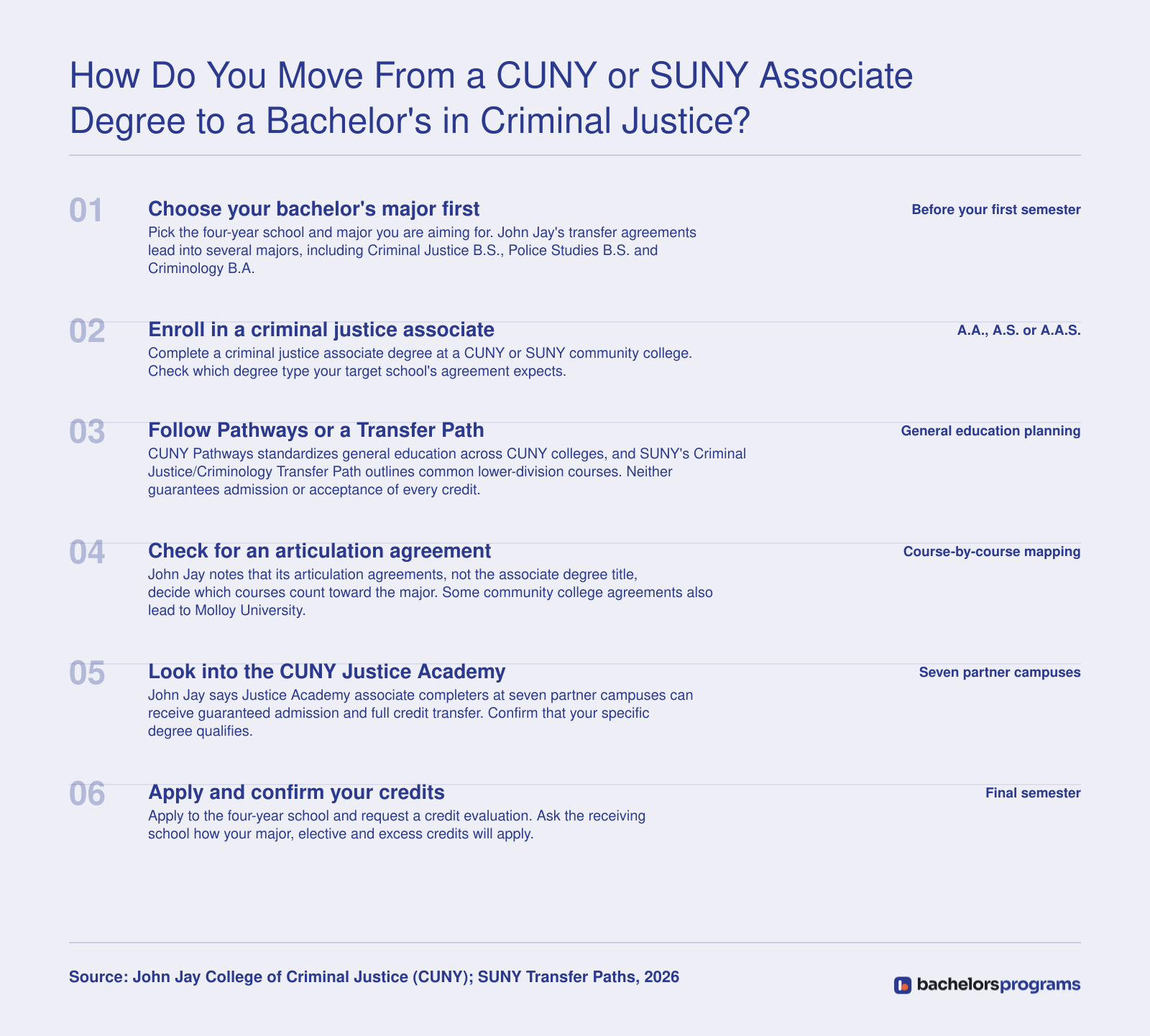
How Do You Move From a CUNY or SUNY Associate Degree to a Bachelor's in Criminal Justice?
Many New York students start at a community college and finish a bachelor's degree in criminal justice at a four-year school. Order matters: credits transfer most smoothly when you plan for the receiving school from day one. Always confirm credit acceptance with the school you plan to attend before you enroll in courses.
New York Police Officer Certification at a Glance
Compare Criminal Justice programs on the data that matters
Explore more Criminal Justice & Law majors or browse every field of study.
All Criminal Justice & Law programs Browse every field of study