Best Online Game Programming & Development Degree Programs
Compare 60+ accredited online Game Programming & Development programs, with net price after aid, graduation rates, earnings and debt from IPEDS and the U.S. College Scorecard.

Can a 100% online bachelor's degree in game programming and development teach you to build games, not just design them, with no campus visits? Yes, and the work is closer to software engineering than to art: C++ and C#, linear algebra, rendering, networking. At the public universities ranked here, average net price after grant aid runs from $3,968 to $9,366. Federal wage data carries no separate game programmer category, so software developer pay is the benchmark graduates get measured against.
Key Points
- Indiana University-Kokomo offers the lowest average net price here: $3,968.
- Expect coursework in C++, C#, linear algebra, physics and engine architecture.
- Among the ranked programs, Baker College graduates report the highest earnings.
Best Fully Online Game Programming & Development Bachelor's Programs Ranked
Every program below is a fully online bachelor's degree in game programming and development, with no hybrid or in-person component required. Net prices shown are average amounts students pay after grant aid, not a fixed tuition quote, and graduation rates describe the whole institution rather than a single major. Editors ordered the list by a mixed composite of cost, completion and program depth, not by cost or salary alone.
George Mason University
#1Fairfax, VA · $15,000 – $20,000/yr (est.)
Best for: Aspiring game artists wanting design depth
George Mason University runs its game curriculum through the visual and performing arts, producing a BFA that treats game design as a creative discipline with technical scaffolding underneath. Students work through a 51 to 53 credit major core, add digital media and visual arts electives, and close with a senior capstone taken twice. Studio ties and regular Global Game Jam hosting give students industry contact before graduation.
- 120 credits including a 28-credit Mason Core
- 51-53 credit major core plus digital media electives
- GAME 490 Senior Game Design Capstone taken twice
- 2.0 GPA in the major, C or better in GAME courses
- 45 upper-division credits required
- Emphasizes artistic game design with technical skills
- Computer Game Design minor also offered
University of Cincinnati
#2Cincinnati, OH · ~$26,000/yr (est.)
Best for: Students wanting paid co-op experience
The University of Cincinnati houses game development inside an information technology degree, so graduates leave with a computing credential as well as game coursework. The concentration covers engines, programming, storytelling, visualization, and testing and publishing, with a parallel thread on simulated training environments. A five-semester paid co-op cycle alternates work terms with classes, and the two-semester senior design project is presented at the annual IT Expo.
- Game Development and Simulation concentration within the BSIT
- Covers game engines, programming, storytelling and visualization
- Five semesters of paid co-op alternating with classes
- Two-semester senior design project shown at the annual IT Expo
- Transfer applicants need 24 semester hours and a 2.75 GPA
- BSIT accredited by the Computing Accreditation Commission of ABET
Kennesaw State University
#3Kennesaw, GA · ~$15,000/yr (est.)
Best for: Career changers needing flexible start dates
Kennesaw State offers the only four-year public game design bachelor's in Georgia, and external rankings have placed it among the top 50 game design programs worldwide. The 120-credit degree starts three times a year and splits into five concentrations, from media production to simulation informatics, with coursework in AI, data structures, and 2D and 3D graphics. A Global Game Jam hackathon and Double Owl pathways into three related master's degrees extend the options.
- 120 credits with fall, spring or summer starts
- Five concentrations including media-production and simulation-informatics
- Only public game design bachelor's of its kind in Georgia
- Named a Top 50 game design program worldwide by The Princeton Review
- Coursework spans artificial intelligence, data structures, 2D and 3D graphics
- Hosts a Global Game Jam hackathon
- Double Owl pathway into three related master's degrees
University of the Cumberlands
#4Williamsburg, KY · ~$14,000/yr (est.)
The University of the Cumberlands built its gaming degree for online delivery from the outset, with a compact 39-credit major that reaches from game development and interactive design to gamification and advanced multiplayer platforms. The curriculum treats games as tools for learning and simulation as well as entertainment. Graduates target designer, programmer, quality assurance tester and software developer roles.
- 39 credit hours in the gaming major
- Built for fully online delivery
- Covers game development plus interactive and UX design
- Gamification and simulation-based learning coursework
- Advanced multiplayer platforms covered
- Prepares for designer, programmer, QA tester and developer roles
Indiana University-South Bend
#5South Bend, IN · $9,000/yr (est. net price)
IU South Bend treats games as one track inside a broader interactive media degree, a joint venture between computer and information sciences and integrated new media studies. The 120-credit program pairs a 67-credit core with an 18-credit concentration, and the Game track runs through 2D and 3D games programming plus three interactive game design courses. A capstone and 17 to 23 credits of supporting math, science and language work complete the degree.
- 120 credits, 67-credit core with a 3-credit capstone
- Five concentrations: Web, Game, Video, 3D or Individualized
- Game concentration is 18 credits of games programming and design
- Includes 2D Games Programming and 3D Games Programming
- Joint degree with Computer and Information Sciences
- 34 major credits must be earned at IU South Bend
- 2.0 GPA minimum for admission
Westcliff University
#6Irvine, CA · ~$35,000/yr (est.)
Westcliff University places game development inside its information technology bachelor's, with an AR/VR Mobile Game Development concentration built around Unity. Coursework covers game design structure, artificial intelligence and intelligent behavior in Unity, and augmented and virtual reality systems, alongside 45 credits of core IT courses. Two internship courses and a capstone add applied work, and up to 30 general education credits can transfer.
- 120 credits with a 2.0 GPA minimum
- AR/VR Mobile Game Development concentration
- Prepares students for Unity game development certification
- Covers artificial intelligence and intelligent behavior in Unity
- 45 credits of core IT courses, 15 in the concentration
- Two internship courses worth 6 credits
- Up to 30 general education credits transferable
- GED, TASC or HiSET accepted in place of a diploma
Lamar University
#7Beaumont, TX · ~$9,000/yr (est.)
Lamar University keeps game development anchored in computer science, requiring the full programming sequence through C++ and UNIX before students reach graphics and game-specific courses. The 120-credit degree adds computer game development, 3D modeling and animation, artificial intelligence, software engineering and Android programming. A two-credit senior assessment closes the program.
- 120 credits built on a computer science major
- Programming sequence through C++ and UNIX
- Computer Game Development I and II plus 3D modeling and animation
- Adds artificial intelligence and software engineering
- Two-credit senior assessment required
- Linear algebra and statistical methods included
Purdue University Global
#8West Lafayette, IN · $5,000 – $10,000/yr (est.)
Purdue University Global delivers game development as a concentration inside a cybersecurity bachelor's, which suits students who want game programming skills alongside a security-focused credential. The 25-credit concentration spans game design and mechanics, game programming, art and animation, and two C# software development courses, and a concentration is optional. The institution holds National Center of Academic Excellence in Cyber Defense Education designation, and the ExcelTrack format allows faster progress.
- 180 quarter credits, 45 in a cybersecurity core
- Game Development concentration totals 25 credits
- Includes two C# software development courses
- Covers game design and mechanics, programming, art and animation
- Concentration optional; cybersecurity capstone required
- ExcelTrack option available
- NSA and DHS National Center of Academic Excellence designation
Grand Canyon University
#9Phoenix, AZ · ~$22,000/yr (est.)
Grand Canyon University runs a dedicated game development bachelor's with 76 of its 120 credits in the major, including a four-course Game Creation sequence that builds a portfolio. Coursework covers game engine architecture, artificial intelligence for game developers, real-time network programming, multiplayer and mobile games, VR and AR, and game physics. Online courses run in seven-week blocks, and up to 90 transfer credits are accepted.
- 120 credits, 76 of them in the major
- Four-course Game Creation sequence builds a portfolio
- Covers VR and AR, game physics and real-time network programming
- Online courses run in seven-week blocks
- Up to 90 transfer credits accepted
- 2.8 unweighted GPA, or 2.5 with ACT 19 or SAT 1000
- Students supply a laptop that runs Adobe Creative Cloud
Baker College
#10Owosso, MI · ~$13,000/yr (est.)
Baker College focuses its game degree on production skills, with 90 of 120 credits in the major and core game development courses delivered fully online in eight-week asynchronous terms. Students train in Unreal and Unity, study mobile development and artificial intelligence, and complete a senior capstone that must be a playable game. A 150-hour work experience course adds professional exposure, and industry professionals review the curriculum.
- 120 credits, 90 in the major
- Core game development courses fully online in 8-week asynchronous terms
- Training in Unreal and Unity engine programming
- Senior capstone: complete a playable game
- 150-hour work experience course required
- Curriculum reviewed by industry professionals
- Mobile development and artificial intelligence coursework
Cost & outcomes by school
Federal data for the highest-earning Game Programming & Development programs, independent of the ranking above. Earnings are this field's bachelor's graduates four years after completing where the Scorecard reports them, else the school's undergraduate median.
| School | Net price / yr | Grad rate | Earnings | Debt | Grads/yr | Format |
|---|---|---|---|---|---|---|
| George Mason University VA | $17,915 | 68% | $76,343 | $19,500 | — | Online or campus |
| University at Albany NY | $17,167 | 62% | $67,979 | $19,500 | — | Online or campus |
| Oregon State University OR | $19,604 | 70% | $64,010 | $21,221 | — | Online or campus |
| Maryville University MO | $22,066 | 66% | $62,105 | $22,000 | — | Hybrid |
| University of Arizona AZ | $16,674 | 68% | $59,979 | $19,620 | — | Online or campus |
| Saint Xavier University IL | $10,970 | 57% | $58,656 | $22,223 | — | Hybrid |
Sources: U.S. Department of Education. Net price, graduation rate, earnings and debt: College Scorecard (earnings and debt for this field's bachelor's graduates where reported, else school-wide); graduates: IPEDS. A dash means no figure is reported.
Cost, debt & payoff
Median earnings of this field's bachelor's graduates (4 yrs after completing, else the school's undergraduate median) vs. their median federal loan debt · U.S. College Scorecard
Across these programs the median graduate earns about $55,552 and finishes with roughly $23,673 in debt — a ratio that clears a common rule of thumb (keep debt below first-year salary). Net price and debt vary widely school to school, so check the per-school figures in the table above before you shortlist.
How We Ranked Online Game Programming Schools
Comparing programs fairly means holding the degree level and delivery format constant. Every program here is a bachelor's degree delivered fully online. Associate degrees and hybrid programs are left out; many competing lists mix them in without explanation, which makes cost and outcome comparisons misleading.
The order comes from a composite of quality signals: net price, graduation rate, and, where published, program-level earnings and debt. The figures are drawn from IPEDS and College Scorecard data.
Treat the results as a starting point. Graduation rates and net price are institution-wide averages, so they describe the school rather than the game programming major. Some programs also lack published program-level earnings, so those schools are judged on the remaining signals. Confirm specifics with each admissions office before you apply.
What a Bachelor's Degree in Game Programming and Development Covers
A game programming bachelor's is a computer science degree aimed at real-time software. Expect C++ and C# programming, data structures, math for games (linear algebra and physics), engine architecture, graphics and rendering, game AI, multiplayer networking and a senior capstone. SNHU, Full Sail University and Champlain College Online each require 120 credits.
Catalog titles show the emphasis. SNHU's Game Programming concentration includes Game Programming I and II, Programming for Game Engines and Game Engine Development. Full Sail's B.S. in Game Development lists Computer Graphics, Engine Development and Game Architecture, built on C++ with Vulkan and DirectX. Champlain's Advanced Game Development Techniques has students build a playtest-ready project in Unity.
Engine choice shapes your job options. SNHU and Full Sail work in Unreal Engine, which runs on C++ and is widely used at large console and PC studios. Champlain covers both Unity and Unreal. Unity's C# scripting is common at mobile and indie studios, so match the engine to the kind of studio you want to join.
Game design and game art tracks are different in practice. They emphasize level design, narrative and visual assets, with far less C++. Read the course list, not just the program title.
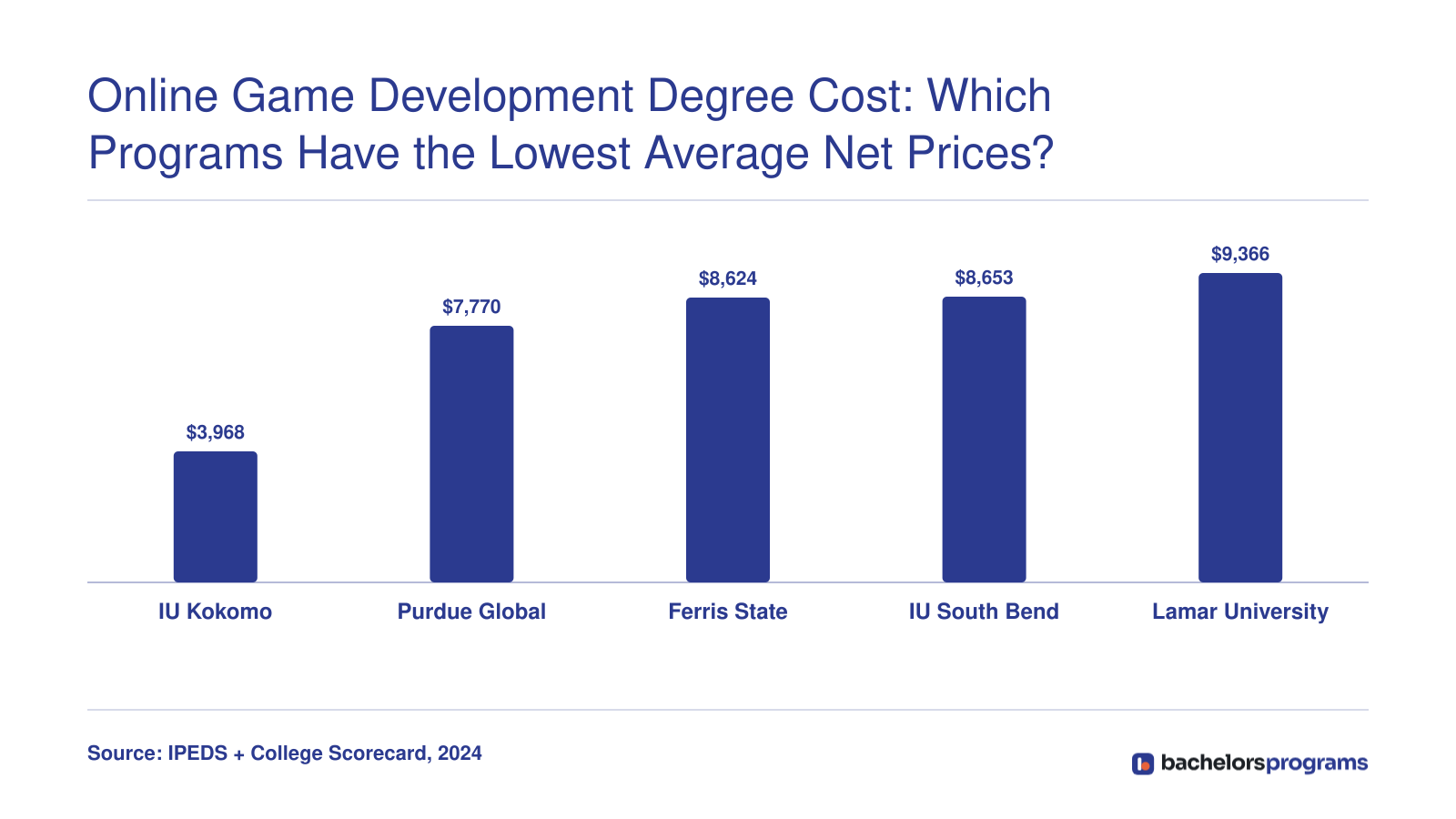
Online Game Development Degree Cost: Which Programs Have the Lowest Average Net Prices?
Average net price is what students paid after grants and scholarships, measured across each university. At these public schools it runs from $3,968 at Indiana University-Kokomo to $9,366 at Lamar University, and 61.8% to 86.2% of students receive Pell grants, with the highest share at Purdue Global. Private online providers publish sticker tuition per credit instead: SNHU lists $354 per credit before other fees, and Full Sail reports an average of $542 per credit that includes its Project LaunchBox laptop and software, textbooks, and lab and technology fees. Read every figure as an average, not a personal price quote.
Related Articles
What Software Developers Earn Nationally
Federal wage data has no separate category for game programmers, so software developers are the closest benchmark.
Game Programmer Salary and Graduate Outcomes: Is the Degree Worth It?
A game programming degree pays off when it leaves you with both a playable portfolio and software skills that carry beyond games.
Earnings and Debt Together
Baker College reports the highest graduate earnings among the ranked programs: $95,210 five years after finishing. Herzing University's Orlando and Akron locations report $82,894, and Full Sail University $81,925, on the same five-year window. At Herzing Orlando, that $82,894 sits against median debt of $31,000 and a monthly 10-year loan payment of about $329, a workable ratio for most graduates.
The Industry Benchmark
The GDC 2025 Salary Report, a July 2025 survey of 562 U.S. professionals with a 3% margin of error, puts average pay across all game-industry disciplines near $142,000, with a median of $129,000.1 Its $150,000 programming average blends game programmers with software engineers, QA analysts, testers, and tools, AI, and UI programmers, so read it as a category figure, not a starting salary.2 Hiring still turns on demonstrated work, and the survey does not quantify how studios split their judgment between a portfolio and a degree.
Verdict: worth it when the program produces shipped projects and general software competence that also qualifies you for non-game developer roles.
Questions to Ask Yourself
Do you want to write engine, gameplay, and multiplayer code in C++, or shape levels, systems, and player experience?
Have you written code before, and if not, does the program start you at the beginning?
Would a computer science degree with a games track keep more non-game software jobs open?
Is the engine you care about, Unity or Unreal, actually taught in required courses?
Portfolio, Engines, and Online Learning Format: What to Check Before You Apply
Use this checklist to compare programs before you apply.
- AccreditationConfirm the accreditor on the school's own listing. SNHU is regionally accredited by NECHE. Full Sail is nationally accredited by ACCSC, which can affect whether other colleges accept its credits.
- Transfer creditAsk for the maximum credits accepted and whether AP or prior coding courses count. SNHU accepts up to 90 of its 120 credits, subject to an official evaluation, and you must take at least 30 at SNHU.
- Engine trainingCheck whether required courses teach Unity, Unreal, or both.
- Portfolio and capstoneLook for a team-based capstone and a graduating portfolio. Full Sail's sequence includes Project and Portfolio VII: Game Development.
- Delivery formatSNHU courses are asynchronous. Full Sail follows an accelerated monthly schedule, so ask whether it requires live sessions.
- HardwareRequest the required PC specifications and software licenses before you enroll.
Game Programming & Development programs by state
Online Game Programming Degree FAQs
Do you need to know how to code before starting a game programming degree?
Can you get a game development degree completely online?
Do game studios care whether your degree was earned online or on campus?
Can a game programming degree lead to non-game software jobs?
Compare Game Programming & Development programs on the data that matters
Explore more Arts & Design majors or browse every field of study.
All Arts & Design programs Browse every field of study