Best Mechanical Engineering Degree Programs
Compare 430+ accredited Mechanical Engineering programs, with net price after aid, graduation rates, earnings and debt from IPEDS and the U.S. College Scorecard.

A bachelor's degree in mechanical engineering still feeds everything from robotics to energy systems, and the programs gathered here are undergraduate only, not master's or doctoral. The usual degree awarded is the Bachelor of Science (B.S.) in Mechanical Engineering.
The schools here award essentially the same B.S., yet the costs diverge sharply. Annual published tuition runs from about $6,400 for in-state students at the University of Florida to roughly $65,900 at Stanford, and debt at graduation and early pay spread just as widely.
ABET accreditation is the one constant worth checking first, because most state licensing boards expect it from anyone pursuing a Professional Engineer license.
Key Points
- Every school ranked here offers a campus-based, four-year B.S. pathway.
- Our ranking weighs student experience and earnings, not academic reputation.
- A co-op year plus a passed FE exam can rival prestige.
Best Mechanical Engineering Schools for a Bachelor's Degree at a Glance
These ten schools make up our 2026 list of the best mechanical engineering degree programs at the bachelor's level, and every one of them is a campus-based, four-year pathway. Each entry notes what the department emphasizes, from design studios and co-op terms to thesis work and optional concentrations. Net price after aid, institution-wide graduation rate and program earnings sit alongside each row so you can compare cost and outcomes in one place.
Princeton University
#1Princeton, NJ · ~$6,000/yr (est.)
Best for: Thesis-driven engineering students
Princeton keeps mechanical engineering inside a single department shared with aerospace engineering, which means undergraduates work with research faculty early and choose among three degree tracks. The second year moves into design labs and a two-semester design sequence, and every senior completes realistic design projects plus independent work and a thesis. Coursework in energy and power systems, aerodynamics and machine dynamics gives the degree a strongly analytical character.
- Three undergraduate tracks: mechanical, aerospace, or combined
- Two-semester design sequence starting in sophomore spring
- Design labs and engineering design coursework in year two
- Advanced coursework in energy and power systems
- Aerodynamics and flow systems coursework
- Dynamics of machines and their control coursework
- Senior-year design projects plus independent work and thesis
- Median earnings of $115,927 four years after finishing
University of California-Berkeley
#2Berkeley, CA · ~$13,000/yr (est.)
Best for: Aspiring national lab researchers
Mechanical engineering at UC Berkeley sits inside one of the largest engineering colleges in the country, and undergraduates enter through the College of Engineering before declaring the major. The department also runs joint majors with nuclear engineering and materials science, giving cross-disciplinary students a structured route rather than an ad hoc double major. Graduates move into industry, the national laboratories, and doctoral research programs.
- ABET-accredited mechanical engineering B.S.
- Joint major with Nuclear Engineering
- Joint major with Materials Science and Engineering
- Both joint majors meet the same ME objectives and outcomes
- Updated ABET student outcomes adopted in fall 2024
- Median earnings of $119,371 four years after finishing
University of Florida
#3Gainesville, FL · ~$7,000/yr (est.)
Best for: Florida residents keeping costs down
The University of Florida runs one of the largest mechanical engineering departments in the Southeast, with a 128-credit B.S. that layers manufacturing, robotics, thermal and fluid systems, dynamics and biomechanics onto a common engineering core. A combination B.S./M.S. path lets strong students double-count graduate courses, and a dual mechanical and aerospace degree adds only one semester. Research funding from the National Science Foundation, the Department of Defense and NASA supports undergraduate lab work.
- ABET-accredited 128-credit Bachelor of Science
- Six concentration options within the major
- Combination B.S./M.S. double-counts graduate courses
- Dual mechanical and aerospace degree adds one semester
- Critical tracking: eight courses, C or better, 2.8 GPA
- Exit interview required before graduation
- Research sponsored by NSF, NASA and the National Institutes of Health
- Median earnings of $97,113 four years after finishing
Georgia Institute of Technology
#4Atlanta, GA · ~$12,000/yr (est.)
Georgia Tech builds its mechanical engineering B.S. around an ME core plus a design and professional practice stem, then opens 15 credit hours of free electives so students can shape the degree. Optional 15-hour concentrations cover acoustics and vibration, automotive, design, manufacturing, and thermal, fluid and energy systems. The co-op plan, running since 1912, alternates full-time industry assignments with classroom terms, and the International Plan and Research Option give students other ways to stand out.
- ME core plus a design and professional-practice stem
- 15 credit hours of free electives
- Optional 15-hour concentrations in acoustics, automotive, manufacturing and energy
- Co-op plan since 1912 alternates industry work with study
- International Plan requires 26 weeks abroad and a capstone
- Research Option requires nine units of research and a thesis
- B.S./M.S. option open at a 3.5 GPA after 30 credit hours
- Median earnings of $99,955 four years after finishing
University of California-Los Angeles
#5Los Angeles, CA · $13,000/yr (est. net price)
Mechanical engineering at UCLA is a Bachelor of Science major in the university's engineering school, and the approved curriculum is published and updated annually in the official general catalog. The path is sequenced from calculus and physics into thermodynamics, fluid mechanics, heat transfer and design, with technical electives in the upper division. Los Angeles gives students a deep local market for internships in aerospace, medical devices and advanced manufacturing.
- Bachelor of Science major listed in the UCLA General Catalog
- Curriculum published annually in PDF and HTML
- Housed in the school of Engineering and Applied Science
- Median earnings of $108,875 four years after finishing
Stanford University
#6Stanford, CA · $10,000 – $15,000/yr (est.)
Stanford's mechanical engineering department pairs a compact major requirement with broad university electives, asking for 116 units in the program against 180 needed to graduate. Undergraduates arrive undeclared and declare the major during sophomore or junior year, which leaves room to explore before committing. A two-quarter capstone design sequence doubles as the writing-in-the-major requirement, and an honors option adds a faculty-advised thesis.
- 116 units in the major; 180 university units to graduate
- 45 units of math and science, including 24 in math
- 68-unit minimum in engineering topics plus 12 units of technical electives
- Two-quarter capstone design sequence satisfies the writing requirement
- Honors option: 3.5 major GPA plus a faculty-advised thesis
- Undeclared admission; declare the major in sophomore or junior year
- Summer Undergraduate Research Institute with faculty mentors
- Median earnings of $117,072 four years after finishing
Massachusetts Institute of Technology
#7Cambridge, MA · ~$20,000/yr (est.)
MIT's Course 2 is the institute's undergraduate mechanical engineering degree, taught by a department that has shaped the field for more than 150 years. Students pair a technical core with 48 units of unrestricted electives and departmental electives planned with an assigned faculty advisor. Design, experimentation and manufacturing labs keep the work hands-on, and graduates are set up for doctoral study, industry leadership roles or entrepreneurial ventures.
- Course 2 is MIT's Bachelor of Science in Mechanical Engineering
- ABET-accredited under the EAC general and mechanical program criteria
- 48 units of unrestricted electives planned with an advisor
- Faculty advisor assigned to every student
- Coursework in thermal, electromechanical and mechanical systems
- Design, experimentation and manufacturing labs
- Median earnings of $131,967 four years after finishing
Purdue University
#8West Lafayette, IN · ~$15,000/yr (est.)
Purdue's mechanical engineering school is among the largest in the country, and its B.S.M.E. follows a fixed eight-semester plan that starts with first-year engineering and moves into statics, thermodynamics, fluids and senior design. Students pick concentrations in energy processes, manufacturing, dynamical systems, or microelectronics and semiconductors, or build a technical selective route instead. Internships, co-ops, undergraduate research and study abroad are built into the advising structure, and the degree is offered at West Lafayette and Indianapolis.
- ABET-accredited B.S.M.E. offered at West Lafayette and Indianapolis
- 128 credits, 61 to 62 of them in major requirements
- Concentrations in energy processes, manufacturing, dynamical systems and semiconductors
- 9 credits of technical selectives and 6 credits of ME selectives
- Senior design teams solve open-ended engineering challenges
- Instructional laboratories and design projects throughout
- Updated program map published in March 2026
- Median earnings of $102,572 four years after finishing
University of Michigan
#9Ann Arbor, MI · $18,000 – $61,000/yr (est.)
Michigan's mechanical engineering department awards a Bachelor of Science in Engineering and requires 128 credits split across college core courses, intellectual breadth, major requirements and general electives. Three optional 12-credit concentrations in energy, manufacturing systems and robotics let students signal a specialty to employers. A five-year SUGS option combines the bachelor's and master's degrees, and dual degrees are possible with an adjusted credit total.
- Bachelor of Science in Engineering in Mechanical Engineering
- 128 credits across college core, breadth, major and electives
- 45 credits of ME core in design, mechanics, dynamics and thermal sciences
- Optional 12-credit concentrations in energy, manufacturing systems and robotics
- Declare after one full term with a 2.0 GPA and C or better in prerequisites
- Five-year SUGS bachelor's and master's option
- Median earnings of $105,888 four years after finishing
University of California-San Diego
#10La Jolla, CA · $10,000 – $15,000/yr (est.)
UC San Diego's mechanical and aerospace engineering department offers a four-year B.S. that moves from mechanics, vibrations and thermodynamics into fluid flow, heat transfer, control theory and mechanical design. First-year students follow a published four-year plan, while transfer students follow a three-year version of the same requirements. Graduates typically move into the region's electro-mechanical and aerospace industries.
- ABET-accredited B.S. in Mechanical Engineering
- Four-year plan for first-year students; three-year plan for transfers
- Coursework in thermodynamics, fluid flow, heat transfer and controls
- Required MAE and science courses must be taken for a letter grade
- Prerequisites completed before a course, never concurrently
- Median earnings of $104,229 four years after finishing
Cost & outcomes by school
Federal data for the highest-earning Mechanical Engineering programs, independent of the ranking above. Earnings are this field's bachelor's graduates four years after completing where the Scorecard reports them, else the school's undergraduate median.
| School | Net price / yr | Grad rate | Earnings | Debt | Grads/yr | Format |
|---|---|---|---|---|---|---|
| Massachusetts Institute of Technology MA | $20,111 | 96% | $131,967 | $11,507 | 118 | Campus |
| Franklin W Olin College of Engineering MA | $25,171 | 96% | $129,455 | $19,500 | 27 | Campus |
| California Institute of Technology CA | $16,075 | 94% | $128,566 | — | 39 | Campus |
| Duke University NC | $29,612 | 97% | $120,991 | $10,000 | 115 | Campus |
| University of California-Berkeley CA | $13,481 | 93% | $119,371 | $13,000 | 227 | Campus |
| Stanford University CA | $13,807 | 92% | $117,072 | $12,000 | 57 | Campus |
| Princeton University NJ | $6,128 | 98% | $115,927 | $10,320 | 49 | Campus |
| University of Pennsylvania PA | $28,699 | 97% | $114,492 | $12,910 | 63 | Campus |
| Cornell University NY | $28,690 | 95% | $112,212 | $15,500 | 172 | Campus |
| Columbia University in the City of New York NY | $21,590 | 96% | $111,491 | $10,057 | 69 | Campus |
| Johns Hopkins University MD | $18,809 | 94% | $110,210 | $10,750 | 47 | Campus |
| Rice University TX | $13,370 | 95% | $108,970 | $15,375 | 74 | Campus |
Sources: U.S. Department of Education. Net price, graduation rate, earnings and debt: College Scorecard (earnings and debt for this field's bachelor's graduates where reported, else school-wide); graduates: IPEDS. A dash means no figure is reported.
Cost, debt & payoff
Median earnings of this field's bachelor's graduates (4 yrs after completing, else the school's undergraduate median) vs. their median federal loan debt · U.S. College Scorecard
Across these programs the median graduate earns about $88,830 and finishes with roughly $23,031 in debt — a ratio that clears a common rule of thumb (keep debt below first-year salary). Net price and debt vary widely school to school, so check the per-school figures in the table above before you shortlist.
How We Ranked Bachelor's Degree Programs in Mechanical Engineering
A reputation ranking asks what academics think of a program. Ours asks what students experience and earn. The two approaches can point to different schools, so it helps to know which one you are reading.
What Goes Into Our Ranking
We combine five kinds of data:
- Earnings and debt: College Scorecard program-level figures for bachelor's mechanical engineering graduates, drawn from the 2022 outcomes year.
- Net price: what students pay on average after grants and scholarships.
- Graduation and retention: institution-wide rates, not specific to engineering.
- Admissions: acceptance rates and related selectivity data.
- Institutional data year: the 2024 Scorecard release.
Some school cards lack an earnings figure. The Scorecard does not publish program-level data for every school, so a blank means the federal dataset has nothing to report for that program.
That net price averages what students who received aid paid. It is not a personal quote, and your own cost depends on your finances and the aid you are offered.
How U.S. News Differs
The 2026 U.S. News undergraduate engineering rankings rest solely on peer assessment.1 In spring and summer 2026, the publication surveyed deans and senior faculty at ABET-accredited undergraduate engineering programs. Respondents rated programs they knew on a 5-point scale, from marginal (1) to outstanding (5), and could answer "don't know" for the rest.
U.S. News averages each program's scores with a trimmed mean that drops the two highest and two lowest ratings.2 A program needs at least 10 ratings after trimming to be ranked. Schools without a doctorate in engineering are ranked separately from doctorate-granting schools. In the 2026 "no doctorate" mechanical engineering list, Rose-Hulman Institute of Technology is #1.
Read both: peer reputation shows how faculty regard a program, and outcomes data shows what graduates earn and owe.
What a Bachelor's Degree in Mechanical Engineering Involves
A mechanical engineering bachelor's degree teaches you to design, analyze, and build machines, engines, structures, and thermal systems using math and physics. The Bachelor of Science is the usual credential, and it typically takes four years and roughly 120 to 130 credits. Those figures are typical, not universal. Co-op schedules, transfer credits, and part-time or online formats can stretch or shorten the timeline.
The Core Course Sequence
The first two years build the foundation: calculus, differential equations, and calculus-based physics, often alongside chemistry and an introductory engineering course. From there, the mechanical engineering core takes over:
- Statics and dynamics: How forces act on objects at rest and in motion.
- Thermodynamics and heat transfer: How energy converts and moves through engines, turbines, and cooling systems.
- Fluid mechanics: How liquids and gases behave in pipes, pumps, and around vehicles.
- Materials: Why metals, polymers, and composites fail or hold up under load.
- Machine design and controls: How components fit together and how feedback keeps systems stable.
The program ends with a senior capstone design project, in which a small team takes a real problem from concept to a working prototype, often for an industry sponsor.
Labs and Design Software
Lab courses turn theory into practice. You will test material strength, measure airflow, and run thermal experiments. Alongside them, you will learn CAD and simulation tools. SolidWorks is common for 3D modeling, and MATLAB is widely used for calculations, data analysis, and control simulations. Employers expect this fluency from new graduates, so look for programs with strong lab access and project-based coursework.
Concentrations and Electives
Upper-level electives are where programs diverge. Common focus areas include robotics, aerospace, energy systems, and biomechanics. A robotics track leans on controls and mechatronics, while an aerospace track adds propulsion and aerodynamics. Energy concentrations emphasize thermal systems and renewables, and biomechanics pairs mechanics with human physiology. Not every school offers every option, so check each program's listed concentrations against the career you want.
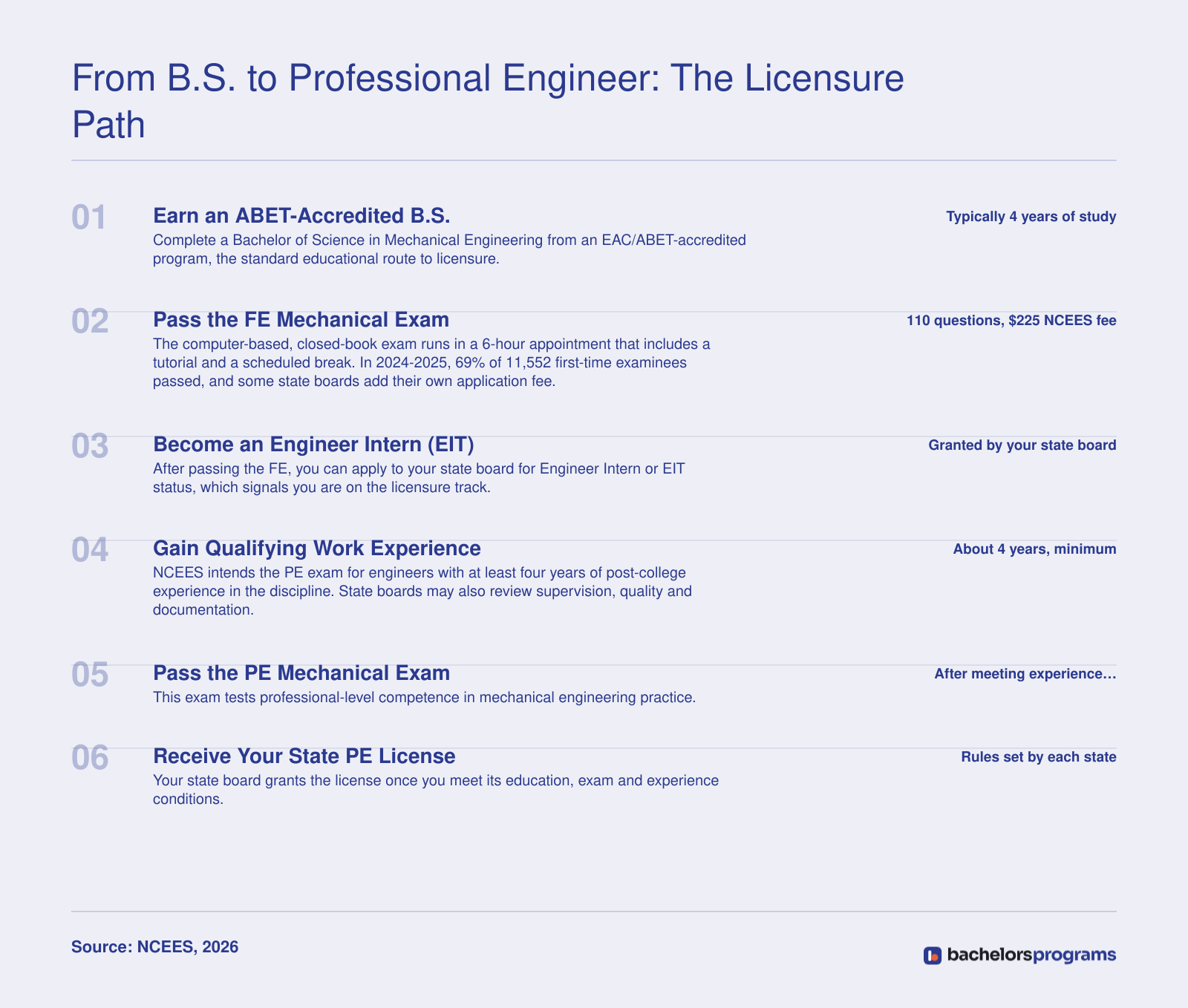
From B.S. to Professional Engineer: The Licensure Path
A bachelor's degree in mechanical engineering is the first step toward a Professional Engineer (PE) license. NCEES designs the FE exam for recent graduates and for students close to finishing an EAC/ABET-accredited degree, so many students sit for it in their final year. Exact requirements vary by state board.
Related Articles
Questions to Ask Yourself
Do you want a required co-op that may add a fifth year, or a traditional four-year path with summer internships?
Is the program ABET EAC-accredited, and do you plan to pursue a PE license?
Will you pay in-state tuition at a strong public program, or does a private school's aid package bring its net price lower?
Do you want robotics, aerospace or energy depth that only some schools offer as a formal concentration?
Mechanical Engineering programs by state
Compare Mechanical Engineering programs on the data that matters
Explore more Science & Engineering majors or browse every field of study.
All Science & Engineering programs Browse every field of study