Best Information Technology Schools in Georgia
Compare 21 accredited Information Technology programs in Georgia at 19 colleges, with net price after aid, graduation rates, earnings and debt from IPEDS and the U.S. College Scorecard.
A bachelor's degree in information technology pays off fastest in Georgia because Atlanta anchors one of the largest concentrations of technology employers in the Southeast, from payment processors to cloud and cybersecurity firms. Typically the degree is a Bachelor of Science (B.S.) in Information Technology, though some schools label it a Bachelor of Information Technology or fold it into management information systems.
Programs here run from large public universities to private and career-focused institutions, delivered on campus and online. The real tension is price against format: in-state tuition at public universities sits far below private sticker prices, but online and evening options at private schools can fit a working schedule better.
Employers in the Atlanta metro hire on skills and certifications as readily as on the diploma, so the program's hands-on labs often matter as much as its name.
Key Points
- In-state tuition at Georgia's most affordable ranked publics runs $5,038 to $5,898.
- Mercer University's $42,312 tuition drops to a $23,847 average net price.
- Technical college AAS credits don't always transfer into IT bachelor's degrees.
Best Information Technology Schools in Georgia: Our Top 10 Ranked
Ten Georgia schools on this list award a bachelor's degree in information technology, and the differences that matter most to readers tend to be format, concentration depth and what you pay after aid. Start with the delivery format and the concentration list on each card, since those two decide whether a program fits your schedule and your target job. Then compare cost, because a cheaper program you can finish on time beats a prestigious one you cannot.
Georgia State University
#1Atlanta, GA · $9,000 – $25,000/yr (est.)
Best for: Atlanta students who want a large research campus
Georgia State's Atlanta campus gives IT students a large, city-based research university with a computer science department behind the degree. The Bachelor of Information Technology shares its foundation with computer science and data science, then adds career-oriented lab work and a two-semester capstone that ends in a team design project. Students can start in fall, spring or summer, and the university runs an active scholarship calendar with a November priority date.
- Four-year degree taught by the Department of Computer Science
- Shares foundational coursework with computer science and data science
- Two-semester Capstone Senior Design course
- Fall, spring and summer entry terms
- Career-oriented lab experiences built into the major
- Prepares students for database, security, network and web roles
- Common Application accepted
- Scholarships available
Mercer University
#2Macon, GA · ~$24,000/yr (est.)
Best for: Working adults needing evening and online classes
Mercer runs its IT and informatics degree through the College of Professional Advancement, which is built around adults balancing school with work. Students take classes at the Atlanta campus, online, or in a blend of the two, and each course runs in an eight-week session with five start dates a year. The curriculum pairs programming logic, database design and systems analysis with a specialized area of study, and a Database Design and Analytics certificate can be added.
- Five start dates per year
- Eight-week course sessions
- On campus, online, or blended formats
- Evening classes at the Atlanta campus
- Coursework in programming logic, database design and systems analysis
- Database Design and Analytics certificate can be added
- Informatics Club and Upsilon Pi Epsilon honor society
- Examines project management, decision theory and ethics in information systems
Georgia Southern University
#3Statesboro, GA · $15,000 – $20,000/yr (est.)
Best for: Hands-on learners wanting a required internship
Georgia Southern offers the degree on its Statesboro and Armstrong campuses and through a fully online route, which makes it one of the more flexible options on this list. The on-campus program holds accreditation from the Computing Accreditation Commission of ABET and requires an internship of every IT student. Four emphasis areas and a Data Science concentration let students aim at cybersecurity, networking, web and mobile development or analytics.
- 123 credit hours with four concentration options
- On-campus program accredited by the Computing Accreditation Commission of ABET
- Emphasis areas in web and mobile development, information management, network and data center management, cybersecurity
- Data Science concentration covers data mining, analytics and visualization
- Every IT student completes an internship before graduating
- Campus networking labs
- Accelerated bachelor's to master's pathway
- Online BSIT accreditation pending
Kennesaw State University
#4Kennesaw, GA · ~$15,000/yr (est.)
Kennesaw State teaches the degree from its Marietta campus and lets each student choose the format: fully online, fully in class, or a 50/50 hybrid. The 120-credit program focuses on designing, implementing and maintaining the systems and networks that move data through an organization. Double Owl Pathways let undergraduates start a master's in IT, cybersecurity or healthcare informatics at lower cost and in less time.
- 120 credit hours, four-year degree
- Students choose fully online, in class, or a 50/50 hybrid format
- Primary campus in Marietta
- Coursework in designing, implementing and maintaining systems and networks
- Double Owl Pathway to an IT or cybersecurity master's
- Fall, spring and summer entry terms
- Prepares graduates for systems analyst, security analyst and database roles
Augusta University
#5Augusta, GA · $8,000 – $25,000/yr (est.)
Augusta places its IT degree inside the School of Computer and Cyber Sciences, next to the university's security operations center and a short drive from the Georgia Cyber Center. Undergraduates can add a business concentration, join the Cyber Defense Team, and apply for internships through SIEGE CyberOps, which hires up to five student assistants each semester. Augusta is a designated Center of Academic Excellence in cyber defense, and the city has become a regional hub for security work.
- Housed in the School of Computer and Cyber Sciences
- Coursework in programming, database management, network administration and cybersecurity
- Optional concentration in business
- Internships through SIEGE CyberOps, the university's security operations center
- Located near the 332,000-square-foot Georgia Cyber Center
- JAGByte living-learning community for freshmen
- Cyber Defense Team and honor society
- Assistance programs for veterans and service members
Clayton State University
#6Morrow, GA · $5,000 – $10,000/yr (est.)
Clayton State structures its BIT around a compact 120-credit plan: core curriculum, an 18-credit field of study, upper-division major courses and a concentration. Seven concentration options include Database Administration, Networking and Security, and Security for Financial Technology, with FinTech courses delivered through the USG FinTech Academy. Students must earn at least a C in every IT, computer science and math course counted toward the degree.
- 120 credit hours: 42 core, 18 field of study, 24 major, 9 concentration
- Seven concentrations, including Database Administration and Networking and Security
- Grade of C or better required in all IT, CS and MATH courses
- FinTech courses delivered through the USG FinTech Academy on eCampus
- Four-year suggested plan of study for first-time freshmen
- Minor in another discipline possible
Albany State University
#7Albany, GA · ~$12,000/yr (est.)
Albany State awards a Bachelor of Science in Management Information Systems and Technology through its business division, which holds ACBSP accreditation. The program leans toward the organizational side of IT: how information systems are coordinated, supported and used to solve business problems. Coursework reaches into office automation, decision support and expert systems, which suits students aiming at analyst and systems coordination roles rather than pure software development.
- Business division holds ACBSP accreditation
- Emphasizes design, development and support of information systems
- Covers office automation, management information and decision support systems
- Trains students to build technology solutions for business and industry
- Prepares students to coordinate and facilitate information systems
Georgia Southwestern State University
#8Americus, GA · $10,000 – $15,000/yr (est.)
Georgia Southwestern runs an ABET-accredited IT degree from its Americus campus with four concentrations, and students may pair two of them. The coursework is hands-on and language-heavy, covering Python, Java, C++, network design, data management and cybersecurity. Internships carry both class credit and pay, and employer immersion visits put students inside local workplaces.
- ABET accredited
- Four concentrations: Data Science, Health Informatics, Multimedia and Mobile App Development, Project Management
- Students may combine two concentrations
- Coursework in Python, Java, C++, web development and cybersecurity
- Paid internships that also carry class credit
- Employer immersion visits place students in workplaces
- Undergraduate research and live event production work
Columbus State University
#9Columbus, GA · ~$13,000/yr (est.)
Columbus State's 120-credit BSIT includes a senior capstone and an unusual practicum requirement: students take the IT practicum three times across three approved subject areas. Required courses reach into cloud computing, cybersecurity risk management, wireless and IoT security, and systems analysis and design. There are no program-specific admission requirements, which makes the program straightforward to enter once a student is admitted to the university.
- 120 credit hours, including a senior capstone
- Coursework in cloud computing, cybersecurity risk management and wireless and IoT security
- IT practicum taken three times across three subject areas
- No program-specific admission requirements
- Grade of C or better required in CPSC and MISM courses
- 49 credits in major requirements
- Fully online option available
Middle Georgia State University
#10Macon, GA · $12,000/yr (est. net price)
Middle Georgia State offers ten concentrations, the broadest set on this list, ranging from Cyber Forensics and Software Engineering to Health Informatics and Technology Entrepreneurship. Classes run at the Macon and Cochran campuses, and several concentrations are available entirely online, including Cyber Forensics and Software Engineering. The same department also runs graduate IT programs, so undergraduates who want to continue have a clear path.
- Ten concentrations, including Cyber Forensics and Software Engineering
- Classes at Cochran, Macon, or online
- Cyber Forensics and Software Engineering available at Macon and online
- Cybersecurity and Networking Technologies and Administration run at Cochran, Macon, and online
- Also offers Data Analytics, Health Informatics and Financial Technology tracks
- Technology Entrepreneurship and Web Applications Development concentrations
Cost & outcomes by school
Federal data for the highest-earning Information Technology programs, independent of the ranking above. Earnings are this field's bachelor's graduates four years after completing where the Scorecard reports them, else the school's undergraduate median.
| School | Net price / yr | Grad rate | Earnings | Debt | Grads/yr | Format |
|---|---|---|---|---|---|---|
| Georgia Southern University GA | $15,267 | 55% | $92,026 | $23,125 | 187 | Online or campus |
| Georgia State University GA | $15,931 | 53% | $87,020 | $24,082 | 315 | Campus |
| Kennesaw State University GA | $15,048 | 52% | $83,249 | $24,976 | 246 | Online or campus |
| Augusta University GA | $13,787 | 49% | $83,000 | $22,750 | 46 | Campus |
| Strayer University-Georgia GA | $18,318 | 21% | $82,304 | $37,500 | 61 | Online or campus |
| Mercer University GA | $23,847 | 70% | $80,937 | $24,199 | 8 | Online or campus |
| Columbus State University GA | $13,115 | 42% | $80,694 | $29,750 | 61 | Online or campus |
| American InterContinental University-Atlanta GA | $16,482 | 21% | $71,486 | $39,223 | 24 | Online or campus |
| Clayton State University GA | $8,365 | 40% | $67,899 | $34,000 | 19 | Campus |
| Middle Georgia State University GA | $12,361 | 25% | $62,734 | $21,422 | 140 | Online or campus |
| Georgia College & State University GA | $20,686 | 64% | $58,140 | $22,250 | — | Campus |
| Georgia Southwestern State University GA | $12,019 | 41% | $57,043 | $18,851 | 2 | Campus |
Sources: U.S. Department of Education. Net price, graduation rate, earnings and debt: College Scorecard (earnings and debt for this field's bachelor's graduates where reported, else school-wide); graduates: IPEDS. A dash means no figure is reported.
Cost, debt & payoff
Median earnings of this field's bachelor's graduates (4 yrs after completing, else the school's undergraduate median) vs. their median federal loan debt · U.S. College Scorecard
Across these programs the median graduate earns about $58,140 and finishes with roughly $24,976 in debt — a ratio that clears a common rule of thumb (keep debt below first-year salary). Net price and debt vary widely school to school, so check the per-school figures in the table above before you shortlist.
Most Affordable Bachelor's Degree in Information Technology Programs in Georgia
These Georgia public universities post the lowest average net prices among the schools ranked here, with in-state tuition and fees from $5,038 to $5,898 a year, according to 2024 U.S. Department of Education data from IPEDS and the College Scorecard. Net price is an average annual cost after grants and scholarships for students who receive aid, so your own bill can land higher or lower depending on family income, housing choices and the aid you qualify for. A low net price shows that a school tends to be affordable once aid is applied, but it does not measure program quality, graduation rates or earnings after graduation, so weigh it alongside those outcomes in the ranking above.
| School | City | Program | In-State Tuition and Fees (per year) | Average Net Price After Aid (per year) | Format |
|---|---|---|---|---|---|
| Clayton State University | Morrow | Information Technology, BIT | $5,180 | $8,365 | Campus |
| Albany State University | Albany | B.S. in Management Information Systems & Technology | $5,656 | $11,898 | Campus |
| Georgia Southwestern State University | Americus | B.S. in Information Technology | $5,220 | $12,019 | Campus |
| Middle Georgia State University | Macon | Information Technology, B.S. | $5,038 | $12,361 | Campus and online |
| Columbus State University | Columbus | Information Technology (BS) | $5,898 | $13,115 | Campus and online |
Online and Hybrid Bachelor's in Information Technology Options at Georgia Schools
On-campus study gives you labs and face-to-face contact with faculty, while online study gives you control over your schedule. Among the schools ranked here, most let you pick one or the other.
How the Ranked Schools Sort
- Campus-only: Georgia State University, Augusta University, Clayton State University, Albany State University and Georgia Southwestern State University.
- Both campus and online: Mercer University, Georgia Southern University, Kennesaw State University, Columbus State University and Middle Georgia State University.
- Fully online only: None of the ranked schools is online-only.
What "Both" Really Means
"Both" means you choose a format. It does not promise a hybrid course design. Mercer describes on-campus, online or blended routes, with eight-week sessions and evening classes at its Atlanta campus. Kennesaw State lists a hybrid option split evenly between online and in-class time. Georgia Southern, Columbus State and Middle Georgia State each advertise a fully online option, and Middle Georgia State also holds classes at Cochran and Macon. Georgia Southern notes that accreditation for its online B.S. is pending, so ask whether the format you want is covered by the program's ABET accreditation.
Who Online Suits
Online study tends to fit working adults, career changers and students outside metro Atlanta who would otherwise face a long commute to Atlanta, Kennesaw or Macon. Mercer's frequent start dates and short sessions suit people returning to school after a gap. If you learn best with hands-on lab access, networking or cybersecurity labs, say, a campus or hybrid format may serve you better.
Check Tuition and Aid Before You Enroll
Confirm on the school's own page whether online students pay the in-state or out-of-state rate. Public universities often price those differently, and the gap is large. Georgia Southern, for example, lists about $6,022 in-state tuition against $17,734 out-of-state. Online fees may also differ from on-campus fees.
Being a Georgia-based school matters for two reasons. It is the basis for in-state rates, and it is tied to eligibility for Georgia's HOPE aid. Residency and academic rules still apply case by case, so confirm both with the school's financial aid office before you commit.
Admission Requirements: GPA, Test Policy and Transfer Credit
What GPA and test scores do you need to get into a Georgia IT program? It depends on the school, and the range is wide. Admissions standards, test policies and transfer rules change from year to year, so confirm every detail on the school's own admissions page before you apply.
GPA and Test Policy
Most public schools here, including Georgia State University, Kennesaw State University, Georgia Southern University, Augusta University and Columbus State University, review your high school transcript, with extra weight on core academic courses such as math, English, science and social studies. Many also use a formula that combines GPA with test scores. Whether SAT or ACT scores are required, optional or ignored can change between application cycles. If a school's admissions page lists no minimum GPA or test requirement, ask the admissions office rather than assuming there is no bar.
Selectivity is not uniform. Georgia State, Kennesaw State and Georgia Southern generally draw larger and more competitive applicant pools. Regional publics such as Georgia Southwestern State University and Middle Georgia State University, along with Georgia Gwinnett College, tend to be more accessible. Career-focused private schools such as Herzing University-Atlanta, Strayer University-Georgia, DeVry University-Georgia and South University-Savannah often take a broader approach to admission, though most still ask for a high school diploma or equivalent.
If You Fall Short
- Raise your numbers: Retake the SAT or ACT if the school considers scores, or strengthen your final-year grades in math.
- Start elsewhere: Complete general education credits at a Georgia technical or community college, then transfer.
- Ask about alternatives: Some schools offer conditional or provisional admission, so find out what is available.
Transfer Credit
Transfer applicants are usually evaluated on college GPA, credit hours completed and official transcripts from every prior institution. Courses typically need a minimum grade, often a C, to count toward the major, and each school decides which courses apply.1 Look for a published transfer equivalency tool,2 and ask how many credits can transfer and how many you must finish in residence.
Application Tips for IT Majors
- Check math placement early: Many IT degrees require college algebra or statistics. A strong placement score can save a semester.
- Complete prerequisites first: Intro programming, networking or discrete math taken before transfer can keep you on schedule.
- Match the program title: Some schools offer a Bachelor of Information Technology, others a B.S. or a management information systems degree. Compare the curriculum, not just the name.
- Mind the deadlines: Priority dates for admission and aid can fall well before the term starts.
Transferring From a Georgia Technical College to a Bachelor's in Information Technology
Starting at a technical college can lower the cost of a bachelor's degree in information technology, but the savings only hold if your credits transfer. An Associate of Applied Science (AAS) is built for the workforce first, so not every course will count toward a four-year degree.
The Clearest Published Pathway
Middle Georgia State University has a statewide articulation agreement with Georgia's technical college system. Under it, graduates of the AAS in Computer Technologies move into the university's Bachelor of Science in Information Technology with full transfer of their credits. It is the most direct IT-specific route published for 2026.
The agreement does not spell out a course-by-course crosswalk, minimum grades or GPA requirements. Ask the university whether each course applies to the major or only to electives. Other AAS titles, programming, networking, cybersecurity, are not confirmed for the same full-credit treatment, there or at other schools.
How Credit Usually Moves
Without a formal agreement, transfer happens course by course. General education courses follow a statewide course transfer chart shared by the technical colleges and Georgia's public universities. Technical and major courses depend on the receiving school's own evaluation. Some technical college degrees also articulate to specific university programs beyond that chart, so confirm the exact outcome before you enroll.
Steps to Protect Your Credits
- Talk to an advisor early: Contact your technical college and your target university in your first term, not your last.
- Request a credit evaluation: Ask for an unofficial transcript review before you apply.
- Check equivalencies: Use the state's online transfer tool to see how individual courses map, including credit hours.
- Get it in writing: Acceptance varies by school and by program, so keep any approval you receive.
Related Articles
Tuition vs. Net Price: How Georgia IT Programs Compare
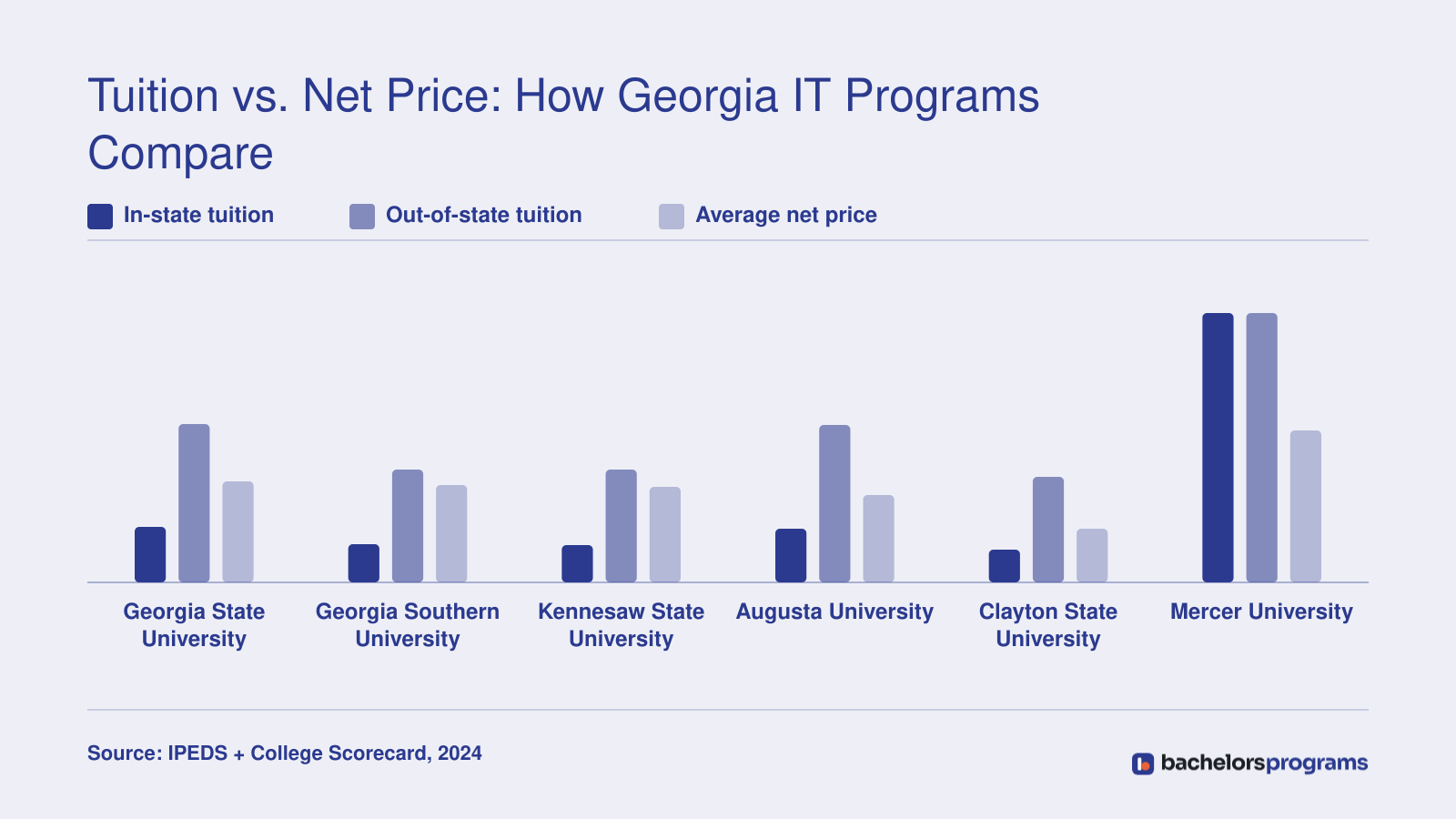
Sticker price and actual cost are different numbers. At Mercer University, private tuition and fees of $42,312 fall to an average net price of $23,847 after grants. At the public universities, net price can exceed in-state tuition because it also counts housing, books and living costs. The in-state discount is large: Georgia State University charges $8,664 to Georgia residents and $24,840 to out-of-state students, and Clayton State University posts the lowest net price shown here at $8,365.
Compare Information Technology programs on the data that matters
Explore more Computers & IT majors or browse every field of study.
All Computers & IT programs Browse every field of study