Best Criminal Justice Schools in Rhode Island
Compare 5 accredited Criminal Justice programs in Rhode Island, with net price after aid, graduation rates, earnings and debt from IPEDS and the U.S. College Scorecard.
A bachelor's degree in criminal justice in Rhode Island comes with a wide price spread: published tuition runs from $13,365 for Johnson & Wales University's online program to $50,100 at Salve Regina University. Most programs here award a Bachelor of Science (B.S.) in Criminal Justice.
The list covers campus programs in Rhode Island and online programs at Rhode Island-based schools. Rankings come first, followed by online and three-year formats, admissions, cost, and state careers and licensure.
In a state this small, internship access, such as Roger Williams University's placements with the State Police and U.S. Marshals, often counts for as much as sticker price.
Key Points
- Salve Regina University ranks first, pairing Newport classes with agency capstone research.
- Roger Williams shows the widest margin: $70,747 earned versus $26,000 borrowed.
- Rhode Island detectives earned an $88,774 median salary in May 2024.
Best Bachelor's Degree in Criminal Justice Programs in Rhode Island, Ranked
The strongest bachelor's degree in criminal justice in Rhode Island is at Salve Regina University, which pairs a Newport campus with capstone research alongside federal and state agencies. Roger Williams University follows closely on the strength of its School of Justice Studies and its pre-law pathways. The four programs below list resident tuition, average net price after aid and school-wide graduation rates so you can weigh cost against fit.
Salve Regina University
#1Newport, RI · ~$37,000/yr (est.)
Best for: Students aiming at federal agency careers
Salve Regina University, a private institution in Newport, awards a Bachelor of Arts in criminal justice and criminology rather than a B.S., and its capstone sends students into research partnerships with federal and state agencies. Across the university, tuition is $50,100 and the average net price after aid is $36,967, with 77% of students completing a degree within six years. Criminal justice graduates earned a median $67,622 four years after finishing, based on federal outcome data.
- BA in criminal justice and criminology at the Newport campus
- Capstone research with the FBI Boston office and R.I. State Fusion Center
- Internships with local, state and federal law enforcement, courts and law firms
- Two courses cover first-year law topics, with a pre-law advisor for applications
- Combined bachelor's/master's in criminal justice and cybersecurity in five years
- Study abroad in 30 countries; Criminal Justice and Criminology Club on campus
Roger Williams University
#2Bristol, RI · ~$38,000/yr (est.)
Best for: Pre-law students wanting a 3+3 pathway
Roger Williams University in Bristol houses criminal justice inside its School of Justice Studies, a program holding an academic-quality endorsement from the Academy of Criminal Justice Sciences and a clear pre-law pipeline. University-wide tuition is $44,867 with an average net price of $37,999 after aid, and 69% of students graduate within six years. Criminal justice graduates reported a median $70,747 four years after completing the degree.
- ACJS endorsement for academic quality
- Internships with the U.S. Marshals Service and R.I. State Police
- Social justice seminar covers racism, sexism, classism, immigration and housing
- 4+1 track earns six graduate credits toward the M.S. in Criminal Justice
- 3+3 program yields a bachelor's and a J.D. in six years
- Inside-Out Exchange Program with sentenced youth at the R.I. Training School
- Justice System Training and Research Institute; John Jay Society club
New England Institute of Technology
#3East Greenwich, RI · ~$36,000/yr (est.)
Best for: Career changers who learn by doing
New England Institute of Technology in East Greenwich is the state's career-focused option, with a B.S. in criminal justice that builds on associate-level study and leans on forensics, police operations and a mock crime scene capstone. Tuition is $34,875 and the average net price after aid is $16,668, the lowest of the four schools here, while 60% of students graduate within six years. Criminal justice graduates earned a median $61,128 four years after finishing, and the program has added a dedicated training facility at the East Greenwich campus.
- B.S. in criminal justice that builds on associate-level study
- Week-long Senior Capstone uses a mock crime scene, evidence collection and witness interviews
- Coursework spans criminal forensics, white-collar crime and domestic terrorism
- Classes average 20 to 25 students across the East Greenwich campuses
- Optional senior internship available
- Accredited by NECHE
Johnson & Wales University
#4Providence, RI · ~$20,000/yr (est.)
Johnson & Wales University, based in Providence, delivers its criminal justice bachelor's entirely online, which makes it the state's fully online path in this ranking. Tuition is $13,365 and the average net price after aid is $20,252. Criminal justice graduates earned a median $56,632 four years after completion, and the Providence campus regularly hosts training for active Rhode Island police, corrections and probation officers.
- 100% online bachelor's in criminal justice
- 90-credit career-focused option or 120-credit traditional option
- Courses run 7 or 15 weeks, with a three-year completion path
- Transfer credit evaluation within 48 hours
- Faculty have worked in law enforcement, community policing, forensics and corrections
- Providence campus hosted training for more than 100 active Rhode Island officers
- 19:1 student-to-faculty ratio
Cost & outcomes by school
Federal data for the highest-earning Criminal Justice programs, independent of the ranking above. Earnings are this field's bachelor's graduates four years after completing where the Scorecard reports them, else the school's undergraduate median.
| School | Net price / yr | Grad rate | Earnings | Debt | Grads/yr | Format |
|---|---|---|---|---|---|---|
| Roger Williams University RI | $37,999 | 69% | $70,747 | $26,000 | 92 | Campus |
| Salve Regina University RI | $36,967 | 77% | $67,622 | $27,000 | 27 | Campus |
| New England Institute of Technology RI | $36,483 | 60% | $61,128 | $41,250 | 8 | Campus |
| Johnson & Wales University RI | $31,027 | 55% | $56,632 | $27,000 | 55 | Online or campus |
| Johnson & Wales University RI | $20,252 | — | $56,632 | $27,000 | 2 | Online |
Sources: U.S. Department of Education. Net price, graduation rate, earnings and debt: College Scorecard (earnings and debt for this field's bachelor's graduates where reported, else school-wide); graduates: IPEDS. A dash means no figure is reported.
Cost, debt & payoff
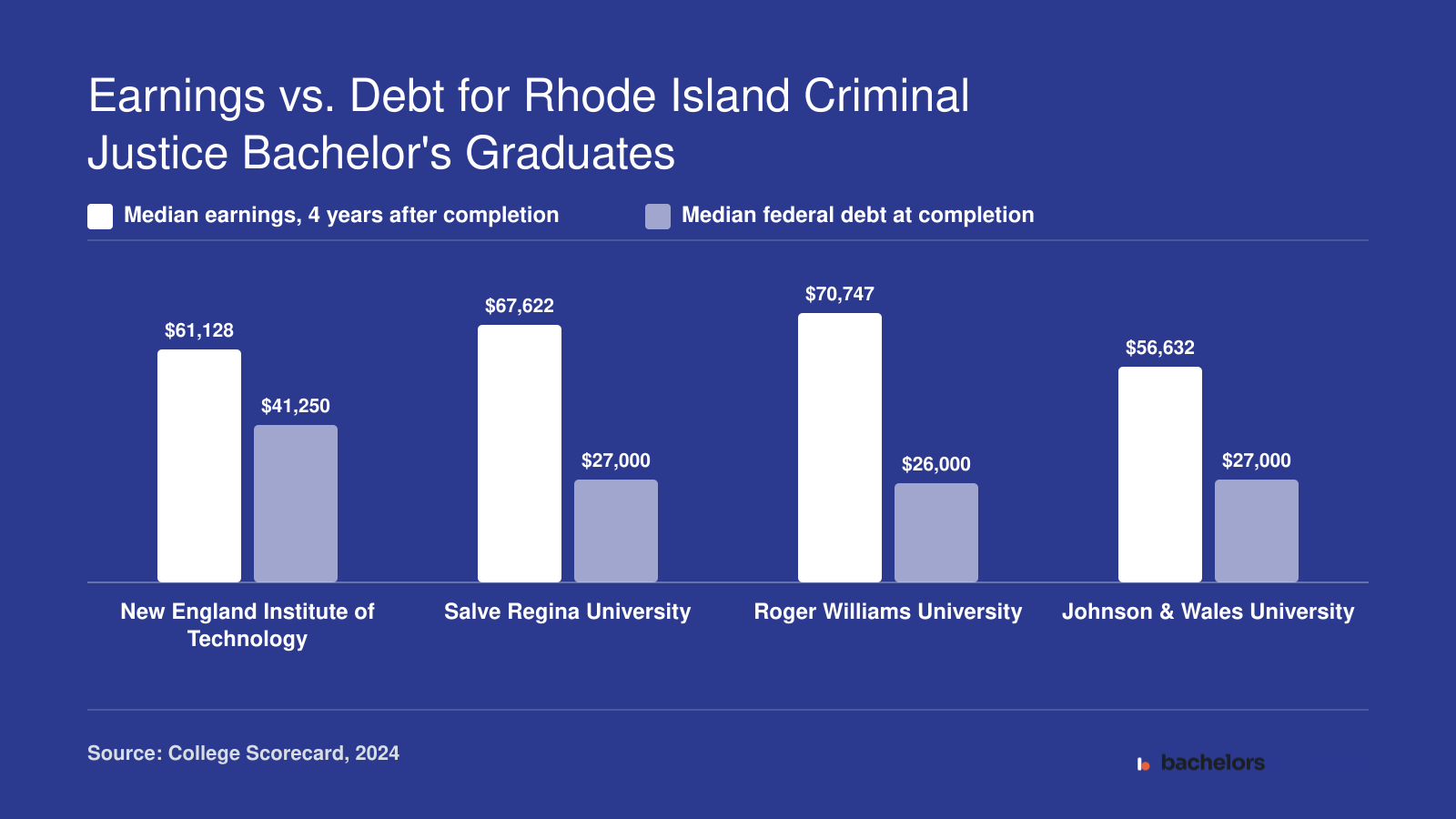
Median earnings of this field's bachelor's graduates (4 yrs after completing, else the school's undergraduate median) vs. their median federal loan debt · U.S. College Scorecard
Across these programs the median graduate earns about $61,128 and finishes with roughly $27,000 in debt — a ratio that clears a common rule of thumb (keep debt below first-year salary). Net price and debt vary widely school to school, so check the per-school figures in the table above before you shortlist.
How We Ranked Rhode Island's Criminal Justice Bachelor's Programs
What Shapes the Order
The order reflects four factors that most prospective students already weigh:
- Cost: what families actually pay after grants and scholarships, not just the published tuition.
- Outcomes: what criminal justice graduates earn after finishing, set against the student debt they carry.
- Graduation rate: how many students who start at the school go on to finish a bachelor's degree.
- Format: whether you can complete the bachelor's degree in criminal justice on campus, online or in a hybrid mix.
School-Wide Numbers vs. Program Numbers
Not every figure describes the same group of students. Graduation rate and net price cover the entire school, so a strong rate at Salve Regina University or Roger Williams University reflects every major, not criminal justice alone. Earnings and debt work differently. When those figures exist, they are tied to graduates of the criminal justice credential itself. Smaller programs sometimes graduate too few students for earnings to be reported, and in those cases the school-wide numbers are the better guide.
Why Rankings Disagree
That mix explains why one site may put New England Institute of Technology or Johnson & Wales University first while another favors a different school. Some rankings score the whole university, some look only at the program, and some leave out online options entirely. Treat any ranking, including this one, as a starting point rather than a verdict.
A Short List by Design
Rhode Island is a small state, and only a handful of colleges award a bachelor's in criminal justice. A few schools make up the entire list, so modest differences in price or earnings can shift a school up or down a spot. Weigh the factors that matter most to you, such as format, location and cost, before treating any position as final.
Earnings vs. Debt for Rhode Island Criminal Justice Bachelor's Graduates
For each school's criminal justice bachelor's program, College Scorecard data shows median earnings four years after completion well above median federal debt at completion. Roger Williams University graduates show the widest margin, $70,747 in earnings against $26,000 in debt. New England Institute of Technology graduates carry the most debt, $41,250 against $61,128 in earnings four years out. A wider gap between pay and borrowing generally means quicker repayment and more room in your budget, though these medians describe past graduates and are not a guarantee of your own results.
Online, Hybrid and Three-Year Criminal Justice Bachelor's Options at Rhode Island Schools
Criminal justice programs have spent the past several years moving lectures online while keeping fieldwork, labs and internships on campus, which is why format deserves a direct answer before you apply.
At the Rhode Island schools ranked here, settle those questions by reading each program page yourself, then confirming the details in writing with an advisor.
Step 1: Open the program page, then the fine print
Start with the criminal justice program page at Salve Regina University, Roger Williams University, New England Institute of Technology and Johnson & Wales University. Read the program page for the degree name and the total credits required, then open the admissions and transfer-credit pages. Those two pages, not a brochure or a third-party listing, will tell you how prior coursework is evaluated and what the application asks for. Request a semester-by-semester sample plan as well; it shows the real sequence of prerequisites rather than an idealized timeline.
Step 2: Put six questions to an advisor
- Delivery: Is the program fully online, hybrid or classroom-based, and are any courses synchronous?
- Pacing: Is there an accelerated or three-year pathway, and does it depend on summer or winter terms?
- Transfer credit: How many credits will the school accept, and is there a residency minimum?
- Fieldwork: Is an internship or field placement required, how many hours does it involve, and who arranges the placement?
- Scheduling: Are evening, weekend or extension sections available for students who work full time?
- Accreditation: Which institutional or programmatic accreditor covers the degree?
Ask by email so you can compare the answers side by side.
Step 3: Cross-check with outside sources
The U.S. Bureau of Labor Statistics Occupational Outlook Handbook describes what criminal justice careers involve and the education they expect. College Scorecard and IPEDS, both from the U.S. Department of Education, let you compare program offerings and outcomes across schools. For the field itself, the Academy of Criminal Justice Sciences and the American Society of Criminology publish career and education guidance. Use them to frame your questions, then let the school's own written answer settle them.
Admissions Requirements: GPA, Test Policy and Transfer Credit by School
For Rhode Island criminal justice programs, the concrete part of admissions is transfer credit, not test scores. The schools here publish little about GPA and test requirements, so use the entries below as a checklist for your calls to admissions.
School-by-School Snapshot
- Salve Regina University (Newport): No minimum GPA or SAT/ACT policy is published in the material we reviewed. Confirm current test requirements with admissions. No criminal justice articulation agreement with a Rhode Island community college is listed, so expect credits to be reviewed course by course.
- Roger Williams University (Bristol): No minimum GPA or SAT/ACT policy is published in the material we reviewed. Ask admissions directly. No criminal justice community college agreement is listed, so request an early credit evaluation.
- New England Institute of Technology (East Greenwich): No minimum GPA or test policy is published in the material we reviewed. The state community college's articulation list includes a Law Enforcement transfer pathway into a B.A. at New England Tech. The list excerpt does not give GPA cutoffs or credit caps, so verify those with an advisor.
- Johnson & Wales University (Providence): No minimum GPA or test policy is published in the material we reviewed. The state community college's articulation list names an agreement for the Criminal Justice B.S. Details on GPA and credit limits are not in the excerpt, so confirm them before you enroll in your associate courses.
What Transfer Students Should Know
Transfer GPA expectations vary widely across four-year colleges, from roughly 2.0 at many institutions to nearly 4.0 at more selective ones. Articulation agreements can guarantee acceptance, transfer credit and advanced standing, but usually only if you finish the associate degree and meet the agreement's stated GPA.1 Students planning a transfer route should meet with a community college advisor before choosing electives. They should also get the four-year school's written credit evaluation.
A few habits protect your credits:
- Ask each school whether your intended criminal justice courses count toward the major or only as general electives.
- Request the agreement's GPA threshold in writing.
- Keep syllabi for every course in case the receiving school reviews credits individually.
- Check whether the agreement covers the exact degree you want, since a law enforcement pathway and a criminal justice B.S. are different tracks.
Questions to Ask Yourself
Would two years at a community college before transferring suit you better than four years at a private school?
Do you need an online or evening schedule to keep working?
Is the net price after aid, not the sticker price, within reach?
Are you aiming at a local police academy, a federal agency or law school?
Related Articles
Criminal Justice Jobs and Wages in Rhode Island for Bachelor's Graduates
May 2024 wage estimates from the Rhode Island Department of Labor and Training show detectives and criminal investigators earning the highest median pay of these criminal justice occupations, at $88,774 a year across 440 jobs, while paralegals and legal assistants hold the most positions in the state at 1,830. Correctional officer and detective roles typically require only a high school diploma plus academy or on-the-job training, but a bachelor's degree in criminal justice is usually expected for probation officer and correctional treatment specialist positions and for most federal law enforcement jobs, and it can strengthen a candidate for promotion into investigative work. Rhode Island figures for patrol officers and for probation officers were not available in the state data used here, so those roles are not listed.
| Occupation | RI Median Annual Wage | RI Employment | Data Year |
|---|---|---|---|
| Detectives and Criminal Investigators | $88,774 | 440 | May 2024 |
| Correctional Officers and Jailers | $60,174 | 990 | May 2024 |
| Paralegals and Legal Assistants | $54,538 | 1,830 | May 2024 |
Rhode Island Police Officer Certification and Hiring Requirements at a Glance
Rhode Island Criminal Justice School FAQs
These answers draw on the ranking, online and cost sections above. Program names, credit totals and formats can change, so confirm details with each school's admissions office before you apply.
What is the best criminal justice school in Rhode Island?
Can you get a bachelor's degree in criminal justice online in Rhode Island?
Can you finish a criminal justice bachelor's degree in three years?
Which Rhode Island colleges offer a criminal justice major?
Compare Criminal Justice programs on the data that matters
Explore more Criminal Justice & Law majors or browse every field of study.
All Criminal Justice & Law programs Browse every field of study