Best Criminology Schools in North Carolina
Compare 11 accredited Criminology programs in North Carolina, with net price after aid, graduation rates, earnings and debt from IPEDS and the U.S. College Scorecard.

North Carolina prices a bachelor's degree in criminology anywhere from $6,126 in in-state tuition at Winston-Salem State to $67,642 at Wake Forest, and that spread, not prestige, is the first decision most students face. The degree comes as a Bachelor of Science or a Bachelor of Arts in Criminology, and several programs sit inside sociology or justice studies departments, so the title tells you less than the coursework does.
Campus, hybrid and fully online versions exist; online sections often share faculty with main campus.
Most students pay somewhere between those figures after grants and state aid, which is why net price matters more than sticker tuition.
Key Points
- NC State's Criminology (BA) posts the strongest graduate earnings in our data.
- UNC Greensboro's $10,965 average net price is the lowest here.
- North Carolina's BLET course (640+ hours) doesn't require a bachelor's degree.
Best Bachelor's in Criminology Schools in North Carolina at a Glance
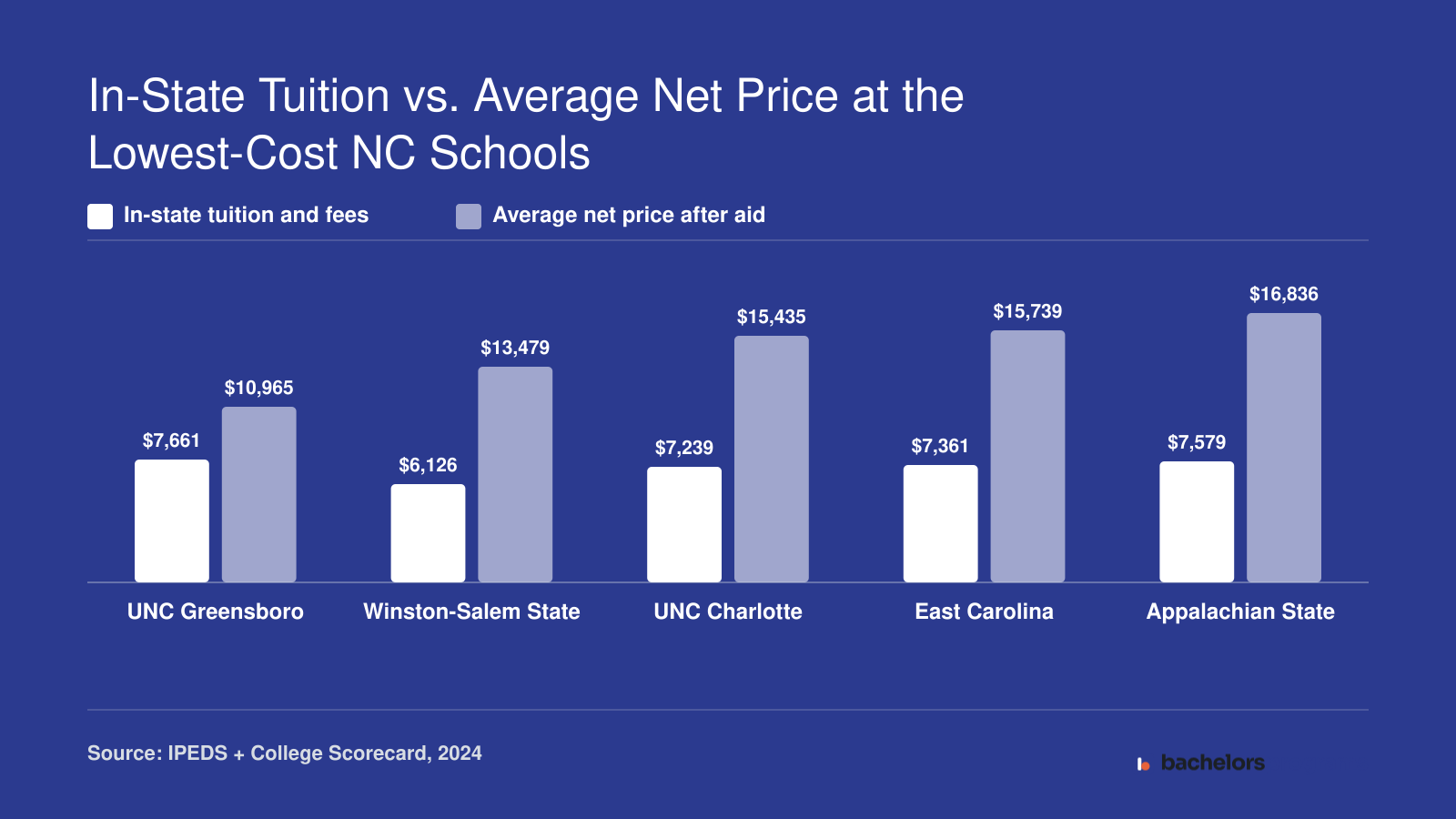
Ten North Carolina bachelor's programs in criminology and closely related fields make this list, from the flagship research university in Raleigh to small private colleges in Winston-Salem. The prices shown with each school are in-state tuition and an approximate average net price after aid for the institution as a whole, and graduation rates are institution-wide rather than program-specific. Scanning for cost, the five lowest net prices belong to UNC Greensboro (about $10,965), Winston-Salem State (about $13,479), UNC Charlotte (about $15,435), East Carolina (about $15,739) and App State (about $16,836). Scanning for earnings, the highest institution-wide median pay about 10 years after entry goes to Wake Forest ($78,158), NC State ($68,758), UNC Charlotte ($57,289), East Carolina ($55,146) and UNC Wilmington ($54,967); those are whole-school figures, not criminology-program results.
North Carolina State University at Raleigh
#1Raleigh, NC · $9,000 – $33,000/yr (est.)
Best for: Research-minded undergrads wanting a large public campus
The largest public university in North Carolina, NC State houses criminology inside its sociology and anthropology department, so the major leans on theory, research methods and the social causes of crime alongside courts and corrections. Seniors log a 120-hour field placement with a justice agency, and electives such as Juvenile Delinquency, Environmental Criminology and Sociology of Law let students shape the degree. The Raleigh location puts students close to state agencies, the General Assembly and a large municipal police department.
- 120 total credit hours over a four-year plan of study
- 2.0 overall GPA and 2.0 major GPA required
- 120-hour senior field placement with a criminal justice agency
- 15 sociology hours at NC State, 9 at the 300 level or above
- C- or higher required in English 101
- Electives include Juvenile Delinquency and Environmental Criminology
- Criminal Justice Club for majors
University of North Carolina Wilmington
#2Wilmington, NC · $7,000 – $24,000/yr (est.)
Best for: Online students wanting campus-equivalent instruction
UNCW runs one of the few criminology programs in the state taught by the same faculty online and on campus, so students who cannot relocate are not getting a separate, thinner version of the degree. Three concentrations (Criminology, Criminal Justice and Public Criminology) let students weight the work toward theory, agency practice or community-focused criminology. Juniors and seniors can take a practicum with local police and sheriff's departments, the district attorney, probation and parole, juvenile services or the State Bureau of Investigation.
- Concentrations in Criminology, Criminal Justice and Public Criminology
- Same faculty teach the online and main campus versions
- Practicum with police, sheriff, district attorney, probation and parole, SBI
- Core includes Criminological Theory, Data Analysis and a senior seminar
- Electives such as Victimology, White Collar Crime and Restorative Justice
- 95% of graduates employed or in graduate school within six months
University of North Carolina at Charlotte
#3Charlotte, NC · $15,000 – $20,000/yr (est.)
Best for: Working adults completing a degree entirely online
UNC Charlotte delivers its criminal justice and criminology bachelor's entirely online as a degree-completion program built for working adults who already have some college credit behind them. Coursework splits cleanly between criminology (why crime and delinquency happen) and criminal justice (how agencies respond), with policing, courts, corrections and rehabilitation as the main destinations. Students need 24 completed credit hours plus a 2.0 GPA before they can declare the major, and a specific introductory CJUS course within two attempts.
- Delivered 100% online as a degree-completion program
- 24 completed credit hours and a 2.0 GPA required to declare
- CJUS 1100 or 1511 with a C or better within two attempts
- Covers crime causes and theory plus agency response
- Prepares for policing, courts, corrections and rehabilitation roles
East Carolina University
#4Greenville, NC · ~$16,000/yr (est.)
East Carolina offers both an on-campus route and a fully online degree-completion route to the same criminal justice and criminology bachelor's, which makes it one of the more flexible public options in the state. The 120-hour curriculum pairs a 40-hour general education core with 18 hours of required CRIM courses, then leaves room for a minor or a block of general electives. Extras include an accelerated path into the department's master's program, field placements, a national criminal justice honor society and an annual job and career fair in Greenville.
- 120 credit hours: 40 general education and 18 core CRIM hours
- 33 elective hours plus 29 in a minor or general electives
- C or better in every CRIM course; CRIM 2004 before upper-level work
- On-campus track and a fully online degree-completion track
- Accelerated BS/MS option in the same department
- Field placements, study abroad and an annual job and career fair
- National criminal justice honor society chapter
Johnson C Smith University
#5Charlotte, NC · ~$21,000/yr (est.)
Johnson C. Smith is a private historically Black university in Charlotte whose criminology major is certified by the North Carolina Department of Justice's criminal justice education and training commission, one of only four four-year schools in the state to hold that recognition. Core classes run mock crime scenes and mock trials, with students photographing scenes, dusting for prints, handling chain of custody and filing bills of indictment. Internships and site visits connect students to the Charlotte-Mecklenburg Police Department, local prisons and the courts.
- Certified by the NC Department of Justice criminal justice education commission
- One of four certified four-year institutions in North Carolina
- Mock crime scenes and mock trials built into core courses
- Covers law enforcement, courts and corrections
- Research methods class runs a survey in the Charlotte-Mecklenburg community
- Internships with Charlotte-Mecklenburg Police Department
- Tours of prisons, police departments and corrections facilities
- Monthly Lunch and Learn networking
Appalachian State University
#6Boone, NC · $8,000 – $25,000/yr (est.)
Appalachian State awards a Bachelor of Science in Sociology with a criminology concentration on its Boone campus, pairing criminology and social deviance with a full sociological theory and research sequence. It suits students aiming at probation and parole, juvenile case management, substance abuse counseling, law enforcement or law school, and the department offers scholarship and aid support. App State holds an R2 Carnegie classification for high research activity and has been named a top five innovative school by U.S. News & World Report.
- Criminology concentration inside the sociology B.S.
- Core courses include Criminology and Social Deviance
- Full sociological theory sequence required
- Prepares for probation, parole, juvenile case management and law enforcement
- Boone campus only, no online version
- R2 Carnegie classification for high research activity
Wake Forest University
#7Winston-Salem, NC · $25,000 – $30,000/yr (est.)
Wake Forest is the most selective and most expensive option on this list, and criminology arrives as a concentration inside the sociology major rather than a stand-alone degree. The concentration takes 12 of the 31 required sociology credit hours and draws on courses such as Courts and Criminal Procedures, Corrections, Family Violence and White-collar Crime; completers earn a department certificate and a transcript notation. A 3-credit internship can stand in for one 300-level course, and the student-faculty ratio sits near 10 to 1.
- 31 credit hours minimum, 12 of them inside the concentration
- Pick four from Courts and Criminal Procedures, Corrections, Juvenile Delinquency, White-collar Crime
- 3-credit internship can replace one 300-level course
- Department certificate and transcript notation for completers
- Substitutions require a petition to the department
- Student-faculty ratio near 10 to 1
University of North Carolina at Greensboro
#8Greensboro, NC · $11,000/yr (est. net price)
UNC Greensboro's criminology and justice studies concentration sits inside the sociology B.A. and ranks among the university's ten most popular undergraduate majors. Coursework pairs social theory with quantitative and qualitative methods and looks closely at how legal systems and public safety agencies actually operate. Students intern with local police departments, public defender offices and legal aid groups, and the department runs study abroad in France, Germany, India, Italy, Mexico and Taiwan.
- Concentration inside the sociology B.A.
- Pairs social theory with quantitative and qualitative methods
- Internships with police, public defender offices and legal aid
- Study abroad in France, Germany, India, Italy, Mexico and Taiwan
- Among UNCG's ten most popular undergraduate majors
- In-person classes only, no online option
Winston-Salem State University
#9Winston-Salem, NC · $10,000 – $15,000/yr (est.)
Winston-Salem State is a public historically Black university whose justice studies degree offers four concentrations, including a forensic science and criminology track focused on why crime happens and how information about it is gathered and analyzed. Students take an internship in settings such as probation, parole, policing, courts or corrections, alongside courses like Police and Community and Race and Economics in the USA. About nine in ten WSSU students receive some form of financial aid, which helps explain a net price among the lowest on this list.
- Four concentrations, including Forensic Science and Criminology
- Other tracks: Global Justice and Law, Social Justice and Public Policy
- Internship in Justice Studies in probation, parole, policing, courts or corrections
- Courses include Police and Community and Race and Economics in the USA
- About 90% of students receive some form of financial aid
- Spatial Justice Studio community projects
Salem College
#10Winston-Salem, NC · $18,000/yr (est. net price)
Salem College is a small private women's college in Winston-Salem where criminology is a concentration inside the sociology major rather than a separate department. Concentrators study the causes of criminal behavior, society's responses to crime and strategies for reducing it, alongside broader sociology work on race, class, gender, housing and immigration. An internship at Bridges to Hope had students helping people apply for protective orders and observing court hearings, and graduates go on to law school, justice system jobs and public policy work.
- Two majors: sociology, and sociology with a criminology concentration
- Covers crime, criminal justice, race, class, gender and immigration
- Internship at Bridges to Hope assisting protective order applicants
- Prepares for law school and justice system roles
- Private women's college in Winston-Salem
Cost & outcomes by school
Federal data for the highest-earning Criminology programs, independent of the ranking above. Earnings are this field's bachelor's graduates four years after completing where the Scorecard reports them, else the school's undergraduate median.
| School | Net price / yr | Grad rate | Earnings | Debt | Grads/yr | Format |
|---|---|---|---|---|---|---|
| Wake Forest University NC | $28,719 | 89% | $78,158 | $21,500 | — | Campus |
| University of North Carolina at Charlotte NC | $15,435 | 69% | $57,289 | $21,500 | — | Online |
| North Carolina State University at Raleigh NC | $17,303 | 85% | $55,303 | $20,374 | 80 | Campus |
| East Carolina University NC | $15,739 | 63% | $55,146 | $22,750 | 174 | Online or campus |
| Appalachian State University NC | $16,836 | 75% | $51,836 | $20,231 | — | Campus |
| Meredith College NC | $22,488 | 70% | $51,539 | $25,000 | — | Campus |
| University of North Carolina Wilmington NC | $20,109 | 71% | $50,514 | $20,000 | 122 | Online or campus |
| University of North Carolina at Greensboro NC | $10,965 | 56% | $48,160 | $22,858 | — | Campus |
| Johnson C Smith University NC | $20,894 | 34% | $46,215 | $30,500 | 7 | Online or campus |
| Winston-Salem State University NC | $13,479 | 47% | $45,344 | $25,000 | — | Campus |
| Salem College NC | $18,277 | 57% | $44,640 | $26,649 | — | Campus |
Sources: U.S. Department of Education. Net price, graduation rate, earnings and debt: College Scorecard (earnings and debt for this field's bachelor's graduates where reported, else school-wide); graduates: IPEDS. A dash means no figure is reported.
Cost, debt & payoff
Median earnings of this field's bachelor's graduates (4 yrs after completing, else the school's undergraduate median) vs. their median federal loan debt · U.S. College Scorecard
Across these programs the median graduate earns about $51,539 and finishes with roughly $22,750 in debt — a ratio that clears a common rule of thumb (keep debt below first-year salary). Net price and debt vary widely school to school, so check the per-school figures in the table above before you shortlist.
How We Ranked North Carolina Criminology Schools
Only bachelor's programs qualify, on-campus and online degrees from schools based in North Carolina. Graduate study is not part of it. Some programs are titled Criminology, while others sit inside Sociology or Justice Studies. Those were included when the criminology focus is clear.
What Drives the Order
Four factors shape the ranking:
- Cost: Lower in-state tuition and a lower average net price (what students pay after grants and scholarships) move a school up.
- Earnings outcomes: Higher median earnings for graduates in the years after finishing move a school up.
- Graduation rates: Schools that graduate more of their students rank higher.
- Program focus: Programs built around criminology, with a dedicated major or a clearly named concentration, rank ahead of general degrees with only a few related courses.
What the Numbers Mean
Two of these figures are broader than any single major. Both are institution-wide averages, so they describe the whole school rather than the criminology program alone. A criminology student's own cost and timeline can differ.
We built the ranking to help you compare schools, not to sell you on any of them. Use it to shortlist, then check each school's current tuition, admissions requirements and curriculum before you apply.
Bachelor's Degree in Criminology vs. Criminal Justice: Which Fits You?
Two Fields, Two Questions
NC State's Criminology (BA) requires 15 hours of sociology coursework at NC State. That requirement shows where criminology comes from: the social sciences. Criminology asks why crime happens, with coursework built on theory, research methods and the social conditions linked to offending. Criminal justice asks how the system responds once a crime occurs, through courses on policing, courts and corrections. Most students take classes from both sides, but the emphasis shapes what you know at graduation.
How North Carolina Schools Label the Major
North Carolina programs label the major in a few ways:
- Criminology on its own: NC State's Criminology (BA), UNC Wilmington's Criminology, B.A. and Johnson C Smith University's Criminology program.
- Hybrid titles: UNC Charlotte's Criminal Justice & Criminology, B.A. and East Carolina University's Criminal Justice and Criminology pair the two fields. UNC Charlotte describes them as two interrelated areas of study.
- Sociology with a criminology track: Appalachian State (Sociology BS, Criminology), UNC Greensboro (Criminology and Justice Studies concentration), Wake Forest (Crime and Criminal Justice concentration) and Salem College (Criminology concentration).
- Justice studies: Winston-Salem State's Justice Studies major includes a Forensic Science and Criminology concentration.
Matching the Path to Your Goal
If research, policy analysis or law school appeals to you, a theory-heavy criminology or sociology-based bachelor's program is the stronger fit. UNC Wilmington and Salem College both cite law school preparation, and UNCG reports law school placements among its graduates. If you want an operational career in law enforcement, probation or corrections, prioritize applied coursework and field placements. Johnson C Smith University offers internships with Charlotte-Mecklenburg Police plus tours of prisons and police departments, while ECU points to careers with the FBI, NCIS and U.S. Courts.
Why the Label Matters Less Than You Think
Job titles overlap heavily. Graduates of criminology, criminal justice and justice studies programs compete for the same policing, probation and court roles. Appalachian State lists law enforcement and probation or parole careers despite housing its track in sociology. Compare required courses, available concentrations and whether a practicum is built in. NC State requires senior-year field work with a justice agency, and UNCW's practicum places juniors and seniors with police departments, district attorney offices and the SBI. Those details will shape your résumé more than the word printed on your diploma.
In-State Tuition vs. Average Net Price at the Lowest-Cost NC Schools
UNC Greensboro has the lowest average net price among the schools ranked here at $10,965. Winston-Salem State has the lowest in-state tuition and fees of these lower-cost options at $6,126. Net price is an institution-wide average after grants and scholarships and includes living costs as well as tuition, so your actual cost will depend on your own aid package.
Related Articles
North Carolina Law-Enforcement Certification at a Glance
What Criminology Graduates Earn After Finishing
North Carolina State University at Raleigh posts the strongest program-level earnings figure in our data for a bachelor's degree in criminology.
What Criminology-Related Jobs Pay in North Carolina
Pay in this field is set locally, so the most reliable number for a job you might actually take is the one printed on a county or agency posting, not a statewide average.
Start With Federal Wage Data
The U.S. Bureau of Labor Statistics publishes Occupational Employment and Wage Statistics for North Carolina. Look up police and sheriff's patrol officers, probation officers and correctional treatment specialists, correctional officers, and forensic science technicians. The occupation pages and state tables show median annual wage and employment counts, which give you a defensible baseline for comparing roles.
Confirm Locally
Cross-check that baseline against NC Commerce labor market information, the NC Department of Public Safety, and the career pages of the city police departments, county sheriff's offices, and corrections facilities where you want to work. O*NET adds task descriptions and outlook context. Pay shifts by city, county, agency, and facility, and by shift differentials and certification level, so live postings tell you more than any single published number.
Ask Programs and Associations
Program websites for criminal justice, forensic science, and corrections list tuition, internship placements, and graduate outcome disclosures. Professional groups, including the NC Police Benevolent Association, NC Sheriffs' Association, American Probation and Parole Association, and American Academy of Forensic Sciences, publish career and compensation context you can weigh against agency listings.
Your Checklist
- Pull BLS median wages for the four roles above.
- Compare them with current local agency postings.
- Confirm outlook through NC Commerce and O*NET.
- Contact programs and associations for current requirements and pay.
Avoid repeating statewide averages you cannot trace to a published source.
Common Questions About Criminology Degrees in North Carolina
These answers draw on the schools ranked on this page and on published tuition and certification requirements. Costs and policies change, so confirm current figures with each school before you apply.
What is the best school for criminology in North Carolina?
Which North Carolina colleges offer a bachelor's degree in criminology?
How much does a criminology degree cost in North Carolina?
Do you need a criminology degree to become a police officer in North Carolina?
Compare Criminology programs on the data that matters
Explore more Criminal Justice & Law majors or browse every field of study.
All Criminal Justice & Law programs Browse every field of study