Best Forensic Science Schools in Michigan
Compare 3 accredited Forensic Science programs in Michigan, with net price after aid, graduation rates, earnings and debt from IPEDS and the U.S. College Scorecard.
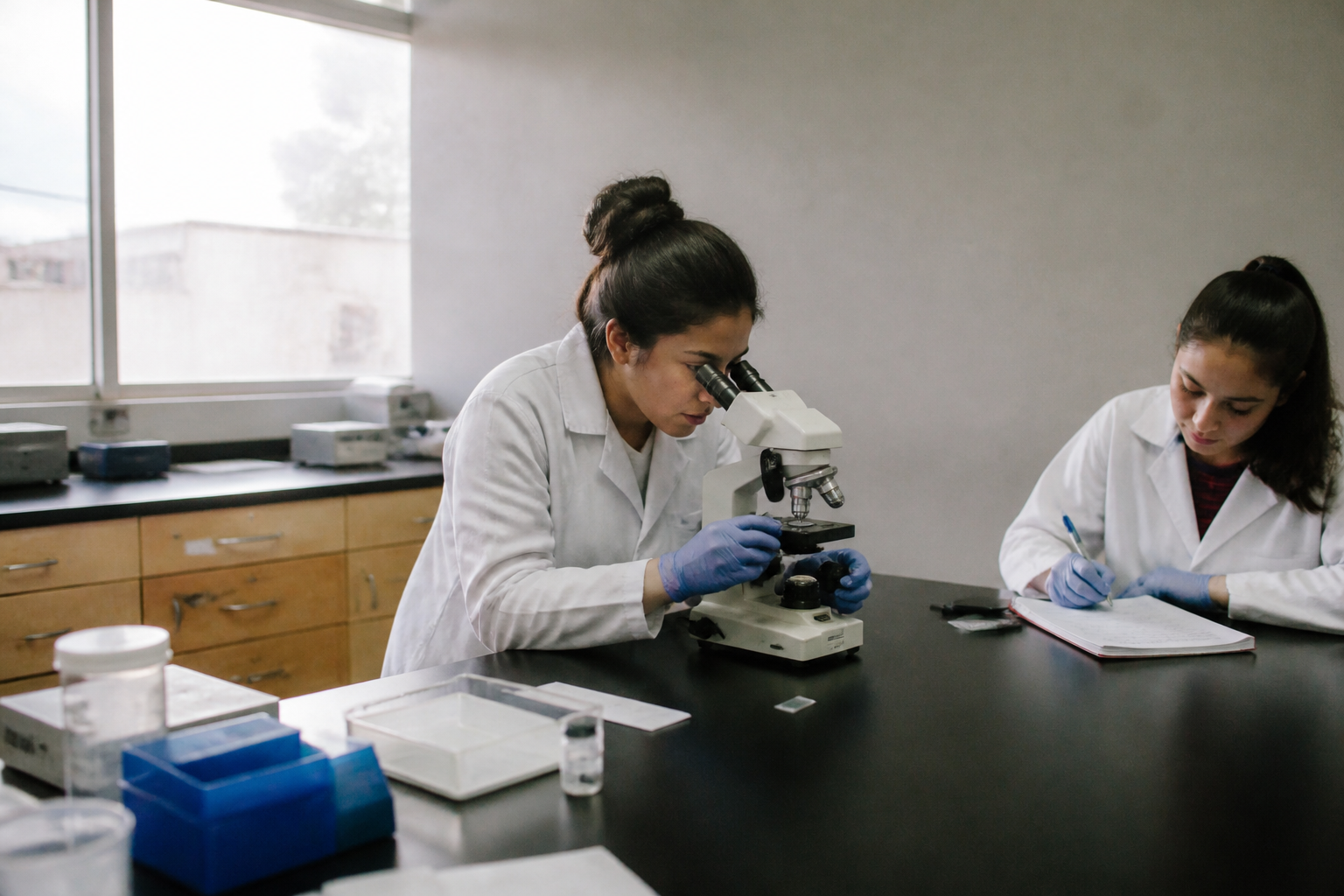
A bachelor's degree in forensic science is the entry credential for Michigan crime lab and investigative careers, and lab hiring leans heavily on chemistry and biology coursework. Schools award it as a Bachelor of Science (B.S.) or Bachelor of Arts (B.A.) in Forensic Science. Each program reaches that goal through a different science: forensic biochemistry at Northern Michigan University, a forensic biology concentration at Ferris State University, and forensic chemistry at Lake Superior State University.
That difference matters more than the name on the diploma. FEPAC status, how much lab work can move online, and cost after aid all shape whether a program fits a lab-bound career, and a thin science transcript narrows options quickly.
Key Points
- Northern Michigan teaches forensic biochemistry; Ferris State, a forensic biology concentration.
- In-state tuition runs $14,277 (Northern Michigan) to $14,890 (Lake Superior State).
- Lab-heavy coursework keeps most forensic science study on campus, not online.
Best Bachelor's in Forensic Science Schools in Michigan
Three Michigan universities carry a ranked bachelor's program in forensic science, and each takes a different scientific route into the field: biochemistry, biology, and chemistry. With a field this small, the decision comes down less to prestige than to which science you want to practice for four years. Each entry below gives the city, format, concentration, school-wide graduation and admission rates, and a one-line note on who fits best.
Northern Michigan University
#1Marquette, MI · $14,000 – $20,000/yr (est.)
Best for: Hands-on fieldwork learners
Northern Michigan University in Marquette runs its forensic training through the NMU Center for Forensic Science, which includes the Forensic Research Outdoor Station (FROST), a forensic anthropology research facility, and a body donation program. The forensic biochemistry major draws coursework from several departments and carries the credit load of a major plus a minor, so students do not add a second minor, and it prepares graduates for crime lab investigator roles as well as graduate study. School-wide, the graduation rate is 52 percent and the admission rate is 84 percent, with net price after aid near $14,100, covered in more detail further down. It is the northernmost of the three options and the one built around outdoor and anthropological fieldwork.
- No additional minor required; credit load equals a major plus a minor
- Coursework drawn from multiple departments across the sciences
- Prepares students for crime lab investigator roles and graduate study
- Training runs through the NMU Center for Forensic Science
- On-campus Forensic Research Outdoor Station (FROST)
- Forensic Anthropology Research Facility and Body Donation Program
Ferris State University
#2Big Rapids, MI · ~$9,000/yr (est.)
Best for: Community college transfers with science credits
Ferris State University in Big Rapids awards a B.S. in biology with a forensic concentration, a 60- to 65-credit track inside a 120-credit degree. Students take forensic biology, DNA analysis, and forensic chemistry alongside organic chemistry, biochemistry, microbiology, and statistics, then work mock crime scenes for decomposition, blood spatter, and gunshot trajectory. The university holds consortium and Building Pathways agreements with community colleges across Michigan, which makes it the most transfer-friendly of the three for students arriving with credits. School-wide, 47 percent of students graduate and 91 percent of applicants are admitted, and net price after aid is roughly $8,600.
- Biology/Forensic concentration runs 60 to 65 credits within a 120-credit degree
- 16 credits of major biology courses plus 10 credits of supporting chemistry
- Forensic coursework in forensic biology, DNA analysis, and forensic chemistry
- Students analyze mock crime scenes for decomposition, blood spatter, and gunshot trajectory
- Criminal justice foundations built into the concentration
- Routes to forensic labs, law enforcement, or graduate and professional study
Lake Superior State University
#3Sault Ste Marie, MI · ~$13,000/yr (est.)
Best for: Chemistry-focused students wanting instrument time
Lake Superior State University in Sault Ste. Marie offers a B.S. in forensic chemistry that pairs a chemistry core with criminal justice coursework and puts serious instruments in undergraduate hands: Q-PCR thermocyclers, ICP-MS, NMR, HPLC, GC-MS, and FTIR spectrometers. The capstone forensic chemistry course is team taught and capped at 24 students, and students can add a senior research project, present at the University Research Symposium, and intern in faculty labs or the Superior Analytics Laboratory. The school-wide graduation rate is 51 percent, net price after aid is about $12,800, and the university does not report a first-year admission rate in federal data. This is the option for a student who wants the chemistry bench rather than the biology bench.
- Capstone forensic chemistry course limited to 24 students, team taught
- Students operate Q-PCR, ICP-MS, NMR, HPLC, GC-MS, and FTIR spectrometers
- Senior research project and presentation at the University Research Symposium
- On-campus internships in faculty labs or the Superior Analytics Laboratory
- Chemistry core combined with criminal justice coursework
- Program reports full placement for graduates entering the workforce
Cost & outcomes by school
Federal data for the highest-earning Forensic Science programs, independent of the ranking above. Earnings are this field's bachelor's graduates four years after completing where the Scorecard reports them, else the school's undergraduate median.
| School | Net price / yr | Grad rate | Earnings | Debt | Grads/yr | Format |
|---|---|---|---|---|---|---|
| Ferris State University MI | $8,624 | 47% | $54,735 | $21,000 | — | Campus |
| Lake Superior State University MI | $12,822 | 51% | $49,045 | $23,250 | — | Campus |
| Northern Michigan University MI | $14,085 | 52% | $47,107 | $21,474 | — | Campus |
Sources: U.S. Department of Education. Net price, graduation rate, earnings and debt: College Scorecard (earnings and debt for this field's bachelor's graduates where reported, else school-wide); graduates: IPEDS. A dash means no figure is reported.
Cost, debt & payoff
Median earnings of this field's bachelor's graduates (4 yrs after completing, else the school's undergraduate median) vs. their median federal loan debt · U.S. College Scorecard
Across these programs the median graduate earns about $49,045 and finishes with roughly $21,474 in debt — a ratio that clears a common rule of thumb (keep debt below first-year salary). Net price and debt vary widely school to school, so check the per-school figures in the table above before you shortlist.
How We Ranked Michigan Forensic Science Schools
What actually separates one Michigan forensic science bachelor's program from another when the brochures all read the same?
Where the Numbers Come From
The figures trace to federal sources: College Scorecard and the Integrated Postsecondary Education Data System (IPEDS). From them we pull net price, graduation rate, selectivity, and, where the federal data reports it, earnings and student debt tied to the specific program rather than the whole campus. That last distinction matters. A forensic science graduate's early outcomes can look very different from the university-wide averages printed on a recruitment page.
Why Only Bachelor's Degrees Appear
The list covers bachelor's degrees in forensic science only. A dedicated B.S. or B.A. in the field means a real laboratory sequence: criminalistics, trace evidence, DNA analysis, instrumental methods, plus the internship or research hours that hiring labs expect. A minor or a certificate bolted onto a biology or chemistry major can supplement a degree, but it is not the same credential and usually skips part of that hands-on lab work.
School-Wide Averages, Read Carefully
The graduation rate and net price cover the whole institution, not one program. A well-equipped program can sit inside a university with a middling overall completion rate, and net price after aid shifts with family income. Treat both as filters for affordability and completion culture, then verify the program itself: faculty with casework experience, instrumentation students actually touch, and working relationships with Michigan crime labs.
Earning a Bachelor's Degree in Forensic Science in Michigan: B.S. vs. B.A. and FEPAC Accreditation
The tradeoff is straightforward: a broader B.A. is easier to finish and less useful in a hiring lab, while a chemistry-heavy B.S. is harder and closer to what accredited crime labs screen for. The Michigan programs ranked on this page all sit on the science side of that line, and the state's FEPAC-accredited bachelor's program is not among them.
What FEPAC accreditation means
FEPAC, the Forensic Science Education Programs Accreditation Commission, reviews a program's curriculum, lab space, faculty and internship requirements against standards written with crime-lab directors.2 As of FEPAC's June 2026 actions, none of the schools ranked on this page appears on the commission's accredited bachelor's list; Michigan's accredited bachelor's program is a B.S. at a school outside this ranking.1 That does not make these programs weak, but if a state lab or graduate school filters applicants by accreditation, know where you stand before you enroll. Many hiring labs and graduate programs use the list as a first cut, because it signals that coursework covers the bench chemistry and biology those labs actually test for.
B.S. versus B.A. coursework
Both degrees can carry the words forensic science; the natural science load is where they part. - B.S.: two semesters of organic chemistry with lab, quantitative and instrumental analysis, biochemistry, physics, and calculus or statistics. FEPAC-aligned programs usually add a chemistry minor or its equivalent. - B.A.: fewer required lab sequences, with the freed credits going to criminal justice, psychology, a language or humanities. Reasonable preparation for policy, law or evidence-handling roles; thin for a bench analyst job.
At the schools ranked here the offerings are science-concentrated: forensic biochemistry, a forensic biology concentration and forensic chemistry. Do not assume a B.A. track exists at any of them.
What to check in a lab-track curriculum
- At least two semesters of organic chemistry with lab, plus quantitative and instrumental analysis.
- Biochemistry, genetics and molecular biology if DNA work interests you.
- Statistics and a research or independent-study course.
- A semester-long internship with an accredited lab, ideally required rather than optional.
- Whether the program maps its requirements to FEPAC standards, and when it last revised them.
Online and Hybrid Forensic Science Bachelor's Options at Michigan Schools
An online or hybrid forensic science bachelor's would let you take some or all of your coursework remotely. The trouble is that the lab science at the core of this degree is hard to move off campus. At the Michigan schools ranked here, the forensic science bachelor's programs are listed as campus-based, so plan on living within reach of Marquette, Big Rapids, or Sault Ste. Marie.
Where the Lab Work Happens
Each program builds the degree around hands-on science you do on site:
- Northern Michigan University: The Forensic Biochemistry program draws courses from multiple departments and offers forensic anthropology fieldwork at FROST, an outdoor research station on campus.
- Ferris State University: The Forensic Biology concentration includes mock crime scene analysis, DNA analysis and evidence handling, and human anatomy and physiology coursework.
- Lake Superior State University: Forensic Chemistry students operate NMR, HPLC, GC-MS, and FTIR instruments, complete a required capstone, and can take on-campus internships.
At any school, general chemistry, biology, and instrumental analysis labs are the courses most likely to require in-person attendance. Some lecture-only general education courses may be available online. Confirm this with each school before you assume any part of the degree can be finished remotely.
Online Criminal Justice and Digital Forensics Are Different Degrees
Ferris State offers criminal justice classes on its Big Rapids campus, online, or in a mixed format.1 Its degree-completion option at statewide and online locations requires either a finished associate degree or at least 48 transferable semester credits.1 That program studies policing, courts, and corrections. It is not the same credential as a forensic biology degree.
Digital forensics programs are often housed in cybersecurity departments.2 They train you to recover evidence from hard drives, phones, and networks, which suits computer crime units rather than wet-lab bench work.
If your goal is a crime lab job analyzing DNA, drugs, or trace evidence, an online criminal justice degree generally won't qualify you. Crime labs typically expect a natural science bachelor's with substantial chemistry and biology lab coursework. The campus programs above are built to deliver that coursework.
Related Articles
Admission Requirements: GPA, Test Policy, and Transfer Credit
Getting into a Michigan forensic science bachelor's program is rarely the hard part. The real question is whether your transcript has prepared you for a major built on chemistry and biology.
How Selective Are These Schools?
Ferris State University admits about 91 percent of applicants, and Northern Michigan University admits about 84 percent. Both are broadly accessible public universities. Lake Superior State University limits its forensic chemistry classes to 24 students, so ask its admissions office how seats in the major are filled, not only how the campus admits.
A high campus-wide admission rate does not always mean open entry to a science major. Some departments set their own progression standards once you enroll, so ask each program whether that applies.
GPA, Testing, and High School Preparation
Each program leans hard on lab science:
- Northern Michigan: The track centers on forensic biochemistry.
- Ferris State: The forensic biology concentration includes human anatomy and physiology.
- Lake Superior State: Forensic chemistry is accredited by the American Chemical Society and trains students on NMR, HPLC, GC-MS and FTIR instruments.
The official pages for these forensic tracks list neither a program-specific minimum GPA nor a current SAT/ACT policy. Confirm both directly with each admissions office rather than assuming a number.
In high school, aim for chemistry, biology and math through at least precalculus, plus physics if your school offers it. These are not published requirements, but they are the courses that make the first year of a forensic science curriculum manageable.
The Michigan Transfer Agreement (MTA) is the main statewide pathway.1 To complete the MTA block, you need at least 30 credits, with a grade of 2.0 or higher in each course, spread across six areas:1
- English composition
- Communications
- Mathematics
- Social sciences
- Humanities and fine arts
- Natural sciences
The MTA generally covers general education requirements, not the major itself. Universities usually evaluate general chemistry, organic chemistry and biology sequences course by course. Lab-heavy forensic courses may need to be taken at the university.
Before you enroll at a community college, ask your target school for a transfer guide or articulation agreement, and request a credit evaluation of your science courses. That one step can save a semester of repeated coursework.
How Much Do Michigan Forensic Science Schools Really Cost After Aid?
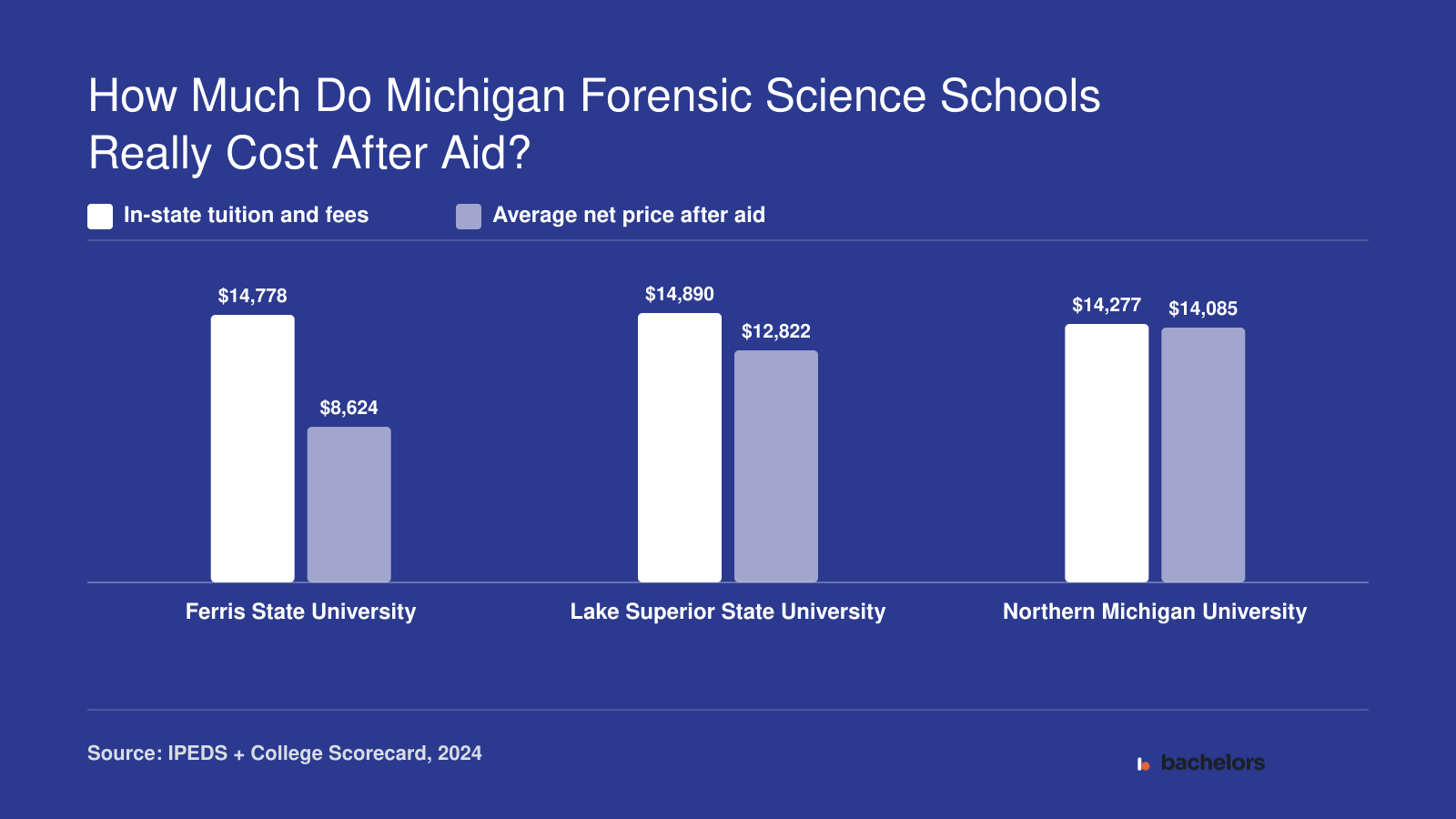
In-state tuition and fees at the schools ranked here fall in a narrow band, from $14,277 at Northern Michigan University to $14,890 at Lake Superior State University, but what families actually pay after grants and scholarships varies much more. Ferris State University shows the widest gap, with an average net price of $8,624, about $6,154 below its sticker price, while Northern Michigan University's net price of $14,085 sits only $192 under its tuition and fees. Keep in mind that net price is an institution-wide average for aided undergraduates, not a figure specific to forensic science majors, so your own cost will depend on your aid package.
Questions to Ask Yourself
Do you want to work in a crime lab or at crime scenes?
Does the program's FEPAC status match the lab jobs you are aiming for?
Can you commit to in-person labs, or do you need a hybrid format?
Will your net price leave manageable debt against Michigan entry-level wages?
Compare Forensic Science programs on the data that matters
Explore more Criminal Justice & Law majors or browse every field of study.
All Criminal Justice & Law programs Browse every field of study