Best Forensic Science Schools in South Carolina
Compare 8 accredited Forensic Science programs in South Carolina, with net price after aid, graduation rates, earnings and debt from IPEDS and the U.S. College Scorecard.
Does South Carolina have a real bachelor's degree in forensic science, or only chemistry degrees with a forensic label? Both exist, and the distinction shows up in job postings. Schools award the credential as a Bachelor of Science (B.S.) or a Bachelor of Arts (B.A.) in Forensic Science, while others tuck a forensic concentration inside chemistry, biology or criminal justice.
FEPAC accreditation is a separate question from the degree title, and cost is separate again: average net price after aid at the South Carolina schools here runs from roughly $11,400 to $21,700 a year.
Crime lab hiring in the state still turns on bench chemistry and instrument time, so the science-heavy track tends to travel further than the criminal justice route.
Key Points
- Francis Marion University has the lowest average net price: $11,386 a year.
- Southern Wesleyan's $29,800 sticker price drops to $15,464 after aid.
- Lander, Francis Marion and USC Upstate house forensic science inside chemistry degrees.
Best Forensic Science Schools in South Carolina: Our Ranked List
South Carolina has no standalone forensic science major at most of its colleges, so this list ranks eight bachelor's programs that get students into the field through a named forensic science degree or a forensic concentration inside chemistry, biology or psychology. One school awards the Bachelor of Science in Forensic Science outright, while the others build the specialty on top of a traditional science or social science major. Tuition, average net price and graduation rate figures shown with each entry are institution-wide rather than program-specific.
Southern Wesleyan University
#1Central, SC · $15,000/yr (est. net price)
Best for: Students seeking a degree titled forensic science
Southern Wesleyan University is a private institution in Central, South Carolina, and the only school on this list that awards a degree carrying the forensic science name outright: a Bachelor of Science in Forensic Science. The major is taught in person and sits alongside biochemistry, biology, chemistry, environmental science and criminal justice studies programs, which gives students adjacent lab and justice coursework to draw on. The university lists forensic science at the bachelor's level only.
- Bachelor of Science in Forensic Science, offered as an on-campus major
- Classes meet in person at the Central, South Carolina campus
- Sits alongside biochemistry, biology, chemistry and environmental science majors
- Criminal justice studies major available as a companion program
- Forensic science listed at the bachelor's level only, with no minor
Winthrop University
#2Rock Hill, SC · $15,000/yr (est. net price)
Best for: Research-minded students preferring a chemistry route
Winthrop University in Rock Hill approaches the field through chemistry rather than criminal justice. Students earn a Bachelor of Science in Chemistry and select the forensic chemistry track, one of five chemistry tracks, with an optional route to professional certification through the American Chemical Society. The department reports that more than 85 percent of its chemistry and biochemistry students complete research, and that 86 percent of recent graduates moved into graduate school or technical positions.
- Forensic chemistry track inside the chemistry major
- One of five chemistry degree tracks students can choose
- Optional track for American Chemical Society certification
- More than 85 percent of chemistry students complete research
- 86 percent of recent graduates entered graduate school or technical roles
- Prepares graduates for government and industry laboratory positions
Coastal Carolina University
#3Conway, SC · $10,000 – $15,000/yr (est.)
Best for: Psychology-focused students aiming at forensic careers
Coastal Carolina University in Conway treats forensics as a concentration inside psychology, so students graduate with a psychology degree and a structured forensic cognate rather than a standalone forensics major. The 120-credit program requires a capstone and a C or better in every concentration course, which keeps the forensic sequence rigorous. Coursework pairs Psychology and the Law with electives such as forensic archaeology and anthropology, digital forensics and victimology.
- 120 total credit hours, including a required capstone
- 31 to 32 credits of psychology major requirements
- 16-credit forensics cognate built into the degree
- Psychology and the Law is a required concentration course
- Electives include forensic archaeology and anthropology and digital forensics
- C or better required in every concentration course
Lander University
#4Greenwood, SC · $15,000/yr (est. net price)
Lander University in Greenwood keeps students inside the chemistry major and adds a forensic science concentration aimed at crime laboratory work. Named courses include criminalistics, microscopical methods and toxicology, with an emphasis on analytical techniques that do not destroy trace evidence. A four-year major guide lays out the recommended course order, and the university points graduates toward local, state and federal criminalistics labs as well as museum and nonprofit roles.
- Chemistry degree with a forensic science concentration
- Built around crime laboratory applications
- Courses in criminalistics, microscopical methods and toxicology
- Analytical methods chosen to preserve trace evidence
- Four-year major guide maps the recommended course order
- Leads to local, state and federal crime laboratory roles
University of South Carolina-Upstate
#5Spartanburg, SC · ~$14,000/yr (est.)
The University of South Carolina Upstate in Spartanburg awards a Bachelor of Science in Chemistry with a forensic science concentration, one of three chemistry tracks alongside a general track and pre-pharmacy. The Department of Natural Sciences supports undergraduate research and internships, and posts degree completion worksheets for each track so students can map the sequence early. Students who want more flexibility can look at the department's biology BS and BA options.
- One of three chemistry tracks, with general and pre-pharmacy options
- Undergraduate research opportunities supported by the department
- Internships available for majors
- Degree completion worksheets posted for each chemistry and biology track
- Department also awards BS and BA degrees in biology
- Pre-professional advisement in medicine, dentistry, pharmacy and optometry
Francis Marion University
#6Florence, SC · $11,000 – $22,000/yr (est.)
Francis Marion University in Florence runs a forensic science option inside the chemistry major and deliberately mixes in criminal justice coursework. Students take the traditional chemistry sequence plus courses in criminology, social deviance, violence, judicial processes and policing, along with a dedicated Essential Forensic Chemistry course and a research course in forensics. The option runs 120 to 122 credit hours and is aimed at crime laboratory work in South Carolina, including the State Law Enforcement Division, and at advanced forensic study.
- Traditional chemistry major with a forensic focus
- Criminal justice courses in criminology, deviance and policing
- Required Essential Forensic Chemistry course
- Research in Forensics course required for the option
- 120 to 122 total credit hours to graduate
- Mathematics sequence runs through Calculus III
Newberry College
#7Newberry, SC · ~$22,000/yr (est.)
Newberry College takes a biology route, awarding a Bachelor of Science in Biology with a forensic biology concentration. The concentration requires 76 credit hours and covers DNA analysis and laboratory testing, and the college states it meets federal educational requirements for DNA analysts. Students can pursue internships through a working relationship with the South Carolina State Law Enforcement Division laboratory, and a senior capstone and experiential learning hours are built into the major.
- Forensic Biology concentration inside the biology major
- 76 total credit hours required for the concentration
- Forensic DNA analysis and laboratory testing experience
- Stated to meet federal educational requirements for DNA analysts
- Internships through a relationship with the SLED laboratory
- Senior capstone and experiential learning hours built into the major
Columbia College
#8Columbia, SC · ~$18,000/yr (est.)
Columbia College in Columbia offers a Bachelor of Science in Forensic Criminal Justice with a forensic concentration, and it is the one school on this list where students can complete the degree on campus or fully online. Concentration work covers forensic toxicology, forensic DNA, fingerprint recognition and comparison, and crime scene investigation, with labs in forensic DNA and crime scene work. Online terms run seven weeks with six start dates a year, and the college accepts up to 90 transfer credits, including 24 training hours.
- Available on campus and fully online
- Coursework in forensic toxicology, DNA and fingerprint comparison
- Labs in forensic DNA and crime scene investigation
- Seven-week online terms with six start dates each year
- Up to 90 transfer credits accepted, including 24 training hours
- Prepares for crime scene technician and DNA analyst roles
Cost & outcomes by school
Federal data for the highest-earning Forensic Science programs, independent of the ranking above. Earnings are this field's bachelor's graduates four years after completing where the Scorecard reports them, else the school's undergraduate median.
| School | Net price / yr | Grad rate | Earnings | Debt | Grads/yr | Format |
|---|---|---|---|---|---|---|
| University of South Carolina-Upstate SC | $13,557 | 43% | $48,587 | $22,310 | — | Campus |
| Newberry College SC | $21,656 | 45% | $48,040 | $26,805 | — | Campus |
| Southern Wesleyan University SC | $15,464 | 52% | $47,756 | $26,000 | 3 | Campus |
| Coastal Carolina University SC | $13,966 | 49% | $47,258 | $23,750 | — | Campus |
| Winthrop University SC | $15,343 | 57% | $47,185 | $26,975 | — | Campus |
| Francis Marion University SC | $11,386 | 43% | $43,888 | $27,000 | — | Campus |
| Lander University SC | $15,363 | 50% | $42,396 | $25,000 | — | Campus |
| Columbia College SC | $18,408 | 37% | $41,338 | $22,750 | — | Online or campus |
Sources: U.S. Department of Education. Net price, graduation rate, earnings and debt: College Scorecard (earnings and debt for this field's bachelor's graduates where reported, else school-wide); graduates: IPEDS. A dash means no figure is reported.
Cost, debt & payoff
Median earnings of this field's bachelor's graduates (4 yrs after completing, else the school's undergraduate median) vs. their median federal loan debt · U.S. College Scorecard
Across these programs the median graduate earns about $47,222 and finishes with roughly $25,500 in debt — a ratio that clears a common rule of thumb (keep debt below first-year salary). Net price and debt vary widely school to school, so check the per-school figures in the table above before you shortlist.
Most Affordable Forensic Science Schools in South Carolina
These are the lowest-cost options among the schools ranked here, ordered by average annual net price after grants and scholarships. Francis Marion University in Florence comes in lowest at $11,386 a year. Every program below is campus-based. Figures come from IPEDS and College Scorecard (2024) data published by the U.S. Department of Education.
| School | City | Program | Format | In-State Tuition and Fees (per year) | Average Net Price (per year) |
|---|---|---|---|---|---|
| Francis Marion University | Florence | Forensic Science Option in Chemistry | Campus | $11,160 | $11,386 |
| University of South Carolina-Upstate | Spartanburg | Chemistry (Forensic Science Concentration) | Campus | $11,588 | $13,557 |
| Coastal Carolina University | Conway | Psychology: Forensics Concentration, B.S. | Campus | $11,640 | $13,966 |
| Winthrop University | Rock Hill | Forensic Chemistry | Campus | $14,678 | $15,343 |
| Lander University | Greenwood | Chemistry, Forensic Science Concentration | Campus | $11,700 | $15,363 |
What a Bachelor's Degree in Forensic Science Looks Like in South Carolina
A bachelor's degree in forensic science trains you to apply lab science to legal questions, but South Carolina schools package it in different ways. Before comparing costs, sort programs by degree type and by how much hard science they require.
B.S. vs. B.A. in Forensic Science
A Bachelor of Science (B.S.) leans on lab courses, chemistry, biology and math, which is what crime lab analyst roles typically expect. A Bachelor of Arts (B.A.) leaves more room for humanities, social science and electives, a better fit for investigative, legal or policy work. Southern Wesleyan University awards a B.S. in Forensic Science.2 Lander University's track sits inside a B.S. in Chemistry, and Coastal Carolina University's forensics concentration is a B.S. in Psychology. USC Upstate offers both B.S. and B.A. degrees in its natural sciences department, so confirm which one carries the forensic concentration.
Forensic Science Majors vs. Related Degrees
Southern Wesleyan lists forensic science as a stand-alone major. Most other programs here are forensic concentrations inside a traditional degree:
- Chemistry: Winthrop University (Forensic Chemistry track with American Chemical Society certification), Lander (criminalistics, microscopical methods, toxicology), USC Upstate, and Francis Marion University (a forensic option that adds criminal justice coursework and prepares students for forensic work at SLED, the State Law Enforcement Division).
- Biology: Newberry College's forensic biology concentration focuses on DNA analysis, includes SLED laboratory internships, and is described by the college as meeting federal DNA analyst requirements.
- Psychology: Coastal Carolina pairs a 16-credit forensics cognate with a required Psychology and the Law course, plus a digital forensics course option and a forensic archaeology and anthropology elective.
- Criminal justice: Columbia College's Forensic Criminal Justice degree covers toxicology, DNA and fingerprinting, and can be completed fully online.
If your goal is a crime lab bench job, the chemistry and biology routes give you the science credits labs look for. Criminal justice and psychology tracks suit investigative and courtroom-adjacent roles.
FEPAC Accreditation Status
The Forensic Science Education Programs Accreditation Commission (FEPAC) reviews forensic science curricula against standards tied to crime lab practice. Many crime labs view a FEPAC-accredited degree as evidence that a graduate completed the right coursework, which can give applicants an edge in a competitive hiring pool.
As of November 2026, we could not confirm FEPAC accreditation for any South Carolina bachelor's program ranked here, so do not assume any of them hold it.1 Check the commission's current accredited-program directory and ask each department directly before you enroll. Winthrop's chemistry program does carry accreditation from the American Chemical Society, a credential that matters to labs hiring chemists.
Online and Hybrid Bachelor's Options at South Carolina Schools
Online study can carry a forensic science bachelor's degree most of the way, but not all of it. The chemistry and biology tracks on this list are built around bench time, and bench time does not move to a screen.
Where Online Works
Columbia College is the one school here that awards its forensic criminal justice bachelor's in both formats: on campus in Columbia and fully online. The online version runs in 7-week terms with no scheduled login times, free e-books, and up to 90 transfer credits accepted, which matters if you are finishing a degree while working. Coursework covers toxicology, DNA, and fingerprinting, and it maps to forensic technician and fingerprint examiner roles. Treat it as a criminal justice degree with a forensic concentration: it fits evidence handling, investigations, and casework rather than a chemistry bench.
Why the Science Tracks Stay on Campus
The chemistry and biology programs at Lander, USC-Upstate, Francis Marion, Winthrop and Newberry are campus-based, and the labs explain why. Instrumental analysis, microscopical methods, toxicology, and DNA testing all need equipment and supervised hours in the room. Newberry's forensic DNA focus and Lander's crime-lab coursework assume you are in the building. Coastal Carolina's psychology-forensics concentration and Southern Wesleyan's forensic science major are designed as on-campus programs as well.
Format Does Not Settle Accreditation
An online degree is not automatically FEPAC-accredited, and a campus degree is not automatically a stronger one. FEPAC reviews curriculum, faculty, and laboratory resources, so check the accreditor's published list instead of inferring from delivery mode. If you apply to an online option, ask in writing how any required lab component is completed and confirm it before you enroll. Working students can make the online route work; students aiming at a crime lab analyst job should plan for campus time.
Admissions Requirements for South Carolina Forensic Science Bachelor's Programs
Test-optional admissions is now common at South Carolina universities, but forensic science programs still expect incoming students to arrive with real lab-science preparation. At the schools ranked here, you apply through the university's undergraduate admissions office first, with any program-specific expectations layered on top. The school's admissions page is the source of record; a program page describes curriculum, not thresholds.
What the Program Pages Publish
Southern Wesleyan University's Forensic Science (B.S.) page does not publish a minimum GPA, an SAT/ACT policy, required high school science courses, or a transfer-credit policy. That is a "no policy published" result, not evidence that standards are loose. The other schools ranked here treat the forensic program page as a curriculum document: it shows whether the degree is a standalone major or a concentration inside chemistry, biology, or criminal justice, but it usually does not restate the university's admission rules.
What to Confirm, School by School
- Southern Wesleyan University: Ask admissions for the GPA floor, test-optional status, high school lab-science expectations, and transfer-credit rules for the Forensic Science (B.S.).
- Winthrop University: Forensic Chemistry is a chemistry-based program; confirm the university test policy and the high school chemistry and math courses the department expects.
- Coastal Carolina University: The forensics concentration is in psychology; verify GPA, test policy, and transfer credit with undergraduate admissions.
- Lander University: The forensic science concentration is in chemistry; ask about lab-science prerequisites and how transfer lab courses are evaluated.
- University of South Carolina-Upstate: Confirm the chemistry-based concentration's math and science preparation with the department.
- Francis Marion University: The forensic science option is in chemistry; check transfer credit for lab courses specifically.
- Newberry College: The listed program is Biology; ask admissions whether forensic coursework is available and what the transfer policy is.
- Columbia College: Forensic Criminal Justice is the track; confirm GPA and transfer rules with admissions.
Transfers and Test-Optional Applicants
For transfer students, the question is not only the GPA floor but which science credits count. Lab courses in chemistry and biology are the ones most likely to be evaluated course by course. For test-optional applicants, ask whether scores are still used for merit scholarships or course placement even when they are not required for admission. Get the answer in writing before you apply.
The Takeaway
Flexibility depends more on your transcript than on a single school's reputation. Southern Wesleyan publishes the least program-specific detail, so a direct conversation with admissions matters most there. Where a program page is silent on GPA, tests, science prerequisites, or transfer credit, the admissions office is the only reliable source.
Cost of a Forensic Science Bachelor's Degree in South Carolina
Published tuition for South Carolina residents at the public universities in this ranking falls into a narrow band, so the sticker-price gap between them is smaller than most families expect. What separates these schools is net price after grant aid, and how much a graduate actually borrows.
Sticker Price vs. Net Price
- Francis Marion University: $11,160 in-state tuition, average net price $11,386
- University of South Carolina-Upstate: $11,588 in-state tuition, average net price $13,557
- Coastal Carolina University: $11,640 in-state tuition, average net price $13,966
- Winthrop University: $14,678 in-state tuition, average net price $15,343
- Lander University: $11,700 in-state tuition, average net price $15,363
Net price is an institution-wide average for first-time, full-time students who receive aid. Treat it as a starting estimate, not a forensic major's bill, and expect a chemistry-heavy program to carry lab fees on top.
What Borrowers Leave With
Median debt among graduates who borrowed runs from roughly $22,300 at USC-Upstate and $23,750 at Coastal Carolina to $25,000 at Lander, $26,975 at Winthrop and $27,000 at Francis Marion. These are institution-wide figures rather than program-specific ones. The school with the lowest tuition is not the school with the lowest borrowing, which is why aid matters more than sticker price.
South Carolina Aid You Can Stack
- SC LIFE Scholarship: up to $5,000 a year.2 At four-year institutions, students must meet at least two of three criteria: a 3.0 GPA, an 1100 SAT or 22 ACT, or top 30% of the high school class.1
- Palmetto Fellows Scholarship: up to $6,700 in the first year and up to $7,500 in years two through four, with continuing eligibility set at a 3.0 institutional GPA and 30 credit hours per academic year.1
- SC HOPE Scholarship: up to $2,800 for the freshman year at a four-year institution, for a student with at least a 3.0 GPA at high school graduation who does not qualify for LIFE or Palmetto Fellows.1
- SC Need-based Grant: up to $3,500 full-time or $1,750 part-time at eligible public institutions, based on FAFSA completion and demonstrated need.3
Every amount above is a maximum, not a guarantee.
One Move That Pays Off
File the FAFSA before the state deadline, then email each financial aid office a single question: how do state awards and your institutional scholarships interact? Some schools let both apply in full, while others reduce one when the other arrives. Getting that answer in writing, before you deposit, is worth more than hours of searching for extra awards.
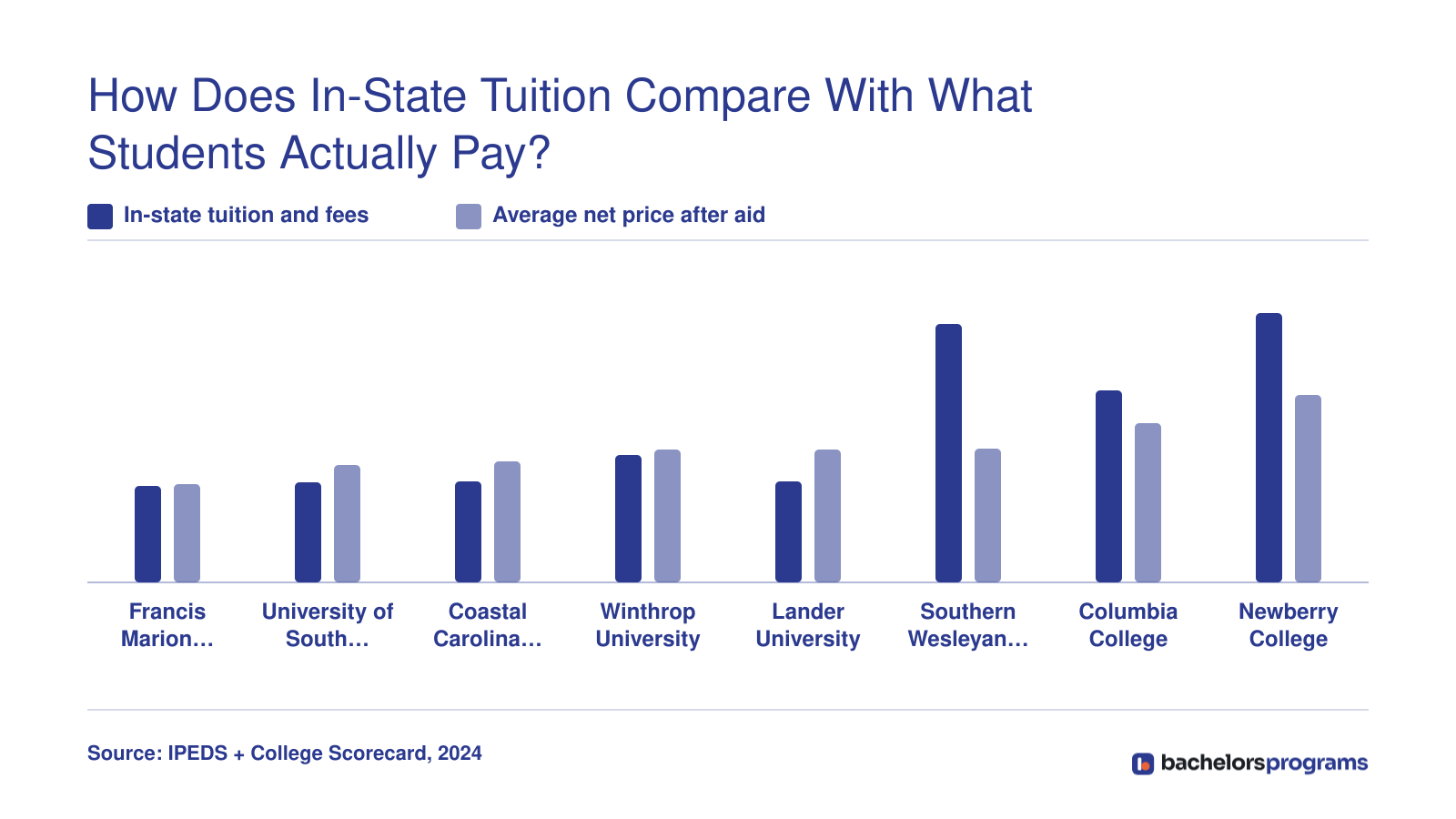
How Does In-State Tuition Compare With What Students Actually Pay?
Private schools show the biggest drop from sticker price: Southern Wesleyan University lists $29,800 in tuition and fees but an average net price of $15,464, and Newberry College falls from $31,100 to $21,656. At public schools such as Francis Marion University and Lander University, net price runs above tuition because it also counts housing, books and other costs after grants are subtracted. Net price here is an approximate institution-wide average for all undergraduates, not a figure specific to the forensic science program.
Related Articles
Frequently Asked Questions
These quick answers cover the questions students ask most about forensic science bachelor's programs in South Carolina. Details on each school appear in the ranked list and cost sections above.
Does South Carolina have a bachelor's degree in forensic science?
Are there FEPAC-accredited forensic science programs in South Carolina?
How much does a forensic science degree cost in South Carolina?
Can you get a forensic science degree online in South Carolina?
How much do forensic scientists make in South Carolina?
Compare Forensic Science programs on the data that matters
Explore more Criminal Justice & Law majors or browse every field of study.
All Criminal Justice & Law programs Browse every field of study