Best Online Homeland Security Degree Programs
Compare 80+ accredited online Homeland Security programs, with net price after aid, graduation rates, earnings and debt from IPEDS and the U.S. College Scorecard.

The same bachelor's degree in homeland security can lead to a federal protective service job or a county emergency management post, but the coursework behind each differs. The credential is a bachelor's degree in homeland security, a B.S. at some schools, a B.A. at others, typically 120 credits, and every program ranked below is 100% online, with no hybrid or in-person requirement. All are undergraduate degrees; master's programs are a separate market. The tension is fit, not format. A curriculum built around intelligence analysis reads differently from one built for hazard mitigation, and each points toward a different hiring pipeline.
Key Points
- Most homeland security bachelor's programs require 120 credit hours to finish.
- Cybersecurity is the highest-paying career path for homeland security graduates.
- Public universities offer the lowest net prices among fully online programs.
Top 10 Fully Online Homeland Security Bachelor's Degree Programs
Every program below can be completed entirely online, with no in-person or hybrid component required to finish the degree. The list runs in overall quality order, and each entry notes the average net price after aid, the institution-wide graduation rate, and, where the federal data reports it at the program level, what graduates of the homeland security program earn and borrow.
American Public University System
#1Charles Town, WV · $5,000 – $10,000/yr (est.)
Best for: Military and public safety professionals
American Public University System serves a heavily military and public safety student population, and its homeland security instructors include people holding government and agency posts. The Bachelor of Arts in Homeland Security runs 120 credits with a broad general concentration and closes with a senior seminar taken last. The school graduates 57% of students, and the average net price after aid is about $9,600. Federal data for the homeland security program shows median earnings of $77,122 four years after finishing, against roughly $24,900 in median debt.
- 120 credit hours, including a 3-credit senior seminar
- 18 credit hours of major core coursework
- 24 credits in a general homeland security concentration
- 45 elective credits; minor and certificate credits accepted
- Coursework on intelligence, border security and cyber warfare
- Faculty hold posts in government and public safety agencies
Thomas Edison State University
#2Trenton, NJ · $5,000 – $10,000/yr (est.)
Best for: Adults transferring existing college credit
Thomas Edison State University is New Jersey's online public institution for adults, built around credit transfer and flexible pacing rather than a traditional campus schedule. Its homeland security degree follows the five National Preparedness System mission areas and lets students apply prior coursework toward the 120 credits. Graduates can continue into a related master's at the same university without starting over.
- 120 credits, offered fully online
- Built on the five National Preparedness System mission areas
- Coursework in public safety, business continuity and policy
- Transfer credit accepted toward the degree
- Progress to an M.S. in Homeland Security or M.S. in Management
- Order of the Sword & Shield honor society available
Arizona State University
#3Tempe, AZ · ~$15,000/yr (est.)
Best for: Accelerated bachelor's plus master's seekers
Arizona State University houses this degree in the Watts College of Public Service and Community Solutions, one of the larger public-service faculties in the country. Online students follow the same 120-credit curriculum as the downtown Phoenix version, with coursework in risk assessment, continuity of operations and emergency operations centers. The school graduates 68% of students, and the average net price after aid is about $15,000. An accelerated option awards both the bachelor's and a master's in as little as five years.
- 120 credits through ASU Online, Downtown Phoenix or ASU Local
- Coursework in risk assessment and continuity of operations
- 2.00 GPA required for change-of-major applicants
- Accelerated bachelor's plus master's option in five years
- HLC accredited; not eligible for the STEM-OPT extension
- Emergency Management Student Association involvement
- Study abroad option on global disaster management
Elizabeth City State University
#4Elizabeth City, NC · $5,000 – $10,000/yr (est.)
Elizabeth City State University is a small public HBCU in northeastern North Carolina, and its homeland security degree runs entirely online. Coursework blends terrorism and counterterrorism, intelligence analysis, emergency planning and criminal justice systems, taught through case studies and simulations. The school graduates 44% of students, and the average net price after aid is about $6,400, the lowest of any school on this list. Named outcomes include intelligence analyst, emergency management coordinator and Transportation Security Officer roles.
- 100% online delivery
- Coursework in terrorism, intelligence analysis and emergency planning
- Case studies and simulations built into the major
- Blends criminal justice, cybersecurity and emergency management
- Target roles include intelligence analyst and TSA officer
Middle Tennessee State University
#5Murfreesboro, TN · ~$13,000/yr (est.)
Middle Tennessee State University pairs homeland security with emergency management in a single Bachelor of Science, and online students take the same courses as the Murfreesboro campus. The curriculum covers hazard analysis, community response planning and mass care operations, with outcomes ranging from air marshal and border patrol agent to counterterrorism analyst. The school graduates 54% of students, and the average net price after aid is about $13,400.
- Available on campus or fully online
- Covers global and local threats to public safety
- Students build emergency action plans and hazard analyses
- Coursework in community response and mass care operations
- Career paths include air marshal, border patrol and counterterrorism analyst
University at Albany
#6Albany, NY · ~$17,000/yr (est.)
The University at Albany teaches this degree through its College of Emergency Preparedness, Homeland Security and Cybersecurity, and online students take the homeland security concentration. The track pairs terrorism and counterterrorism with risk coursework, 100 hours of approved training and an experiential option such as a Washington internship. The school graduates 61% of students, and the average net price after aid is about $17,200. Four years after finishing, median earnings for the homeland security program are $69,365, against roughly $20,000 in median debt.
- Homeland Security concentration available fully online
- Requires 100 hours of approved training
- Core covers cybersecurity, project management and ethics
- Choose an experiential option, including a Washington internship
- Up to 12 credits count toward a combined master's in five years
- Honors track adds seven credits and a thesis
Arkansas Tech University
#7Russellville, AR · $10,000 – $15,000/yr (est.)
Arkansas Tech University describes its emergency management curriculum as the first program of its kind to earn accreditation, and the degree covers the four pillars of mitigation, preparedness, response and recovery. Online students can stack undergraduate certificates in global security, cyber resilience or emergency management on top of the major. The school graduates 49% of students, and the average net price after aid is about $13,000. Median earnings four years after finishing are $53,142, with roughly $22,400 in median debt.
- Covers mitigation, preparedness, response and recovery
- Described as the first accredited emergency management program
- Offered on campus and online
- Stack certificates in cyber resilience or global security
- Industry-experienced faculty teach the courses
- M.S. in Emergency Management and Homeland Security available
Eastern Kentucky University
#8Richmond, KY · $11,000/yr (est. net price)
Eastern Kentucky University packs 14 core courses into a 120-credit homeland security degree, spanning critical infrastructure protection, the intelligence process, GIS and violent extremism, with 45 free elective hours left for customization. The school graduates 50% of students, and the average net price after aid is about $11,000. Median earnings for the program are $67,096 four years after finishing, against roughly $27,000 in median debt.
- 120 credits, including 14 core courses
- 39 upper-division credit hours required
- Core spans critical infrastructure protection and risk analysis
- Coursework in GIS, terrorism and violent extremism
- 45 free elective hours for customization
University of Alaska Fairbanks
#9Fairbanks, AK · ~$11,000/yr (est.)
The University of Alaska Fairbanks offers nine concentrations inside its homeland security and emergency management degree, and the Homeland Security Enterprise track pairs comparative homeland security with homeland defense and security. Prior associate degrees or certificates in fire science, law enforcement or cyber security can count toward the major, and a capstone is required. The school graduates 38% of students, and the average net price after aid is about $10,900.
- Nine concentration options
- Homeland Security Enterprise track covers comparative and defense study
- 120 to 125 credits, capstone required
- C- or better required in every course
- Prior A.A.S. or certificate credit accepted toward the major
- Internship elective in emergency management
University of Akron
#10Akron, OH · $10,000 – $15,000/yr (est.)
The University of Akron runs its degree through the School of Disaster Sciences and Emergency Services, with a step-up pathway for students who already hold a responder-related associate degree and a three-year accelerated option for those arriving with AP or College Credit Plus credit. The curriculum moves through preparedness, mitigation, recovery and crisis leadership, and the internship requires a background check. The school graduates 52% of students, and the average net price after aid is about $13,900.
- 120 credits: 36 general education, 42 core
- Core covers preparedness, mitigation, recovery and crisis leadership
- 3-credit internship requires a background check
- Step-up pathway for responder associate degree holders
- Three-year accelerated option for students with AP or CCP credit
- Service learning with county emergency agencies
- Disaster research specialization available
Cost & outcomes by school
Federal data for the highest-earning Homeland Security programs, independent of the ranking above. Earnings are this field's bachelor's graduates four years after completing where the Scorecard reports them, else the school's undergraduate median.
| School | Net price / yr | Grad rate | Earnings | Debt | Grads/yr | Format |
|---|---|---|---|---|---|---|
| Grand Canyon University AZ | $22,472 | 44% | $84,553 | $25,616 | 196 | Online |
| Excelsior University NY | — | — | $78,493 | $13,769 | 8 | Online |
| American Public University System WV | $9,597 | 57% | $77,122 | $24,942 | 457 | Online |
| Colorado State University Global CO | $16,510 | — | $76,813 | $25,000 | — | Online |
| Columbia Southern University AL | $14,580 | 33% | $73,703 | $21,628 | 109 | Online |
| University at Albany NY | $17,167 | 62% | $69,365 | $20,000 | 150 | Online or campus |
| Thomas Edison State University NJ | — | — | $69,331 | $12,500 | — | Online |
| Eastern Kentucky University KY | $11,040 | 50% | $67,096 | $26,979 | 40 | Online or campus |
| University of Massachusetts-Lowell MA | $17,163 | 65% | $64,874 | $23,704 | — | Online or campus |
| University of North Texas TX | $15,649 | 61% | $63,622 | $17,023 | 40 | Hybrid |
| University of Arkansas Grantham AR | $8,370 | 43% | $63,496 | $21,956 | — | Online |
| Campbell University NC | $24,516 | 61% | $62,695 | $23,956 | 27 | Online or campus |
Sources: U.S. Department of Education. Net price, graduation rate, earnings and debt: College Scorecard (earnings and debt for this field's bachelor's graduates where reported, else school-wide); graduates: IPEDS. A dash means no figure is reported.
Cost, debt & payoff
Median earnings of this field's bachelor's graduates (4 yrs after completing, else the school's undergraduate median) vs. their median federal loan debt · U.S. College Scorecard
Across these programs the median graduate earns about $49,917 and finishes with roughly $23,704 in debt — a ratio that clears a common rule of thumb (keep debt below first-year salary). Net price and debt vary widely school to school, so check the per-school figures in the table above before you shortlist.
How We Ranked These 100% Online Homeland Security Programs
Reputation is the easiest thing to rank and the least useful. What matters most is what a school costs and whether students actually finish, so every score here traces back to public federal records rather than marketing budgets or name recognition.
The Fully Online Filter
Only programs that can be completed entirely at a distance were eligible. Anything requiring a campus residency, a mandatory summer session or scheduled hybrid meetings was excluded before scoring began. A program that reads "online" on a brochure but expects travel does not appear here.
What Goes Into the Score
Figures come from the U.S. Department of Education's College Scorecard and IPEDS, the federal postsecondary data system. The composite weighs affordability, measured by net price, against completion, measured by graduation and retention rates. Program-level outcomes such as earnings and typical debt enter the score wherever those numbers exist.
Where the Numbers Stop
Be careful with comparisons. Graduation rates describe the whole institution, not the homeland security major. Net price averages aid across every student, so an individual bill may land higher or lower. Some small programs publish no earnings data at all, and those schools are judged on what is reported.
Competing lists lean on reputation or advertising spend. This one rests on federal data any reader can pull up and check.
What a Bachelor's Degree in Homeland Security Covers
A bachelor's degree in homeland security trains you to prevent, respond to and recover from threats, and the coursework is broader than most applicants expect. Most programs run 120 credit hours, with a major core sitting on top of general education and electives.
The Typical Core
Expect courses in terrorism and counterterrorism, intelligence analysis, emergency management (including FEMA's incident command structure), border and transportation security, critical infrastructure protection, and homeland security law and policy. Eastern Kentucky University lists terrorism and violent extremism, critical infrastructure protection and geographic information systems. Thomas Edison State University organizes coursework around the five National Preparedness System mission areas. Elizabeth City State University adds case studies and simulations.
Common Concentrations
Specialization usually leans toward intelligence, emergency management, cybersecurity or critical infrastructure. How it is packaged varies by school:
- University of Alaska Fairbanks: Nine concentration options, including Homeland Security Enterprise.
- University at Albany: Two concentrations, one of them Homeland Security, plus a Washington internship option.
- Arkansas Tech University: Certificates in Emergency Management, Cybersecurity and Global Security that sit alongside the degree.
- American Public University System: A general concentration that spans several disciplines, with coverage of terrorism, counterterrorism and hazard management.
- Middle Tennessee State University: Applied skills such as hazard analyses, emergency action plans and community response plans.
How It Ends
Many programs finish with a capstone project or policy paper. Alaska Fairbanks and the University of Akron both require a capstone, and American Public University System ends with a senior seminar. These projects give you a work sample to show employers.
Compare the coursework with criminal justice, emergency management and cybersecurity majors before you decide.
Homeland Security vs. Criminal Justice, Emergency Management and Cybersecurity Degrees
These four majors overlap, but each points toward a different kind of work. Criminal justice suits local policing and courts. Emergency management suits FEMA and state or county emergency offices. Cybersecurity suits technical CISA and private security operations center roles. Homeland security is the broadest policy and intelligence option. No major here is shown to be required for a specific job; university guidance says federal investigator and agent roles at DHS and the FBI typically require a bachelor's degree without naming one major.
| Factor | Homeland Security | Criminal Justice | Emergency Management | Cybersecurity |
|---|---|---|---|---|
| Core focus | Threat prevention, policy, law and intelligence across agencies | Criminal law, corrections and the justice system | Preparing for, responding to and recovering from disasters | Defending systems and investigating cyber-crime |
| Typical courses | Intro to Homeland Security, terrorism, critical-infrastructure protection, homeland-security policy and law | Criminal law, corrections, profiling, victimology, violence | Incident-command systems, emergency operations, disaster recovery, volunteer-resource management | Technology and cybersecurity, cyber-crime investigation (often one course within broader homeland security programs) |
| Best-fit careers | Intelligence analyst, border patrol, customs, TSA, immigration officer, FEMA and Coast Guard roles | Local policing, courts and corrections | FEMA, state and county emergency offices, public administration | Technical CISA roles and private SOC positions |
| Technical or math intensity | Low to moderate, mostly policy, law and analysis | Low to moderate, mostly law and social science | Low to moderate, mostly planning and operations | Highest, with a heavy technology emphasis |
| How employers view it | Fits DHS and other federal agency work; a bachelor's is typically expected for agent roles, no specific major named | A bachelor's is typically expected for federal agent roles, but criminal justice is not named as required | Aligns with emergency-response and public-administration employers | Valued by technical and private-sector security teams for hands-on skills |
Online Homeland Security Degree Tuition: The Lowest-Cost Fully Online Options
This table separates average net price after aid, which is what students typically pay once grants and scholarships are applied, from published annual tuition and fees. Read those columns separately. The public universities here post the lowest net prices but charge nonresidents more: Elizabeth City State University lists $6,536 in-state versus $10,536 out-of-state, and University of Alaska Fairbanks lists $8,736 versus $22,320. Private American Military University charges every student the same $8,400, uses a $360 standard online per-credit rate, offers a $250 Preferred Military Rate for active-duty servicemembers, Guard and Reserve members and military families, and sets a separate $324 veteran rate. Transfer credit is the biggest cost lever. AMU's 120-credit degree runs about $43,200 at $360 per credit. Transferring 60 credits halves what you buy to 60 credits, about $21,600 at the standard rate or $15,000 at the military rate, and AMU accepts up to 90.
| School | Sector | Average net price after aid | Published tuition and fees (in-state) | Published tuition and fees (out-of-state) | Online per-credit tuition | Military per-credit rate | Max transfer credits |
|---|---|---|---|---|---|---|---|
| Elizabeth City State University (NC) | Public | $6,364 | $6,536 | $10,536 | N/A | N/A | N/A |
| American Military University (American Public University System, WV) | Private | $9,597 | $8,400 | $8,400 | $360 | $250 | 90 |
| University of Alaska Fairbanks (AK) | Public | $10,892 | $8,736 | $22,320 | N/A | N/A | N/A |
Related Articles
Are Online Homeland Security Degrees Accredited?
The old split between "regional" and "national" accreditation no longer defines how schools are judged, and that change matters when you vet an online program. The short answer is yes: an online degree from an institutionally accredited school carries the same accreditation as its campus counterpart, and the diploma typically does not say "online."
What Accreditation Means Here
Institutional accreditation covers the college as a whole.2 Former regional accreditors, including HLC, MSCHE, SACSCOC, WSCUC, NECHE and NWCCU, are now treated as institutional accreditors recognized by the U.S. Department of Education.3 The Department does not accredit schools itself; it recognizes the agencies that do.
Programmatic accreditation covers a particular program or field.2 For homeland security, available sources do not establish a single mandatory programmatic accreditor, so institutional accreditation is the check that counts. A program may carry a specialized designation, but confirm its scope and recognition rather than assuming it from the title.
A 3-Step Verification Routine
- Step 1: Search the school in the Department of Education's DAPIP database by exact legal name, campus location and state. Read the accreditor, status, effective dates and any probation, show-cause, withdrawal or adverse action.1
- Step 2: Cross-check the school in CHEA's directory.
- Step 3: Confirm the listed accreditor is currently recognized by the Department.
DAPIP is not audited and may not be current or complete, so contact the accreditor if anything looks off.1
Why It Matters
Federal job announcements and OPM education qualifications generally expect degrees from accredited institutions. Transfer credits and graduate admissions depend on it too, and military Tuition Assistance and GI Bill funding require approved schools.
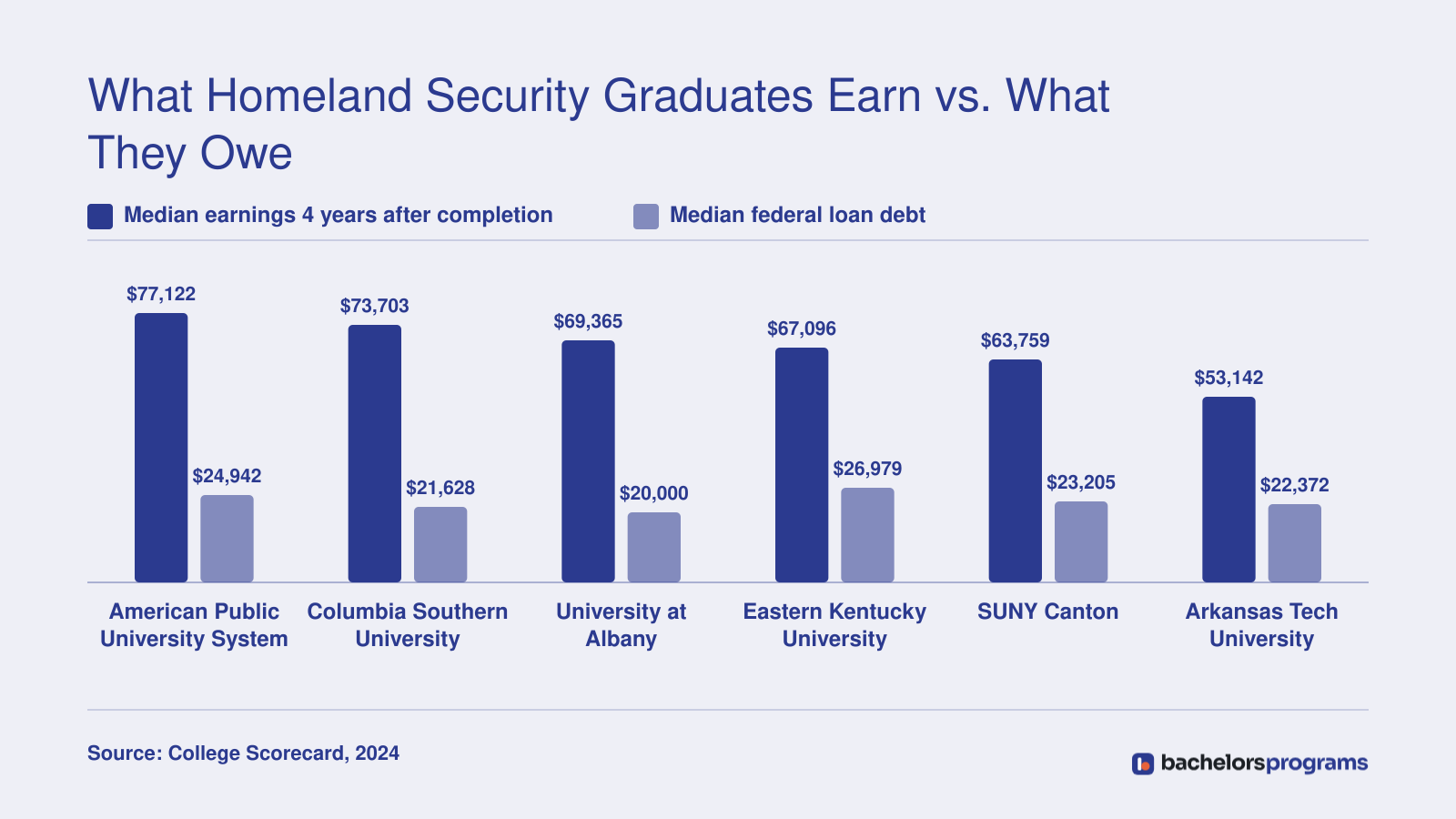
What Homeland Security Graduates Earn vs. What They Owe
This chart compares median earnings four years after completing a bachelor's degree in homeland security with median federal loan debt for the same program at the highest-earning schools here. The healthiest ratio is total debt well below one year of pay; a common rule of thumb is to borrow no more than you expect to earn in your first year. For every program shown, median debt is less than half of four-year earnings, with the University at Albany and Columbia Southern University posting the strongest ratios.
The Highest-Paying Homeland Security Career Path
Of the careers a homeland security degree prepares you for, cybersecurity pays the most.
Homeland Security programs by state
Online Homeland Security Degree FAQs
What are the requirements for a homeland security degree?
How long does an online homeland security bachelor's degree take?
Can you work for DHS without a homeland security degree?
Is a homeland security degree worth it?
Compare Homeland Security programs on the data that matters
Explore more Criminal Justice & Law majors or browse every field of study.
All Criminal Justice & Law programs Browse every field of study