Best Early Childhood Education Schools in Maine
Compare 3 accredited Early Childhood Education programs in Maine, with net price after aid, graduation rates, earnings and debt from IPEDS and the U.S. College Scorecard.

Maine's bachelor's programs in early childhood education are a short list, and the trade-offs between them are real. The common credential is the Bachelor of Science (B.S.) in Early Childhood Education, and the three programs we ranked, at University of Maine, University of Maine at Farmington and Thomas College, span campus and hybrid formats.
The tension is practical. Graduates earn close to $39,000 one year out, against median debt of roughly $26,000 to $27,000. In-state tuition runs from about $11,300 at a public campus to $31,800 at a private one.
Format, cost and the certification each program supports are what separate these schools. Maine's two endorsements, one for prekindergarten through grade 3 and one for birth through kindergarten, shape which classrooms a graduate can lead.
Key Points
- Maine's 029 endorsement covers PreK-3; the 081 covers birth through kindergarten.
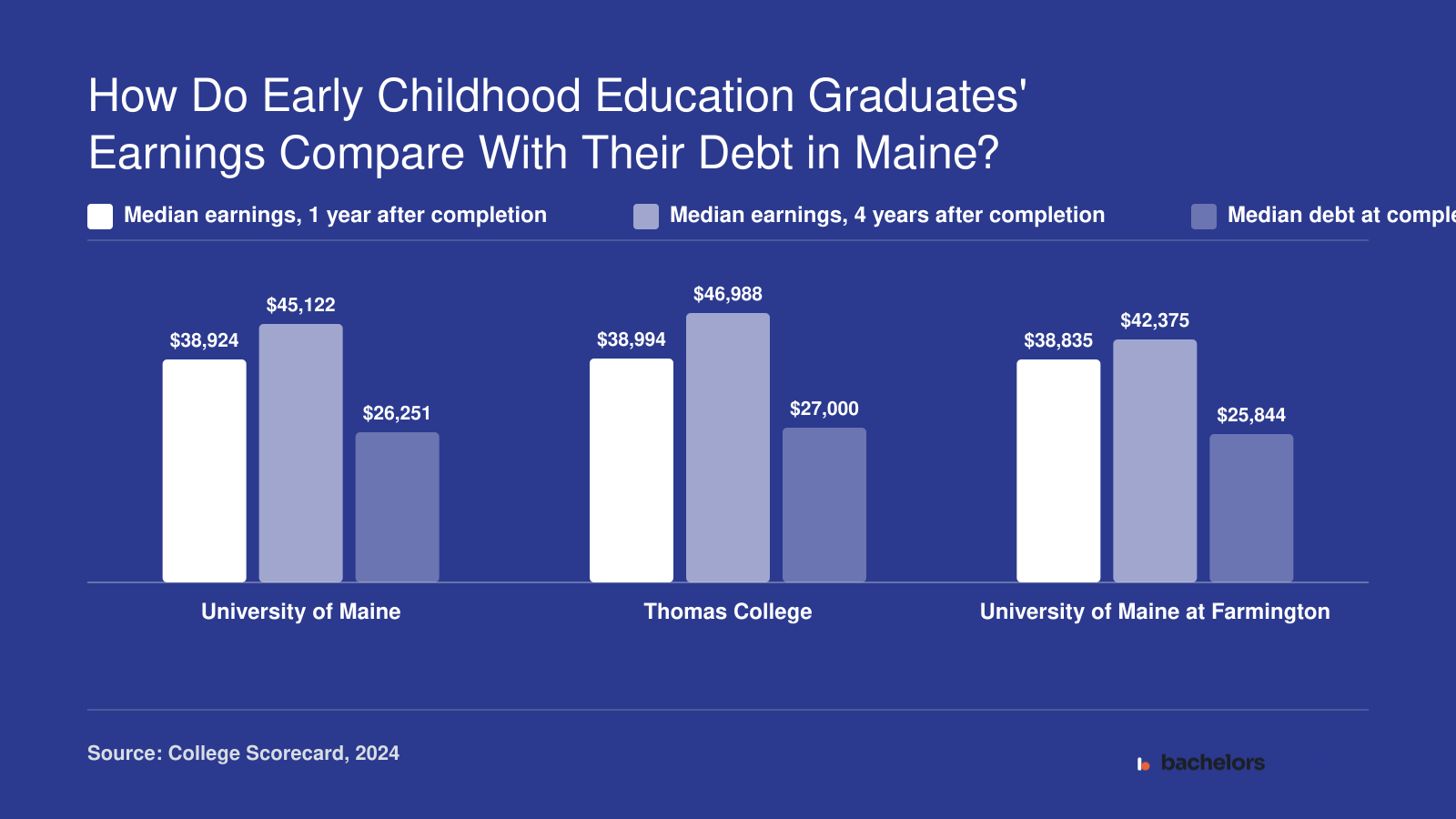
- First-year pay of $38,835 to $38,994 meets median debt of $25,844 to $27,000.
- Thomas College offers a dual certification B.S. in Early Childhood Education.
Best Schools for a Bachelor's Degree in Early Childhood Education in Maine
Maine's early childhood bachelor's programs are few, and each has a distinct personality: a flagship research university, a small public teaching college, and a private career-focused campus. All three below prepare graduates for work with children from birth through the early elementary grades, and each pairs coursework with supervised time in real classrooms. Read the cards for the fit, then compare cost and certification details in the sections that follow.
University of Maine
#1Orono, ME · $18,000/yr (est. net price)
Best for: Future K-3 teachers wanting a research university
The University of Maine is the state's flagship public research university, set in Orono on the Penobscot River. Its early childhood pathway sits inside the Child Development and Family Relations program, which pairs a broad family-studies core with supervised teaching practice. Students can prepare for Maine credentials covering both birth-to-five settings and kindergarten through third grade, and the program holds CAEP educator-preparation accreditation along with state approval. It is the largest of the three programs and offers the widest choice of concentrations.
- CAEP-accredited educator preparation, approved by the State of Maine
- 120 credit hours, with four concentration options inside the major
- Early Childhood Education concentration leads to Endorsement 081, birth to age 5
- Also prepares students for Endorsement 029, Early Elementary Teacher, grades K-3
- Teacher candidacy requires a 2.75 GPA, a portfolio and a K-3 field experience analysis
- Passing Praxis Core subtests can substitute for the GPA requirement
- Core courses require a B or better; capstone completed through CHF 424
- Student teaching in early childhood carries 12 credits
University of Maine at Farmington
#2Farmington, ME · $17,000/yr (est. net price)
Best for: Transfer students entering through community college pathways
The University of Maine at Farmington is a small public liberal arts campus in western Maine with a teacher-preparation tradition stretching back more than 160 years. Early childhood students move quickly into field placements, practicum and student teaching, with the Sweatt-Winter Child Care and Early Education Center serving as a campus lab school. Three certification routes cover birth through third grade, and the university has built apprenticeship, scholarship and community college delivery partnerships aimed at working early childhood professionals. It suits readers who want a tight-knit teaching college rather than a large university.
- Three certification routes: birth to kindergarten, pre-K to grade 3, or both
- Field placements, practicum and student teaching are built into the degree
- Sweatt-Winter Child Care and Early Education Center serves as a campus lab school
- On-campus Curriculum Lab, Assistive Technology Center and Everyone's Resource Depot
- Graduates become lead teachers, coordinators and directors of child care programs
- A 12-credit Early College pathway runs through participating Maine CTE programs
- Partnership with the Maine AEYC T.E.A.C.H. scholarship and career-development program
- Bachelor's program is also delivered at Southern Maine Community College
Thomas College
#3Waterville, ME · $19,000/yr (est. net price)
Best for: Dual-certification seekers in general and special education
Thomas College is a small private college in Waterville whose Lunder School of Education focuses squarely on preparing teachers for Maine classrooms. The early childhood degree blends general and special education preparation, and the dual-certification track lets graduates qualify for both birth-to-five and pre-K through grade three roles. Students log more than 900 hours of classroom experience, with partner sites including Educare of Central Maine, and the program is certified by the Maine Department of Education. It suits readers who want a career-focused, private-college setting with heavy time spent in schools.
- Three tracks: Birth to Age 5, Pre-K to Grade 3, or the dual-certification option
- 121 credit hours, including more than 920 hours of classroom experience
- Certified by the Maine Department of Education; meets Endorsements 081 and 029
- Coursework includes Science for the Young Child and Explorations in STEAM
- Also covers Trauma-informed Education and Social-Emotional Learning
- Field training draws on Educare of Central Maine, Early Head Start, Montessori and Reggio Emilia
- Prepares teachers for both general education and special education settings
- Students network at conferences hosted by the Maine Association for the Education of Young Children
Cost & outcomes by school
Federal data for the highest-earning Early Childhood Education programs, independent of the ranking above. Earnings are this field's bachelor's graduates four years after completing where the Scorecard reports them, else the school's undergraduate median.
| School | Net price / yr | Grad rate | Earnings | Debt | Grads/yr | Format |
|---|---|---|---|---|---|---|
| Thomas College ME | $18,885 | 54% | $46,988 | $27,000 | 20 | Campus |
| University of Maine ME | $17,510 | 55% | $45,122 | $26,251 | 75 | Campus |
| University of Maine at Farmington ME | $16,857 | 52% | $42,375 | $25,844 | 67 | Campus |
Sources: U.S. Department of Education. Net price, graduation rate, earnings and debt: College Scorecard (earnings and debt for this field's bachelor's graduates where reported, else school-wide); graduates: IPEDS. A dash means no figure is reported.
Cost, debt & payoff
Median earnings of this field's bachelor's graduates (4 yrs after completing, else the school's undergraduate median) vs. their median federal loan debt · U.S. College Scorecard
Across these programs the median graduate earns about $45,122 and finishes with roughly $26,251 in debt — a ratio that clears a common rule of thumb (keep debt below first-year salary). Net price and debt vary widely school to school, so check the per-school figures in the table above before you shortlist.
How We Ranked Maine's Bachelor's in Early Childhood Education Programs
Our ranking compares bachelor's programs in early childhood education, and the closely related field of child development, at Maine-based schools. It weighs what a student pays, how likely students are to finish, and what graduates earn and owe afterward.
What We Looked At
- Net price after aid: What students actually pay once grants and scholarships are subtracted, a truer figure than the posted tuition rate.
- Graduation rate: The share of students who complete a degree at the school.
- Program-level earnings and debt: What graduates of the specific program earn and borrow, where the federal government reports it.
- Completions: How many students finish the program each year, a rough signal of its size and track record.
Limits Worth Knowing
Both figures are institution-wide averages. They describe the whole school, not the early childhood education program inside it, so treat them as a guide rather than a promise. Earnings and debt are the program-specific figures. When one is not reported for a program, we leave it out instead of estimating.
Who Made the List
Only bachelor's programs at Maine-based schools were included, whether delivered on campus or online. That means University of Maine, University of Maine at Farmington and Thomas College. Programs at schools based elsewhere were left out, even if they enroll Maine residents online.
Where the Data Comes From
We do not score admissions policy, curriculum quality, faculty or campus life. For admissions requirements, check each school's program page before you apply.
Online and Hybrid Bachelor's Options at Maine Schools
A fully campus-based degree and a hybrid cohort ask for different things from you: one wants your weekdays, the other wants your Friday evenings and Saturdays. Among the schools here, the options sort out clearly.
Campus, Hybrid, or Both
- University of Maine: Campus-based. Our data lists its Child Development and Family Relations program (Early Childhood Education concentration) as a campus program.
- Thomas College: Campus-based. Its dual-certification Early Childhood Education B.S. is listed as a campus program, with on-site observations, internships, and student teaching.
- University of Maine at Farmington: Campus-based in Farmington, plus a hybrid B.S. cohort in South Portland. Most courses mix face-to-face and online work, held Friday evenings and Saturdays.1 Admission to the cohort requires an associate degree in early childhood education or equivalent.1
None of these programs is presented as a fully online bachelor's in early childhood education, so verify current formats with each admissions office.
Can Student Teaching Be Done Remotely?
No. Field placements, practicum hours, and student teaching happen in real classrooms and child care settings, even when coursework is online or hybrid. For students living far from a campus, that is the practical limit of distance learning in this field.
How Placements Work for Online and Hybrid Students
In the Farmington cohort, full-time UMF faculty supervise practicum and student teaching, and the program is built for Maine licensure (Birth to 5 and K-3).1 The program page does not promise placements near your home, and it does not state a general in-state placement rule. The cohort is designed for working professionals in the greater Portland area, so expect local placements there. Thomas College's program carries 920 clinical hours, which is a lot of time in classrooms to plan around. Ask any program how sites are assigned, who approves a site supervisor, and whether your current workplace can count.
A Tip for Working Adults
A hybrid cohort gives you a fixed schedule you can plan childcare and shifts around, but it requires regular travel to one location. Before choosing hybrid over a more flexible online format, map your placement hours, not just class time. Student teaching usually falls during school-day hours, so ask early about your employer's flexibility.
Admissions: GPA, Test Policy, and Transfer Credit at Maine Schools
Most published admissions rules for Maine early childhood education bachelor's programs come from transfer documents, so the table below reflects the path of a student moving from a Maine community college into a four-year degree. There are two main routes. Transfer ME lets eligible associate degree holders in early childhood education enter a Maine public university in good standing, with joint advising and no test scores required. Program-specific articulation agreements map an Associate in Applied Science in early childhood education onto a bachelor's that leads to Birth-5 or PreK-3 certification. Thomas College's minimum GPA, test policy and transfer rules did not appear in the sources we reviewed, so confirm them with its admissions office before you apply.
| School | Minimum GPA | Test Policy | Transfer Credit Policy |
|---|---|---|---|
| University of Maine at Farmington | No admissions minimum appears in UMF's transfer articulation agreement. The agreement says transfer students are held to the same admission standards as UMF students. Graduation requires a 2.75 cumulative GPA and B- or better in major courses. | According to the Transfer ME page, students transferring through Transfer ME do not need to submit test scores. | According to UMF's articulation agreement with a Maine community college, courses transfer with a C- or better, and courses required for the major need a B- or better. The B.S. in Early Childhood Special Education, Birth-5 Certification requires at least 120 total credits. A UMF early childhood education bachelor's has also been delivered on a Maine community college campus through a partnership that began in 2007. |
| University of Maine | The Transfer ME page lists no numeric minimum. It defines eligibility through academic performance and progress markers. | According to the Transfer ME page, students transferring through Transfer ME do not need to submit test scores. | According to the Transfer ME page, eligible Maine community college students in early childhood education who finish the associate degree can transfer to a relevant Maine public university in good standing, with joint advising toward the bachelor's. The sources we reviewed list no program-specific minimum transfer grade, so ask how credits apply to the Child Development and Family Relations major. |
Related Articles
Maine Certification for Early Childhood Educators: Prek-3, Birth-5 and Education Technician
Maine splits early childhood teaching into two endorsements, and the one you choose decides which classrooms you can lead. The 029 Early Elementary Teacher endorsement covers prekindergarten through grade 3.1 The 081 Early Childhood Teacher endorsement covers birth through kindergarten, and the state names it as the qualification for public preschool teachers, whether held fully or conditionally.2
Endorsement 029: PreK Through Grade 3
The approved-program route is the standard path: complete a Maine-approved educator-preparation program at the bachelor's level, earn the institution's recommendation, and complete an approved course in teaching students with exceptionalities.4 General certification adds the Chapter 115 Part I core, meaning an application and a criminal history check, plus the endorsement-specific requirements in Part II.3 Testing requirements apply on top of those, so confirm the current tests for your endorsement with the Department before you schedule an exam.
Endorsement 081: Birth Through Kindergarten
A bachelor's degree is the base requirement here too, and Part I applies the same way.4 In the children-with-disabilities context, the state also recognizes a bachelor's degree plus at least three years as an Educational Technician III with positive administrator evaluations, a practical route for working paraprofessionals.
Education Technician I, II and III
These are classroom support roles, and only the upper levels carry college credit expectations. - Ed Tech I: High school diploma or GED. - Ed Tech II: 48 semester hours of approved educationally related study; CTE certification accepts two years of paid applied employment instead. - Ed Tech III: 90 semester hours, or an approved Maine Ed Tech III training program, which can waive the credit minimum when the other requirements are met; CTE certification calls for three years of paid applied employment. Every level requires applicants to be at least 18, of good moral character, and to file an application and pass a criminal history check.
Which Programs Fit These Pathways
Thomas College offers its early childhood education degree as a dual certification track, and the University of Maine at Farmington's early childhood education major is built around teacher preparation, so those two line up most directly with the endorsements above. The University of Maine's child development and family relations program leans toward child and family studies; ask the program directly whether it carries the institutional recommendation for 029 or 081. Approval and recommendation language are handled program by program, so verify before you enroll.
Confirm Before You Apply
Rules change. The Maine Department of Education publishes current endorsement requirements, application steps and renewal details; check them in the year you apply.
How Do Early Childhood Education Graduates' Earnings Compare With Their Debt in Maine?
The ranked Maine programs land within a few hundred dollars of each other on first-year pay: $38,835 to $38,994 one year after completing a bachelor's degree in early childhood education, against median debt of $25,844 to $27,000. University of Maine at Farmington has the best earnings-to-debt balance at one year because its graduates carry the least debt. By year four, Thomas College and the University of Maine pull ahead on pay, with median earnings of $46,988 and $45,122.
Maine Early Childhood Education Degree: Common Questions
What is the best school for early childhood education in Maine?
Can you get an early childhood education degree online in Maine?
What certification do you need to teach preschool in Maine?
Can I transfer an associate degree from a Maine community college into a bachelor's program?
Compare Early Childhood Education programs on the data that matters
Explore more Education & Teaching majors or browse every field of study.
All Education & Teaching programs Browse every field of study