Best Elementary Education Degree Programs in Wisconsin
Compare 28 accredited Elementary Education programs in Wisconsin, with net price after aid, graduation rates, earnings and debt from IPEDS and the U.S. College Scorecard.
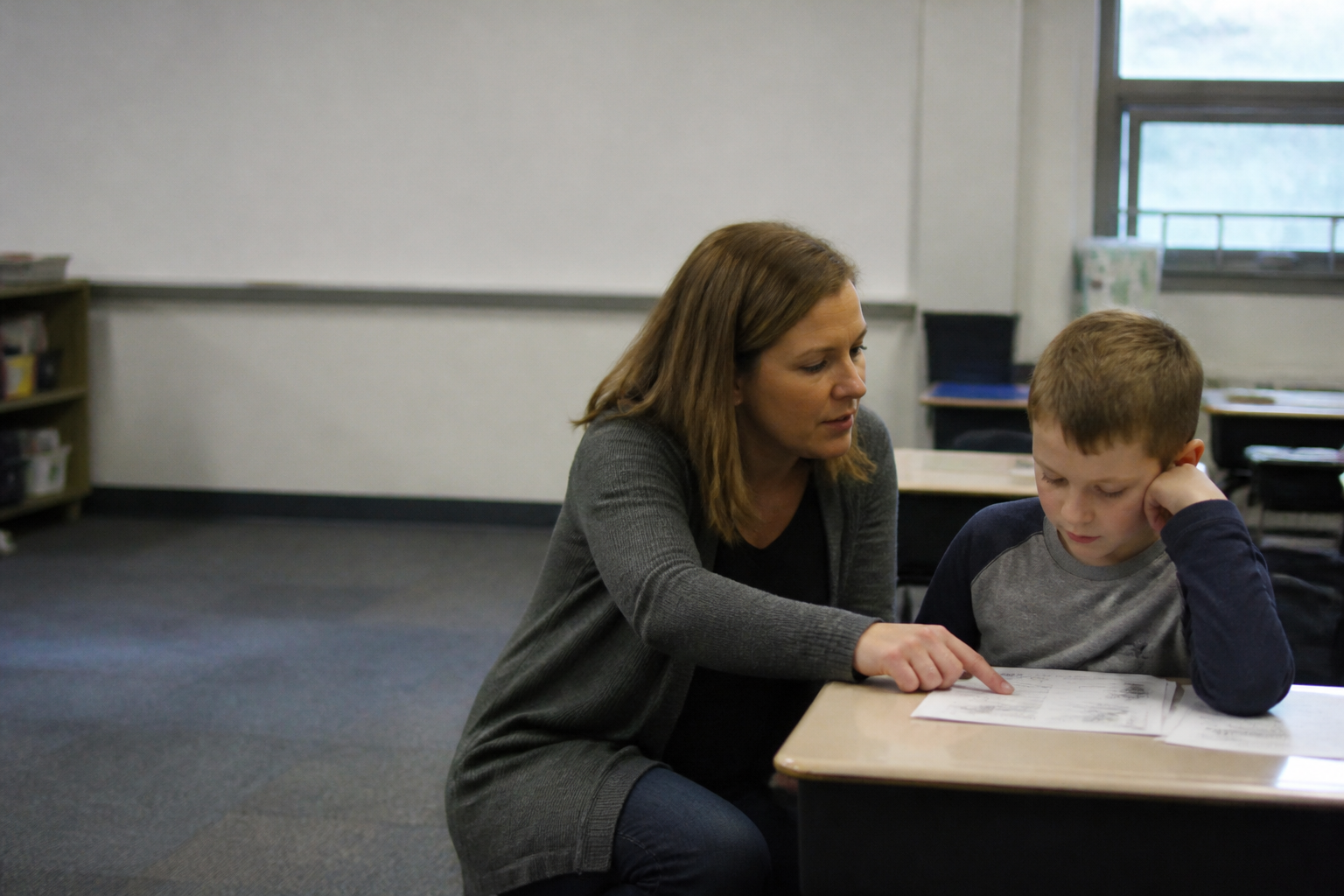
A bachelor's degree in elementary education, most often a Bachelor of Science (B.S.), is the standard route to a Wisconsin teaching license for kindergarten through ninth grade. Wisconsin's Department of Public Instruction approves the programs, and the license band runs wider than the title suggests, covering middle grades as well.
Public universities such as UW-Madison and UW-Eau Claire, private colleges like Marquette and Carroll, and online or hybrid programs all offer the degree. The real tension is not finding a program but matching one to your budget, your admission odds, and the student-teaching semester that no online format removes.
Program quality varies less than price and format do, so those two factors usually decide the comparison.
Key Points
- Wisconsin DPI's Elementary and Middle School license (code 1088) covers grades K-9.
- University of Wisconsin-Superior offers its K-9 elementary bachelor's 100% online.
- Most programs require a separate education-program application after about two years.
Best Elementary Education Schools in Wisconsin: Our Ranked List
Wisconsin's elementary education bachelor's programs run from flagship research universities to small private colleges and a fully online degree-completion option. Every school below leads to a Wisconsin teaching license in a K-9 band or a close variant such as K4-9 or PK-9. Prices, admission bars and field-experience models differ widely, so the program details under each entry matter as much as the order.
University of Wisconsin-Madison
#1Madison, WI · ~$17,000/yr (est.)
Best for: Research university seekers in teacher preparation
The flagship campus in Madison carries the widest research and school-partner network in the state, and its elementary education degree is one of the most structured pathways into a Wisconsin classroom. Students earn a Bachelor of Science in Education in Elementary Education with K-9 certification through a two-year professional sequence that begins in the junior year. Declaration happens once a year, and the department's Teacher Pledge covers in-state tuition and fees in exchange for several years of teaching at a Wisconsin PreK-9 school.
- 120 credits, including 30 senior credits in residence
- 2.75 GPA required in all coursework, professional education and the major
- Two 120-hour practicum placements before full-semester student teaching
- Declare once a year, December 1 to February 1; admission effective in summer
- Five concentration options; study abroad in the Galapagos Islands in June
- Teacher Pledge covers in-state tuition and fees for a three to four year commitment
- Wisconsin teaching license fee: $125
University of Wisconsin-La Crosse
#2La Crosse, WI · $15,000 – $20,000/yr (est.)
Best for: Hands-on learners wanting early fieldwork
UW-La Crosse pairs a 120-credit elementary and middle education major with a heavy field component and deep school partnerships across western Wisconsin. Students complete 29 credits before admission to the School of Education and 36 after, then finish with a full student teaching semester. The Reading Buddies program with the Boys and Girls Club of Greater La Crosse gives future teachers literacy practice outside a traditional classroom.
- 120 credits; 40 credits at the 300/400 level and 30 in residence
- Aligned with Wisconsin Teacher Standards, CAEP and AMLE standards
- 29 credits before School of Education admission, 36 credits after
- Add a license in special education, TESOL, or Spanish or French
- Reading Buddies partnership with the Boys and Girls Club of Greater La Crosse
- C or better required in all education, special education and TESOL courses
- Benchmark assessments must be cleared before student teaching
Marquette University
#3Milwaukee, WI · ~$31,000/yr (est.)
Best for: Urban Milwaukee students seeking licensure
Marquette is the largest private option on this list, a Jesuit university in Milwaukee offering a K4-9 elementary and middle education degree. Unusually, every candidate adds a second major outside education, which stretches the degree to about 123 credits but broadens what graduates can teach or move into later. Field experience is built into each year, and the program closes with a 15-credit student teaching semester.
- Leads to a Wisconsin teaching license for grades K4-9
- Second major required outside education, in arts and sciences or communication
- 30-credit Marquette Core Curriculum plus a 66-credit education major
- 2.750 GPA required overall, in the education major and in the second major
- 15-credit student teaching semester approved by the Office of Teacher Education
- Methods courses in early childhood literacy for K-3 and STEM for grades 4-9
- Typical plan of study totals 123 to 124 credits
University of Wisconsin-Eau Claire
#4Eau Claire, WI · ~$17,000/yr (est.)
UW-Eau Claire runs a four-year elementary and middle education major built on one of the deepest placement networks in the Upper Midwest. Students student teach for a full semester split between an elementary and a middle school classroom, drawing on more than 150 partner schools and 60 Wisconsin districts. The program reports that every known 2024-2025 graduate was employed or continuing their education.
- Bachelor of Science leading to Wisconsin licensure for grades K-9
- Full semester of student teaching split into two nine-week placements
- Placements across more than 150 partner schools, including 60 Wisconsin districts
- More than 600 practicum placements and 300 student-teaching placements
- Coursework in literacy, math, science, social studies, technology and performing arts
- Capstone seminar required; no minor required
- Annual on-campus Education Job Fair
Maranatha Baptist University
#5Watertown, WI · ~$26,000/yr (est.)
Maranatha Baptist University is a small Christian campus in Watertown, and its elementary teacher education degree is designed for students who want to teach in Christian, public or home school settings. Fieldwork begins in the first year and builds to a 12-credit student teaching semester. Coursework covers reading diagnosis and remediation, classroom management, assessment and teaching the exceptional child, all taught from a biblical worldview.
- Bachelor of Science in Elementary Teacher Education taught from a biblical worldview
- Fieldwork begins freshman year, followed by a two-credit junior practicum
- 12 credits of student teaching in the final semester
- Reading diagnosis and remediation coursework, including reading disabilities
- Prepares graduates for Christian, public or home school teaching
- Suggested schedule runs four years, with the heaviest term at 18 credits
Carroll University
#6Waukesha, WI · $15,000 – $20,000/yr (est.)
Carroll University in Waukesha offers a K-9 elementary education degree alongside an unusual full-year residency model that places candidates in a school for 20 to 25 hours a week. Some residents are paid as district staff, which offsets part of the final year. Students who want special education credentials can add a cross-categorical K-12 license and still finish in four years.
- Leads to Wisconsin licensure in grades K-9
- Optional second licensure track in cross-categorical special education, K-12
- Full-year Inclusive Teacher Residency, 20 to 25 hours a week in a school
- Ends with a 15-week student teaching placement
- Some residents are paid as district staff
- Both licensure tracks can be completed in four years
University of Wisconsin-Whitewater
#7Whitewater, WI · $10,000 – $15,000/yr (est.)
UW-Whitewater awards the largest number of elementary education degrees in the University of Wisconsin system, with nearly 200 completions in the most recent federal data. Candidates choose one of three tracks (Dual Licensure, STEM/STEAM, or Social Justice Literacy) and follow a structured four-year plan with field study and directed teaching. Majors can apply to the Teacher Internship Program for a paid teaching role, and the university cites a No. 1 value ranking within the UW system.
- Leads to Wisconsin licensure for kindergarten through ninth grade
- Three tracks: Dual Licensure, STEM/STEAM and Social Justice Literacy
- Teacher Internship Program pays a $4,500 stipend
- Classroom observations in Ecuador, Jamaica, Mexico and Sweden
- Structured four-year plan with field study and directed teaching
- Separate application required for Professional Education admission
University of Wisconsin-River Falls
#8River Falls, WI · $10,000 – $15,000/yr (est.)
UW-River Falls prepares teachers for grades PK-9 through an undergraduate major with a strong liberal arts core: children's literature, educational psychology, and foundations of diversity and equity in education sit alongside methods courses. Adding the early childhood education minor extends the license to the pre-K level. The program reports that 99 percent of graduates are employed or attending graduate school.
- Prepares teachers for grades PK-9, with a Wisconsin K-9 teaching license
- Early childhood education minor adds a pre-K license
- Coursework in children's literature, educational psychology and school and society
- Methods courses in language arts, math, science and middle school social studies
- Introduction to special education included in the major
- $2.3 million in scholarship dollars awarded in 2022-2023
University of Wisconsin-Platteville
#9Platteville, WI · $9,000 – $18,000/yr (est.)
UW-Platteville structures its K-9 elementary and middle level degree around a compact 120 credits, with 32 in the major and 36 in professional education. The program sets a 3.00 GPA bar in the major and in professional education, higher than several peers on this list, and requires a C or better in every major course. Coursework emphasizes reading and literacy, interdisciplinary STEM methods and social justice in rural classrooms.
- 120 credits: 32 in the major, 36 in professional education, 33 in general education
- 3.00 GPA required in the major and in professional education
- 2.75 overall GPA required before student teaching
- C or better required in every major course
- 12 credits of student teaching (Elementary I and II) or a teaching internship
- Coursework in reading and literacy, interdisciplinary STEM and rural social justice
- 7 to 8 credits of additional supporting courses
Viterbo University
#10La Crosse, WI · ~$21,000/yr (est.)
Viterbo University in La Crosse is the online route on this list, a degree-completion program built for students who already hold roughly 35 to 65 credits from an associate degree. The 120-credit program runs fully online with three start dates a year and can be finished in two to three years. Field service can be completed anywhere in Wisconsin, and candidates can add cross-categorical special education or early childhood licensure.
- Fully online degree completion with field service anywhere in Wisconsin
- 120 credits; 35 to 65 transfer in from an associate degree
- Complete in two to three years, full time or part time
- Three start dates a year: August, January and May
- $430 per credit
- Leads to initial Wisconsin K-9 elementary/middle licensure
- Add a cross-categorical special education or early childhood license
Cost & outcomes by school
Federal data for the highest-earning Elementary Education programs, independent of the ranking above. Earnings are this field's bachelor's graduates four years after completing where the Scorecard reports them, else the school's undergraduate median.
| School | Net price / yr | Grad rate | Earnings | Debt | Grads/yr | Format |
|---|---|---|---|---|---|---|
| Marquette University WI | $31,487 | 83% | $56,955 | $23,250 | 28 | Campus |
| Lakeland University WI | $24,212 | 43% | $55,961 | $25,000 | 13 | Campus |
| Lawrence University WI | $23,401 | 77% | $55,789 | $26,000 | — | Campus |
| Viterbo University WI | $21,260 | 68% | $55,660 | $25,000 | 43 | Online |
| University of Wisconsin-Milwaukee WI | $15,014 | 49% | $54,990 | $23,000 | — | Campus |
| Ripon College WI | $20,216 | 63% | $54,902 | $27,000 | 19 | Campus |
| Wisconsin Lutheran College WI | $23,245 | 64% | $53,548 | $27,000 | 26 | Campus |
| Marian University WI | $21,937 | 44% | $53,501 | $25,000 | 10 | Campus |
| University of Wisconsin-Parkside WI | $11,772 | 40% | $51,129 | $20,492 | 25 | Campus |
| Carroll University WI | $15,193 | 71% | $50,285 | $27,000 | 38 | Campus |
| University of Wisconsin-Madison WI | $17,354 | 90% | $49,640 | $21,500 | 110 | Campus |
| Edgewood University WI | $26,113 | 60% | $48,946 | $25,875 | 14 | Campus |
Sources: U.S. Department of Education. Net price, graduation rate, earnings and debt: College Scorecard (earnings and debt for this field's bachelor's graduates where reported, else school-wide); graduates: IPEDS. A dash means no figure is reported.
Cost, debt & payoff
Median earnings of this field's bachelor's graduates (4 yrs after completing, else the school's undergraduate median) vs. their median federal loan debt · U.S. College Scorecard
Across these programs the median graduate earns about $47,911 and finishes with roughly $25,000 in debt — a ratio that clears a common rule of thumb (keep debt below first-year salary). Net price and debt vary widely school to school, so check the per-school figures in the table above before you shortlist.
Most Affordable Elementary Education Bachelor's Programs in Wisconsin
The schools below have the lowest sticker prices for an elementary education bachelor's in Wisconsin, based on 2024 IPEDS and College Scorecard data from the U.S. Department of Education. Lac Courte Oreilles Ojibwe University and College of Menominee Nation charge the same tuition to in-state and out-of-state students. UW-Superior adds a fully online path, and UW-River Falls, one of our ranked schools, posts the highest graduation rate in this group.
| School | City | In-State Tuition and Fees | Out-of-State Tuition and Fees | Average Net Price After Aid | Graduation Rate | Format |
|---|---|---|---|---|---|---|
| Lac Courte Oreilles Ojibwe University | Hayward | $6,030 | $6,030 | $8,657 | 23% | Campus |
| College of Menominee Nation | Keshena | $6,200 | $6,200 | $8,805 | 32% | Campus |
| University of Wisconsin-Parkside | Kenosha | $8,270 | $17,429 | $11,772 | 40% | Campus |
| University of Wisconsin-Superior | Superior | $8,812 | $16,726 | $12,220 | 42% | Campus and online |
| University of Wisconsin-River Falls | River Falls | $9,008 | $17,470 | $14,054 | 57% | Campus |
How to Choose a Bachelor's Degree in Elementary Education in Wisconsin
Wisconsin's elementary license covers more grades than the name suggests, so comparing programs by title alone can mislead.
What the License Covers
Wisconsin DPI issues an Elementary and Middle School license (code 1088) for kindergarten through grade 9.1 That is wider than an elementary-only program and narrower than a K-12 license. Programs at UW-La Crosse, UW-Eau Claire, UW-Platteville and UW-Whitewater use K-9 or elementary/middle wording in their titles, and Marquette's program leads to a K4-9 license. A K-9 license lets you teach in a primary classroom or a middle school team, which widens your job options. K-12 licenses, such as Cross-categorical Special Education, are a separate credential.1
Confirm DPI Approval
To be licensed, you need a bachelor's degree and must complete a state-approved educator preparation program. A degree from a school without that approval does not lead to a Wisconsin license. DPI publishes the full list of approved programs as a downloadable spreadsheet.2 Check the school's exact program name against it, and ask the admissions office to confirm in writing.
B.S., B.A. and Add-On Options
The B.S. versus B.A. label matters less than the license behind it. Both lead to the same K-9 license when the program is approved. UW-Eau Claire and Viterbo offer a B.S., while Concordia University-Wisconsin, Edgewood University and Lakeland University offer a B.A. Concentrations and add-ons vary:
- Special education: Carroll University lists dual special education licensure for K-12.
- Early childhood: UW-River Falls offers an early childhood minor that adds a pre-K license.
- Dual licensure: UW-Whitewater lists dual licensure among its options.
- Second major: Marquette requires one outside education.
Three Rules to Apply Fast
- Check the license level: Look for K-9 in the program description, not just "elementary."
- Verify DPI approval: Match the program name to DPI's list before you apply.
- Ask where you will student teach: UW-Eau Claire splits placements between elementary and middle schools, and Viterbo lets online students complete field service anywhere in Wisconsin. Other schools may place you locally, which affects commuting and living costs.
Questions to Ask Yourself
Do you want to teach kindergarten through third grade only, or keep upper elementary and middle grades open?
Can you commit to full-time, in-person student teaching, or do you need an online or hybrid format?
Do you plan to teach in Wisconsin after graduation?
Related Articles
Online and Hybrid Elementary Education Bachelor's Options at Wisconsin Schools
Online delivery has moved into elementary education preparation, but the license still runs through an in-person classroom.
The University of Wisconsin-Superior offers its Elementary Education (Grades K-9) bachelor's on campus or 100% online. The university describes it as the only fully online elementary education bachelor's from a Wisconsin public university. Among the schools ranked here, Viterbo University offers the other online option: a degree completion track with three start dates a year and field service that can be completed anywhere in Wisconsin.
Student Teaching Is Still In Person
Every Wisconsin K-9 license runs through a full-semester student teaching placement in a real school. At UW-Superior, placements go through the Department of Education Field Experience Office. Students may not solicit their own placements, though they can suggest nearby schools and districts. Student teaching must fall within 400 miles of campus. Exceptions are decided case by case and must be requested well in advance; they cover military assignments at on-base American schools and candidates employed by a recognized international American school. UW-Stevens Point allows any Wisconsin district but charges location-based supervision fees1; out-of-state requests are limited to spousal or domestic-partner relocation and can require planning three semesters ahead.2 UW-Parkside places students outside Kenosha County but within 30 miles, with the candidate providing transportation.3
Campus or Online: The Tradeoff
Online buys schedule control. Campus buys cohort support and the local school partnerships that make placements easier to land. In either format, confirm that placements are coordinated for you rather than left to your own search.
Who Online Suits Best
Online suits career changers, working adults and transfer students who already hold an associate degree. Viterbo accepts 35 to 65 credits from an associate degree, which shortens the path considerably. Both programs are built for Wisconsin licensure, so graduates who plan to teach in another state should check that state's rules before enrolling.
Admissions Requirements: GPA, Test Policy and Transfer Credit
Most Wisconsin elementary education programs use two gates: admission to the university, then a separate application to the education program, usually after about two years of coursework. The figures below come from official program and transfer pages and can change by catalog year, so confirm them before you apply.
- UW-Madison program entryThe program page sets no minimum GPA to apply. Pre-Elementary transfer requires a 2.50 on all UW coursework or your last 60 credits, plus at least 40 credits by the end of fall of your declaration year.
- UW-Madison graduationYou need a 2.75 cumulative GPA and a 2.75 professional-education GPA to finish.
- UW-Eau Claire program entryYou apply at sophomore standing with a 2.5 total and resident GPA. Admission is competitive, so meeting the minimum does not guarantee a seat.
- UW-Eau Claire transferFor Fall 2025, a 2.0 GPA earned transfer students consideration and the major required a 2.50. Check whether these figures changed for 2026.
- UW-Eau Claire before student teachingYou need 90 credits, a 2.75 GPA, and either a 3.0 content-area GPA or a passing Praxis II score.
- UW-Whitewater transferMost programs require a 2.0 cumulative GPA and at least 12 transferable credits.
- UW-Superior program entryYou need a 2.75 GPA, 40 credits, a passing grade in T ED 200, and a B or better in T ED 100. Transfer credit can cover required licensure coursework.
- Licensure examsUW-Superior no longer requires Praxis for licensure. Instead, you show content knowledge through a content-area GPA or a passing DPI-approved exam.
- Carroll and MarquetteAsk each admissions office directly about program GPA, test policy and transfer rules. The official pages we reviewed did not spell these out.
- Test-optional statusCheck each school's 2026 ACT/SAT policy on its main admissions page. The program pages reviewed here don't address it.
- Background checkExpect a criminal background check before classroom field experiences, and confirm the timing with your program.
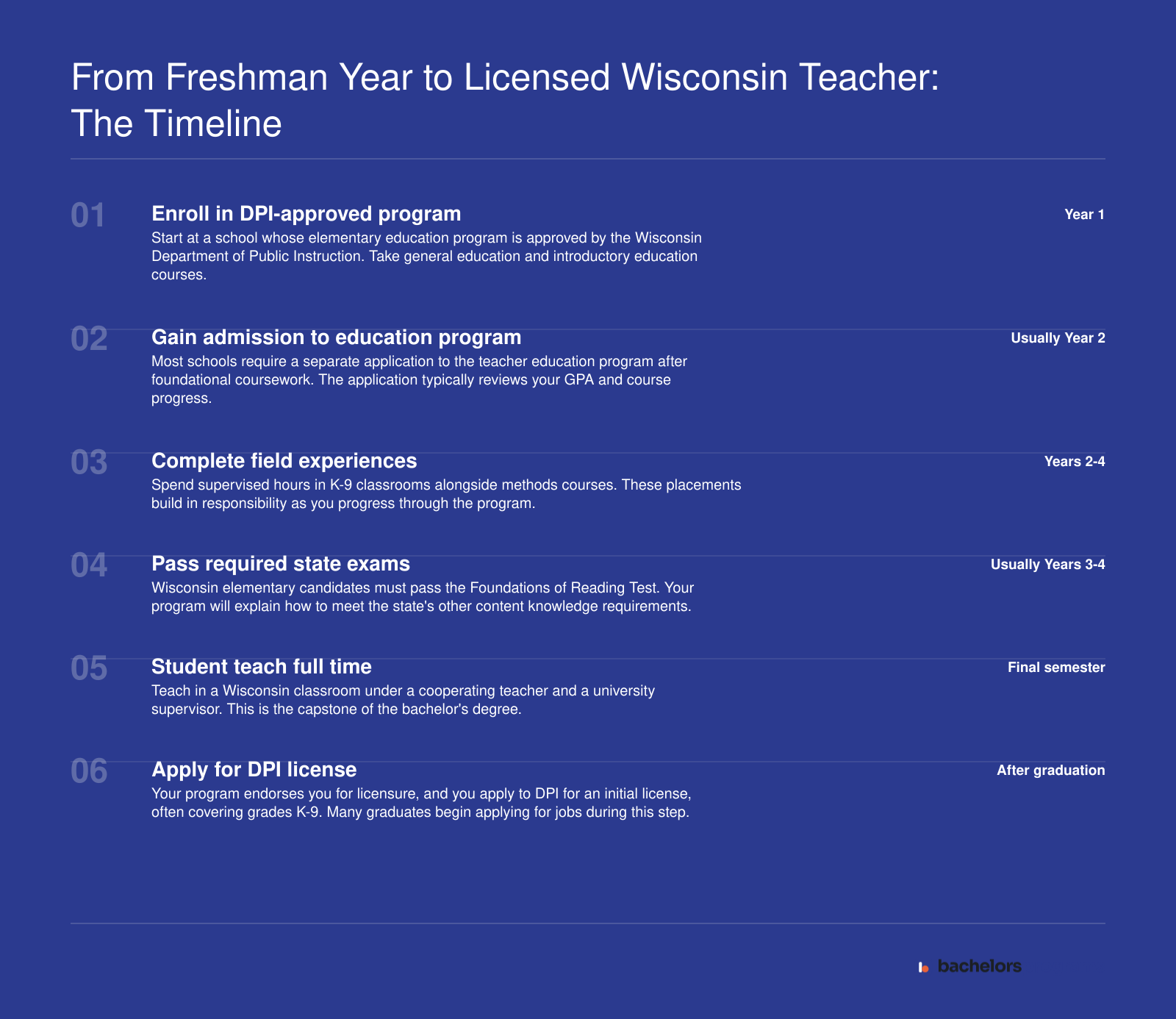
From Freshman Year to Licensed Wisconsin Teacher: The Timeline
Most students move from first-year coursework to an initial Wisconsin teaching license in about four years. The order below reflects how DPI-approved bachelor's programs typically sequence the process, though exact timing varies by school, so confirm details with your program's education office.
Elementary Education in Wisconsin: Common Questions
These answers cover the questions Wisconsin students ask most often about earning a bachelor's degree in elementary education and moving into the classroom.
What is the best college for elementary education in Wisconsin?
How long does it take to become an elementary teacher in Wisconsin?
What grades does a Wisconsin elementary education license cover?
Does an online bachelor's degree in elementary education still require in-person student teaching?
Compare Elementary Education programs on the data that matters
Explore more Education & Teaching majors or browse every field of study.
All Education & Teaching programs Browse every field of study