Best Medical Studies Degree Programs
Compare 8 accredited Medical Studies programs, with net price after aid, graduation rates, earnings and debt from IPEDS and the U.S. College Scorecard.

Will a bachelor's degree in medical studies get you into medical school, and what do four years of it cost? The credential most schools award is the Bachelor of Science (B.S.) in Medical Studies, a pre-health major built on biology, chemistry, and physics coursework that overlaps heavily with MCAT content. It is not a medical degree, and every program is undergraduate, none is graduate study or medical school itself.
The tension is practical: a curriculum that clears every physician assistant prerequisite can leave thin spots in MCAT preparation, and published prices at the schools ranked here differ by tens of thousands of dollars. Admissions committees still weigh GPA and patient care hours well above the name on the diploma.
Key Points
- Dominican University posts the lowest net price here: $11,745 a year.
- Published tuition runs from $11,627 (Arizona State, in state) to $47,505 (Thomas Jefferson).
- Accelerated BS/MS PA pathways save a year but demand higher GPAs early.
Best Bachelor's Degree in Medical Studies Programs, Ranked
Every program below awards a bachelor's degree in medical studies or a close variant, and each is ranked on cost, completion, and selectivity, with the full criteria laid out in the methodology section further down. The entries focus on what you would actually study, how much clinical or research work is built in, and where graduates tend to land.
Thomas Jefferson University
#1Philadelphia, PA · ~$29,000/yr (est.)
Best for: Pre-med students near a major medical center
Thomas Jefferson University is a Philadelphia health sciences university and home to Sidney Kimmel Medical College. Its Pre-Medical Studies major on the East Falls campus is built almost entirely from the sciences medical schools expect, with 100 hours spent across two off-campus preceptorships with licensed practitioners. Upper-level courses run on case histories and problem-based learning, and program directors report that more than 90% of graduates go on to careers as physicians, dentists, physical therapists, veterinarians, pharmacists, optometrists, podiatrists, or chiropractors. The school graduates 69% of students.
- 127-128 credit, four-year major on the East Falls campus
- 100 hours across two off-campus preceptorships with licensed practitioners
- Upper-level science courses use case histories and problem-based learning
- Coursework spans organic chemistry, biochemistry, genetics, microbiology, pathology
- Prepares students for the MCAT, GRE, and DAT
- More than 90% of graduates enter health professions careers
Dominican University
#2River Forest, IL · ~$12,000/yr (est.)
Best for: Career changers completing pre-med prerequisites
Dominican University is a private university in suburban Chicago whose Bachelor of Medical Science is built for people who already hold a bachelor's degree and want a second one organized around medical school prerequisites. Students block-transfer up to 90 credits and finish the remaining coursework on the River Forest campus, with required seminars in medical professionalism, medical ethics, and a clinical preceptorship. Because the rest of the curriculum is set with an advisor, the program suits career changers filling specific science gaps rather than a fixed four-year sequence. Program graduates report median earnings of $65,844 five years after finishing, and the school graduates 55% of students.
- 124 credit hours, awarded as a second bachelor's degree
- Requires a bachelor's degree from a regionally accredited U.S. college
- Up to 90 credits block-transferred from the first degree
- All courses are undergraduate, and outside courses do not transfer in
- Required courses include Medical Professionalism and Leadership and Medical Ethics
- Includes a 2-credit Clinical Preceptorship
- Remaining coursework is set with an advisor as an individualized path
Arizona State University
#3Scottsdale, AZ
Best for: Online learners needing a science-heavy pre-med track
Arizona State University runs its Medical Studies BS through the College of Health Solutions, with on-campus options in the Phoenix area and a fully online route. The 120-credit curriculum covers human biology, disease, physiology, health systems, and patient-centered care, and preparation for the revised MCAT is built in. Juniors can add clinically related internships, and an accelerated bachelor's-plus-master's option pairs the degree with a master's in health care administration and policy. Program graduates report median earnings of $55,043 four years after finishing.
- 120 credit hours, offered on campus in Arizona or fully online
- Sample courses include human anatomy and physiology and general chemistry
- First required math course is MAT 170 Precalculus
- Accelerated bachelor's plus master's option in Health Care Administration and Policy
- Clinically related internships and electives in the junior year
- Prepares students for the revised MCAT
- STEM-OPT 24-month extension eligible for F-1 students
- Includes American Medical Student Association membership
Lenoir-Rhyne University
#4Hickory, NC · $21,000/yr (est. net price)
Lenoir-Rhyne University awards a BS in Medical Studies on its Hickory campus with a heavy science core: 67 credit hours in the major on top of general education and support work in statistics, pre-calculus, and psychology. Anatomy and physiology, microbiology, genetics, cell and molecular biology, organic chemistry, and biochemistry sit alongside electives such as histology, animal physiology, and immunology. Students can take practicum experiences in medical and healthcare settings, and honors work in biology is open by invitation to students holding a 3.0 GPA. The school graduates 48% of students.
- At least 120 credit hours, including 67 in the major
- 11 technical hours in statistics, pre-calculus, and psychology
- Coursework runs through anatomy, microbiology, genetics, and biochemistry
- 8 elective hours from vertebrate zoology, histology, animal physiology, or immunology
- Practicum experiences available in medical and healthcare settings
- Honors work in Biology open by invitation to students with a 3.0 GPA
- Work-study positions as a lab or faculty assistant
University of Dubuque
#5Dubuque, IA · ~$23,000/yr (est.)
The University of Dubuque's BS in Medical Science builds a foundation in biology, chemistry, anatomy, physiology, and supporting math and science courses, with electives students shape around a target professional program. It is set up as a pathway to medical, dental, pharmacy, and physician assistant study as well as healthcare and biomedical careers. Chlapaty and Butler Summer Research Fellowships fund 400 hours of research over 10 weeks with a $4,500 stipend plus $500 for supplies or travel. Program graduates report median earnings of $63,655 four years after finishing, and the school graduates 40% of students.
- Coursework spans biology, chemistry, anatomy, physiology, and supporting math
- Students choose from a wide range of electives
- Pathway to medical, dental, pharmacy, and physician assistant programs
- Chlapaty and Butler Summer Research Fellowships available
- Fellows commit 400 hours over 10 weeks for a $4,500 stipend
- Additional $500 for supplies or travel, with a conference presentation
Ferrum College
#6Ferrum, VA · ~$20,000/yr (est.)
Ferrum College is a small private college in Virginia offering a Medical Sciences major that pairs the basic sciences with psychology, ethics, professional preparation, and statistics, then lets students tailor upper-level courses to the prerequisites of specific graduate programs. Personal advising is built into the major, and the coursework is interdisciplinary rather than locked to a single pre-professional track. Graduates apply to MD, DO, optometry, dental, pathology, and pharmacy programs. The school graduates 32% of students.
- Coursework includes basic sciences, psychology, ethics, professional preparation, statistics
- Additional courses tailored to specific graduate program application requirements
- Personal advising built into the major
- Interdisciplinary coursework
- Prepares students for MD, DO, optometry, dental, pathology, and pharmacy programs
Southeastern University
#7Lakeland, FL · ~$32,000/yr (est.)
Southeastern University's BS in Biology, Medical Sciences splits 120 credits into a 34-hour foundational core, a 71-hour major core, and 15 hours of Divine Design electives. Students complete a thesis or a capstone presented at the school's Science Symposium, and undergraduate research opportunities run alongside the coursework. The degree prepares graduates for MD or DO study as well as dental, veterinary, physician assistant, and pharmacy programs. The school graduates 43% of students.
- 120 credit hours: 34 foundational, 71 major core, 15 Divine Design electives
- Thesis or capstone presented at the Science Symposium
- Undergraduate research opportunities available
- Prepares for MD or DO study plus dental, veterinary, PA, and pharmacy programs
- Career paths include physician, surgeon, lab scientist, and epidemiologist
Cost & outcomes by school
Federal data for the highest-earning Medical Studies programs, independent of the ranking above. Earnings are this field's bachelor's graduates four years after completing where the Scorecard reports them, else the school's undergraduate median.
| School | Net price / yr | Grad rate | Earnings | Debt | Grads/yr | Format |
|---|---|---|---|---|---|---|
| Thomas Jefferson University PA | $28,928 | 69% | $77,449 | $14,744 | 59 | Campus |
| University of Dubuque IA | $23,386 | 40% | $63,655 | $25,750 | 17 | Campus |
| Dominican University IL | $11,745 | 55% | $60,327 | $24,411 | 11 | Campus |
| Arizona State University AZ | $14,967 | 68% | $55,043 | $22,935 | 143 | Online or campus |
| Arizona State University AZ | — | — | $55,043 | $22,935 | 296 | Online or campus |
| Southeastern University FL | $31,942 | 43% | $46,744 | $21,500 | — | Campus |
| Lenoir-Rhyne University NC | $20,689 | 48% | $45,543 | $26,000 | 3 | Campus |
| Ferrum College VA | $20,082 | 32% | $44,296 | $27,000 | 15 | Campus |
Sources: U.S. Department of Education. Net price, graduation rate, earnings and debt: College Scorecard (earnings and debt for this field's bachelor's graduates where reported, else school-wide); graduates: IPEDS. A dash means no figure is reported.
Cost, debt & payoff
Median earnings of this field's bachelor's graduates (4 yrs after completing, else the school's undergraduate median) vs. their median federal loan debt · U.S. College Scorecard
Across these programs the median graduate earns about $55,043 and finishes with roughly $23,673 in debt — a ratio that clears a common rule of thumb (keep debt below first-year salary). Net price and debt vary widely school to school, so check the per-school figures in the table above before you shortlist.
How We Ranked These Medical Studies Schools
Our ranking weighs what a degree costs against what it returns, using federal data rather than reputation. Six inputs drive it, and each one is a number a prospective student could look up.
The Inputs
- Net price after aid: the average a student pays per year after grants and scholarships are applied.
- Median federal debt: what borrowers typically owe when they finish.
- Earnings after completion: median pay for graduates of the specific program, drawn from federal tax records.
- Completions: how many students actually finish the program.
- Admission rate: how selective the school is.
- Graduation rate: the share of first-year students who finish within a normal timeframe.
Together they describe access, cost and payoff: whether you can get in, what you will owe, and what the credential earns.
Where the Data Gets Thin
Net price is a school-wide average, not a medical studies figure, so a small program's true cost may differ. Graduation rate covers the whole student body. Program earnings come from a limited number of completers, and many of these graduates move straight into medical school or a physician assistant program, so early-career pay understates what the degree eventually returns.
What We Left Out
We skipped reputation surveys, which measure familiarity more than outcomes, and med school acceptance rates, which schools calculate and report so inconsistently that comparing them would mislead. If a school will not publish a number under a common definition, it does not belong in a comparison.
What a Medical Studies Degree Is (And Isn't)
A Pre-Health Major, Not Medical School
A bachelor's degree in medical studies is an undergraduate major for students headed toward medicine, physician assistant (PA) programs or other health professions. It does not make you a physician, does not confer an MD, and does not replace medical school. It also differs from "pre-med," which at most colleges is an advising track or a set of recommended courses added to any major rather than a degree of its own.
Programs in Australia and other countries sometimes lead straight from a Bachelor of Medical Studies into a Doctor of Medicine. Those combined pathways follow a different system. In the United States, you earn a bachelor's degree first and then apply to medical or PA school separately.
How the Curriculum Lines Up With Prerequisites
Each medical school sets its own required courses, so no single list applies everywhere. AAMC guidance says most applicants will complete about one year of biology, one year of English and two years of chemistry through organic chemistry.1 AAMC's MCAT preparation guidance adds physics, biochemistry, psychology, sociology, research methods and statistics as useful foundations. A well-designed medical studies curriculum builds most of this into the major itself, so you are not piecing it together from electives. Still, check each target school's rules on lab sections, AP credit and online coursework.
Do You Need This Major for Medical School?
No. Medical schools accept applicants from any major.3 Biology still leads by volume: in the AAMC's 2025-2026 table of applicants and matriculants by undergraduate major, biological sciences majors made up 13,480 of 23,440 U.S. medical school matriculants, roughly 57 percent.2 That leaves thousands of new medical students who came from other fields. What matters most is completing the prerequisites, scoring well on the MCAT and building clinical experience. A medical studies major is a structured way to do that, not a requirement.
Medical Studies for Medical School vs. Physician Assistant School
A medical studies degree prepares you well for medical school only if the curriculum covers the MCAT content areas and the program publishes both advising support and acceptance outcomes.
That condition matters because the major supplies premedical preparation, not an admissions guarantee. A program that leaves out organic chemistry, physics, or biochemistry creates a gap students must fill elsewhere. Look for a pre-health committee, dedicated advising, and outcomes published by application year, not just a list of required courses.
Reading the Acceptance Numbers
The published rates below describe broader pre-health cohorts at schools that offer the major, not graduates of a B.S. in Medical Studies specifically. Calvin University reported a 67% medical school acceptance rate for 2026, compared with a 41% national average the school cites.2 The University of Dayton reported 74% over the past five years, compared with a 42% national average.4 SUNY Oneonta reported 82% for osteopathic medical school over the past four years.1 PA outcomes are also strong: Calvin reported 80% for 2026 against a 31% national average, and Dayton 78% over five years against 39%.2
For national context, the AAMC reported a 55.7% acceptance rate for May 2021 applicants.3 That is not a 2026 rate and covers MD applicants, so treat school figures as evidence of advising strength rather than a like-for-like comparison. A school that publishes rates by application cycle gives you a more honest signal than a single headline number.
How PA Prerequisites Differ
PA programs typically require patient care hours, built through work as a certified nursing assistant, medical assistant, EMT, or scribe.5 Patient care hours are usually the biggest scheduling constraint, so start early. Some programs require the GRE or PA-CAT; others do not. Physics is usually lighter than the medical school sequence, often one semester rather than two. Medical school prerequisites remain heavier in physics, biochemistry, and upper-level biology.
Which Path Fits
Choose the medical school track if you want to diagnose and treat patients as a physician and can commit to medical school plus residency. Choose the PA track if you want a shorter route to clinical practice and are willing to build patient care hours before applying. The degree can serve either goal, but the prerequisite map and timeline are not the same. If you are unsure, shadow both a physician and a PA before committing.
Traditional Pre-Med Track vs. Accelerated BS/MS PA Pathway
The accelerated route saves a year and can lock in a graduate seat, but it asks for a higher GPA earlier and commits you to PA school sooner. The traditional route is slower and fully competitive, yet it keeps more doors open. Thresholds vary by school, so confirm each number on the program's current page, such as those from Wagner College, SUNY Plattsburgh or Springfield College, before you plan around it.
| Comparison Point | Traditional Pre-Med Track | Accelerated BS/MS PA Pathway |
|---|---|---|
| Time to clinical credential | Finish the bachelor's degree first, then apply to a PA program. At least two years of undergraduate study is typical, though a completed bachelor's is usually preferred. | 3+2 format: five years in total rather than six. The first year of PA study can fulfill the remaining undergraduate degree requirements. |
| When you apply to graduate study | After completing the undergraduate degree. | At the end of the second year of undergraduate study. |
| Minimum GPA | About 3.0 overall and in science courses for most PA programs. | 3.2 cumulative, 3.0 in science and 3.0 each semester. Some pathways set a 3.0 cumulative and prerequisite GPA for the guaranteed interview. |
| Prerequisite grade rule | C or higher in each prerequisite course. | C+ or above in each prerequisite course. |
| Patient care hours | About 1,000 hours of direct patient care plus shadowing. Programs strongly recommend 1,000 to 2,000 hours before applying. | At least 100 hours of healthcare or community service. Healthcare experience, paid or volunteer, is recommended but not required. |
| Graduate admission | Competitive and never automatic. Some Pre-PA tracks guarantee qualified students an interview with the graduate admissions committee in sophomore year. | Assured if you are accepted before graduation and complete the prerequisites, healthcare experience and degree with at least a 3.20 GPA. Some pathways guarantee only an interview, not a seat. |
| If you miss the requirements | Continue the undergraduate degree and reapply to PA programs. | The assured seat depends on meeting the GPA and course conditions. Ask the school what fallback it offers. |
Related Articles
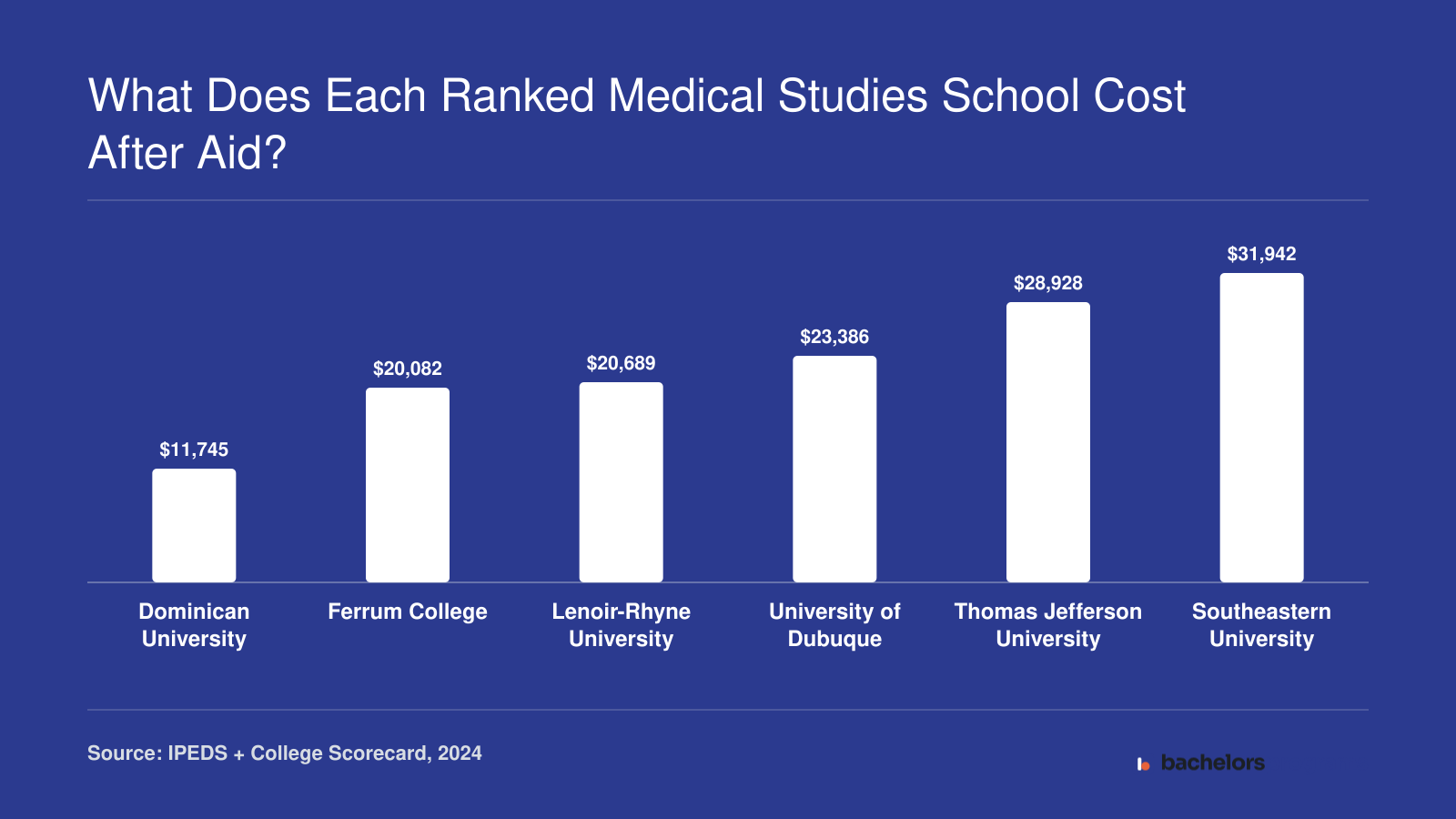
What Does Each Ranked Medical Studies School Cost After Aid?
Net price is the school-wide average yearly cost that undergraduates paid after grants and scholarships, so your own quote may land higher or lower. Dominican University is the most affordable option here at $11,745 a year, while Southeastern University runs $31,942, a gap of $20,197 per year. Run each school's net price calculator with your family's finances before comparing offers.
Medical Studies Degree Cost and Return on Investment
A medical studies degree has a sticker price and a payoff timeline, and both vary widely by school.
Published tuition among the ranked schools ranges from $11,627 in state at Arizona State University to $47,505 at Thomas Jefferson University. Arizona State charges $13,925 out of state. After aid, net price at the schools that report it spans $11,745 at Dominican University to $31,942 at Southeastern University. That gap between sticker price and net price is the number to watch.
Debt and Early Earnings
At Arizona State, median program debt at completion is $22,935, and the median 10-year monthly payment is $243. Pair that with program earnings: $36,058 one year after graduation, $55,043 four years out, and $55,479 five years out. The time window matters. The one-year figure reflects new graduates, not established professionals.
School Context, Not Program Outcomes
Institution-wide 10-year earnings are $62,668 at Arizona State, $60,327 at Dominican, and $51,190 at Dubuque. Median graduate debt at those schools is $19,500, $24,411, and $25,750. These figures describe the whole institution. They are not this program's outcome, so do not treat them as a direct payoff estimate for the major.
Why the Payoff Arrives Later
A medical studies bachelor's is preparation for another program, not a final credential. Most graduates go on to PA school, medical school, or another professional program, so modest earnings in the first year or two are expected. The real return arrives after the graduate credential and license, when physician assistant or physician pay begins. Judge the degree on whether it gets you into that next step with manageable debt, not on a first-year salary.
Questions to Ask Yourself
Do you want to practice as a physician, or do you want to see patients sooner as a PA?
Could you keep the progression GPA an accelerated PA pathway demands every semester?
Do your target graduate programs accept online lab credits, or do you need in-person labs?
If graduate admission doesn't happen, which allied health or administrative role would you pursue with this degree?
Where the Medical Studies Path Often Leads: Physician Assistant Pay
Many medical studies graduates aim for physician assistant practice, one of the better-paid clinical careers open to them.
Medical Studies programs by state
Medical Studies Degree FAQs
These answers cover the questions students ask most often about a bachelor's degree in medical studies. Policies vary by school, so confirm details with each program you are considering.
Is a medical studies degree good for medical school?
How much does a medical studies degree cost?
Do medical schools prefer medical studies majors over biology majors?
Can I switch out of an accelerated PA pathway and still graduate on time with a medical studies degree?
Compare Medical Studies programs on the data that matters
Explore more Healthcare majors or browse every field of study.
All Healthcare programs Browse every field of study