Best Data Science Degree Programs in Connecticut
Compare 6 accredited Data Science programs in Connecticut at 5 colleges, with net price after aid, graduation rates, earnings and debt from IPEDS and the U.S. College Scorecard.

Data scientists in Connecticut work in an occupation whose median wage runs near $103,500, the figure Quinnipiac University cites to prospective students. The entry credential is a bachelor's degree in data science, usually the Bachelor of Science (B.S.), and a small but growing set of Connecticut schools now offers one, at the University of Connecticut, Quinnipiac, Southern Connecticut State, the University of Hartford and Post University.
Admissions screens, state grant aid and local hiring all shape the choice. The coursework is technical; the decision is mostly financial.
Key Points
- Post University offers its B.S. in Data Science online or in Waterbury.
- University of Hartford's average net price runs $18,793 below published tuition.
- Data scientists earn a $103,500 median wage, a figure Quinnipiac highlights.
Best Bachelor's in Data Science Schools in Connecticut, Ranked
Connecticut's data science bachelor's programs range from an engineering-heavy B.S. at the state's flagship university to small, track-based degrees that pair analytics with business coursework. The five schools below all award an undergraduate credential you can enroll in now, whether you want a Storrs campus experience, a Hamden program wired into finance and insurance employers, or a fully online degree you can complete from anywhere in the state.
University of Connecticut
#1Storrs, CT · ~$25,000/yr (est.)
Best for: In-state students seeking engineering-focused analytics
The University of Connecticut is the state's flagship public research university, and its data science offerings reflect that scale: one Bachelor of Science housed in the School of Computing and a second, statistics-based degree run through the College of Liberal Arts and Sciences. Students get a large-course catalog, a year-long senior design experience on the engineering side, and a fully online path on the statistics side. UConn's cross-disciplinary data science ecosystem reaches into business, engineering, agriculture and education, which gives undergraduates room to pair analytics with a domain interest.
- Bachelor of Science in the School of Computing
- Minimum of 120 credits to graduate
- Required coursework in databases, statistical inference and machine learning
- Course in data security, privacy and ethics
- Year-long senior design project on data-intensive problems
- Electives include AI, data mining, software engineering and stochastic modeling
- Written Plan of Study filed in the first semester of junior year
- Six concentration options available
- Fully online option available
- 3.2 GPA minimum for admission
- 24 credits required for admission, 15 of them earned at UConn
- Capstone required for the degree
- Nine-credit domain concentration sequence
- Field study internship option
- Core areas include programming, data management and data visualization
Quinnipiac University
#2Hamden, CT · $41,000/yr (est. net price)
Best for: Finance-bound analysts wanting industry internships
Quinnipiac University in Hamden runs its data science bachelor's jointly through the Mathematics & Statistics and Economics departments, so the degree leans on quantitative modeling rather than pure software engineering. It holds Department of Homeland Security STEM designation, and the university reports that every 2025 graduate was employed or in graduate study six months after finishing. Internship placements have included BlackRock, Morgan Stanley, MSCI, Citi, Travelers Insurance and Pratt & Whitney, and students can attach a second major such as economics, mathematics, biology or industrial engineering.
- Jointly administered by Mathematics & Statistics and Economics
- Department of Homeland Security STEM designation
- Capstone project required for graduation
- Coursework in Python, predictive modeling and advanced machine learning
- Internships at BlackRock, Morgan Stanley, Citi and Travelers
- Second major option in economics, mathematics, biology or industrial engineering
- Universities reports 100% of 2025 graduates employed or in graduate study
Southern Connecticut State University
#3New Haven, CT · ~$21,000/yr (est.)
Best for: Career changers starting with Python basics
Southern Connecticut State University in New Haven offers a data science B.S. that is co-taught by the Computer Science and Mathematics departments, giving students a grounding in both programming and statistical theory. The program is deliberately scaffolded, starting with foundational Python and data science courses before moving into machine learning and database work. SCSU also runs a free virtual Python and Data Analytics Bootcamp through its BioPath Skills Academy for STEM students with little or no programming background, an on-ramp that makes the degree accessible to students arriving without a coding history.
- Joint program of the Computer Science and Mathematics departments
- Starts with Python programming and data science fundamentals
- Upper-level work in data mining, machine learning and Bayesian analysis
- Additional coursework in time series and non-parametric statistics
- Emphasis on storing, safeguarding and interpreting data
- Training in presenting findings to different audiences
- Prepares graduates for both industry roles and graduate study
University of Hartford
#4West Hartford, CT · $30,000/yr (est. net price)
The University of Hartford launched its data science bachelor's in fall 2021, making it one of the earlier dedicated undergraduate programs in the state. The degree is compact and track-driven: a 53-credit core in calculus, linear algebra, probability and data structures, then a choice between a computing and mathematics track or a business track. That structure suits students who want analytics skills but also want a defined second lane, and the two-course capstone gives every major a portfolio project before graduation.
- Major requires 71 to 72 credits
- Core courses total 53 credits
- Two tracks: CS/Math at 19 credits or Business at 18 credits
- Business track covers financial accounting, business finance and analytics
- Two-course capstone in data science
- 2.0 GPA required in major courses
- Major courses must be taken for a letter grade
Post University
#5Waterbury, CT · ~$22,000/yr (est.)
Post University in Waterbury offers a STEM-designated data science bachelor's that can be completed fully online or on the Connecticut campus, which makes it the most flexible option in the state for working adults. The 120-credit degree is organized into an essential skills core, general education, major coursework and open electives, with concentrations in Big Data or Interdisciplinary Studies. There is no application fee, and the university is accredited by the New England Commission of Higher Education.
- 120 credits, designed as a four-year program
- Offered fully online or on the Waterbury campus
- Two concentrations: Big Data or Interdisciplinary Studies
- 57 credits of major and concentration coursework
- Interdisciplinary track includes an independent study or internship
- $0 application fee, military tuition reductions available
- Preparation for the CompTIA IT Fundamentals+ exam
- Accredited by the New England Commission of Higher Education
Cost & outcomes by school
Federal data for the highest-earning Data Science programs, independent of the ranking above. Earnings are this field's bachelor's graduates four years after completing where the Scorecard reports them, else the school's undergraduate median.
| School | Net price / yr | Grad rate | Earnings | Debt | Grads/yr | Format |
|---|---|---|---|---|---|---|
| Quinnipiac University CT | $40,675 | 76% | $83,759 | $26,000 | 11 | Campus |
| University of Connecticut CT | $25,097 | 83% | $73,997 | $21,500 | 10 | Campus |
| University of Hartford CT | $30,282 | 54% | $60,823 | $27,000 | 2 | Campus |
| Southern Connecticut State University CT | $20,857 | 50% | $55,043 | $22,250 | 5 | Campus |
| Post University CT | $21,634 | 25% | $38,696 | $30,157 | 3 | Online or campus |
Sources: U.S. Department of Education. Net price, graduation rate, earnings and debt: College Scorecard (earnings and debt for this field's bachelor's graduates where reported, else school-wide); graduates: IPEDS. A dash means no figure is reported.
Cost, debt & payoff
Median earnings of this field's bachelor's graduates (4 yrs after completing, else the school's undergraduate median) vs. their median federal loan debt · U.S. College Scorecard
Across these programs the median graduate earns about $67,410 and finishes with roughly $24,125 in debt — a ratio that clears a common rule of thumb (keep debt below first-year salary). Net price and debt vary widely school to school, so check the per-school figures in the table above before you shortlist.
How We Ranked Connecticut Data Science Schools
Every program here was compared on the same practical factors: what a student pays and what they get after graduation.
What We Compared
- Cost: Average net price, meaning what students typically pay after grants and scholarships, not the sticker tuition.
- Completion and selectivity: The share of students who finish their degree, plus how competitive admission is.
- Format: Whether a program runs on campus, online, or both, so commuters and working adults can find a realistic fit.
Read the Averages Carefully
Graduation rates and net price are institution-wide averages. They describe the whole university, not the data science major alone. A school with a strong overall graduation rate can still run a demanding, math-heavy data science curriculum, so read these numbers as a signal about a university's support and value, not a promise about one department.
Program-level earnings need more care. The College Scorecard reports earnings for a specific field of study only when enough graduates are counted, and smaller or newer programs may not have them yet. We use those figures only where the Scorecard publishes them, and every time we cite one, we state how long after graduation it was measured, such as one year or four years out.
Who Is Included
Every school ranked here is based in Connecticut and offers a bachelor's degree in data science or a closely related major, such as UConn's Data Science and Engineering and Statistical Data Science options. Programs that a Connecticut-based school delivers online are eligible too, so students outside commuting range can still weigh these options.
Choosing a Bachelor's Degree in Data Science: B.S. vs. B.A. and Concentrations
The real choice is between technical depth and flexibility to pair data skills with another field. A B.S. leans toward heavier coursework in math, statistics and computing. A B.A. typically trades some of that load for electives or room to study a second subject such as economics, public policy or the social sciences.
What the Connecticut Programs Offer
Every data science program at the schools here awards a Bachelor of Science, so the useful question is what each one emphasizes. Southern Connecticut State University runs its B.S. jointly through Computer Science and Mathematics. Quinnipiac University's is run by Math and Economics and allows a second major. UConn's Data Science and Engineering program sits in engineering and includes a year-long senior design project. Hartford's B.S. shows how a single major can split into separate tracks.
Concentrations and Career Paths
University of Hartford and Post University each offer two concentration options. Hartford's tracks are CS/Math (19 credits) and Business (18 credits). Here is how the tracks map to work:
- Computer science or math-focused: Fits machine learning engineering and data engineering, where you build models and pipelines.
- Business or economics-focused: Fits business intelligence and analytics roles, where you turn data into decisions. Quinnipiac lists BI analyst, data architect and ML engineer among its career paths.
Do You Need Strong Math or Programming Skills First?
No. Basic algebra and a willingness to learn Python or R are typical starting points, and the programs teach the rest. SCSU's curriculum begins with Python programming fundamentals, and Post's coursework covers both Python and R. Expect the math to get harder in upper-level courses, so you should be ready to work at it.
A Simple Rule of Thumb
If you want to build models, systems or pipelines, choose the most math and computing-heavy track available. If you want to apply data inside a business or another field, choose a business-oriented concentration or a program that lets you add a second major.
Online and Hybrid Bachelor's in Data Science at Connecticut Schools
Can you earn a data science bachelor's online in Connecticut?
Yes. Of the Connecticut schools on this list, Post University offers its Bachelor of Science in Data Science online or on campus in Waterbury. Online sections have no class meetings or set login times, so you work on your own schedule within each term. The degree is the same either way: 120 credit hours, two concentration options, and an independent study or internship. Post's program page lists no in-person requirement for online students; confirm exam proctoring and internship placement with an advisor before you enroll.
The other programs are built for students who come to campus. University of Connecticut's Data Science and Engineering major, Quinnipiac University's B.S. in Data Science, Southern Connecticut State University's B.S. in Data Science,2 and University of Hartford's B.S. in Data Science are each listed as on-campus degrees. Their pages describe semester coursework, capstones, and senior projects rather than an online route to the major, and none is advertised as a hybrid program.
What changes when the format changes
- In-person work: UConn closes its major with a year-long senior design project, and Quinnipiac and Hartford both require a capstone.1 Team projects and local employer contacts come with those campuses.
- Schedule: Post's online sections are asynchronous, which suits students holding a job or managing a family. Campus programs follow the academic calendar with set meeting times.
- Cost: Post lists one tuition rate for Connecticut residents and out-of-state students, and its page presents online and Waterbury delivery as the same degree rather than a separately priced online track.
Online study suits working adults finishing a degree around a job, transfer students who want to keep credits moving without relocating, and commuters far from Waterbury. None of these programs currently advertises a hybrid format that mixes online and on-campus coursework.
Admissions for Connecticut Data Science Bachelor's Programs: GPA, Test Policy, and Transfer Credit
Getting into a university and getting into the data science major are two separate steps at some Connecticut schools, and the second is often the harder one. These details come from each school's admissions and catalog pages, and where a school states nothing on a point, we say so.
GPA and Test Policy
- University of Connecticut: The Statistical Data Science, B.S. requires a 3.2 GPA across MATH 1132Q, STAT 1000Q or 1100Q, and one approved intro programming course (CSE 1010, CSE 1729, or STAT 2255). Applicants also need at least 24 completed credits, 15 of them at UConn, and a 3.2 cumulative GPA, which must be maintained after entry. General admissions review is holistic (GPA, rank, essays, activities, recommendations), and SAT/ACT scores are optional and considered only if submitted.1
- Quinnipiac University: No policy published on GPA or test requirements in the sources we reviewed.
- Southern Connecticut State University: No policy published on GPA or test requirements in the sources we reviewed.
- University of Hartford: No policy published on GPA or test requirements in the sources we reviewed.
- Post University: No policy published on GPA or test requirements in the sources we reviewed.
Before you apply, confirm current requirements on each school's admissions page, since policies can change from one cycle to the next.
Transfer Credit Rules
UConn's published sources do not state a transfer-credit maximum, a residency minimum, or how credits apply to this major. They also describe no community college articulation agreement specific to Statistical Data Science. Quinnipiac, University of Hartford, and Post University: No policy published on transfer credit in the sources we reviewed.
The state's community college system offers the most clearly documented pathway. A transfer associate degree includes at least 30 credits of transferable general education coursework, is capped at 64 credits, and guarantees junior status plus admission to the Connecticut State Universities, a group that includes Southern Connecticut State University. Credits do not need to be matched course by course. Major-specific GPA or performance requirements can still apply, so check the articulation for data science before you enroll.
The Easiest Way In for Transfer Students
For transfer students, the clearest guaranteed route is a transfer associate degree followed by Southern Connecticut State University. The guarantee covers admission and junior standing, with no 3.2 major gate like UConn's. UConn is the harder target: the guarantee does not extend to it, and you must clear the 3.2 requirement in the major's prerequisite courses after admission.
Accreditation: What to Check Before You Enroll
Does a data science bachelor's degree in Connecticut need specialized accreditation to be worth your money?
Institutional Accreditation Comes First
For Connecticut schools, the baseline is institutional accreditation from the New England Commission of Higher Education (NECHE).1 That status covers the institution as a whole, including its programs and online offerings, and it is what keeps federal financial aid and credit transfer working. UConn's standing is confirmed: a NECHE member since 1931, with a comprehensive evaluation visit in 2016 and the next one scheduled for fall 2026.2 NECHE is explicit that institutional accreditation does not guarantee the quality of any individual program, course or graduate.1
Specialized Program Accreditation Is Often Absent
ABET's Computing Accreditation Commission accredits computing programs at the associate's, bachelor's and master's levels3, but none of the bachelor's data science programs listed here is confirmed to hold ABET or another specialized seal. That is normal for a field this young, and employers hiring data analysts rarely screen for it. Curriculum carries more weight: statistics, programming, databases and a capstone.
How to Verify It Yourself
Search the NECHE directory by institution name, confirm the member listing and note the next evaluation date. Then ask admissions directly whether the data science major falls within the institution's accredited scope.
State Authorization Is Not Accreditation
Connecticut state authorization lets a school operate or enroll online students here. It is a separate gate, not a substitute for NECHE.
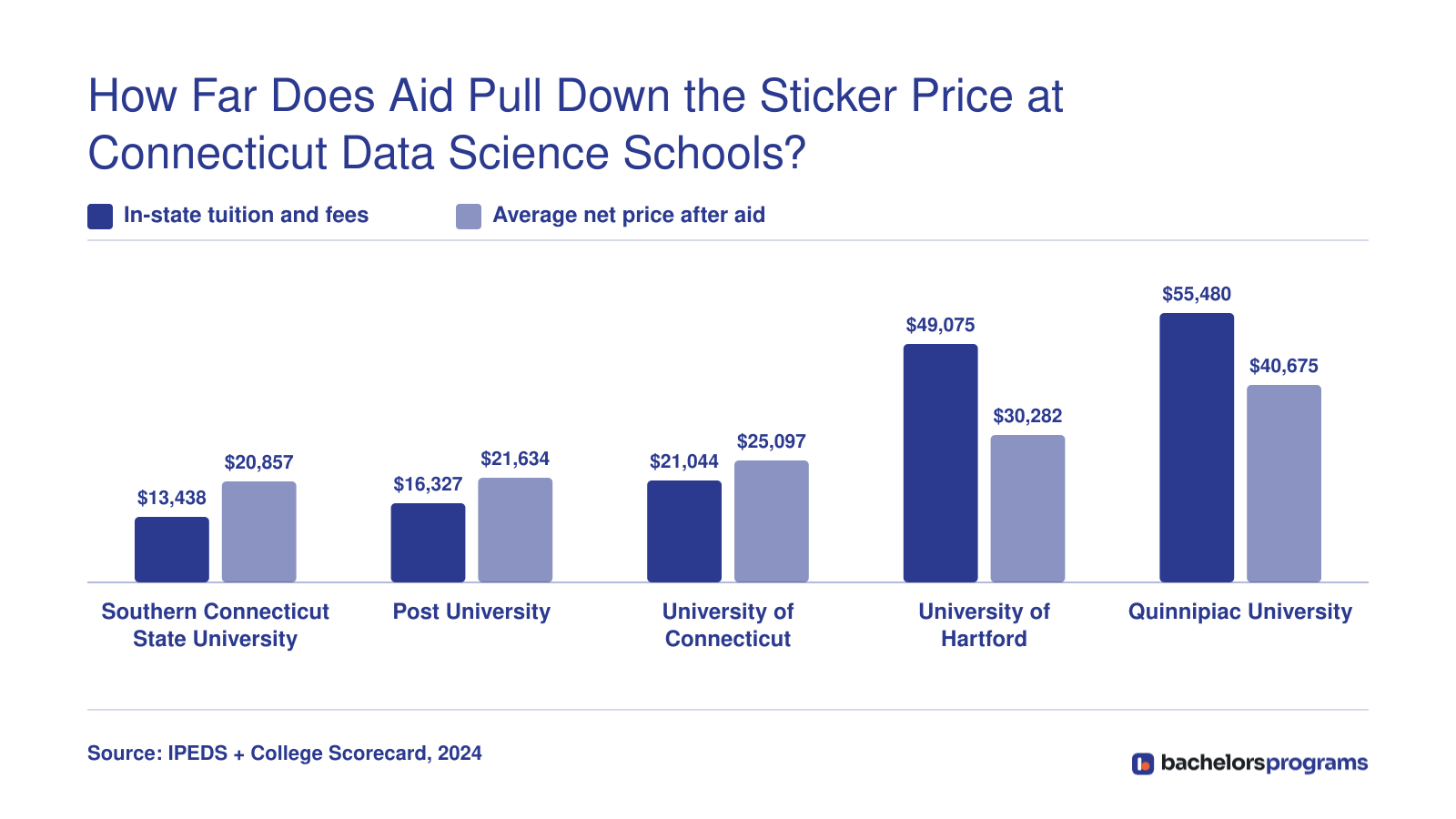
How Far Does Aid Pull Down the Sticker Price at Connecticut Data Science Schools?
The widest gaps between sticker price and what families actually pay appear at the private schools. University of Hartford's average net price runs $18,793 below its published tuition, and Quinnipiac University's runs $14,805 below. At University of Connecticut, Southern Connecticut State University and Post University, net price lands above tuition because it is a full cost-of-attendance figure that includes housing, food and books after grants. Net price is an institution-wide average for full-time, first-time undergraduates receiving aid, not a figure specific to data science majors.
Related Articles
What Connecticut Data Science Graduates Earn
Data science pays well, and Quinnipiac points prospective students to a median data scientist wage of $103,500, an occupation-wide figure rather than a measure of its own graduates.
Choosing a Connecticut data science program means matching a technical degree to your budget, your schedule and the work you want to do.
Filter in that order. Start with cost: the gap between published tuition and average net price is widest at the private schools, so run each net price calculator first. Then pick a format: Post University's online B.S. is the clearest fully online route, and the other schools are campus-based. Then choose a concentration, from the engineering-heavy path at University of Connecticut to business-adjacent tracks.
Confirm admissions on each school's own page, file the Connecticut aid applications, and this week ask one admissions office for a transfer credit review.
Compare Data Science programs on the data that matters
Explore more Science & Engineering majors or browse every field of study.
All Science & Engineering programs Browse every field of study