Best Data Science Degree Programs in Texas
Compare 9 accredited Data Science programs in Texas, with net price after aid, graduation rates, earnings and debt from IPEDS and the U.S. College Scorecard.
Dallas-Fort Worth and Austin hold some of the country's largest concentrations of corporate data teams, and Houston and San Antonio employers keep hiring analysts. A bachelor's degree in data science in Texas usually means the Bachelor of Science (B.S.) in Data Science: calculus, statistics, programming and a capstone, 120 credit hours or more.
Cost separates the choices. Net price after aid at the public options runs near $10,500 to $18,300 a year, while private tuition runs from $37,090 to $67,040. Figures here come from College Scorecard data and are approximate.
Key Points
- University of Houston-Downtown posts the lowest average net price: $10,542.
- Texas data science bachelor's degrees remain mostly campus-based, with limited online options.
- Southern Methodist University data science graduates carry $19,500 median federal debt.
Best Bachelor's Degree in Data Science Programs in Texas, Ranked
Nine Texas bachelor's programs in data science make this list, eight taught on campus and one delivered in a hybrid mix of online, blended and face-to-face classes. Institution-wide graduation rates at these schools span 33% to 84%, so the range of student outcomes behind the same degree title is wide. The net price shown on each card is a sector-based average for the institution after grant aid, not a personal quote; your own figure depends on grants, transfer credit and housing.
The University of Texas at Dallas
#1Richardson, TX · $18,000/yr (est. net price)
Best for: Math-strong students eyeing early grad coursework
A public research university with deep STEM departments, UT Dallas runs its data science bachelor's jointly through mathematical sciences and computer science, so the degree is quantitative from the start. A Fast-Track option lets strong seniors apply up to 15 credit hours of approved graduate coursework toward the undergraduate degree. A dedicated STEM career center supports internships and the job search. It rewards students who want rigor and a research-adjacent path.
- 120 total credit hours, including 42 in the university core
- 65 to 67 credit hours in the major, plus 11 to 13 electives
- Capstone project required
- Jointly offered by mathematical sciences and computer science
- Fast-Track option: up to 15 graduate credit hours in senior year
- Trigonometry and calculus highly recommended before entry
- NSM Career Success Center supports STEM job searches
University of North Texas
#2Denton, TX · $11,000 – $21,000/yr (est.)
Best for: Working students blending online and campus classes
A large public university where data science sits in the Department of Information Science rather than a math department, which pushes the curriculum toward data management, analytics and information organization. Students pick between information science and business analytics, and can take classes online, blended or in person. The department belongs to the iSchools network and offers scholarships. It is the most schedule-flexible option on this list.
- 120 credit hours over about four years
- Two concentration options: information science or business analytics
- Online, blended and face-to-face classes
- Department of Information Science offers scholarships and financial support
- Coursework in SQL and NoSQL databases, data mining and text mining
- Department holds membership in iSchools and the ALA
- Career Center advising includes internship placement
Southern Methodist University
#3Dallas, TX · ~$41,000/yr (est.)
Best for: Dual-degree planners combining data with another field
A private university that structures its data science B.S. as a second major: students pair it with a discipline such as economics, biology or engineering, and the statistics department builds the core around statistics, computer science and optimization. That design produces graduates with an application area, not just tool skills. Small cohorts keep the work close to faculty. It suits students who already know what field they want to apply data to.
- 122 credit hours, with at least 36 in the major (12 courses)
- A second major in another discipline is required
- Data science cannot be the first declared major
- The B.S. cannot be paired with a B.A. in mathematics
- Combines statistics, computer science and optimization
- Housed in Dedman College's Department of Statistics and Data Science
The University of Texas at Arlington
#4Arlington, TX · ~$14,000/yr (est.)
A Carnegie R-1 public university with about $125 million in research spending, UT Arlington houses data science in the College of Science and leans on industry and academic partners for projects, research and hiring pipelines. Transfer students can enter in fall, spring or summer, and the surrounding metro area hosts 24 Fortune 500 companies. It is a strong fit for students who want research access and a large employer market at a public price.
- 120 credit hours in the College of Science
- Merit scholarships and financial aid for eligible incoming students
- Transfer students can start in fall, spring or summer terms
- Industry and academic partners support projects and career prep
- Carnegie R-1 institution with $125 million in research expenditures
- 24 Fortune 500 companies operate in the surrounding metro
- Science Learning Center provides study support
Baylor University
#5Waco, TX · ~$41,000/yr (est.)
A private Christian university where the data science major sits in the School of Engineering and Computer Science and carries an unusually structured undergraduate load: 124 credit hours, 60 in residence, 36 advanced, plus chapel. The curriculum covers programming, database design, cloud computing, machine learning, big data and a capstone. A required 18-hour minor or secondary major adds a second field. It fits students who want a defined, cohort-style experience.
- 124 total credit hours, including 60 in residence and 36 advanced
- Data science capstone required
- 18-hour minor or secondary major required
- Math, statistics and computer science minors do not satisfy that requirement
- 2.0 overall GPA, with a C or better in all CSI and DSC major courses
- Coursework covers cloud computing, machine learning, big data and cybersecurity
- Two semesters of chapel required
University of Houston-Downtown
#6Houston, TX · $8,000 – $18,000/yr (est.)
An urban public university whose mathematics and statistics department launched the first undergraduate data science degree in Texas. The program is applied by design, teaching students to collect, clean, query and model large data sets and then explain the results to nontechnical audiences. The department publishes a four-year degree plan, transfer information and a degree sheet, which makes planning straightforward for students juggling work and school.
- 120 credit hours; a four-year degree plan is published
- First undergraduate data science program in Texas
- Housed in the Department of Mathematics and Statistics
- Built on mathematics, statistics and computer programming
- Training in collecting, cleaning, querying and combining large data sets
- Data visualization and communication for technical and nontechnical audiences
- Career fields include defense, energy, finance, healthcare and robotics
University of the Incarnate Word
#7San Antonio, TX · ~$23,000/yr (est.)
A private university with a 120-hour data science B.S. that deliberately mixes mathematics, computer information systems, statistics, machine learning and programming instead of parking the degree in one department. Electives reach into data mining, predictive analytics and business intelligence, and a senior capstone pulls the pieces together. Graduates head into retail and brand offices, technology firms, healthcare, finance and banking. Class sizes are modest compared with the public flagships.
- 120 credit hours with a capstone in the senior spring semester
- Integrates mathematics, computer information systems, statistics and machine learning
- Electives in data mining, design, predictive analytics and business intelligence
- Programming coursework runs alongside the statistics core
- Prepares students for data engineer and data integration roles
Sam Houston State University
#8Huntsville, TX · ~$16,000/yr (est.)
A public university offering three data science concentrations, one of which pairs the major with computer science coursework in data structures, data mining, systems modeling and simulation. Requirements are spelled out clearly: 120 to 121 credit hours, a 2.0 overall and major GPA, and no minor. The department aligns the curriculum with the state's 60x30TX marketable skills plan.
- 120 to 121 credit hours, with 33 to 34 in the computer science concentration
- Three concentration options overall
- 2.0 overall GPA and 2.0 major GPA required
- A minor is not required
- Foundation includes calculus I and II, linear algebra and regression modeling
- Concentration adds data structures, data mining and system modeling
- Curriculum aligns with the state's 60x30TX marketable skills plan
Saint Edward's University
#9Austin, TX · ~$26,000/yr (est.)
A private university whose applied data science B.S. requires a minor and builds the capstone around that second field, so graduates leave with a defined application area. Coursework runs on R and Python through data analysis, machine learning and statistical modeling, with lab access and paid STEM internship support. It suits students who want a smaller program with an internship pipeline into the local technology economy.
- 54 hours of applied data science courses in the major
- Pair the major with any minor except statistics
- R and Python used across data analysis, machine learning and modeling
- Capstone project tied to the chosen minor
- Access to the Advance Computing Lab
- Paid STEM internships available
Cost & outcomes by school
Federal data for the highest-earning Data Science programs, independent of the ranking above. Earnings are this field's bachelor's graduates four years after completing where the Scorecard reports them, else the school's undergraduate median.
| School | Net price / yr | Grad rate | Earnings | Debt | Grads/yr | Format |
|---|---|---|---|---|---|---|
| Southern Methodist University TX | $40,892 | 84% | $78,354 | $19,500 | 74 | Campus |
| The University of Texas at Dallas TX | $18,267 | 76% | $68,227 | $18,000 | 54 | Campus |
| Baylor University TX | $41,104 | 80% | $65,793 | $23,000 | 28 | Campus |
| The University of Texas at Arlington TX | $13,951 | 54% | $63,199 | $17,527 | 18 | Campus |
| Saint Edward's University TX | $25,578 | 63% | $58,826 | $24,803 | — | Campus |
| University of North Texas TX | $15,649 | 61% | $57,010 | $19,250 | 56 | Hybrid |
| University of the Incarnate Word TX | $22,775 | 51% | $56,733 | $27,000 | 2 | Campus |
| Sam Houston State University TX | $16,404 | 55% | $54,211 | $21,983 | — | Campus |
| University of Houston-Downtown TX | $10,542 | 33% | $53,551 | $18,750 | 18 | Campus |
Sources: U.S. Department of Education. Net price, graduation rate, earnings and debt: College Scorecard (earnings and debt for this field's bachelor's graduates where reported, else school-wide); graduates: IPEDS. A dash means no figure is reported.
Cost, debt & payoff
Median earnings of this field's bachelor's graduates (4 yrs after completing, else the school's undergraduate median) vs. their median federal loan debt · U.S. College Scorecard
Across these programs the median graduate earns about $58,826 and finishes with roughly $19,500 in debt — a ratio that clears a common rule of thumb (keep debt below first-year salary). Net price and debt vary widely school to school, so check the per-school figures in the table above before you shortlist.
Most Affordable Texas Data Science Bachelor's Programs
Public universities hold the lowest net prices on this page, with average net price after aid running from $10,542 at University of Houston-Downtown to $18,267 at The University of Texas at Dallas, according to 2024 IPEDS and College Scorecard data. Private options such as Southern Methodist University, Baylor University, and Saint Edward's University do not appear among the most affordable choices. Median debt for these specific data science programs is not yet reported, so the table compares net price and in-state tuition and fees.
| School | City | Program | Format | Avg. Net Price After Aid | In-State Tuition and Fees |
|---|---|---|---|---|---|
| University of Houston-Downtown | Houston | Bachelor of Science in Data Science | Campus | $10,542 | $7,708 |
| The University of Texas at Arlington | Arlington | Bachelor of Science in Data Science | Campus | $13,951 | $11,950 |
| University of North Texas | Denton | Bachelor of Science in Data Science | Hybrid | $15,649 | $11,309 |
| Sam Houston State University | Huntsville | Bachelor of Science, Major in Data Science | Campus | $16,404 | $9,228 |
| The University of Texas at Dallas | Richardson | B.S. in Data Science | Campus | $18,267 | $14,644 |
Online and Hybrid Bachelor's Data Science Options at Texas Schools
Online delivery has spread across undergraduate computing, but most Texas data science bachelor's programs still meet on campus. The schools here build their programs around in-person calculus, statistics, and programming sequences, and the University of North Texas stands out for describing a mixed format.
Format at a Glance
- Hybrid: The University of North Texas in Denton lists its Bachelor of Science in Data Science as hybrid, with online, blended, and face-to-face classes.
- On campus: The University of Texas at Dallas, Southern Methodist University, The University of Texas at Arlington, Baylor University, University of Houston-Downtown, University of the Incarnate Word, Sam Houston State University, and Saint Edward's University present their programs as campus-based. UT Arlington's page calls its degree an on-campus bachelor's program.
UNT's online classes deserve a closer look before you plan around them. The program page mentions online sections, but it does not confirm that the full 120-credit degree can be finished without coming to Denton. Treat it as hybrid until an advisor confirms otherwise in writing.
Residency and Tuition
Texas public universities price by residency, and the gap is wide. UNT lists in-state tuition and fees of $11,309 against $21,149 for out-of-state students. If you live outside Texas and plan to take mostly online sections, ask the bursar whether a separate online rate applies. Don't assume online coursework removes the out-of-state premium. Private schools such as Baylor ($58,100) and SMU ($67,040) charge the same tuition and fees regardless of residency.
International Students
Federal rules for F-1 students generally allow only one online class (or three credit hours) per term to count toward full-time enrollment. That makes an in-person schedule the practical route for most visa holders, and a hybrid program like UNT's needs careful course planning to stay compliant. Students living outside the U.S. should ask each school's international admissions office whether enrolling from abroad in online-only coursework is permitted at all.
The Bottom Line
Can you earn this degree fully online from a Texas school? No school ranked here confirms a fully online B.S. in Data Science. UNT's hybrid format offers the most flexibility for students who need some remote coursework. Working adults who need fully remote study should get written confirmation from UNT on which courses run online before applying, and should weigh whether occasional trips to Denton fit their schedule.
Related Articles
Admissions for Texas Data Science Bachelor's Programs: GPA, Test Policy, and Transfer Credit
Selectivity varies widely across the schools here. Federal Scorecard admission rates run from about 51% at Baylor University and 63% at Southern Methodist University to roughly 65% at The University of Texas at Dallas and 72% at the University of North Texas. The University of Texas at Arlington admits about 80%, Saint Edward's University about 81%, and University of Houston-Downtown, Sam Houston State University and the University of the Incarnate Word all sit at 90% or above.
GPA, Test Policy, and Math Prerequisites
We did not find a freshman GPA minimum or SAT/ACT rule written specifically for the data science major at these schools. General university admission standards govern entry, so confirm the current policy on each admissions page before you apply. Two 2.0 GPA figures you may see, at Baylor and Sam Houston State, are degree-completion requirements for students already enrolled, not admission cutoffs.
Math is where the major pages are more specific. UT Dallas, which runs its program jointly through math and computer science, highly recommends trigonometry and calculus in high school. It also lists the Texas Success Initiative Assessment (TSIA2) for students who do not qualify for an exemption.1 Most other schools here do not publish a separate high school math prerequisite for the major.
Top 10% Rule and Transfer Credit
Under the Texas Top 10% Rule, graduates in the top tenth of their class at an accredited Texas high school are generally eligible for automatic admission to Texas public universities. Here that means UT Dallas, UNT, UT Arlington, Houston-Downtown and Sam Houston State. Deadlines and any extra requirements still apply. The rule does not cover private schools such as SMU, Baylor, Incarnate Word or Saint Edward's.
Transfer credit rules are also thinly published for these programs. UT Arlington notes that transfer students can start in fall, spring or summer. For every school, ask for a written credit evaluation before you commit, and check whether your calculus and statistics courses count toward the major.
Note for International Students
International applicants should expect to prove English proficiency, usually with TOEFL or IELTS scores, and to submit foreign transcripts for credential evaluation. Minimum scores differ by school and are set by each admissions office, so check the international applicant page directly.
Key Takeaways
- Selectivity: Baylor, SMU and UT Dallas are the most selective here, while several others admit nine in ten applicants.
- Test policy: Confirm each school's current SAT/ACT stance, since major-specific rules are not published.
- Math prep: Calculus before arrival gives you a head start, especially at UT Dallas.
- Texas residents: Class rank may secure automatic admission at the public schools.
- Transfers and international applicants: Request a credit evaluation early, and plan for English testing and transcript review.
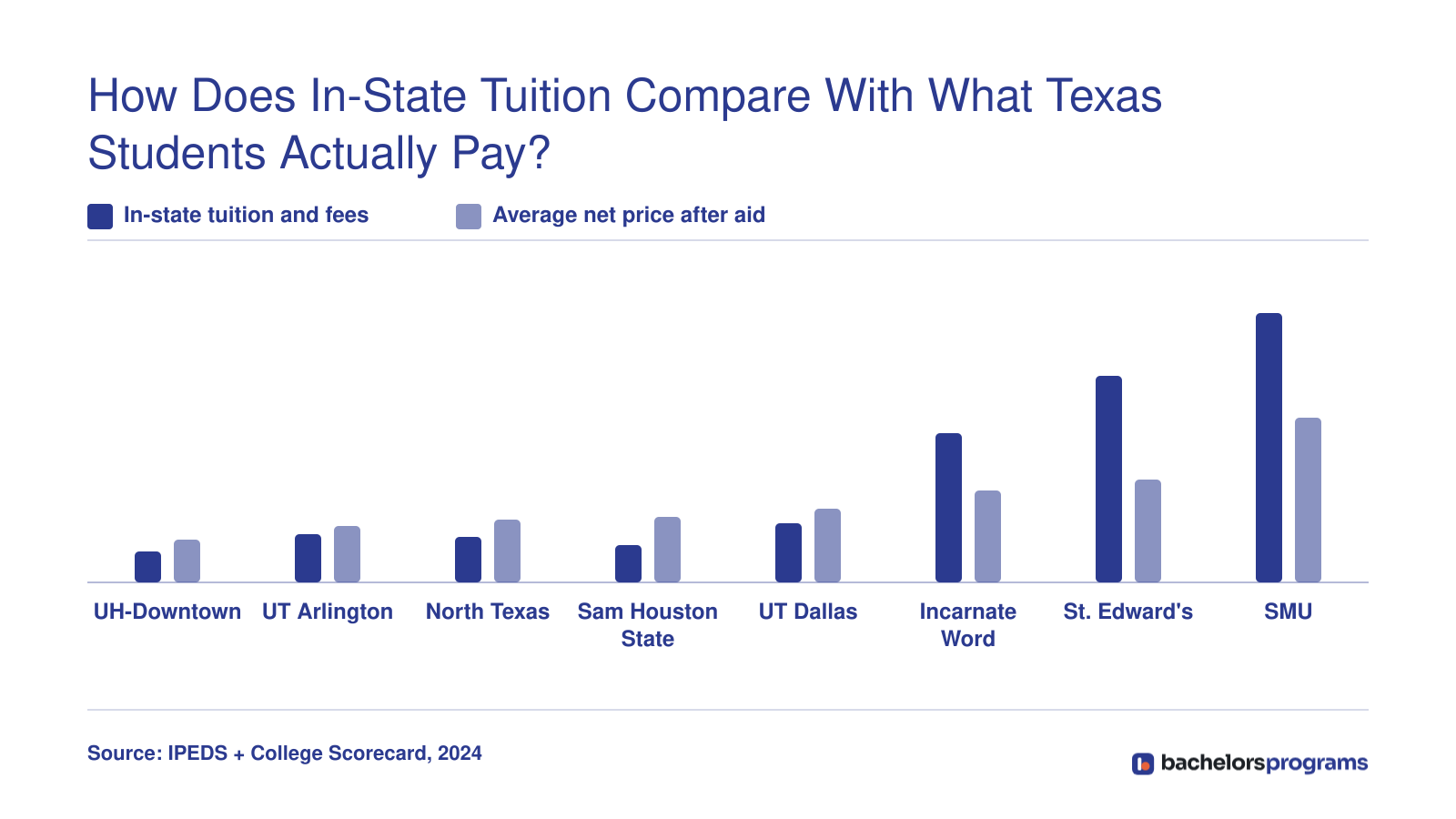
How Does In-State Tuition Compare With What Texas Students Actually Pay?
Sticker price and the amount students actually pay rarely match. At the public universities here, average net price runs above in-state tuition and fees because it covers the full annual cost of attendance, including housing, books and living expenses, after grants and scholarships. At the private schools, aid cuts the bill well below tuition: Southern Methodist University's $67,040 sticker price falls to an average net price of $40,892, and Saint Edward's University drops from $51,384 to $25,578. The gap varies by school. Net price is also a sector-based average: public schools report it for in-state students receiving aid, and private schools report it for all aided students. Your own cost will depend on your family income and aid package.
Questions to Ask Yourself
Does the curriculum offer a concentration that matches the Texas industry you want to enter?
Does the school place students in internships or co-ops in Austin, Dallas-Fort Worth, Houston, or San Antonio?
Is the school SACSCOC-accredited, so your credits and degree are recognized by employers and graduate schools?
Data Science Careers and Salaries in Texas by Metro
Graduates with a bachelor's degree in data science in Texas typically start in data analyst or business intelligence analyst roles and can grow into data scientist and machine learning engineer positions, and 2026 job postings show demand in finance (J.P. Morgan, General Motors Financial), automotive (Toyota), aerospace and defense (Lockheed Martin), consulting (Deloitte, Tata Consultancy Services), homebuilding (D.R. Horton), solar energy (Hanwha Qcells), technology (HP) and state government. The U.S. Bureau of Labor Statistics puts the May 2025 median wage for data scientists in Dallas-Fort Worth at $127,750, but its metro figures for Austin, Houston and San Antonio were not available for this update, so the table shows single-employer pay ranges posted in 2026 for Austin and Houston, which are examples of posted pay, not metro averages. Keep in mind that these figures describe wages across the whole occupation, including experienced workers, and are different from what recent graduates of a specific program earn, which the College Scorecard tracks and the next section covers.
| Metro Area | Median Annual Wage | Employment | Other Pay Data | Source |
|---|---|---|---|---|
| Dallas-Fort Worth-Arlington | $127,750 | 10,120 data scientist jobs | Mean annual wage: $123,150 | U.S. Bureau of Labor Statistics, May 2025 |
| Austin | N/A | N/A | Posted range of $114,000 to $125,000 for a Data Scientist II role | Office of the Texas Governor job posting, 2026 |
| Houston | N/A | N/A | Posted range of $140,000 to $180,000 for a Data Scientist role | Hanwha Qcells job posting, 2026 |
Common Questions About Data Science Bachelor's Programs in Texas
These answers draw on the program details and cost figures covered earlier on this page. Confirm current numbers with each school before you apply.
Can you get a data science degree online from a Texas school?
How much does a bachelor's degree in data science cost in Texas?
What is the salary for data science graduates in Texas?
Are there data science programs in Texas for international students?
Compare Data Science programs on the data that matters
Explore more Science & Engineering majors or browse every field of study.
All Science & Engineering programs Browse every field of study