Best Online Electrical Engineering Degree Programs
Compare 30+ accredited online Electrical Engineering programs, with net price after aid, graduation rates, earnings and debt from IPEDS and the U.S. College Scorecard.

Can you earn a bachelor's degree in electrical engineering without setting foot in a lab? Yes, and the credential matches what campus graduates hold: the Bachelor of Science (B.S.) in Electrical Engineering. The sticking points are real ones, though, and they come down to labs, ABET accreditation and required campus visits, each with a concrete answer.
Labs arrive as at-home kits or remotely operated equipment. ABET reviews the online program itself rather than the campus that hosts it. Every program ranked here is fully online; hybrid formats were excluded.
What narrows the field fastest is licensing. State boards and the PE exam hinge on an ABET-accredited degree, regardless of where you sat for class.
Key Points
- ABET accredits individual programs, so verify the exact online degree.
- Arizona State University Online's electrical engineering B.S.E. requires 120 credits.
- Engineering technology graduates face a 6-year experience requirement for PE licensure.
Best Fully Online Electrical Engineering Bachelor's Degree Programs for 2027
Every program below can be completed 100 percent online, with no hybrid or in-person component required, and hybrid formats were left off the list. The schools are listed in a composite order that weighs several quality measures together rather than a single metric. Each entry shows what the school offers beyond the degree itself: concentrations, capstones, and where available, program-level earnings and debt for graduates.
Florida International University
#1Miami, FL · ~$9,000/yr (est.)
Best for: Working adults wanting broad concentration choices
Florida International University is a public research university in Miami with a large online footprint and a strong regional engineering presence. Its electrical engineering bachelor's degree runs 128 credits and asks students to pick at least two of 15 specialized concentrations, among them power and energy, communications, cybersecurity, and embedded system software. A two-semester Senior Design capstone pairs teams with faculty and industry mentors, and optional Pre-Medical and Physics tracks add further specialization. New terms begin January 11 and May 10, 2027.
- 128-credit B.S. in Electrical Engineering
- Choose at least two of 15 specialized concentrations
- Options include power and energy, cybersecurity and embedded software
- Senior Design capstone spans the final two semesters
- Optional Pre-Medical and Physics tracks available
- Spring 2027 term starts January 11; Summer A starts May 10
- Median earnings of $98,697 four years after finishing
- Median debt of $19,600 for program graduates
Stony Brook University
#2Stony Brook, NY · ~$19,000/yr (est.)
Best for: Transfer students finishing an upper-level degree
Stony Brook University is a public research university on Long Island, New York, and this is an upper-level, two-year completion degree for students who already hold lower-division engineering coursework. Classes are asynchronous and can be taken part-time or full-time, and students do not need to travel to the New York campus. The program is built for both traditional students and working adults carrying family responsibilities while they finish the degree.
- Upper-level, two-year B.S. in Electrical Engineering completion program
- Asynchronous coursework, part-time or full-time
- No travel to the New York campus required
- Open to working and non-traditional students
- Median earnings of $98,573 four years after finishing
- Median debt of $14,500 for program graduates
University of Arizona
#3Tucson, AZ · ~$17,000/yr (est.)
Best for: Students wanting a combined electrical and computer curriculum
The University of Arizona is a large public research university in Tucson. Its bachelor's degree in electrical and computer engineering blends the electrical and computer sides of the field, and the Electrical Engineering track lets students concentrate on that half of the curriculum. Focus areas include microelectronics, robotics, biomedical devices, software design, and power systems and signaling, and undergraduates join company-sponsored design projects and faculty research.
- B.S. in Electrical and Computer Engineering with an Electrical Engineering track
- Focus areas include microelectronics, robotics, biomedical devices and power systems
- Undergraduates join sponsored design projects and faculty research
- Median earnings of $105,839 four years after finishing
- Median debt of $21,000 for program graduates
American Public University System
#4Charles Town, WV · $5,000 – $10,000/yr (est.)
American Public University System is a private institution based in Charles Town, West Virginia, that caters heavily to military, veteran, and adult learners. Its Bachelor of Engineering in Engineering: Electrical Engineering requires 128 semester hours and offers a General concentration or a Robotics and Autonomous Systems concentration. Students complete labs at home, and lab materials can cost up to $8,000 beyond tuition and are not covered by the undergraduate book grant. The program does not prepare graduates for a state-issued professional license.
- Bachelor of Engineering in Engineering: Electrical Engineering
- 128 semester hours, including 30 in general education
- Two concentrations: General, or Robotics and Autonomous Systems
- At-home lab materials may cost up to $8,000, not covered by book grant
- Requires math preparation equivalent to pre-calculus
- Up to 18 transfer credits accepted
- Program does not prepare graduates for state professional licensure
Oregon State University
#5Corvallis, OR · $15,000 – $20,000/yr (est.)
Oregon State University is a public research university in Corvallis. Its electrical and computer engineering bachelor's degree requires 180 to 181 credits and spans communications, signal processing and controls, electronics and integrated circuits, power electronics and energy systems, electromagnetics, and computer architecture. Students finish with a senior design sequence, choosing between an ECE design project and a multidisciplinary capstone, and an Honors Bachelor of Science option is available for high achievers.
- B.S. and Honors B.S. in Electrical and Computer Engineering
- 180 to 181 credits with a four-year sample plan
- Coursework in signal processing, power electronics and electromagnetics
- Senior design sequence with a multidisciplinary capstone option
- Junior and senior elective options
- Median earnings of $105,359 four years after finishing
- Median debt of $24,167 for program graduates
Southern California Institute of Technology
#6Anaheim, CA · ~$33,000/yr (est.)
Southern California Institute of Technology is a small private institute in Anaheim, California, focused on hands-on engineering and technology training. Its electrical engineering bachelor's degree runs 182 quarter credit units in 5-week modules year round, so students can finish in under three years while attending evening classes that start between 5 p.m. and 9 p.m. The curriculum leans heavily on labs and carries a concentration in Electrical Power and Automation, and a separate Electronic Engineering bachelor's degree is also offered.
- 182 quarter credit units, completable in under three years
- 5-week course modules with year-round starts
- Evening classes with starts between 5 p.m. and 9 p.m.
- Concentration in Electrical Power and Automation
- Two senior design project courses
- Median earnings of $84,440 four years after finishing
- Median debt of $35,989 for program graduates
North Dakota State University
#7Fargo, ND · ~$16,000/yr (est.)
North Dakota State University is a public R1 research university in Fargo. Its electrical engineering degree covers electric power systems and information technologies, with focus areas in biomedical engineering and nanotechnology, and in electromagnetics. Students can alternate classroom terms with paid professional work through the Cooperative Education Program, and high achievers can pair the bachelor's with a master's in electrical and computer engineering in about five years.
- Focus areas in biomedical engineering and nanotechnology, and electromagnetics
- Paid cooperative education placements alternate with classroom study
- Accelerated path to a master's in electrical and computer engineering
- Dedicated academic advisor builds a personalized plan
- Recent graduates report 95% employment or continuing education
- Median earnings of $94,510 four years after finishing
- Median debt of $22,000 for program graduates
Ferris State University
#8Big Rapids, MI · ~$9,000/yr (est.)
Ferris State University is a public university in Big Rapids, Michigan, with a long history of applied and technical programs. Its bachelor's degree in electronics and automation engineering technology is a 69-credit completion program for students who already hold an associate degree, with 60 credits inside the major. Coursework covers PLCs, industrial controls, robotics integration, embedded systems, and power distribution, and students finish with a 4-credit internship and a senior capstone.
- B.S. in Electronics and Automation Engineering Technology
- 69 credits total, with 60 in the major
- Coursework in PLCs, robotics integration and industrial communications
- Requires an associate degree in a related field
- Includes a 4-credit internship and a senior capstone
- 80% of students receive job offers before graduation
- Median earnings of $86,348 four years after finishing
University of North Dakota
#9Grand Forks, ND · ~$19,000/yr (est.)
The University of North Dakota is a public research university in Grand Forks. Its 126-credit Bachelor of Science in Electrical Engineering takes most students four to five years and finishes with a senior design project built around industry partners. Graduates meet the education requirement to sit for the NCEES Fundamentals of Engineering exam, the first step toward Professional Engineer licensure, and a combined B.S./M.Eng. option lets qualifying students double-count courses.
- 126-credit B.S.E.E. that most students finish in four to five years
- Senior design project partners students with industry leaders
- Meets the education requirement for the NCEES Fundamentals of Engineering exam
- Combined B.S./M.Eng. option lets qualifying students double-count courses
- Asynchronous classes with remote labs completed via lab kits
- Median earnings of $106,162 four years after finishing
- Median debt of $27,000 for program graduates
Kennesaw State University
#10Kennesaw, GA · ~$15,000/yr (est.)
Kennesaw State University is a large public university in Georgia, and its electrical engineering program sits in the Southern Polytechnic College of Engineering. The 124-credit degree starts in fall, spring, and summer and covers engineering electronics, electric machines, electromagnetics, communications systems, and power and energy. Students must reach Engineering Standing with a 2.7 GPA in selected math, science, and engineering courses before beginning upper-division work, and a Double Owl pathway links the bachelor's to a graduate degree.
- 124-credit B.S. in Electrical Engineering
- Starts in fall, spring and summer terms
- Coursework in power and energy, electromagnetics and communications systems
- Engineering Standing requires a 2.7 GPA in selected courses
- Housed in the Southern Polytechnic College of Engineering
- Double Owl bachelor's-to-graduate pathway
- Median earnings of $96,935 four years after finishing
- Median debt of $30,500 for program graduates
Cost & outcomes by school
Federal data for the highest-earning Electrical Engineering programs, independent of the ranking above. Earnings are this field's bachelor's graduates four years after completing where the Scorecard reports them, else the school's undergraduate median.
| School | Net price / yr | Grad rate | Earnings | Debt | Grads/yr | Format |
|---|---|---|---|---|---|---|
| Florida International University FL | $9,288 | 74% | $98,697 | $14,637 | 115 | Online |
Sources: U.S. Department of Education. Net price, graduation rate, earnings and debt: College Scorecard (earnings and debt for this field's bachelor's graduates where reported, else school-wide); graduates: IPEDS. A dash means no figure is reported.
Cost, debt & payoff
Median earnings of this field's bachelor's graduates (4 yrs after completing, else the school's undergraduate median) vs. their median federal loan debt · U.S. College Scorecard
Across these programs the median graduate earns about $90,088 and finishes with roughly $22,595 in debt — a ratio that clears a common rule of thumb (keep debt below first-year salary). Net price and debt vary widely school to school, so check the per-school figures in the table above before you shortlist.
How We Ranked Online Electrical Engineering Schools
Hybrid programs and any degree with a required on-campus residency were removed before a single score was calculated. Only bachelor's programs that can be completed fully online stayed in the ranking pool.
What the Composite Measures
The remaining schools were scored on a blend of three things:
- Affordability: Net price and published tuition, so a low sticker price and a low average cost after aid both count.
- Completion: The school's overall graduation rate.
- Program outcomes: Earnings and debt for graduates of the specific program, taken from the federal College Scorecard where those figures are published.
Higher scores reflect lower costs, stronger completion, and better reported outcomes. A school with no published outcome figures is judged on the measures it does have.
Limits Worth Knowing
Graduation rates describe the whole institution, not the electrical engineering program or its online students. Net price is an average, and what you pay depends heavily on family income and aid eligibility. ABET status was checked separately and is covered in the accreditation section below. It was verified, not scored, so it did not raise or lower any school's position.
Why Some Cards Show Fewer Statistics
The federal government does not publish program-level earnings or debt when too few graduates completed the program. Smaller programs therefore show fewer numbers on their cards. That reflects a reporting threshold, not a weakness in the program.
Before You Apply
Treat the ranking as a shortlist, not a final answer. Confirm ABET accreditation for the exact degree you plan to enroll in, and ask each school how labs are delivered, whether through lab kits, remote access, or any in-person component, and what lab materials cost.
What to Expect From a Bachelor's Degree in Electrical Engineering Online
Credits and credential
A bachelor's degree in electrical engineering online almost always leads to a Bachelor of Science, and the credit load is substantial. Arizona State University Online's Bachelor of Science in Engineering in Electrical Engineering requires 120 credits across roughly 40 classes, and its Electric Power and Energy Systems concentration carries the same 120-credit total. Figure on 120 to 126 credits depending on the school, since accredited engineering curricula leave little room to trim the math and science core.
The course sequence
The first two years are heavy on calculus, differential equations, calculus-based physics and chemistry. Those courses are prerequisites for nearly everything that follows, so a weak start here delays the whole degree. Upper-division work moves into circuit analysis, digital logic, signals and signal processing, electronics, embedded systems, electromagnetics and power or energy systems. ASU Online's curriculum spans circuits, signal processing, embedded systems and power systems, and students in the power concentration study electric power plants, photovoltaic energy conversion, power-system analysis and electrical machinery under the 2026-27 curriculum. Most programs close with a senior design capstone: at ASU Online it runs two semesters as a team technical design project, taken from concept through construction and demonstration.
How long it takes
Four years full time is the standard benchmark for a student starting from scratch, though ASU notes that actual time varies by individual circumstances. Transfer students who arrive with an associate degree and a completed math sequence often finish in two to three years. Part-time pacing, common among working students, can stretch the same 120 credits to five or six years. Term structure matters too: ASU Online runs lower-division courses in 7.5-week sessions and upper-division courses in 15-week sessions.
Engineering versus engineering technology
Watch the degree title closely. A B.S. in Electrical Engineering Technology (EET) is more applied and hands-on, with lighter theoretical mathematics, and a large share of fully online options are EET rather than EE. The distinction affects accreditation and licensure, which the next section covers.
Are Online Electrical Engineering Degrees ABET-Accredited?
Many are, but ABET accredits individual programs rather than entire schools, so you need to confirm the exact online degree you plan to enroll in. Electrical engineering degrees are reviewed by ABET's Engineering Accreditation Commission (EAC), while electrical engineering technology (EET) degrees fall under its Engineering Technology Accreditation Commission (ETAC), and in many states an EAC-accredited degree offers the most direct path to the FE exam and a PE license, while ETAC graduates may face added experience requirements or limits. Each school below has a program in ABET's search of 100% online programs, which ABET says were evaluated as fully online at their most recent review, but you should still verify the specific program in three steps: search ABET's accredited program database, match the exact degree title you plan to earn, and ask admissions whether the online and campus versions share the same accreditation.
| School | Online Program Title | Covers Online Delivery? |
|---|---|---|
| Arizona State University | Not specified in ABET listing | Yes, listed in ABET's 100% online program search |
| University of North Dakota | Not specified in ABET listing | Yes, listed in ABET's 100% online program search |
| Excelsior University | Not specified in ABET listing | Yes, listed in ABET's 100% online program search |
Related Articles
What Electrical Engineers Earn Nationally
A bachelor's degree in electrical engineering prepares you for engineer-level roles, and the national pay figures reflect that.
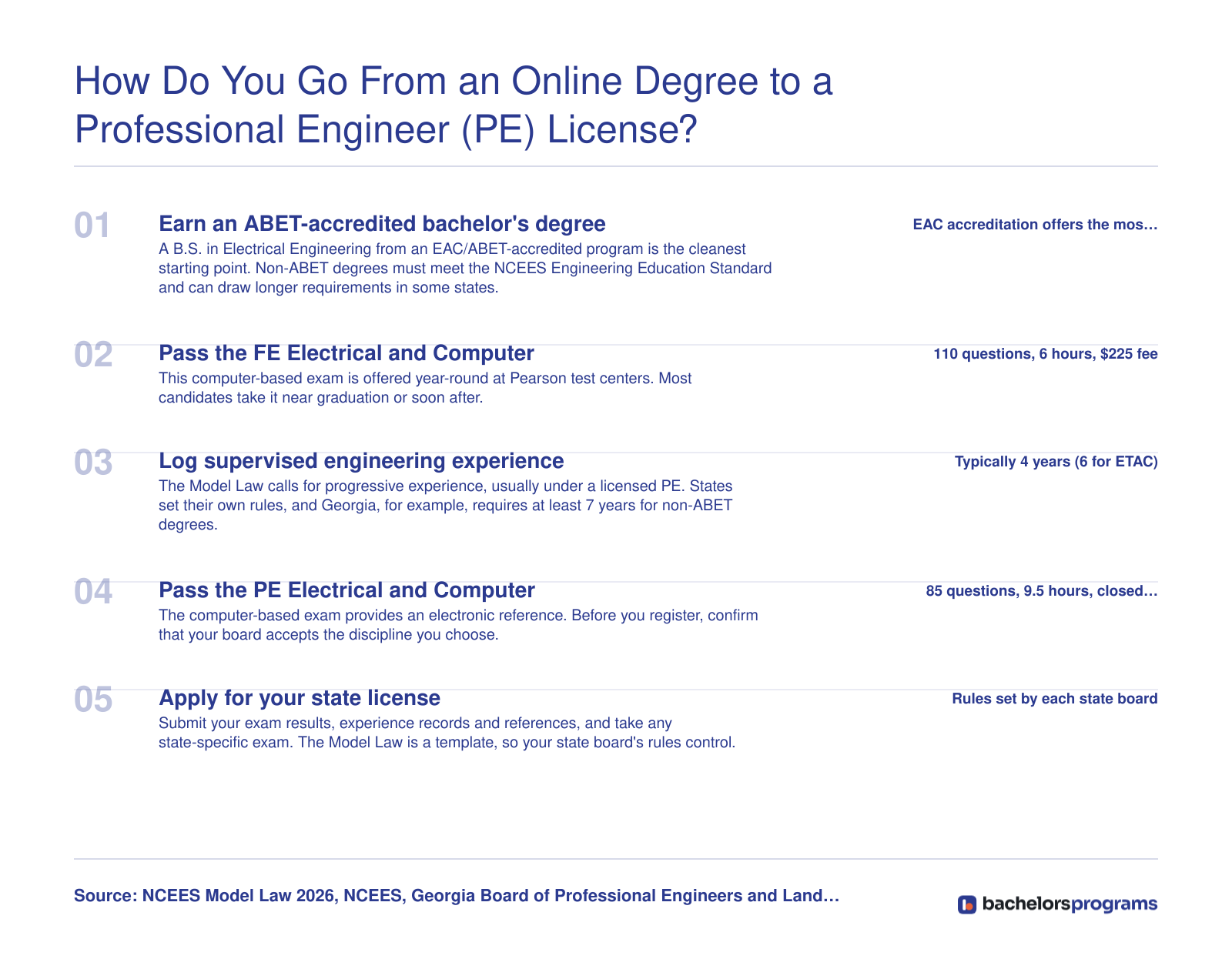
How Do You Go From an Online Degree to a Professional Engineer (PE) License?
State engineering boards do not care whether you earned your bachelor's degree in electrical engineering online or on campus. They care whether it is ABET-accredited. Graduates of engineering technology (ETAC) programs face a 6-year experience requirement under the NCEES Model Law, and some states add extra review or limit exam eligibility, so confirm your path with your state engineering board.
Electrical Engineering programs by state
Online Electrical Engineering Degree FAQs
How long does it take to earn an online electrical engineering bachelor's degree?
Can you complete electrical engineering lab courses online?
Do employers view an online electrical engineering degree differently from a campus degree?
What math and science should I finish before applying to an online electrical engineering program?
Compare Electrical Engineering programs on the data that matters
Explore more Science & Engineering majors or browse every field of study.
All Science & Engineering programs Browse every field of study