Best Online Mechanical Engineering Degree Programs
Compare 8 accredited online Mechanical Engineering programs, with net price after aid, graduation rates, earnings and debt from IPEDS and the U.S. College Scorecard.

Can you earn a bachelor's degree in mechanical engineering entirely online? Rarely. The Bachelor of Science (B.S.) in Mechanical Engineering runs on thermodynamics labs, materials testing and machine-shop capstones, so few schools deliver the whole credential at a distance. Most of the programs ranked here are hybrid: lectures and problem sets online, labs and design reviews on campus in concentrated blocks.
That format drives the real decision. Published tuition at these schools ranges from $10,245 in state to $50,404 at a private campus, and travel for lab weeks adds cost no catalog lists. Accreditation weighs heavier still: without an ABET-accredited degree, the standard route to a PE license narrows sharply.
Key Points
- Most online mechanical engineering degrees are hybrid, with required campus lab days.
- Choose ABET EAC accreditation to keep the standard PE licensure path open.
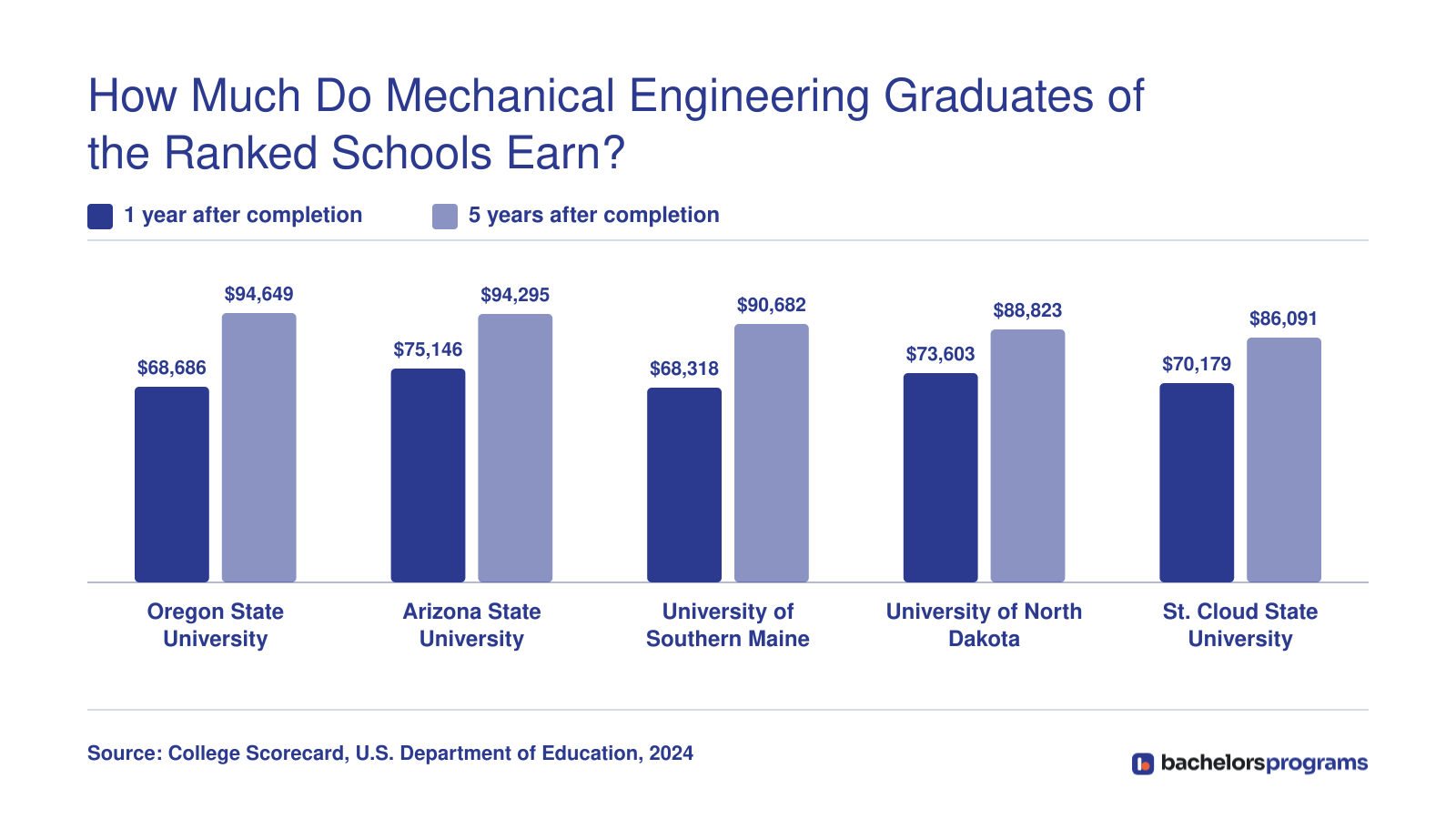
- Ranked schools' graduates earn medians of $86,091 to $94,649 five years out.
Best Online and Hybrid Bachelor's in Mechanical Engineering Programs Ranked for 2027
Mechanical engineering is a lab-heavy discipline, so the programs below mix online and hybrid formats: lecture courses can travel, but laboratories, machine shops and capstone build work usually cannot. Several schools deliver most coursework at a distance and bring students to campus for the hands-on pieces, while a smaller number offer a route that needs no campus visits at all. Each card notes the format, the institution-wide average net price after aid, the school's graduation rate and the program details that shape who the degree fits.
Oregon State University
#1Corvallis, OR · $15,000 – $20,000/yr (est.)
Best for: Online learners wanting varied concentration options
Oregon State University runs one of the broadest mechanical engineering operations on this list, with the degree available in Corvallis, through its Ecampus distance program and at OSU-Cascades in Bend. Ecampus students pay a residency-neutral per-credit rate, so enrolling from outside Oregon does not trigger a nonresident surcharge. The program offers eight option areas, from aerospace engineering to robotics and control, and closes with a two-term capstone design sequence.
- Accredited by the Engineering Accreditation Commission of ABET
- 180 total credit hours with a four-year sample plan
- Eight option areas, including aerospace, robotics and product design
- Two-term MIME Capstone Design I and II required
- Offered in Corvallis, through Ecampus online and at OSU-Cascades
- Focal areas span design, manufacturing, materials and thermal-fluid sciences
University of North Dakota
#2Grand Forks, ND · ~$19,000/yr (est.)
Best for: Transfer students entering through partner colleges
The University of North Dakota pairs an ABET-accredited mechanical engineering degree with a hybrid delivery model: online students take asynchronous classes but come to Grand Forks for portions of the program and summer labs. Engineering pathway agreements with Bismarck State College, Dickinson State University and Williston State College let students complete lower-division work closer to home before finishing through UND. Co-op internships with major employers and industry-sponsored design projects give the degree a strongly applied bent.
- ABET accredited and meets the education requirement for the NCEES FE exam
- 128 total credit hours
- Four areas: mechanical design, thermal sciences, manufacturing and materials, aerospace
- Asynchronous online classes plus campus visits for portions and summer labs
- Co-op internships with employers including Coca-Cola, Honeywell and Textron
- Deadlines: Aug. 15 for fall, Dec. 15 for spring, May 1 for summer
- Four lab science courses in the first two years
University of Southern Maine
#3Portland, ME · $11,000 – $28,000/yr (est.)
Best for: Maine residents needing a commutable hybrid program
The University of Southern Maine teaches mechanical engineering in Portland on a 127.5-credit plan built around a 40-credit mechanical engineering core and a long mathematics sequence. Honors in the Major adds a research or service component and requires passage of the Fundamentals of Engineering exam. It is a sensible fit for students who want a laboratory-based engineering education within commuting distance of Maine's largest city.
- ABET accredited through the Engineering Accreditation Commission
- 127.5 credits to graduate, 115.5 of them in the major
- 40-credit mechanical engineering core covering thermo, fluids and machine design
- 19 credits of mathematics ending with Calculus C and differential equations
- 12 credits of upper-level technical electives
- Honors in the Major requires a 3.5 major GPA and passage of the FE exam
- 2.0 overall and 2.0 engineering GPA required to graduate
Saint Cloud State University
#4Saint Cloud, MN · ~$14,000/yr (est.)
St. Cloud State University houses mechanical engineering in a 100,000-square-foot science and engineering laboratory facility and pairs the degree with company-funded senior design projects that put a working engineer on the student team. Faculty specialties run toward controls and robotics, automation, quality engineering and lean manufacturing, which gives the program a manufacturing flavor. Select classes are available online, and dedicated mechanical and manufacturing scholarships help offset cost.
- ABET accredited through the Engineering Accreditation Commission
- Company-funded senior design projects with a company engineer on the team
- 100,000 sq. ft. Integrated Science and Engineering Laboratory Facility
- Select classes available online
- Dedicated mechanical and manufacturing engineering scholarships
- Faculty specialize in controls, robotics, automation and lean manufacturing
- Coursework in CAD, production management and quality engineering
Arizona State University
#5Scottsdale, AZ
Arizona State University delivers its mechanical engineering degree in several formats, including a distance route that mirrors the Tempe and ASU Local versions, and the program carries ABET accreditation. Coursework covers energy transfer, mechanical design, and sensors and control devices, with an accelerated path that combines the bachelor's and a master's in five years. ASU's scale shows in the range of study abroad programs and change-of-major options open to students.
- ABET accredited through the Engineering Accreditation Commission
- 120 total credit hours
- Online delivery available, plus Tempe and ASU Local campuses
- First-year applicants need a 1210 SAT, 24 ACT, 3.00 GPA or top 25% rank
- Transfers need a 3.00 GPA, or 2.50 plus 2.75 in key math and physics courses
- Accelerated bachelor's and master's option in five years
- Change-of-major pathway for current ASU students
Eastern Michigan University
#6Ypsilanti, MI · $15,000 – $20,000/yr (est.)
Eastern Michigan University runs its mechanical engineering program through the GameAbove College of Engineering and Technology, with an emphasis on design and materials and a capstone built around problems supplied by outside customers. Classes meet in person and in hybrid form in Ypsilanti, and admission requires a meeting with a faculty member before enrollment. The degree carries STEM designation, which matters to international students weighing the optional practical training extension.
- ABET accredited and STEM-designated with an OPT extension
- 120 total credits, 85 of them inside the major
- Two-course senior capstone with design problems from outside customers
- Admission needs a 2.7 GPA, PHY 217 and MATH 120/121 at C or better
- Faculty meeting required before admission
- Classes meet in person and in hybrid form in Ypsilanti
- Coursework in thermodynamics, fluids, heat transfer and manufacturing
Sacred Heart University
#7Fairfield, CT · ~$46,000/yr (est.)
Sacred Heart University is a private institution in Fairfield, Connecticut, and its mechanical engineering degree sits in the School of Computing & Engineering. The IDEA Lab gives students access to 3D printers, laser cutters and electronics for project work, and internships, co-ops and faculty-led research are part of the experience. Dual-degree routes into an MBA or a cybersecurity master's appeal to students who want a management or computing angle alongside engineering.
- Coursework in machine design, CAD and fluid mechanics
- IDEA Lab with 3D printers, laser cutters and electronics
- Internships, co-ops and faculty-led research
- MBA 4+1 and Cybersecurity MS 4+1 dual degree options
- Housed in the School of Computing & Engineering
None of the ranked Mechanical Engineering programs match the online lens yet. The full ranking is at the link above.
Cost, debt & payoff
Median earnings of this field's bachelor's graduates (4 yrs after completing, else the school's undergraduate median) vs. their median federal loan debt · U.S. College Scorecard
Across these programs the median graduate earns about $88,830 and finishes with roughly $23,031 in debt — a ratio that clears a common rule of thumb (keep debt below first-year salary). Net price and debt vary widely school to school, so check the per-school figures in the table above before you shortlist.
How We Ranked Online Mechanical Engineering Programs
Three sources sit behind the list above: the U.S. Department of Education's College Scorecard, the federal IPEDS collection for published tuition and net price, and the schools' own program pages for anything the federal files do not capture, such as lab weekends, proctoring rules and whether a track is genuinely online or hybrid.
What the score weights
Format comes first. A program only qualifies if coursework is delivered online or in a hybrid structure that a working student can realistically manage. From there, each school is scored on a baseline quality composite:
- Cost: published tuition and average net price, since a bachelor's degree in mechanical engineering runs four years of billing, not one.
- Institutional strength: graduation and first-year retention rates, which signal whether a school tends to carry students through to the credential.
- Program outcomes: post-enrollment earnings and completion figures at the field level, used where the federal data publishes them.
Where the data falls short
Two limits matter. Graduation rates and average net price describe the whole university rather than the engineering college specifically, and a large school's figure can mask real variation between departments. Second, field-level earnings are suppressed for programs with small graduating cohorts, which is common in online engineering. When that figure is absent, the score leans harder on cost and institutional measures.
Verify two things yourself
Ranking position does not substitute for two checks you should make before applying. Confirm the specific program's ABET accreditation status, and confirm what has to happen on campus. Both vary enough between schools that the answer for one program tells you nothing about the next.
Is an Online Bachelor's Degree in Mechanical Engineering Fully Online? Labs, Campus Visits and Format
Short answer: usually not fully online. Most online bachelor's degree programs in mechanical engineering are hybrid, because laboratory and design work depends on equipment a laptop cannot replace. Expect online coursework combined with a limited number of required campus days, proctored exams and a team design capstone.
Why a bachelor's degree in mechanical engineering is rarely 100% online
- At-home lab kits: some programs ship instrumented kits so students can run circuits, instrumentation and materials experiments at home. Ask what the kit costs, who covers shipping, and whether sensors or software licenses are bundled in.
- Summer lab intensives: the University of North Dakota brings distance students to campus for one to two weeks in summer to meet professors and complete the mechanical engineering laboratory portions. Four labs are required: three in person and one, Machine Component Design Laboratory, completed remotely alongside its lecture.
- Proctored exams: North Dakota requires all exams proctored unless the instructor says otherwise. Options include ProctorU Live+, an in-person testing center, and Honorlock for Blackboard exams, which needs no appointment but requires internet access and a Chrome extension.
- Capstone design: senior design is usually team based and sometimes tied to company sponsored projects. Confirm whether final presentations or design reviews require travel.
Asynchronous versus synchronous delivery
Asynchronous courses have no fixed meeting time: you watch posted lectures, work through modules and submit on your own schedule. Synchronous courses meet live at set hours, which matters if you work full time or live in another time zone. Delivery at North Dakota varies by instructor, with lesson modules, streaming video, posted lectures and online simulations, so ask for the live session times in your time zone before you commit.
Software and virtual labs
Engineering coursework leans on CAD, simulation and finite element analysis tools, including ANSYS. North Dakota's campus-wide MATLAB and Simulink license covers university-owned and personally owned computers, and UND Labs Anywhere runs specialized classroom software in a browser. Ask whether SolidWorks or MATLAB is included in tuition or must be purchased.
One question to ask early
Request the exact number of required campus days, their dates and whether housing is arranged, then budget airfare and lodging for each trip before you enroll.
ABET Accreditation for Online Mechanical Engineering Degrees
ABET's Engineering Accreditation Commission (EAC) accredits the Bachelor of Science in Mechanical Engineering, and most state licensing boards expect an EAC-accredited degree for the standard path to the Fundamentals of Engineering (FE) exam and the Professional Engineer (PE) license. ABET reviews on-site, online and combined delivery under the same criteria, but mechanical engineering technology degrees are accredited by a separate commission (ETAC) and should not be confused with the B.S. in Mechanical Engineering. ABET's online-inclusive search for U.S. bachelor's programs in this discipline returns 15 institutions, yet it names institutions without confirming each program's commission or whether online or hybrid delivery is covered, so no school can fairly be called the only ABET-accredited online option. Its 100% online search shows only programs evaluated as fully online at their latest review, which means strong hybrid programs may not appear there. The table below marks status as Not verified wherever ABET's public records stop short. Before you apply, confirm each program's status yourself at abet.org.
| School | Credential | ABET Commission | Online/Hybrid Delivery Covered | Notes |
|---|---|---|---|---|
| Arizona State University | Bachelor's in mechanical engineering (exact title not verified) | ABET listed; commission not verified | Not verified | Appears in ABET's online-inclusive search for U.S. bachelor's mechanical engineering programs |
| University of Arizona | Bachelor's in mechanical engineering (exact title not verified) | ABET listed; commission not verified | Not verified | Appears in ABET's online-inclusive search; confirm the online option is named in the accreditation record |
| Clarkson University | Bachelor's in mechanical engineering (exact title not verified) | ABET listed; commission not verified | Not verified | Appears in ABET's online-inclusive search; delivery format coverage not confirmed |
| University of Connecticut | Bachelor's in mechanical engineering (exact title not verified) | ABET listed; commission not verified | Not verified | Appears in ABET's online-inclusive search; check whether EAC accreditation extends to any online coursework |
| Gonzaga University | Bachelor's in mechanical engineering (exact title not verified) | ABET listed; commission not verified | Not verified | Appears in ABET's online-inclusive search; ask the school which delivery mode was reviewed |
| Missouri University of Science and Technology | Bachelor's in mechanical engineering (exact title not verified) | ABET listed; commission not verified | Not verified | Appears in ABET's online-inclusive search; older ABET records may list it under its former name, University of Missouri-Rolla |
Related Articles
What Mechanical Engineers Earn Nationally
A bachelor's degree in mechanical engineering is the standard entry point to a field that pays well above the national median.
How Much Do Mechanical Engineering Graduates of the Ranked Schools Earn?
Federal data show median earnings of $68,318-$75,146 one year after completion for mechanical engineering bachelor's graduates at these schools, rising to $86,091-$94,649 five years out. Even the five-year figures fall below the national median for mechanical engineers, because these graduates are still early in their careers. Pay typically keeps climbing with experience and with the Professional Engineer (PE) license, which follows passing the FE exam, completing supervised work experience and passing the PE exam.
Mechanical Engineering vs. Mechanical Engineering Technology Online
Many online degrees with "mechanical" in the title are actually engineering technology programs, and the two credentials lead to different places. The choice affects how much math you take, how smoothly you can pursue a PE license, and which job titles you are likely to hold. Technology graduates are valued for hands-on roles in manufacturing, testing and technical services, but they may hit ceilings when applying for design engineer titles.
| Factor | B.S. in Mechanical Engineering | B.S. in Mechanical Engineering Technology |
|---|---|---|
| ABET commission | Engineering Accreditation Commission (EAC), which emphasizes theory and conceptual design | Engineering Technology Accreditation Commission (ETAC), which emphasizes application and implementation |
| Math depth | Multiple semesters of calculus, higher-level math and calculus-based theoretical science | Algebra, trigonometry and applied calculus, with more practical than theoretical coursework |
| Typical job roles | Engineering positions involving theory, conceptual design and engineering analysis | Design, installation, manufacturing, testing, technical sales and maintenance work on mechanical components and systems |
| FE/PE licensure path | Most state boards require a bachelor's degree from an EAC/ABET-accredited program, then typically 4 years of progressive experience (the North Carolina and Ohio examples) | Accepted in some states if the degree is ABET-accredited and board-approved. Florida and Tennessee have recognized pathways, but the North Carolina and Ohio examples require 8 years of experience |
| Availability fully online | Varies by school. Confirm that the online format is covered by the program's EAC accreditation | Varies by school. Confirm that the online format is covered by the program's ETAC accreditation |
Admission Requirements for Online Mechanical Engineering Programs
Requirements vary by school and entry route. Check each program's current admission page before you apply, because several of the rules below change with the 2027 cycle.
- High school diploma or transfer GPAFirst-year applicants to Arizona State University meet at least one of several criteria, such as a 3.00 GPA, a 1210 SAT or a 24 ACT. Transfer minimums run from 2.0 at Alabama and Arkansas State to 2.5 for prerequisites at UW Tacoma.
- Calculus readinessOregon State judges calculus readiness from completed, in-progress and planned coursework, and students who aren't ready enter undeclared. FIU requires Calculus I within three academic terms, not counting summers.
- Physics and chemistry prerequisitesTransfer-entry programs such as UW Tacoma expect Calculus I–III, Physics I–III and General Chemistry I completed within the last seven years.
- Transcripts and transfer creditAt ASU and Alabama, transfer students with fewer than 24 credits are reviewed under first-year standards, so send high school and college transcripts.
- Test policyAlabama is test-optional through Fall 2026 entry, while Arkansas State still requires first-year applicants to submit ACT or SAT scores.
- Deadlines and start termsAlabama's deadlines are July 1 for fall and November 1 for spring. UND's are August 15 for fall, December 15 for spring and May 1 for summer. ASU's next online start is January 11, 2027.
- Campus lab sessions (hybrid)UND's hybrid format includes condensed summer labs on campus, so confirm you can travel before you enroll.
Mechanical Engineering programs by state
Online Mechanical Engineering Degree FAQs
These answers cover the questions prospective students ask most about earning a bachelor's degree in mechanical engineering online. Rules on licensure exams and prior credits vary, so confirm details with the school and your state board.
Can you get a mechanical engineering degree online?
Is there a self-paced online mechanical engineering degree?
Can I take the FE exam before I finish my online degree?
Can I earn a mechanical engineering bachelor's degree online if I already have an engineering technology or other bachelor's degree?
Compare Mechanical Engineering programs on the data that matters
Explore more Science & Engineering majors or browse every field of study.
All Science & Engineering programs Browse every field of study