Best Mechatronics Degree Programs
Compare 150+ accredited Mechatronics programs at 130+ colleges, with net price after aid, graduation rates, earnings and debt from IPEDS and the U.S. College Scorecard.

A bachelor's degree in mechatronics combines mechanical design, electrical engineering, controls and software, the mix that automation, robotics and smart manufacturing employers hire for. Most programs award a Bachelor of Science (B.S.) in Mechatronics, though the title rarely appears in that form.
Programs often carry other labels: robotics engineering at Worcester Polytechnic Institute, a mechatronics option inside mechanical engineering at the University of Washington, an engineering technology track at Texas A&M. The ranked list covers bachelor's programs only, drawing on cost, graduation, debt and earnings data for each school.
That naming gap matters: accreditation and job titles follow the curriculum, not the diploma label.
Key Points
- First-year median earnings range from $71,664 (MTSU) to $85,340 (WPI).
- Seminole State charges in-state students $3,122 yearly versus $11,447 out-of-state.
- ABET-accredited standalone mechatronics majors are a minority; specialty tracks are more common.
The 10 Best Mechatronics Degree Programs for 2027
The strongest programs here are not simply the most famous engineering schools. Each earns its place on outcomes, affordability and how the coursework is built, from ABET-accredited mechanical engineering options to dedicated robotics departments. Every entry is a bachelor's degree in mechatronics or a closely related robotics major, and every net price below reflects average aid.
University of Michigan
#1Ann Arbor, MI · $18,000 – $61,000/yr (est.)
Best for: Future roboticists wanting research depth
Michigan's College of Engineering runs one of the first undergraduate robotics programs at a top-tier engineering school, with more than 175 declared majors. The department pairs a human-robot interaction core with 18 credits of technical electives, paid summer research and multidisciplinary design teams. The school graduates 93% of students, and in-state students see an average net price of about $13,100 after aid.
- One of the first undergraduate robotics programs at a top engineering school
- More than 175 declared robotics majors
- Five optional concentrations, including perception and control
- 18 credits of technical electives for customization
- Paid SURE summer research and UROP stipends
- Accelerated BSE and MS in five years through SUGS
- Transfer applicants admitted to the BSE starting winter 2026
- Graduates hired at NASA JPL, SpaceX, Tesla and Amazon Robotics
United States Naval Academy
#2Annapolis, MD
Best for: Midshipmen headed for military robotics
The Naval Academy's robotics and control engineering major is a full bachelor's program taught by the Weapons, Robotics, and Control Engineering Department, with weekly labs and a capstone spanning land, sea and air systems. Admission carries a service obligation that sets it apart from every other school here, and midshipmen commission as officers. A planned restructuring would create a standalone school combining robotics and autonomous systems with computing and cybersecurity by summer 2027.
- Five application areas, majors concentrate in two
- Capstone project required in the first class year
- Weekly lab work on land, sea and air robotics
- Honors version available for exceptional students
- Coursework in sensors, actuators and feedback loops
- Faculty research in soft robotics and microrobots
- Graduates enter defense, automotive and biomedical fields
University of Washington-Seattle Campus
#3Seattle, WA · ~$14,000/yr (est.)
Best for: Washington residents adding a mechatronics option
Washington's mechatronics option lives inside the ABET-accredited mechanical engineering bachelor's, so students graduate with a mechanical engineering degree plus 18 to 20 credits of mechatronics coursework. Admission is competitive and autumn only, with a 2.50 GPA threshold in prerequisite math, chemistry and physics. The school graduates 85% of students, and graduates report median earnings of $81,517 one year after finishing and $105,016 four years out.
- ABET-accredited BSME with a mechatronics option
- 180 total credits, 18 to 20 of them in the option
- Autumn-only admission with an April 5 deadline
- 2.50 minimum GPA in required prerequisite courses
- Option coursework includes ME 471, ME 473 and ME 477
- About 40 department scholarships awarded each year
- Co-op program through the College of Engineering
- College Honors and Departmental Honors available
Carnegie Mellon University
#4Pittsburgh, PA · ~$32,000/yr (est.)
Carnegie Mellon's robotics bachelor's sits in the School of Computer Science and is built around a computer science core alongside robot kinematics, computer vision and a senior capstone. Students complete 360 units and can apply an honors research thesis toward electives. The school graduates 94% of students, and the average net price after aid is about $31,900.
- 360 units total, built on a computer science core
- Senior capstone plus robotics systems engineering
- Three general robotics electives worth 27 to 36 units
- 63 units of humanities and arts required
- Sample schedule finishes the degree in four years
- SCS Honors Research Thesis counts toward electives
- Tools include CAD, ROS and MATLAB
Texas A&M University-College Station
#5College Station, TX · ~$21,000/yr (est.)
Texas A&M's mechatronics track lives inside a multidisciplinary engineering technology bachelor's, an ABET-accredited program anchored by a team-based, industry-sponsored capstone. Students take 127 credits across mechanical, electronic and embedded systems, and the major is also offered at the Higher Education Center in McAllen. The school graduates 84% of students, and average net price after aid is about $21,300.
- 127 semester credit hours, ABET accredited
- 29-credit mechatronics focus area
- Industry-sponsored team capstone design sequence
- Coursework in mobile and industrial robotic systems
- Also offered at the McAllen Higher Education Center
- Math placement exam required for entering students
- Grade of C or better required in specified courses
Purdue University
#6West Lafayette, IN · ~$15,000/yr (est.)
Purdue Polytechnic Institute runs two relevant bachelor's degrees, mechatronics engineering technology and robotics engineering technology, both built on lab work in hydraulics, pneumatics, electronics and machine controls. Purdue reports 14 years of frozen tuition, and the average net price after aid is about $14,600. The school graduates 83% of students.
- Coursework in pneumatics, hydraulics and electronic controls
- 2.5 GPA minimum for transfer admission
- Frozen tuition rate for 14 consecutive years
- Internships and hires at GE, Rolls Royce, GM and John Deere
- Prepares for manufacturing, production and project engineering
- Design, build and program robots
- Combines mechanical, electrical and software skills
- Prepares for robotics and automation engineering roles
- Four years of high school math recommended
University of California-Riverside
#7Riverside, CA · ~$14,000/yr (est.)
UC Riverside's robotics engineering bachelor's draws faculty from three engineering departments and offers more than 60 robotics classes, with electives in artificial intelligence, perception and embedded systems. The campus supplies one research center, 10 labs and multiple maker spaces for hands-on building. The school graduates 76% of students, and average net price after aid is about $14,300.
- More than 60 robotics classes to choose from
- Faculty drawn from three engineering departments
- 72 lower-division and 65 upper-division units
- One research center and 10 robotics labs
- Electives in AI, perception and embedded systems
- Maker spaces available for hands-on projects
Arizona State University
#8Tempe, AZ · ~$15,000/yr (est.)
Arizona State's robotics and autonomous systems degree is a 120-credit bachelor's taught on the Polytechnic campus, covering controls, autonomy, systems integration, data fusion and simulation. Students can move into an accelerated bachelor's plus master's path, and switching into the major carries no extra requirements. The school graduates 68% of students, and average net price after aid is about $15,000.
- 120-credit bachelor's on the Polytechnic campus
- Coursework in controls, autonomy and data fusion
- Bachelor's plus master's in five years available
- 24-month STEM-OPT extension for F-1 students
- No extra requirements to switch into the major
- Higher Learning Commission accredited
Northeastern University
#9Boston, MA · ~$31,000/yr (est.)
Northeastern's Bachelor of Science in Mechatronics is offered through the College of Professional Studies and is one of the few bachelor's-level mechatronics degrees in New England. Coursework is organized around workplace projects with employers such as GE Aviation, Brooks Automation and Teradyne, and students work in engineering labs using AutoCAD, SolidWorks and Multisim. The school graduates 91% of students, and average net price after aid is about $30,900.
- Offered through the College of Professional Studies
- Projects with GE Aviation, Brooks Automation and Teradyne
- Lab software includes AutoCAD, SolidWorks and Multisim
- Scholarships up to $15,000, including Lowell Institute awards
- Faculty experience at Gillette, GE, Sikorsky and BAE
- Prepares for robotics, automation and mechatronics engineering roles
Worcester Polytechnic Institute
#10Worcester, MA · $40,000 – $45,000/yr (est.)
WPI's ABET-accredited robotics engineering bachelor's runs on seven-week terms with projects at more than 50 project centers and 17 robotics labs covering surgical, swarm and soft robotics. The curriculum includes ROS, computer vision and Simulink control work, and an accelerated BS/MS path finishes both degrees in five years. The school graduates 90% of students, and graduates report median earnings of $85,340 one year after finishing and $111,103 four years out.
- ABET-accredited robotics engineering bachelor's
- Seven-week terms with projects at 50+ project centers
- 17+ robotics labs, including surgical and soft robotics
- Coursework in ROS, TensorFlow, PyTorch and OpenCV
- Accelerated BS/MS in as few as five years
- STEM-designated, qualifies for Optional Practical Training
- Deadlines include Nov. 1 early action and Feb. 1 regular decision
Cost & outcomes by school
Federal data for the highest-earning Mechatronics programs, independent of the ranking above. Earnings are this field's bachelor's graduates four years after completing where the Scorecard reports them, else the school's undergraduate median.
| School | Net price / yr | Grad rate | Earnings | Debt | Grads/yr | Format |
|---|---|---|---|---|---|---|
| Stanford University CA | $13,807 | 92% | $124,080 | $12,000 | — | Campus |
| Carnegie Mellon University PA | $31,944 | 94% | $114,862 | $21,750 | 12 | Campus |
| Worcester Polytechnic Institute MA | $43,071 | 90% | $111,103 | $27,000 | 115 | Campus |
| University of Washington-Seattle Campus WA | $14,091 | 85% | $105,016 | $14,615 | 28 | Campus |
| Cornell University NY | $28,690 | 95% | $104,043 | $14,000 | — | Campus |
| Northeastern University MA | $30,915 | 91% | $92,538 | $24,250 | — | Campus |
| Middle Tennessee State University TN | $13,359 | 54% | $92,533 | $19,125 | 54 | Campus |
| California Polytechnic State University-San Luis Obispo CA | $16,665 | 86% | $90,768 | $18,500 | — | Campus |
| University of California-San Diego CA | $12,470 | 86% | $84,943 | $15,500 | — | Campus |
| Drexel University PA | $38,509 | 78% | $84,648 | $25,325 | — | Campus |
| New Jersey Institute of Technology NJ | $16,504 | 73% | $84,276 | $21,000 | — | Campus |
| Embry-Riddle Aeronautical University-Daytona Beach FL | $41,272 | 67% | $84,131 | $23,666 | — | Campus |
Sources: U.S. Department of Education. Net price, graduation rate, earnings and debt: College Scorecard (earnings and debt for this field's bachelor's graduates where reported, else school-wide); graduates: IPEDS. A dash means no figure is reported.
Cost, debt & payoff
Median earnings of this field's bachelor's graduates (4 yrs after completing, else the school's undergraduate median) vs. their median federal loan debt · U.S. College Scorecard
Across these programs the median graduate earns about $56,880 and finishes with roughly $22,113 in debt — a ratio that clears a common rule of thumb (keep debt below first-year salary). Net price and debt vary widely school to school, so check the per-school figures in the table above before you shortlist.
How We Ranked These Bachelor's in Mechatronics Programs
The College Scorecard reports median earnings and federal student debt at the program level, not just the campus level; that program-level detail is what anchors this ranking of mechatronics bachelor's programs.
The Inputs
- Cost: average net price once grant and scholarship aid is applied, rather than the published sticker tuition.
- Outcomes: median earnings for graduates of the mechatronics program, plus the federal debt those graduates carry.
- Completion: how many degrees the program awards, plus graduation and retention rates for the institution as a whole.
- Access and format: admission rate, and whether the program runs on campus, online or a mix of both.
Data Sources and Snapshot Dates
Figures are drawn from the College Scorecard program and institution files and from IPEDS. Everything reflects the latest available snapshot in those releases, not a forecast, so a school's numbers can move between federal publication cycles.
Why Outcomes Outrank Reputation
A B.S. in mechatronics is a major purchase, and anyone financing one deserves to know what graduates earn and owe before reading about lab equipment or faculty awards. Earnings and debt therefore carry more weight than brand recognition or the overall size of a university's engineering college. Reputation is easy to market and hard to verify.
Where the Data Thins Out
Net price is a school-wide average, so it will not match what a mechatronics major actually pays. Those graduation and retention figures cover everyone enrolled at the university, not just the mechatronics department. Smaller programs sometimes report no program-level earnings at all, which is a gap in the federal record rather than a warning sign about the program.
What a Bachelor's Degree in Mechatronics Covers
A B.S. in Mechatronics is a four-year engineering degree that blends mechanical design, electronics, control systems and programming. The goal is to train you to build machines that sense, decide and move, from factory robots to medical devices.
Core Coursework
Expect a mix of hardware and software classes. Most programs build around these topics:
- Control systems: Feedback, stability and tuning for motors and automated processes.
- PLCs and industrial automation: Programming the controllers that run manufacturing lines.
- Robotics: Kinematics, motion planning and robot programming.
- Embedded systems and microcontrollers: Writing code that runs on small, dedicated hardware.
- Sensors and actuators: Choosing and integrating the parts that measure and move.
- Circuits: Analog and digital electronics, often with lab work.
Math, Physics and the Capstone
Underneath the specialty courses sits a standard engineering foundation: calculus through differential equations, plus physics with lab sections. Most students finish with a senior capstone, and many teams design and build an automated or robotic system from concept to working prototype. It tends to be the project employers ask about first.
Engineering vs. Engineering Technology
Some schools offer mechatronics engineering technology instead of a mechatronics engineering B.S. The technology route is more applied and hands-on, with heavier emphasis on installing, troubleshooting and maintaining systems. The engineering route leans further into theory, analysis and design math. Read the program title carefully, because the two routes can lead to different job titles and are treated differently for accreditation and licensure.
Credit Load
Mechatronics programs generally follow the credit load typical of four-year engineering degrees, which is heavier than many other majors. Required credit hours vary, so confirm the exact total and course sequence with each school before you apply.
What Mechatronics-Related Jobs Pay
The closest federal wage benchmark for mechatronics work comes from the technician side of the field.
ABET Accreditation: Which Mechatronics Degrees Have It and Why It Matters
More schools now teach mechatronics as a specialty inside a traditional engineering degree than as a standalone major. Some standalone bachelor's programs do hold ABET accreditation, but they are a minority. ABET's program search currently lists 6 U.S. institutions with programs titled Mechatronics Engineering and 7 with programs titled Mechatronics Engineering Technology.1 A few more use variant titles: Mechatronic Engineering, Mechatronics & Robotics Engineering, and a joint engineering program with a mechatronics concentration. Titles and accreditation dates change, so confirm any specific school yourself rather than relying on a list.
EAC vs. ETAC
ABET accredits programs, not whole institutions, and it does so through separate commissions.2 The Engineering Accreditation Commission (EAC) covers engineering programs at the bachelor's and master's levels.2 The Engineering Technology Accreditation Commission (ETAC) covers engineering technology programs at the associate and bachelor's levels.2 A degree titled Mechatronics Engineering Technology falls under ETAC and is typically more hands-on.3 ETAC criteria call for work in areas such as embedded systems and control, industrial automation and PLCs, sensors and instrumentation, and troubleshooting.4 An EAC program usually carries heavier math and design theory.
Why It Matters for Licensure
In most states, an EAC-accredited degree is the most direct route to the Fundamentals of Engineering (FE) exam and then a Professional Engineer (PE) license. Graduates of ETAC programs can often still pursue licensure, but many state boards add experience requirements or other conditions. Rules vary, so check your state board before you commit, especially if you want a PE license.
Concentrations Inside Accredited Degrees
A mechatronics concentration inside an accredited mechanical or electrical engineering program carries that parent program's accreditation. Your diploma will read Mechanical Engineering or Electrical Engineering, and for many employers that is as good as a standalone mechatronics degree, sometimes better because the title is familiar. It also keeps the licensure path straightforward.
Verify Before You Apply
Use ABET's accredited program search to check a program's current status. Newer mechatronics programs may still be pursuing accreditation, and a program's accreditation usually applies from a set year forward, so ask the school whether it covers the year you would graduate.
Mechatronics Degree Cost, Debt and Return on Investment
Sticker tuition is where most cost comparisons start, and residency is the single biggest lever on it.
What Residency Does to Tuition
At Seminole State College of Florida, in-state undergraduates pay $3,122 a year against $11,447 for out-of-state students. Alcorn State University charges the same $8,785 to both groups. Middle Tennessee State University shows the widest split among the lower-cost options: $10,266 in state versus $31,574 out of state, a gap above $21,000 a year. Michigan's public universities follow the same pattern, from $15,640 in state and $32,896 out of state at UM-Dearborn up to $18,848 and $63,081 at the University of Michigan in Ann Arbor.
Net Price Is the Realistic Figure
Average net price after grant aid runs $8,970 at Seminole State, $9,120 at Oakland University, $9,492 at UM-Dearborn, and $12,766 at Wayne State. The better-known names land in a narrow band: $13,138 at Michigan, $13,359 at Middle Tennessee State, $14,091 at UW-Seattle, $14,182 at Michigan Tech, and $14,304 at UC Riverside. Each of these is a school-wide average across all undergraduates, not a quote for a mechatronics major, so treat it as a starting point and run the school's own net price calculator.
Debt and Repayment
Where a program publishes completer debt, the numbers look manageable. Middle Tennessee State reports median federal debt of $19,125 for graduates of its mechatronics engineering program, which works out to roughly $203 a month on a standard 10-year repayment plan. Ask any department you are serious about for the same figures before you commit.
Earnings Context and Return
Earnings-to-cost ratios are institution-wide: about 5.4 at UW-Seattle, 4.3 at Michigan, 3.9 at UC Riverside and 3.8 at Seminole State. Read them as school context, never as mechatronics program outcomes. The takeaway is simpler than the ratios. An in-state public program, with resident tuition near $10,000, a net price near $13,000 and graduates earning a median $71,664 a year after finishing, is the cost-to-earnings profile that out-of-state and private options struggle to match.
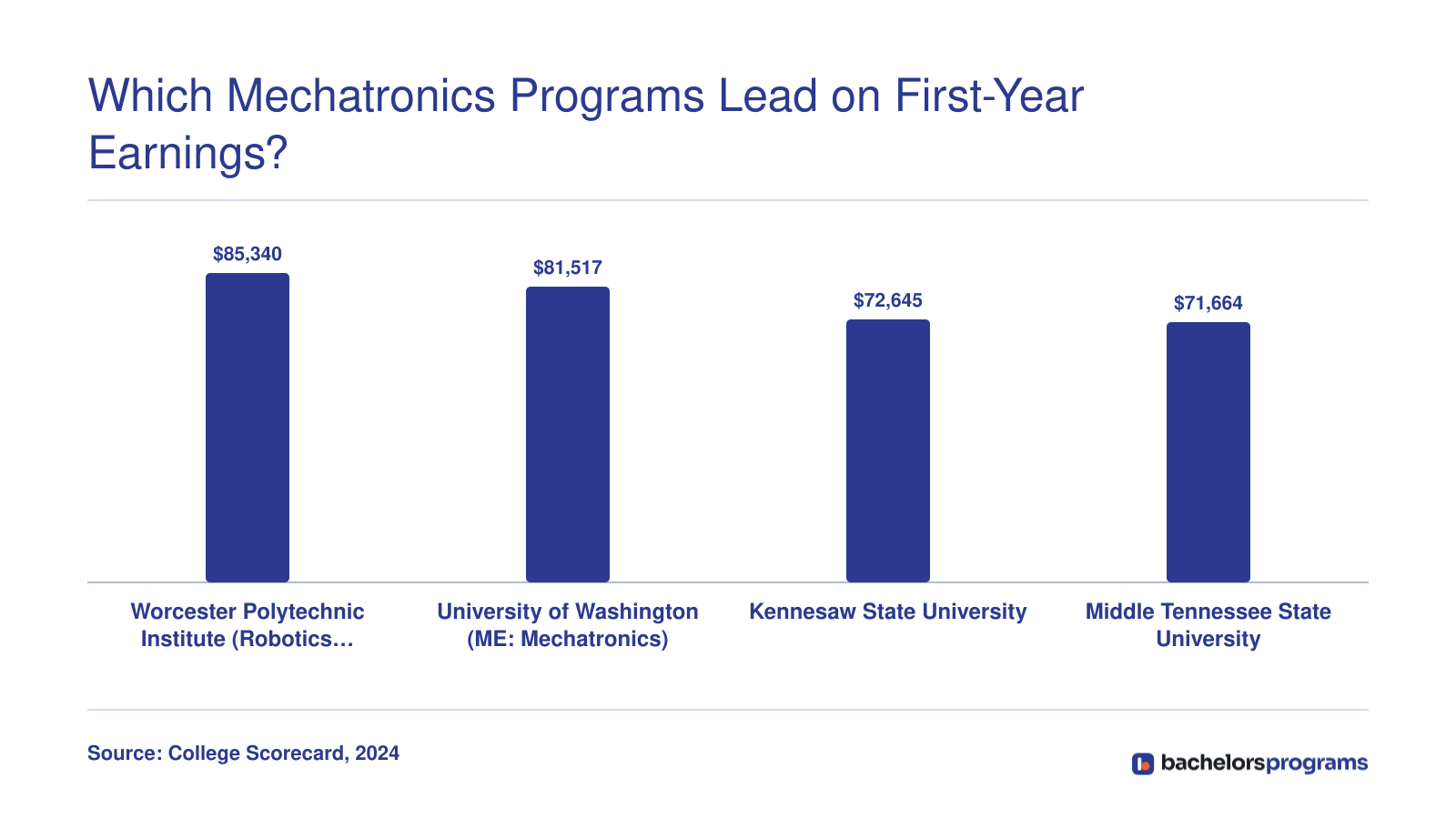
Which Mechatronics Programs Lead on First-Year Earnings?
Among programs with a published figure, median earnings one year after finishing range from $71,664 at Middle Tennessee State University to $85,340 at Worcester Polytechnic Institute. Median program debt is $27,000 at WPI, $28,437 at Kennesaw State and $19,125 at Middle Tennessee State, so graduates of each of those programs earn well above what they borrowed in their first year. Early earnings reflect regional labor markets and co-op exposure as much as school quality.
Related Articles
Mechatronics vs. Mechanical, Electrical and Computer Engineering
Should you pick a mechatronics degree or a mechanical, electrical or computer engineering degree with a robotics focus? The honest answer depends on how narrow you want your first job search to be and how much you care about the licensure path.
How the four degrees differ
- Mechatronics: Blends mechanical systems, electronic circuits, control systems and computer science, with heavy use of sensors, actuators and embedded controllers. ABET expects graduates to model, analyze and design systems that integrate hardware and software to control mechanical systems.1 Common titles include automation engineer, robotics engineer and controls engineer.
- Mechanical engineering: Built on calculus, differential equations, linear algebra and calculus-based physics, applied to mechanical systems. ABET criteria for ME do not carry a separate hardware-software integration outcome.1 Titles run toward design engineer, manufacturing engineer and thermal or structural roles.
- Electrical engineering: Requires advanced mathematics including differential equations, linear algebra, complex variables and discrete mathematics, plus probability and statistics.2 Graduates design complex electrical and electronic devices and hardware-software systems. Think power engineer, embedded systems engineer, test engineer.
- Computer engineering: Shares the EE math core but must include discrete mathematics, with design work aimed at devices, software and combined hardware-software systems.2 Firmware engineer and hardware design engineer are typical destinations.
Accreditation and licensure
All four can be ABET accredited, and all four require at least 45 semester credit hours of engineering topics with breadth and depth matching the program title.1 Where they diverge is downstream: state PE licensure boards are built around long-established disciplines, and mechanical and electrical are the familiar paths. An ABET accredited mechatronics degree generally satisfies the education requirement, but if you expect to stamp drawings, confirm your state board's position before you enroll.
The verdict
If you already know you want automation, robotics or factory controls, a dedicated mechatronics degree gets you there with less self-assembly. If you are still deciding, or you want the cleanest licensure route and the widest set of recruiters, an ME or EE degree with a mechatronics or robotics concentration keeps more doors open.
Mechatronics programs by state
Mechatronics Degree FAQs
These answers cover the questions prospective students ask most often about a bachelor's degree in mechatronics, including accreditation, engineering comparisons, licensure and study as an international student.
What are the best mechatronics programs for international students?
Is a mechatronics degree ABET accredited?
Is mechatronics better than mechanical engineering?
Can you become a licensed Professional Engineer with a mechatronics degree?
Compare Mechatronics programs on the data that matters
Explore more Science & Engineering majors or browse every field of study.
All Science & Engineering programs Browse every field of study