Best Online Occupational Safety & Health Degree Programs
Compare 8 accredited online Occupational Safety & Health programs, with net price after aid, graduation rates, earnings and debt from IPEDS and the U.S. College Scorecard.

A missed lockout/tagout step can bring a six-figure OSHA penalty and a hospitalized crew member. Employers hire for documented training, and the Bachelor of Science (B.S.) in Occupational Safety & Health is the standard entry credential.
A bachelor's degree in occupational safety and health is now available 100% online, which matters for people already working on plant floors. Every program here is fully online at the bachelor's level, with no hybrid or graduate options.
Cost is the real divide: out-of-state tuition runs from about $6,800 to $26,000.
Key Points
- Indiana State lists $22,322 out-of-state tuition but a $10,873 average net price.
- Most online B.S. programs require about 120 credits, roughly four years full-time.
- BCSP Qualified Academic Program graduates can earn the GSP, skipping the ASP exam.
Best Fully Online Occupational Safety & Health Bachelor's Programs Ranked
Every program below can be completed fully online, with no required campus visits, and each entry lists the school's city and state, tuition for in-state and out-of-state students, an approximate institution-wide net price after aid, and the school's graduation rate. They are ordered by a composite that blends cost, completion, and program strength, so the sequence does not reflect any single number.
Eastern Kentucky University
#1Richmond, KY · $11,000/yr (est. net price)
Best for: Accelerated seven-week term learners
Eastern Kentucky University in Richmond, Kentucky, runs its occupational safety program through a dedicated School of Safety, Security and Emergency Management, and online students never need to come to campus. Courses run in accelerated seven-week terms with six start dates a year, and students can transfer up to 90 credits. The university also lets strong undergraduates apply up to nine graduate credit hours toward a master's degree in the same field.
- 120 credit hours, fully online with no campus visits required
- Accelerated 7-week terms with six start dates per year
- $472 per credit hour for online coursework
- Transfer up to 90 credits, with 30 completed at EKU
- Coursework covers OSHA regulations, hazardous materials, ergonomics and workers' compensation
- 3+2 option applies up to nine graduate hours toward the MS in five years
- Free online tutoring and career services for online students
- Internship partnerships include Toyota, Bechtel, BMW and Marathon Petroleum
University of Wisconsin-Whitewater
#2Whitewater, WI · $10,000 – $15,000/yr (est.)
Best for: Wisconsin residents seeking in-state rates
The University of Wisconsin-Whitewater teaches its occupational safety program in the Department of Occupational and Environmental Safety and Health, and online students get the same curriculum and instruction as the campus cohort. The final semester places each student in an internship matched by the program's coordinator, and a 2023-24 survey of graduates reported 100% career placement. Tuition is notably lower for Wisconsin residents than for out-of-state students.
- ABET accredited through the Applied and Natural Science Accreditation Commission
- Fully online option uses the same curriculum as the campus program
- Coursework in construction safety, fire protection, ergonomics and industrial safety analysis
- Final-semester internship individually matched by the program coordinator
- Construction Safety Management certificate available
- Industrial hygiene minor offered
- Scholarships available to safety majors
Southeastern Oklahoma State University
#3Durant, OK · $8,000/yr (est. net price)
Best for: Students wanting a large safety alumni network
Southeastern Oklahoma State University in Durant offers its occupational safety major through the John Massey School of Business, and the department describes itself as one of the largest safety programs in the country, with 250 alumni and internship contacts each year. The major builds on 44 semester hours of general education and includes lab work in industrial hygiene. Students can complete it online, and employers of graduates have included Alcoa, General Motors, Exxon-Mobil, NASA and OSHA.
- 41 semester hours in the major on top of 44 hours of general education
- Major/minor option runs 58 semester hours
- Courses include Safety Program Management and Industrial Hygiene with a lab
- Senior Seminar and a required sequence of SFTY prerequisites
- Chemistry, physics and math must be finished before upper-level safety courses
- Online and face-to-face formats available
- Department reports 250 annual alumni and internship contacts
Indiana State University
#4Terre Haute, IN · $11,000/yr (est. net price)
Indiana State University in Terre Haute offers a safety management degree, now titled Safety, Health, and Environment, that is accredited by ABET's Applied and Natural Science Accreditation Commission and recognized as a Qualified Academic Program by the Board of Certified Safety Professionals. Online students complete a one-week summer residency on campus during their junior or senior year. Internships are paid and have included Alcoa, Cargill, Eli Lilly, General Electric, Pfizer and Toyota.
Columbia Southern University
#5Orange Beach, AL · $15,000/yr (est. net price)
Columbia Southern University in Orange Beach, Alabama, is built entirely around online study, with courses open 24/7 and 11 start dates a year. Its occupational safety and health bachelor's degree holds Qualified Academic Program status from the Board of Certified Safety Professionals, so graduates can apply for the Graduate Safety Practitioner designation and waive the Associate Safety Professional exam. Tuition is the same for in-state and out-of-state students and includes textbooks.
- 120 credit hours delivered 100% online with courses available 24/7
- $278 per credit hour with textbooks included
- 11 start dates per year and up to 90 transfer credits accepted
- BCSP Qualified Academic Program; GSP designation waives the ASP exam
- Board-approved through the Institute of Hazardous Materials Management
- Active-duty military using tuition assistance pay $250 per credit hour
- Payment plans available weekly, biweekly or monthly
University of Alaska Anchorage
#6Anchorage, AK · ~$15,000/yr (est.)
The University of Alaska Anchorage offers a Bachelor of Science in Occupational Safety and Health with unusually broad major coursework, spanning industrial hygiene, fire science, hazardous materials, ergonomics, process safety management and construction safety. The degree requires a capstone course on the economic value of safety plus a three-credit advanced internship, and students must earn at least a C in every required course. Advising is required before registering for safety courses.
- 120 credits, including 39 upper-division credits
- Major coursework covers industrial hygiene, ergonomics, fire science and process safety
- Capstone course on the economic value of safety is required
- Three-credit advanced internship required
- Minimum grade of C required in all courses for the degree
- Advising interview checklist required before safety course registration
Waldorf University
#7Forest City, IA · ~$20,000/yr (est.)
Waldorf University in Forest City, Iowa, delivers its safety programs entirely online and is approved as a Graduate Safety Practitioner Qualified Academic Program, so graduates can apply to the Board of Certified Safety Professionals for the GSP designation. The university offers both a dedicated Bachelor of Arts in Occupational Safety and a Bachelor of Science in Organizational Leadership with an occupational safety and health concentration, which suits students who want safety training alongside a leadership degree. Students need a 2.0 GPA and at least 36 upper-division credits.
- 120 credits, fully online
- 30 credits of required major coursework plus 30 credits of professional electives
- Includes industrial hygiene, construction safety, fire safety and risk management
- Approved GSP Qualified Academic Program through the Board of Certified Safety Professionals
- Grade of C or higher required in all major courses
- Open to students without prior safety experience
- 120 credits, fully online, designed as a four-year program
- 15-credit occupational safety and health concentration
- Concentration covers industrial hygiene and environmental safety
- Concentration is optional within the leadership degree
- Grade of C or higher required in major courses
- 36 upper-division credits required
Cost & outcomes by school
Federal data for the highest-earning Occupational Safety & Health programs, independent of the ranking above. Earnings are this field's bachelor's graduates four years after completing where the Scorecard reports them, else the school's undergraduate median.
| School | Net price / yr | Grad rate | Earnings | Debt | Grads/yr | Format |
|---|---|---|---|---|---|---|
| Columbia Southern University AL | $14,580 | 33% | $94,480 | $23,425 | 964 | Online |
| Eastern Kentucky University KY | $11,040 | 50% | $92,289 | $30,849 | 81 | Online or campus |
| Waldorf University IA | $19,693 | 21% | $83,151 | $18,699 | 110 | Online |
| Indiana State University IN | $10,873 | 43% | $82,303 | $24,000 | 9 | Hybrid |
| University of Wisconsin-Whitewater WI | $14,158 | 59% | $81,385 | $21,500 | 21 | Online or campus |
| Southeastern Oklahoma State University OK | $8,039 | 32% | $66,785 | $22,000 | 54 | Online or campus |
| University of Alaska Anchorage AK | $15,301 | 30% | $51,871 | $20,210 | 3 | Online or campus |
Sources: U.S. Department of Education. Net price, graduation rate, earnings and debt: College Scorecard (earnings and debt for this field's bachelor's graduates where reported, else school-wide); graduates: IPEDS. A dash means no figure is reported.
Cost, debt & payoff
Median earnings of this field's bachelor's graduates (4 yrs after completing, else the school's undergraduate median) vs. their median federal loan debt · U.S. College Scorecard
Across these programs the median graduate earns about $83,151 and finishes with roughly $24,281 in debt — a ratio that clears a common rule of thumb (keep debt below first-year salary). Net price and debt vary widely school to school, so check the per-school figures in the table above before you shortlist.
How We Ranked Online Bachelor's Programs in Occupational Safety and Health
Every program here can be completed fully online, and accreditation separates the strongest from the rest. Each school is scored on College Scorecard outcomes, net price, graduation rate, and program completions. Graduation rate and net price are institution-wide averages, not safety-major figures, and program earnings appear only where Scorecard reports them.
Indiana State University and the University of Wisconsin-Whitewater both hold ABET ANSAC programmatic accreditation, according to ABET's accredited program search. Indiana State is institutionally accredited by the Higher Learning Commission2 and Columbia Southern University by SACSCOC. Southeastern Oklahoma State is a BCSP Qualified Academic Program1, while Columbia Southern University holds IHMM approval; ABET accreditation is not confirmed for either.
ABET accreditation can qualify a program as a BCSP Qualified Academic Program, which supports the GSP route.
Most Affordable Fully Online OSH Programs: Cost, Debt, and Earnings
Indiana State University shows the widest gap between sticker price and what students actually pay: out-of-state tuition of $22,322 a year compared with an average net price of $10,873, according to U.S. Department of Education College Scorecard data. At Eastern Kentucky University, the $327 monthly payment on the program's median federal debt is about 5.5 percent of the $71,240 median graduates earn one year after finishing, and Southeastern Oklahoma State University's $233 payment is a similar share of its $51,356 one-year median. Indiana State does not report program-level debt, and its online students complete a one-week summer residency.
| School | Annual in-state tuition | Annual out-of-state tuition | Average net price (per year) | Median federal debt at completion | Estimated 10-year monthly payment | Median earnings, 1 year after finishing | Median earnings, 4 years after finishing |
|---|---|---|---|---|---|---|---|
| Southeastern Oklahoma State University (Durant, OK) | $7,200 | $16,410 | $8,039 | $22,000 | $233 | $51,356 | $66,785 |
| Indiana State University (Terre Haute, IN) | $10,258 | $22,322 | $10,873 | Not reported | Not reported | $71,755 | $82,303 |
| Eastern Kentucky University (Richmond, KY) | $10,320 | $21,230 | $11,040 | $30,849 | $327 | $71,240 | $92,289 |
What a Bachelor's Degree in Occupational Safety and Health Covers and How Long It Takes
Most online B.S. programs in this field require about 120 credits, and Southeastern Oklahoma State sets its total at 124. Full-time students typically finish in about four years.
Core Coursework
The curriculum centers on OSHA standards and regulatory compliance, industrial hygiene, ergonomics, hazardous materials, fire protection, safety management systems, and accident investigation. Some schools add specializations or certificates. Construction safety is a common one, and environmental health is another, as in North Carolina A&T's Environmental Health and Safety program.
Pace and Transfer Credit
Accelerated formats shorten the timeline. Eastern Kentucky runs 7-week online terms with six start dates a year, while Columbia Southern offers 11 start dates annually. Columbia Southern and Southeastern Oklahoma State each accept up to 90 transfer credits, and Eastern Kentucky allows up to 90 credit hours as well. An associate degree, or military training that earns credit, can cover much of the general education load. That can bring the timeline closer to two years.
Internships and Capstones
Requirements vary. Southeastern Oklahoma State offers a 3-credit, 7-week internship supervised on-site, and it requires 15 semester hours of safety coursework first. Whitewater places students in an individualized final-semester internship, and Alaska Anchorage requires a capstone. Ask each program whether you can arrange the placement with an employer near you.
Related Articles
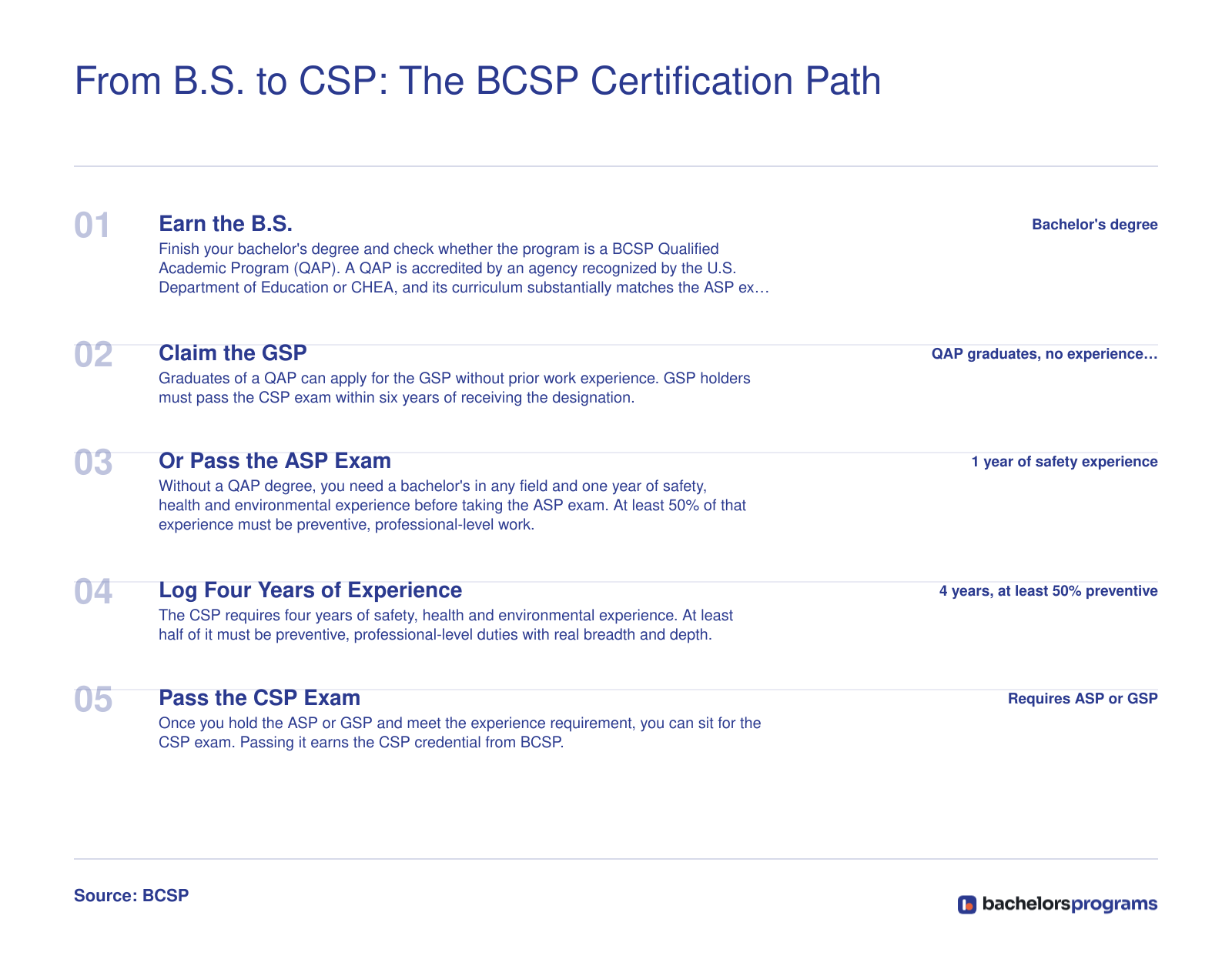
From B.S. to CSP: The BCSP Certification Path
According to BCSP, graduates of a Qualified Academic Program can earn the Graduate Safety Practitioner (GSP) designation and skip the ASP exam, because the GSP counts as a qualifying credential for the Certified Safety Professional (CSP). Graduates of other programs take the ASP exam first. Both routes still require safety experience and a passing CSP exam score.
Careers and Salary Outlook for OSH Graduates
A bachelor's degree in occupational safety and health leads to well-paid work with steady demand. Graduates typically pursue these roles:
- Occupational health and safety specialist
- Safety coordinator
- EHS manager
- Industrial hygienist (entry level)
- Compliance inspector
The Bureau of Labor Statistics put the May 2025 median wage at $90,150 for specialists and $61,560 for technicians.1 Combined, the median was $83,740, well above the $50,980 median for all U.S. occupations. BLS projects growth of 18% for specialists and 19% for technicians from 2025 to 2035, with about 20,900 openings a year, driven largely by replacement as workers retire or change fields.2
Program Earnings Versus BLS Pay
BLS figures cover the whole profession at every experience level. Scorecard figures track graduates of specific programs. One year after completion, graduates of Columbia Southern University's B.S. earned a median of $78,532, and Eastern Kentucky University's graduates earned $71,240. Five years out, those medians reached $91,754 and $91,722.
Is It Worth It?
For most graduates, yes. Median program debt was $23,425 at Columbia Southern and $30,849 at Eastern Kentucky, both below a single year of early-career earnings.
Questions to Ask Yourself
Do you want the GSP route to the CSP, and does the program hold Qualified Academic Program status?
Are you aiming at construction, industrial hygiene, or general EHS work?
How many of your existing credits will this school actually accept?
Can you complete the internship or capstone where you already live and work?
How to Choose the Right Fully Online Safety Program
Can you earn a fully online occupational safety degree without ever setting foot on campus? Sometimes, but you need written answers before you enroll.
Delivery Format and Campus Visits
Asynchronous courses let you study on your own schedule, which suits working adults and caregivers. Synchronous classes meet at set times and suit students who want live discussion. If you need fully asynchronous delivery, ask the school to confirm it in writing, since a program can be 100% online and hold live sessions. Franklin University's online program uses 6- and 12-week courses, but course length alone does not confirm the meeting pattern. Labs and fieldwork are the usual exceptions. Indiana State's online Safety Management B.S. includes a one-week summer residency. Southeastern Oklahoma State and Arkansas State list industrial hygiene lab courses, so confirm whether those meet online, at a nearby site, or on campus. Ask whether exams are proctored remotely or in person, and get written confirmation that no on-campus visit is required.
State Authorization
Check the school's state authorization page and its NC-SARA membership. Approval can vary by program.
A Three-Part Decision Rule
- Beginners: Prioritize ABET accreditation or BCSP Qualified Academic Program status.
- Working professionals: Prioritize transfer credit and accelerated terms.
- Budget-focused readers: Compare net price against median debt.
Occupational Safety & Health programs by state
Compare Occupational Safety & Health programs on the data that matters
Explore more Science & Engineering majors or browse every field of study.
All Science & Engineering programs Browse every field of study