Best Online Urban Planning Degree Programs
Compare 5 accredited online Urban Planning programs, with net price after aid, graduation rates, earnings and debt from IPEDS and the U.S. College Scorecard.

Urban and regional planners earned a median of $89,320 in May 2025, and a bachelor's degree in urban planning is the most direct undergraduate route into zoning, transportation, housing, and land-use work. Degrees are usually titled Bachelor of Science in Urban Planning or B.S. in Urban and Regional Planning.
Few planning bachelor's programs can be completed entirely at a distance. The schools ranked here mix online and hybrid formats, and many still expect studio work, fieldwork, or a local internship.
That creates the real tradeoff. Flexible delivery and Planning Accreditation Board (PAB) status don't always come together, and an accredited degree can shorten the experience needed before sitting for the AICP exam.
Key Points
- Few urban planning bachelor's programs run fully online; many are hybrid.
- Online formats don't always carry PAB accreditation, so verify before enrolling.
- Urban and regional planners earned a median $89,320 in May 2025.
Top Online and Hybrid Urban Planning Bachelor's Programs Ranked
Only a handful of urban planning bachelor's programs can be finished entirely at a distance, so this list mixes online and hybrid options, and several blend remote coursework with studios, field projects, or internships. Programs are ordered on a composite of delivery flexibility, cost, available concentrations, and outcomes, and the graduation rate reflected here is the institution-wide figure rather than a program-level one, with net prices treated as approximate averages after aid.
Florida Atlantic University
#1Boca Raton, FL · $4,900 – $17,000/yr (est.)
Best for: South Florida residents eyeing an accelerated master's
Florida Atlantic pairs its planning degree with small classes and a professional-practice orientation, with studio courses sitting alongside work in housing, transportation, sustainability, and economic growth. The department describes itself as the only accredited urban and regional planning program in South Florida, and an accelerated pathway lets strong students begin master's work early. A separate Bachelor of Urban Design and an undergraduate certificate in Smart Cities and the Internet of Things give students adjacent credentials.
- Studio courses plus a professional practice component
- Department calls it the only accredited planning program in South Florida
- Accelerated pathway into the department's master's degree
- Bachelor of Urban Design also offered
- Undergraduate certificate in Smart Cities and Internet of Things
- Small classes and noted job placement rates
Portland State University
#2Portland, OR · ~$10,000/yr (est.)
Best for: Community organizers drawn to Pacific Northwest partnerships
Portland State runs its planning degree as a community-embedded program built on a 12-credit core, skills coursework, and an 8-credit focus area chosen from four tracks covering climate and health, community organizing, housing, and planning and design. Students learn in classrooms, online, and in the field, working alongside Portland-area agencies, nonprofits, and firms on live projects. The degree feeds both direct employment in local and state government and graduate study in planning, public policy, real estate, or law.
- 12-credit core plus 12 credits of skills coursework
- 8-credit focus area and 26 elective credits
- Four focus areas, including housing and community organizing
- At least 6 elective credits must be at the 400 level
- No more than 8 credits may come from outside the department
- Community-based learning with Portland-area partners
- Prepares students for planning, policy, real estate, or law study
Arizona State University
#3Scottsdale, AZ
Best for: Career changers who need remote flexibility
Arizona State offers a 120-credit urban planning bachelor's that students can take on the Tempe campus, through ASU Online, or at ASU Local sites, with a curriculum built around equitable, healthy, and livable communities. Coursework spans comprehensive planning, computer and analytical methods, GIS, housing, transportation, urban design, and planning and zoning law. Accelerated bachelor's-plus-master's pathways in urban and environmental planning, public policy, or public administration let students finish both degrees in as few as five years.
- 120 total credit hours
- Accelerated bachelor's plus master's in as few as five years
- Coursework in GIS, housing, transportation, urban design, and zoning law
- No extra requirements to change into the major
- Student Planning Association membership available
- More than 300 study abroad programs in 65 countries
- Not eligible for the STEM-OPT extension
Westfield State University
#4Westfield, MA · $15,000 – $20,000/yr (est.)
Westfield State's planning major is the oldest in New England and takes a field-based approach, with regional travel, GIS and remote-sensing training, and a long list of internship placements. Students choose from six concentrations spanning cities and social justice, climate and energy, environmental planning, food systems, real estate and economic development, and urban design and architecture. Foundation coursework covers planning history, public participation techniques, data collection, and geospatial analysis, and first-year admission is test-optional.
- Six concentrations, from cities and social justice to urban design
- Oldest planning major in New England
- Field-based classes and regional travel
- Training in GIS, drones, and remote sensing
- Coursework covers the AICP Code of Ethics
- More than 700 internship opportunities
- Test-optional admission, no essay or recommendation letters
Cost & outcomes by school
Federal data for the highest-earning Urban Planning programs, independent of the ranking above. Earnings are this field's bachelor's graduates four years after completing where the Scorecard reports them, else the school's undergraduate median.
| School | Net price / yr | Grad rate | Earnings | Debt | Grads/yr | Format |
|---|---|---|---|---|---|---|
| Arizona State University AZ | $14,967 | 68% | $68,163 | $23,444 | 57 | Online or campus |
| Arizona State University AZ | — | — | $68,163 | $23,444 | 87 | Online or campus |
| Florida Atlantic University FL | $8,752 | 63% | $66,093 | $21,114 | 16 | Online or campus |
| Westfield State University MA | $16,721 | 54% | $59,524 | $23,628 | 5 | Hybrid |
| Portland State University OR | $9,552 | 53% | $57,906 | $20,500 | 13 | Hybrid |
Sources: U.S. Department of Education. Net price, graduation rate, earnings and debt: College Scorecard (earnings and debt for this field's bachelor's graduates where reported, else school-wide); graduates: IPEDS. A dash means no figure is reported.
Cost, debt & payoff
Median earnings of this field's bachelor's graduates (4 yrs after completing, else the school's undergraduate median) vs. their median federal loan debt · U.S. College Scorecard
Across these programs the median graduate earns about $64,573 and finishes with roughly $20,896 in debt — a ratio that clears a common rule of thumb (keep debt below first-year salary). Net price and debt vary widely school to school, so check the per-school figures in the table above before you shortlist.
PAB Accreditation and the Path to AICP Certification
The choice comes down to flexibility versus credentials. The online and hybrid formats that fit a working schedule are not always the formats that carry planning's specialized accreditation.
What PAB Accreditation Means
The Planning Accreditation Board (PAB) reviews and accredits planning degree programs in North America, and few bachelor's programs earn its approval. As of January 1, 2026, PAB's list counted 16 accredited bachelor's programs.1 Ball State, Cal Poly Pomona, Michigan State, the University of Cincinnati and the University of Virginia are among them, and most are campus-based.
Accreditation varies by school, so evaluate each program individually. Florida Atlantic University describes its program as the only accredited planning program in South Florida. Westfield State's curriculum covers the AICP Code of Ethics. Neither claim substitutes for a check of PAB's own list, so do not assume any program below is accredited until you confirm it there.
Why It Matters for AICP
The American Institute of Certified Planners (AICP), the professional institute of the American Planning Association (APA), sets eligibility rules for its certification exam. Graduates of PAB-accredited programs can qualify with less professional planning experience than candidates with other degrees. APA updates these rules, so confirm the exact number of years on its AICP eligibility page before you build your timeline. Employers and graduate programs also treat PAB status as a sign of curriculum quality.
How to Verify Before You Enroll
- Check the source: Search PAB's published list for the exact degree name, not just the school.
- Ask about format: Ask the department to confirm in writing whether accreditation covers the online or hybrid version you plan to take.
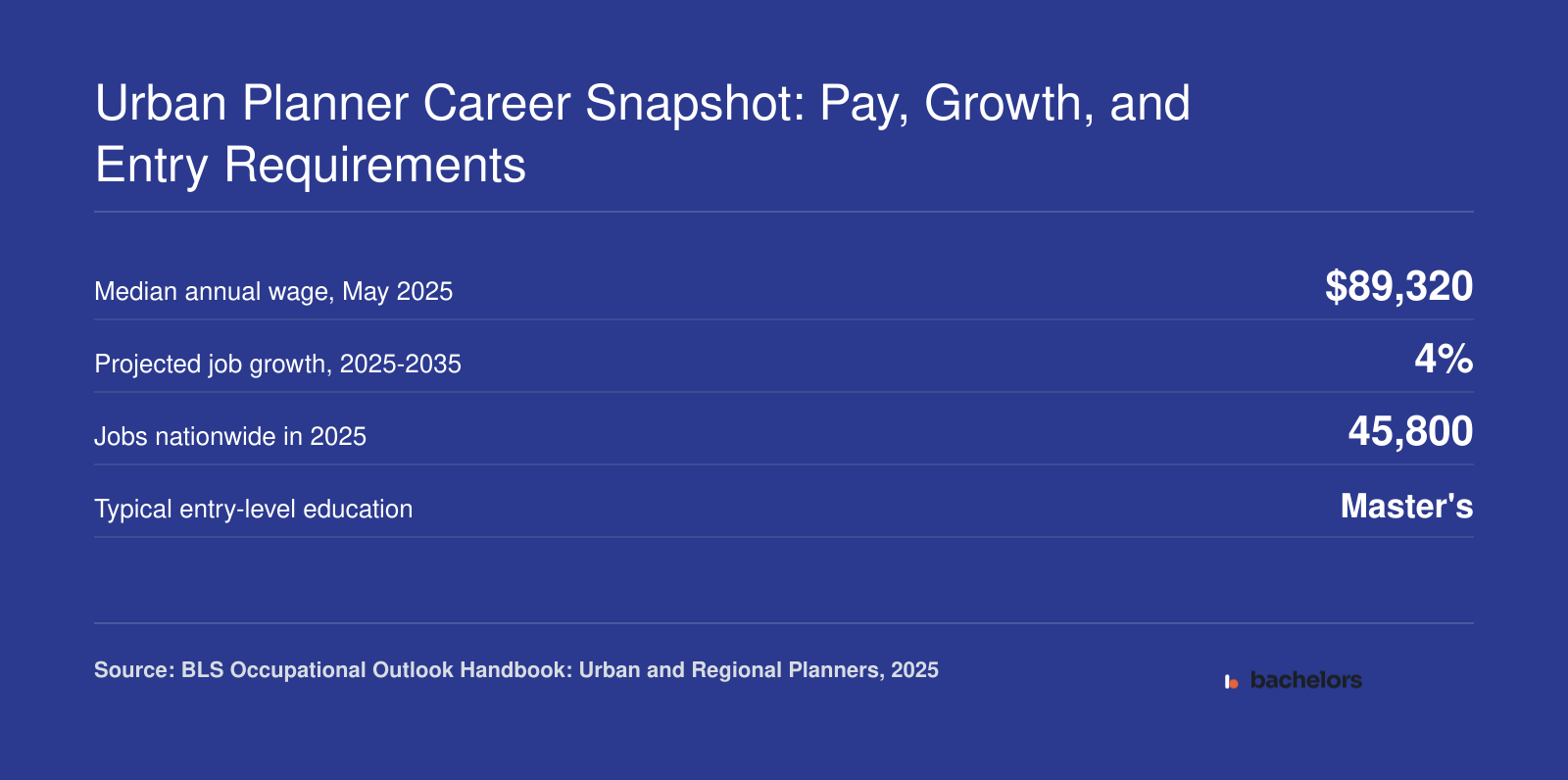
Urban Planner Career Snapshot: Pay, Growth, and Entry Requirements
Urban and regional planners earned a median of $89,320 in May 2025, and the BLS projects about 3,200 openings each year through 2035. The BLS lists a master's degree as the typical entry-level education, though planners can enter the field with a bachelor's or master's degree from an accredited planning program. A bachelor's degree in urban planning can lead to planning technician, assistant planner, and GIS roles, and many graduates add a master's degree later.
Related Articles
Online Urban Planning Degree Cost vs. Earnings: Is It Worth It?
Is an online urban planning degree worth it? U.S. Department of Education data from IPEDS and the College Scorecard show that urban planning graduates of Florida Atlantic University and Arizona State University left with median debt of about $21,000 to $23,500, and both programs reported median earnings above $66,000 four years after finishing, well above their first-year figures. Net price is an approximate institution-wide average after grants and scholarships, not a quote for every student, so use the final column, the estimated monthly payment on a standard 10-year plan, as your most practical check on whether the debt fits a new planner's budget.
| School | Avg. Net Price After Aid (Institution-Wide) | Median Debt (Program Graduates) | Median Earnings 1 Year After Finishing | Median Earnings 4 Years After Finishing | Est. Monthly Loan Payment (10-Year Plan) |
|---|---|---|---|---|---|
| Florida Atlantic University | $8,752 | $21,114 | $22,719 | $66,093 | $224 |
| Arizona State University | N/A | $23,444 | $46,954 | $68,163 | $249 |
How to Choose an Online Bachelor's Degree in Urban Planning
The right online urban planning program depends on where you are starting. Transfer limits and prior-learning rules are set school by school, so no national standard exists. Ask each admissions office for its policy in writing.
Career Changers
Favor asynchronous courses that fit around a job, and ask how much credit the school gives for prior learning. Exam, military, and portfolio credit are often handled differently from credit earned at another accredited college. Also check whether you can complete an internship with a local planning agency near you.
Community College Transfer Students
Confirm the transfer-credit ceiling before you apply. Ask whether a completed associate degree satisfies general education requirements, since some schools apply it as a block and others review course by course.
Recent High School Graduates
Weigh hybrid programs with studio or fieldwork components. Those experiences build a portfolio and a professional network, which matter when you start looking for planning jobs.
Planning a Master's Later
A planning bachelor's is not required for most graduate programs. Harvard and the University of Louisville accept applicants from any major in their master's programs.1 Still, a planning degree can strengthen an application. It can also open advanced-standing options: Illinois lets applicants with a planning bachelor's petition for up to 16 hours of waived coursework.2 A planning bachelor's can also shorten your AICP timeline.
Questions to Ask Yourself
Do you plan to pursue AICP certification, and does the program's PAB status shorten your experience requirement?
Can your schedule handle synchronous sessions or in-person studio days, or do you need fully asynchronous coursework?
Is there a city or county planning office near you where you could complete a required internship?
How many of your existing credits will transfer, and how much does that cut your total cost?
Urban Planning programs by state
Frequently Asked Questions About Online Urban Planning Degrees
Can you get a bachelor's degree in urban planning online?
Are online urban planning programs PAB accredited?
Do you need a master's degree to work as an urban planner?
What jobs can you get with a B.S. in urban planning while working toward AICP?
Compare Urban Planning programs on the data that matters
Explore more Science & Engineering majors or browse every field of study.
All Science & Engineering programs Browse every field of study