Best Criminology Schools in Washington
Compare 5 accredited Criminology programs in Washington, with net price after aid, graduation rates, earnings and debt from IPEDS and the U.S. College Scorecard.

Washington employers and graduate committees read a criminology degree as a social-science credential, not a police certification. A bachelor's degree in criminology is the entry point for either path, whether the school awards it as a Bachelor of Science (B.S.) or a Bachelor of Arts (B.A.).
Washington State University, Gonzaga University, Seattle University, Whitworth University and Saint Martin's University award it; WSU also delivers its criminal justice major fully online.
The squeeze is cost against flexibility. Tuition and fees top $52,000 at the priciest private option; the public route costs less but leaves less room to keep working. Net price after aid, not the sticker, is what separates them.
Key Points
- Washington State University ranks first and offers a fully online option.
- WSU tuition is about $13,400; private net prices range $15,000 to $35,100.
- Washington police recruits need agency sponsorship and the CJTC's 720-hour basic training.
Best Criminology Schools in Washington: Our Ranked List
Washington State University tops our list for 2026, pairing the oldest continuous criminal justice program in the country with a degree that runs on the Pullman campus and fully online. Gonzaga University and Seattle University follow, each offering a different private-university route into the field. The methodology section below explains how the order was built.
Washington State University
#1Pullman, WA · ~$15,000/yr (est.)
Best for: Working adults seeking a fully online criminology degree
Washington State University is a public research university in Pullman whose criminal justice and criminology department dates to 1943 and is the oldest continuous program of its kind in the nation. The curriculum is policy-based and drawn from the social sciences, and students can complete the degree on campus or fully online through the Global Campus. Undergraduates have access to faculty-guided research, the WSU Police Intern program and a chapter of Alpha Phi Sigma, the honor society that was founded at WSU. The university reports a graduation rate of 60.5% and awarded 163 bachelor's degrees in the field in the most recent federal year.
- Oldest continuous criminal justice program in the U.S., founded 1943
- Policy-based curriculum drawn from the social sciences
- Available on campus at Pullman or fully online through the Global Campus
- WSU Police Intern program and faculty-guided undergraduate research
- Alpha Phi Sigma national honor society was founded at WSU
- Transfer credit from AP, IB, CLEP, associate degrees and Running Start
- More than 700 WSU scholarship programs through one application
Gonzaga University
#2Spokane, WA · ~$35,000/yr (est.)
Best for: Students drawn to a Jesuit liberal arts core
Gonzaga University is a private Jesuit university in Spokane, and its criminology major is compact and writing-intensive: 33 credit hours in the field, capped by a senior capstone, on top of a 45-credit core curriculum rooted in Catholic and Jesuit liberal education. Students choose 15 credits of upper-division criminology electives, and an honors track is open to those who maintain a 3.3 cumulative GPA. The university reports a graduation rate of 86.3%, and program graduates reported median earnings of $68,190 four years after finishing.
- 33 credit hours in the major, capped by a senior capstone
- 15 credits of upper-division criminology electives
- 45-credit University Core Curriculum in the Jesuit tradition
- Foundation courses in crime and social control, statistics and research methods
- Upper division includes Criminological Theories and the senior capstone
- Honors track requires a 3.3 cumulative GPA
Seattle University
#3Seattle, WA · ~$35,000/yr (est.)
Best for: Urban students aiming for law school
Seattle University is a private Jesuit campus on First Hill in Seattle, where criminal justice and criminology students take 120 semester credits in person and choose an upper-level specialization area. Field learning is unusually hands-on for the field: internships in prisons, jails, crime labs and medical examiner offices, plus police ride-alongs, prison tours and courtroom observations. Accelerated routes include a Bachelor/JD 3+3 pathway that finishes both degrees in six years and a five-year BA and MA option. The university reports a graduation rate of 75.5%.
- 120 semester credits taught in person on the First Hill campus
- Upper-level specialization in Criminology and Criminal Justice Theory
- Internships in prisons, jails, crime labs and medical examiner offices
- Police ride-alongs, prison tours and courtroom observations
- Bachelor/JD 3+3 pathway completes both degrees in six years
- Five-year BA and MA in Criminal Justice and Criminology option
- Criminal Justice, Criminology and Forensics minor available
Whitworth University
#4Spokane, WA · ~$27,000/yr (est.)
Whitworth University is a private Christian liberal arts university in Spokane with a criminology and criminal justice major that blends theory, research methods and applied practice. Students complete practicums and internships and can join the Alpha Phi Sigma honor society. Graduates have moved into the Washington State Department of Corrections as research and data analysts, into county sheriff's deputy roles, and into law schools including the University of Washington and Gonzaga. The university reports a graduation rate of 70.9%.
- Coursework in criminological theory, policing, courts and corrections
- Practicums and internships built into the major
- Alpha Phi Sigma honor society chapter on campus
- Recent placement: research and data analyst, Washington State Department of Corrections
- Graduates have entered the University of Washington School of Law
- Also covers juvenile justice, statistics and research methods
Saint Martin's University
#5Lacey, WA · ~$28,000/yr (est.)
Saint Martin's University is a private Catholic Benedictine university in Lacey offering criminology and criminal justice as both a major and a minor, taught in person at the Lacey campus and at the JBLM location. Majors pick one of four concentrations (corrections, law enforcement and investigation, legal studies, or victim services) and finish with a senior capstone and a Scholars Day presentation. Faculty include working professionals from the Washington State Patrol and the Olympia Police Department, and the university reports a graduation rate of 51.9%.
- Four concentrations, including corrections and victim services
- 12 credit hours of core criminal justice system courses
- Senior capstone project and Scholars Day presentation required
- Faculty include working professionals from Washington State Patrol and Olympia Police Department
- Offered as both a major and a minor
- Taught in person at the Lacey campus and at Saint Martin's-JBLM
Cost & outcomes by school
Federal data for the highest-earning Criminology programs, independent of the ranking above. Earnings are this field's bachelor's graduates four years after completing where the Scorecard reports them, else the school's undergraduate median.
| School | Net price / yr | Grad rate | Earnings | Debt | Grads/yr | Format |
|---|---|---|---|---|---|---|
| Seattle University WA | $34,662 | 76% | $75,272 | $19,883 | — | Campus |
| Washington State University WA | $14,971 | 61% | $68,905 | $19,500 | 136 | Online or campus |
| Gonzaga University WA | $35,119 | 86% | $68,190 | $21,488 | 55 | Campus |
| Saint Martin's University WA | $28,119 | 52% | $62,092 | $22,500 | — | Campus |
| Whitworth University WA | $26,534 | 71% | $58,561 | $25,000 | — | Campus |
Sources: U.S. Department of Education. Net price, graduation rate, earnings and debt: College Scorecard (earnings and debt for this field's bachelor's graduates where reported, else school-wide); graduates: IPEDS. A dash means no figure is reported.
Cost, debt & payoff
Median earnings of this field's bachelor's graduates (4 yrs after completing, else the school's undergraduate median) vs. their median federal loan debt · U.S. College Scorecard
Across these programs the median graduate earns about $68,190 and finishes with roughly $21,488 in debt — a ratio that clears a common rule of thumb (keep debt below first-year salary). Net price and debt vary widely school to school, so check the per-school figures in the table above before you shortlist.
How We Ranked Washington Criminology Schools
Cost and flexibility rarely point the same direction. A school with the lower sticker price may be the one you can only attend full time on campus, while the pricier option may let you keep working. The ranking below tries to hold both in view.
The ordering reflects a handful of practical measures:
- Cost and net price: published tuition and the average net price students actually pay after grant aid.
- Graduation and retention: whether first-year students return and whether they finish.
- Outcomes: earnings and completions reported for the criminology program where the data exists.
- Selectivity and format: admission rates, plus whether the bachelor's can be completed online.
Two of those measures are blunt instruments. Neither is criminology-specific: graduation rate and net price are institution-wide averages covering every major at the university. Read them as context, not as a verdict on the department.
Only bachelor's programs based in Washington, whether campus or online, are included.
Which Factor to Weight
Start with the constraint that actually binds you. If money is tight, compare net price after aid first and treat sticker tuition as background. If you work full time or live far from Pullman, Spokane, Seattle, or Lacey, weight format and location ahead of a few points of prestige. If you are aiming at a federal agency or law school, weight completion, internship access, and reported earnings.
Online and Hybrid Criminology Bachelor's Options at Washington Schools
Can you finish a criminology or criminal justice bachelor's degree online from a Washington school? Yes, through Washington State University. WSU Global Campus delivers a Bachelor of Arts in Criminal Justice that is 100% online, major coursework included, so you never need to relocate to Pullman. The other programs covered here, at Gonzaga University, Seattle University, Whitworth University, and Saint Martin's University, are built as campus programs with in-person coursework, internships, and capstone work.
Online Versus Campus Delivery
WSU's degree is listed on campus as Criminal Justice and Criminology, but the online version offered through Global Campus is marketed under the Criminal Justice title.1 If your goal is a degree that says "criminology" on the diploma, ask a WSU advisor exactly how the online award is titled before you enroll. The distinction matters less for most employers than it does for graduate school applications, but it is worth a direct answer.
The published material leaves one detail unsettled: whether every general-education requirement can be completed online alongside the major courses. The program itself is fully online; the delivery mode of each individual core class is something to confirm with an enrollment counselor, especially if you are transferring in partial credit.
Start Terms and Deadlines
WSU Global Campus admits undergraduates at several points each year, and deadlines shift by cycle, so check the current calendar rather than assuming last year's dates carry forward. For the 2026 cycle, spring classes began January 12, 2026, with the early summer session starting May 11, 2026;1 summer applications closed April 10, 2026 for the early session and May 22, 2026 for the late session. The next posted cycle lists December 6, 2026 for spring 2027, May 21, 2027 for summer 2027, and July 23, 2027 for fall 2027.
For the Spokane, Seattle, and Lacey programs, no fully online or hybrid track is published. Contact each department directly if remote coursework is a requirement for you.
Bachelor's Degree in Criminology Admissions: GPA, Test Policy, and Transfer Credit in Washington
Applying to the university and applying to the criminology major are two separate steps in Washington, and the schools on this list handle them differently. Confuse the two and you can be admitted in the fall with no clear path into the program you wanted.
University admission first, major declaration second
At Gonzaga University, Seattle University, Whitworth University, and Saint Martin's University, the binding decision is usually your first-year or transfer application to the university, with the major declared once you are enrolled. Do not assume that is automatic. Ask each department whether declaration requires a form, a minimum college GPA, or a specific course grade.
Washington State University is the one to check most carefully. Confirm whether you enter as a pre-major in Criminal Justice and Criminology and what GPA or coursework moves you into the full major.
Test scores and transfer credit
SAT and ACT policy in Washington has shifted repeatedly since 2020, so treat any summary, including this one, as a starting point and read the first-year and transfer pages for your intended start term. Applicants transferring with substantial college credit are often exempt from submitting scores, but that is a school-by-school decision.
Transfer credit matters just as much. Washington's community colleges send a large share of students into these programs, and each university sets its own rules for how many credits apply to the major rather than to general education. Ask two questions before you commit: what minimum college GPA do I need, and how many criminology credits will transfer? Get the credit evaluation in writing.
If a school publishes nothing specific
Where an admissions page lists no separate standard for the criminology major, the university's general requirements are the bar; confirm with the department that no declaration form or extra GPA applies. A short email to the program director settles it faster than any guide.
Criminology Degree Cost in Washington: Tuition, Net Price, and State Aid
How much does a criminology degree cost in Washington? Plan on about $13,400 in tuition and fees at Washington State University, and average net prices from roughly $15,000 to $35,100 at the private universities ranked here, with state grants reducing those figures further.
Published Tuition and Average Net Price
- Washington State University: $13,391 in tuition and fees for residents, $29,950 otherwise; average net price $14,971.
- Saint Martin's University: $45,510 tuition; average net price $28,119.
- Whitworth University: $52,880; average net price $26,534.
- Seattle University: $56,721; average net price $34,662.
- Gonzaga University: $55,480; average net price $35,119.
Read net price as a benchmark, not a criminology figure: it is an institution-wide average for first-year students after grants and scholarships, across every major.
The Washington College Grant
Washington's largest need-based award requires state residency, need verified through the FAFSA or WASFA, and no prior bachelor's degree.1 For 2026-27, a family of four earning $83,500 or less qualifies for a full award, with partial awards up to $139,500.1 Amounts vary by family size, income, school, and enrollment, and the grant covers up to six full-time years.1
College Bound and Passport to College
College Bound, which students sign up for by an early deadline and requalify for annually, pays public tuition and fees plus $500 in books each year; 2026-27 income limits include $61,050 for a household of four.2 It applies after the Washington College Grant and can shrink if other aid already covers tuition, with a combined maximum of $13,200 at Washington State University.3 Passport to College, for students who experienced foster care, adds a $2,000 maximum award and makes them eligible for the maximum grant.4
Check Your Own Number
Enter your own financial details into each school's net price calculator. State aid applies only at participating institutions, and if you live outside Washington, the out-of-state rate above is what you pay.5
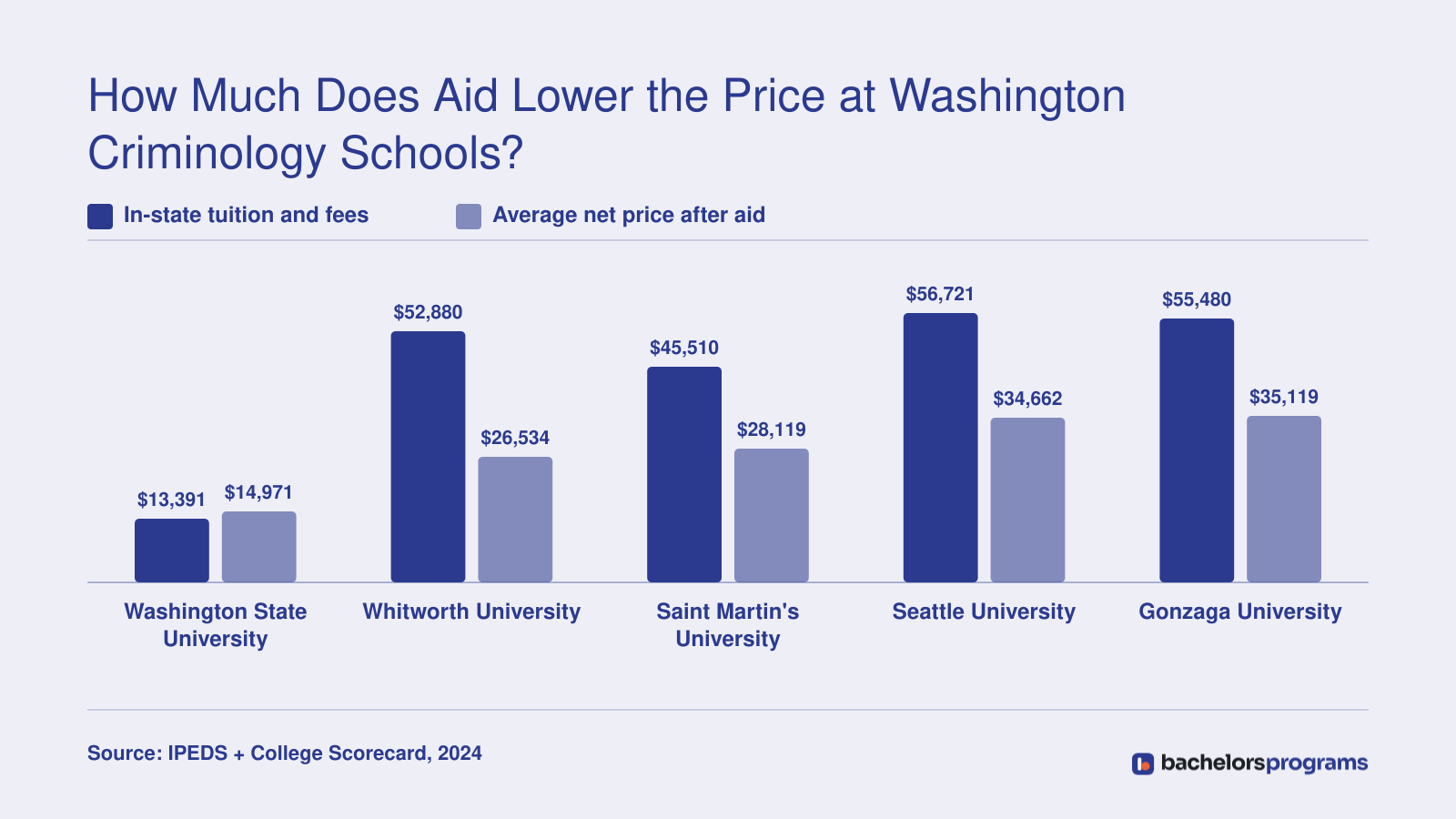
How Much Does Aid Lower the Price at Washington Criminology Schools?
At Washington's private schools, financial aid cuts the yearly price by $17,000 to $26,000. Whitworth University shows the widest gap, with $52,880 in tuition and fees against an average net price of $26,534. Seattle University and Gonzaga University each come in more than $20,000 below sticker price. Washington State University works differently: its $14,971 net price is higher than its $13,391 in-state tuition because net price also counts housing, food and books after grants. Net price is a school-wide average for aided first-year students, not a figure for the criminology major alone.
Criminology vs. Criminal Justice: Choosing the Right Bachelor's Program
Is a criminology degree different from a criminal justice degree, and does the label matter when you apply in Washington? The two fields differ in focus, but most Washington programs blend them.
What Each Field Studies
Criminology asks why crime happens. It draws on sociology, psychology, and research methods to examine the causes of offending, patterns of victimization, and how communities shape behavior. Criminal justice looks at how the system responds once a crime occurs: policing, courts, and corrections, including how those agencies operate and where they fall short.
How Washington Programs Label Themselves
Gonzaga University offers the most purely criminology-focused option, a B.A. in Criminology with a required capstone and 15 credits of upper-division criminology electives. The other schools combine both fields in one major: Washington State University's Criminal Justice and Criminology, Seattle University's Criminal Justice and Criminology, BA (with an emphasis on criminology and criminal justice theory), Whitworth University's Criminology & Criminal Justice, and Saint Martin's University's Criminology and Criminal Justice, which offers four concentration options. A blended major lets you study both causes and responses before committing to a path.
Specializations and Who They Suit
- Forensics: Seattle University offers a Criminal Justice and Forensics minor and crime lab internships, a fit for students drawn to evidence and investigation.
- Corrections: Seattle University's prison internships and tours, plus Whitworth's preparation for adult and juvenile counseling, suit students interested in rehabilitation and supervision.
- Policy: WSU builds its curriculum on policy and the social sciences, with undergraduate research alongside faculty, a good match for future analysts and advocates.
- Digital crime: Whitworth points graduates toward computer forensics, an option for tech-minded students.
A Quick Rule of Thumb
Choose criminology-heavy coursework if you want research, policy work, law school, or graduate study. Seattle University's Bachelor/JD 3+3 pathway is one example. Choose criminal justice coursework, internships, and agency ties if you plan to enter policing, corrections, or court administration right after graduation.
Related Articles
Washington Police Certification Through the CJTC
Common Questions About Criminology Degrees in Washington
These answers cover the questions prospective students ask most about studying criminology in Washington. Each one draws on the program details covered earlier on this page.
Can you get a criminology degree online in Washington?
Is a criminology degree worth it in Washington?
What is the difference between criminology and criminal justice?
Do you need a criminology degree to become a police officer in Washington?
Compare Criminology programs on the data that matters
Explore more Criminal Justice & Law majors or browse every field of study.
All Criminal Justice & Law programs Browse every field of study