Best Forensic Science Schools in Ohio
Compare 12 accredited Forensic Science programs in Ohio at 10 colleges, with net price after aid, graduation rates, earnings and debt from IPEDS and the U.S. College Scorecard.
Ohio schools award the forensic science bachelor's degree under several different names. Some schools confer it as a Bachelor of Science (B.S.) or a Bachelor of Arts (B.A.) in Forensic Science; others fold the coursework into a criminal justice, chemistry or biology major. Cedarville University and Youngstown State University carry dedicated B.S. programs, Ohio Northern University runs its version as a criminal justice option, and Ashland University teaches it as a forensic biology concentration inside biology.
Employers read transcripts, not program titles, and instrument time and lab hours are what separate applicants. That is the trade-off to weigh as you compare net price, format, admissions terms and Ohio hiring: the cheapest program and the best-equipped one rarely sit on the same campus.
Key Points
- Youngstown State University has the lowest average net price here.
- Muskingum's $32,665 tuition drops to a $19,532 average net price.
- Required lab and crime-scene work keeps these bachelor's programs campus-based.
Best Forensic Science Schools in Ohio: Our Top 10 Ranked
Ten Ohio colleges award a bachelor's degree in forensic science, some as a dedicated B.S. and others as a named option or concentration inside criminal justice, chemistry or biology. The programs below range from a state crime-lab partnership in Bowling Green to small-college chemistry tracks with required internships. Each entry notes what the school actually requires of forensic science majors, so you can compare lab time, internship hours and concentrations before you apply.
Bowling Green State University
#1Bowling Green, OH · ~$24,000/yr (est.)
Best for: Hands-on learners wanting crime-lab access
Bowling Green State University runs a forensic science bachelor's degree built around three specializations: DNA analysis, drug analysis and forensic examination. Its strongest asset is a long-running partnership with the Ohio Attorney General's Office and the Ohio Bureau of Criminal Investigation, which places a professional criminal investigation facility on campus and connects students with working state scientists. Instruction happens in dedicated forensic classrooms, lab space and a mock crime scene house, and the capstone asks students to process a mock case and defend it in moot court.
- Trains students to apply biology and DNA analysis to forensic evidence
- Curriculum built with the Ohio Attorney General's Bureau of Criminal Investigation
- Covers evidence collection, legal and ethical issues and courtroom testimony
- Internship option of 200 or more on-site hours
- Capstone processes a mock case and includes moot court testimony
- On-campus mock crime scene house and criminal investigation lab
- Focus on drug chemistry for crime laboratory work
- Combined bachelor's-to-master's degree option available
- On-campus criminal investigation lab staffed with Ohio BCI scientists
- Internship option of 200 or more on-site hours
- Capstone ends in moot court testimony
- Prepares graduates for latent fingerprint and trace evidence work
- 200 on-site hours required for the concentration
- Thesis or capstone option to finish the degree
- Faculty bring decades of crime lab experience
- Trains students for expert testimony in court
Ohio University
#2Athens, OH · ~$22,000/yr (est.)
Best for: Chemistry-minded students eyeing DNA labs
Ohio University awards its forensic science degree as a forensic chemistry major, a Bachelor of Science that applies chemistry to criminal investigation. Students take 48 semester credit hours of chemistry plus supporting work in math, physics and law enforcement technology, and the genetics courses double as a biological sciences minor that qualifies graduates for DNA sections of crime laboratories. Graduates head into crime lab and law enforcement roles at agencies such as the FDA, OSHA and EPA, and program materials state AAFS accreditation through FEPAC.
- AAFS accreditation through FEPAC, per program materials
- 48 semester credit hours of chemistry coursework
- Genetics courses complete a Biological Sciences minor
- Optional Forensic Firearms and Ballistics Analysis course
- No admission requirements beyond university admission
- Fixed tuition and fees through Guarantee+
- Prepares for crime lab roles at FDA, OSHA and EPA
Cedarville University
#3Cedarville, OH · ~$24,000/yr (est.)
Best for: Christian students wanting a science-heavy major
Cedarville University offers a residential Bachelor of Science in Forensic Science with an unusually heavy science load: 72 credit hours across chemistry, biology, physics and math, plus 18 credit hours of criminal justice. A crime lab internship is part of the degree, and lab work covers trace evidence, fingerprints, handwriting samples and chemical analysis of simulated drugs. The curriculum is taught with biblical integration in every course, and alumni include graduates working at the FBI.
- 72 credit hours of science coursework
- 18 credit hours of criminal justice courses
- Crime lab internship required for the degree
- At least 10 credits of math and 22 credits of chemistry
- Lab work in trace evidence, fingerprints and simulated drugs
- Biblical integration in every course
- Alumni work at the FBI
Ohio Northern University
#4Ada, OH · $24,000/yr (est. net price)
Ohio Northern University delivers forensic science as an option inside its Bachelor of Arts in Criminal Justice, laid out as a four-year fall and spring semester plan. Students take Forensic Biology 1 and 2, Crime Scene Investigation, anatomy and physiology, and chemistry for health sciences with labs, then finish a two-part senior thesis and a public service internship. The degree requires 480 internship hours, so it suits students who want heavy field experience alongside a criminal justice core.
- 480 internship hours required for the degree
- Two-part senior thesis and public service internship
- Forensic Biology 1 and 2 plus Crime Scene Investigation
- Anatomy and physiology and chemistry for health sciences labs
- Four-year fall and spring semester plan published
- Investigative accounting option also offered
Youngstown State University
#5Youngstown, OH · ~$13,000/yr (est.)
Youngstown State University awards a Bachelor of Science in Applied Science in Forensic Science, a 120 to 122 semester hour degree that draws on criminal justice, biology, chemistry, sociology and anthropology. Students pick a concentration in biology, chemistry, anthropology or a flexible option, then complete a six-semester-hour internship worth roughly 45 on-site hours per credit. A capstone in forensic practice and ethics, plus courses such as forensic firearms examination and death investigation, round out the major, and transfer students need a 2.5 GPA and must maintain it.
- Four concentrations: biology, chemistry, anthropology, flexible
- 120 to 122 semester hours total
- Six-semester-hour internship, about 45 on-site hours per credit
- 2.5 cumulative GPA required of transfer students
- Capstone in forensic practice and ethics
- Courses in forensic firearms examination and death investigation
- Biological and chemical sciences plus criminal justice core
Tiffin University
#6Tiffin, OH · ~$27,000/yr (est.)
Tiffin University builds its forensic science bachelor's degree on 96 credit hours of biology, chemistry, math and physics, with a laboratory attached to every forensic course. Lab topics run from blood spatter and ballistics to explosives, fire forensics, entomology and anthropology, and the program includes autopsy observation in working morgues. Tiffin reports that graduates finish in four years or less and land STEM jobs within six months, and it endorses the degree as preparation for medical school applications.
- 96 credit hours of biology, chemistry, math and physics
- A laboratory with every forensic course
- Labs cover blood spatter, explosives, ballistics and entomology
- Autopsy observation in actual morgues
- Endorsed as preparation for medical school
- Scholarships for on-campus students up to $17,000 a year
Mount Vernon Nazarene University
#7Mount Vernon, OH · ~$22,000/yr (est.)
Mount Vernon Nazarene University offers a Bachelor of Science in Forensic Science with a chemistry concentration on its Mount Vernon campus. The degree pairs chemistry with criminal justice, so students train in the lab skills used in a chemical crime lab while learning criminal investigation basics, and upperclassmen can serve as paid laboratory assistants or recitation leaders. Alumni work as crime scene investigators, toxicologists and forensic chemists, and graduates have continued at Case Western Reserve, Purdue, the University of Iowa, Kent State and Ohio State.
- Pairs chemistry coursework with criminal justice
- Chemistry concentration inside the forensic science major
- Upperclassmen can serve as paid lab assistants
- Faculty-mentored research experiences
- Alumni work as crime scene investigators and toxicologists
- Graduates continue at Case Western, Purdue and Ohio State
Defiance College
#8Defiance, OH · $25,000 – $30,000/yr (est.)
Defiance College awards a bachelor's degree in forensic science that combines chemistry, biology, physics, medicine and criminal justice, and students who complete the major also earn a minor in chemistry. Coursework covers arson accelerant analysis, DNA fingerprinting, presumptive narcotics tests, ballistics trajectories and human remains, along with the legal procedures for preserving evidence and presenting it in court. Graduates have gone on to Cleveland Clinic, the Kansas Bureau of Investigation, the Louisiana State Police Crime Lab and Honda R&D Americas.
- Combines chemistry, biology, physics, medicine and criminal justice
- Finishing the major also earns a minor in chemistry
- Coursework in arson accelerants, DNA fingerprinting and ballistics
- Covers legal procedures for preserving evidence for court
- Alumni at Cleveland Clinic and Kansas Bureau of Investigation
Muskingum University
#9New Concord, OH · $20,000/yr (est. net price)
Muskingum University houses forensic science in a forensic chemistry track inside its chemistry major, with 45 hours of chemistry drawn from organic, analytical and physical coursework. Criminal justice, math and physics courses are required alongside the chemistry sequence, and students can add an internship in forensic science. The same department also offers an American Chemical Society certification option for students who want a stronger professional chemistry credential.
- 45 hours in chemistry, including organic, analytical and physical
- Criminal justice, math and physics courses required
- Optional internship in forensic science
- American Chemical Society certification option available
- Electives in biology and statistics recommended
Ashland University
#10Ashland, OH · ~$22,000/yr (est.)
Ashland University offers forensic science as an optional forensic biology concentration inside its Bachelor of Science in Biology, a 120 credit hour in-person program. Coursework includes molecular biology, genetics, organic chemistry, forensic science and criminal justice, and the program states its courses meet FBI standards for DNA analysis. Students can pursue independent research for course credit, and Choose Ohio First Scholarships are available.
- Optional forensic biology concentration within the biology major
- 120 credit hours required
- Coursework includes molecular biology, genetics and organic chemistry
- Courses meet FBI standards for DNA analysis
- Independent research available for course credit
- Choose Ohio First Scholarships available
Cost & outcomes by school
Federal data for the highest-earning Forensic Science programs, independent of the ranking above. Earnings are this field's bachelor's graduates four years after completing where the Scorecard reports them, else the school's undergraduate median.
| School | Net price / yr | Grad rate | Earnings | Debt | Grads/yr | Format |
|---|---|---|---|---|---|---|
| Ohio Northern University OH | $24,478 | 76% | $80,928 | $27,000 | 16 | Campus |
| Tiffin University OH | $26,500 | 40% | $57,509 | $27,000 | 28 | Campus |
| Cedarville University OH | $24,468 | 73% | $55,443 | $20,937 | 8 | Campus |
| Ashland University OH | $21,988 | 61% | $52,928 | $25,000 | — | Campus |
| Ohio University OH | $21,637 | 66% | $52,581 | $21,056 | — | Campus |
| Mount Vernon Nazarene University OH | $22,421 | 68% | $49,555 | $25,000 | — | Campus |
| Defiance College OH | $26,337 | 31% | $49,351 | $26,813 | 4 | Campus |
| Muskingum University OH | $19,532 | 56% | $48,440 | $25,369 | — | Campus |
| Bowling Green State University OH | $24,022 | 64% | $47,896 | $25,000 | — | Campus |
| Youngstown State University OH | $12,767 | 51% | $41,544 | $24,000 | 10 | Campus |
Sources: U.S. Department of Education. Net price, graduation rate, earnings and debt: College Scorecard (earnings and debt for this field's bachelor's graduates where reported, else school-wide); graduates: IPEDS. A dash means no figure is reported.
Cost, debt & payoff
Median earnings of this field's bachelor's graduates (4 yrs after completing, else the school's undergraduate median) vs. their median federal loan debt · U.S. College Scorecard
Across these programs the median graduate earns about $49,453 and finishes with roughly $25,000 in debt — a ratio that clears a common rule of thumb (keep debt below first-year salary). Net price and debt vary widely school to school, so check the per-school figures in the table above before you shortlist.
How We Ranked Ohio Bachelor's Degree in Forensic Science Programs
"Best" here means bachelor's programs that combine verified quality with solid student outcomes and a manageable cost. School-level figures come from the federal College Scorecard, and accreditation evidence comes from the field's own accreditor.
What the Criteria Measure
- Accreditation: Whether the program has been reviewed by the field's specialized accreditor, the criterion that carries the most weight.
- Outcomes: How many students at the school finish their degrees.
- Cost: What students typically pay once grants and scholarships are counted.
How FEPAC Accreditation Is Weighed
The Forensic Science Education Programs Accreditation Commission (FEPAC) reviews bachelor's and master's programs in forensic science. Only the bachelor's level matters here. FEPAC status is the closest thing the field has to a common quality standard, so it carries the most weight.
Bowling Green State University's B.S. in Forensic Science holds full FEPAC accreditation from January 1, 2024 through December 31, 2029.1 Ohio University describes its B.S. in Forensic Chemistry as FEPAC-accredited.2 The accreditation records we reviewed show a term running through January 2023, though, so confirm its current status with FEPAC before you apply.3
The other schools here offer forensic science options or chemistry and biology majors with a forensic focus. We found no confirmed FEPAC status for them. That is not the same as a denial, so check each program directly.
Read the Numbers Carefully
Graduation rate and net price are institution-wide, approximate figures. They describe the whole university, not the forensic science program, and they shift from year to year. Use them to compare schools, not to predict your own result.
So, What Is the Best Forensic Science School in Ohio?
By these criteria, Bowling Green State University is the strongest all-around choice: its FEPAC accreditation is current and documented through 2029. Ohio University is a close alternative for students who want a chemistry-heavy forensic path, once its accreditation status is confirmed.
Most Affordable Ohio Forensic Science Programs
These schools are ordered by average annual net price, which is what students pay after grants and scholarships, based on 2024 IPEDS and College Scorecard data from the U.S. Department of Education. Youngstown State University has the lowest net price here, at $12,767 a year. Muskingum University, Ashland University and Mount Vernon Nazarene University all publish tuition above $31,000, but institutional aid brings their net prices close to Ohio University's, a public school.
| School | Location | Program | Type | Published In-State Tuition and Fees | Average Annual Net Price | Median Debt at Graduation (Schoolwide) |
|---|---|---|---|---|---|---|
| Youngstown State University | Youngstown, OH | Bachelor of Science in Applied Science in Forensic Science | Public | $11,113 | $12,767 | $24,000 |
| Muskingum University | New Concord, OH | Chemistry (Forensic Chemistry Track) | Private nonprofit | $32,665 | $19,532 | $25,369 |
| Ohio University | Athens, OH | Forensic Chemistry Major | Public | $14,158 | $21,637 | $21,056 |
| Ashland University | Ashland, OH | B.S. in Biology, Forensic Biology Concentration | Private nonprofit | $31,210 | $21,988 | $25,000 |
| Mount Vernon Nazarene University | Mount Vernon, OH | Chemistry (Forensic Science) | Private nonprofit | $37,158 | $22,421 | $25,000 |
Online and Hybrid Bachelor's Options at Ohio Schools
Can you earn a bachelor's degree in forensic science in Ohio without ever setting foot on campus? At the Ohio schools ranked here, the published program formats point to campus-based study, and the required lab and crime-scene work explains why.
Why the Lab Work Sets the Format
Forensic science is a bench science before it is a criminal justice field. Students run instruments, handle mock evidence and testify about what they found. Youngstown State's catalog lists a dedicated crime-scene lab course covering fingerprinting and blood-pattern analysis, and requires a senior internship of 6 semester hours at 45 on-site hours per credit, 270 hours in total. Bowling Green builds its program around campus facilities, including a mock crime-scene house, and its capstone asks students to work mock evidence through instruments, written reports and a mock trial; the internship option there calls for more than 200 on-site hours. None of that translates to a screen.
Where Online Credit Does Fit
Ohio University offers an online bachelor's completion degree in criminal justice that can lead toward forensic science or law enforcement careers. It is a criminal justice degree rather than a forensic science or forensic biology major, and its page does not state a forensic lab, practicum, internship or crime-scene requirement. If you already hold college credits, ask each department whether lecture-based courses such as criminal justice, ethics or statistics can be completed online, and whether lab sections run in summer or evening blocks.
Who a Flexible Format Suits
- Working adults: online or evening lecture courses can keep a job moving while you reserve campus time for labs and internships.
- Transfer students: a completion-style route can absorb prior credits quickly, but confirm that the forensic lab sequence still fits your timeline.
- Career changers: map the internship hours first, since 200 to 270 on-site hours shape your semester schedule more than any online option will.
Related Articles
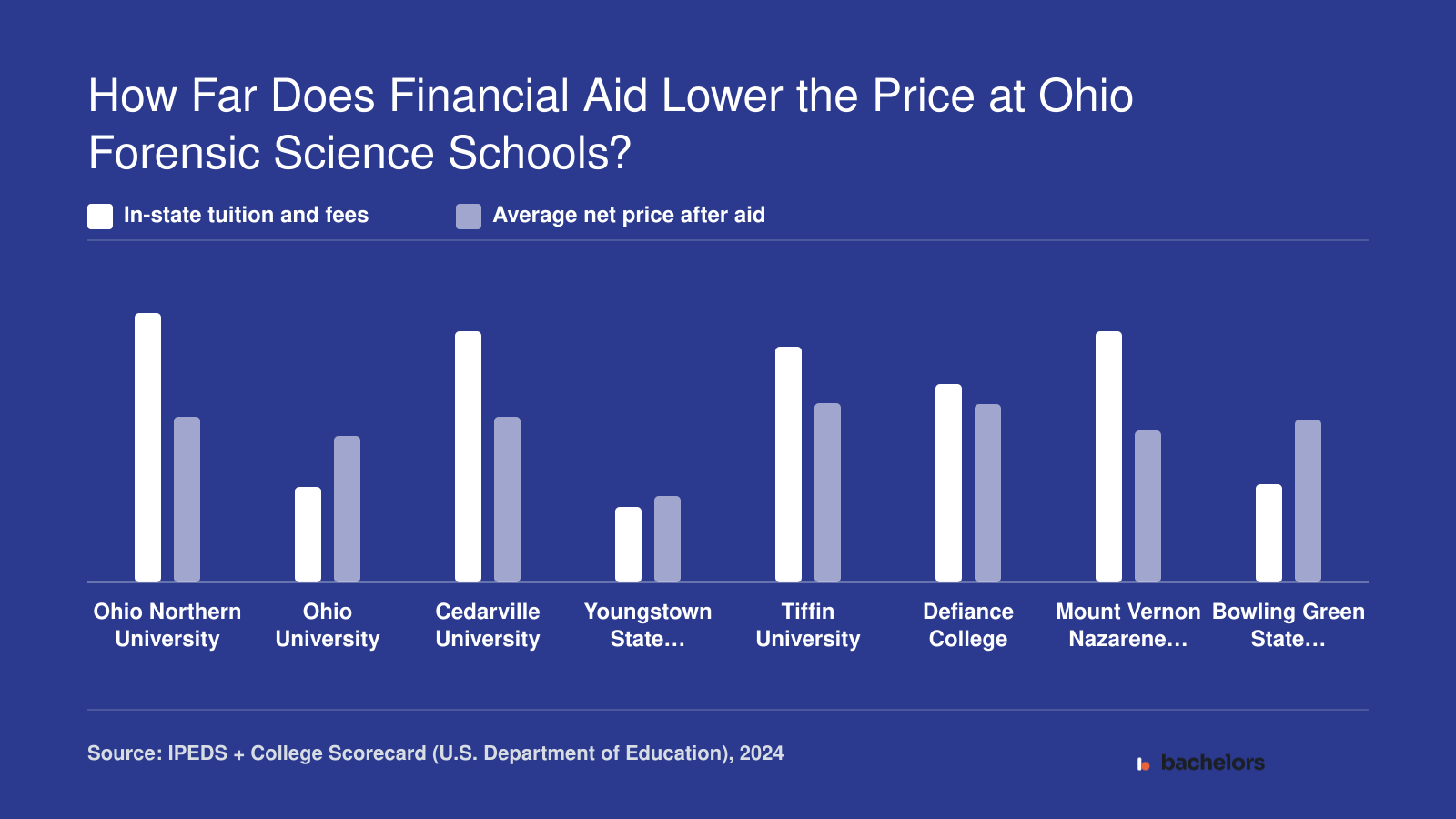
How Far Does Financial Aid Lower the Price at Ohio Forensic Science Schools?
At private schools such as Ohio Northern, Cedarville and Mount Vernon Nazarene, the average net price after aid runs about $12,700-$15,300 below published tuition. Muskingum ($32,665 tuition, $19,532 net price) and Ashland ($31,210, $21,988) follow the same pattern. At Ohio University, Bowling Green State and Youngstown State, net price is higher than in-state tuition because it also counts housing, food and books after grants. Every net price shown is a school-wide average for first-time, full-time undergraduates who receive aid, not a figure for the forensic science program alone.
Forensic Science vs. Forensic Biology vs. Criminalistics Degrees
These labels overlap, and schools use them differently. A bachelor's degree in forensic science is the broadest, forensic biology leans on life science, and criminalistics usually describes crime lab work rather than a separate major. If you want DNA work, look for biology-heavy coursework. If you want drug analysis or evidence examination, favor chemistry-heavy programs, and confirm accreditation before you apply.
| Feature | Forensic Science (B.S./B.A.) | Forensic Biology | Criminalistics |
|---|---|---|---|
| Focus | Broad lab science applied to evidence | Biology applied to biological evidence | Collection and analysis of physical evidence |
| Typical coursework emphasis | Chemistry, biology, evidence, lab methods | Genetics, molecular biology, biochemistry | Chemistry, trace evidence, pattern analysis |
| Common specialization tracks | DNA, drug analysis, toxicology, evidence examination | DNA and serology | Drug analysis, trace, firearms, impression evidence |
| Ohio examples | Bowling Green, Cedarville, Tiffin, Defiance, Youngstown State | Ashland (Biology, Forensic Biology Concentration) | Often a track inside a forensic science or chemistry major |
| Typical career fit | Crime lab analyst, forensic technician | DNA analyst, biological lab technician | Crime lab examiner, evidence analyst |
| Federal occupation match | Forensic science technicians: $72,060 median wage (2025) | Biological technicians: $57,510 median wage (2025) | No separate category, grouped with forensic science technicians |
| FEPAC implications | FEPAC accredits specific programs, so verify each one | A biology major with a forensic concentration may not be FEPAC accredited | Rarely accredited under this label, so check the host major |
| Best fit if you want | Flexibility across lab specialties | A DNA or biology-focused lab path | Hands-on evidence examination |
Common Questions About Forensic Science Schools in Ohio
These answers point you to the sources that settle each question for the current year. Accreditation, hiring rules and program details change, so confirm them directly before you apply.
How do I check whether an Ohio forensic science program has FEPAC accreditation?
How should I compare Ohio forensic science programs beyond rankings?
How can I find out what Ohio crime labs require when they hire?
Is FEPAC accreditation required for a crime-lab job, and can a chemistry or biology degree qualify?
Compare Forensic Science programs on the data that matters
Explore more Criminal Justice & Law majors or browse every field of study.
All Criminal Justice & Law programs Browse every field of study