Best Online Biomedical Engineering Degree Programs
Compare 6 accredited online Biomedical Engineering programs, with net price after aid, graduation rates, earnings and debt from IPEDS and the U.S. College Scorecard.

Yes, a bachelor's degree in biomedical engineering can be completed online, though the options are narrow. The degree is a Bachelor of Science (B.S.) in Biomedical Engineering, and because engineering programs depend on labs, few schools deliver the full credential at a distance.
Genuinely 100% online programs are rare. Only fully online degrees make the ranking, and hybrid formats are excluded.
Four factors separate strong choices from weak ones: ABET accreditation, how lab work is handled remotely, total cost, and starting salary. Accreditation matters most, since it keeps the path to professional licensure open.
Employers in medical devices care less about delivery format than about the accreditation behind the diploma.
Key Points
- Programs here with published requirements run about 120 to 128 credit hours.
- Arizona State University Online requires 120 credits, at least 46 upper-division.
- Choosing an ABET-accredited program keeps a future Professional Engineer license possible.
Best Fully Online Biomedical Engineering Bachelor's Programs for 2027
Only a small number of U.S. schools deliver a bachelor's degree in biomedical engineering online, and the four programs below are the ones that hold up when cost, completion and student support are weighed together. Hybrid and on-campus-only programs were set aside, so every card here represents coursework you can complete online; where a program still asks for a short laboratory residency, the card says so plainly. A short list is the honest answer, because the supply of genuinely online biomedical engineering programs is thin and padding the page with near-misses would not help you compare.
University of Michigan-Dearborn
#1Dearborn, MI · ~$9,000/yr (est.)
Best for: Dual-degree seekers pairing bioengineering with mechanical engineering
A public University of Michigan campus in suburban Detroit, UM-Dearborn runs its bioengineering B.S.E. inside an ABET-accredited engineering college with rolling admissions year round. The university flags the program as STEM Online, which matters to international students mapping post-study work options, and it offers a 143-credit dual degree with mechanical engineering for readers drawn to device design. The school's overall graduation rate is 58 percent, and in-state tuition and fees run well below the out-of-state rate.
- ABET-accredited by the Engineering Accreditation Commission
- Designated STEM Online for immigration and employment planning
- Six electives from more than 30 options, including drug delivery and microfluidics
- Dual BSE in bioengineering and mechanical engineering totals 143 credits
- Accelerated path awards bachelor's and master's in five years at a 3.2 GPA
- Rolling admissions reviews applications year round
- In-state tuition and fees $15,640; out-of-state $32,896
University of North Dakota
#2Grand Forks, ND · ~$19,000/yr (est.)
North Dakota's flagship campus in Grand Forks awards its biomedical engineering B.S. through the College of Engineering & Mines, with the core BME sequence delivered asynchronously online and one to two weeks of laboratory work in Grand Forks over the summer. Online students pay a single tuition rate regardless of residency, and the BioInnovation Zone places them on paid industry projects that can offset costs. The school's overall graduation rate is 60 percent, and start terms run in fall, spring and summer.
- ABET-accredited program in the College of Engineering & Mines
- Core biomedical engineering courses run asynchronously with no set meeting times
- One-to-two-week summer laboratory session on the Grand Forks campus
- 128 credit hours across roughly four years, with fall, spring and summer starts
- Online students pay one tuition rate regardless of legal residency
- Paid industry roles available through the BioInnovation Zone
- Seven concentration options spanning three collaborating departments
- Deadlines: Aug. 15 for fall, Dec. 15 for spring, May 1 for summer
Arizona State University
#3Scottsdale, AZ
Best for: Medical-device hopefuls seeking clinical design experience
Arizona State's Fulton Schools of Engineering teaches the biomedical engineering B.S.E. through ASU Online and on the Tempe campus, with the same ABET-accredited, 120-credit curriculum in either format. A Mayo Clinic partnership adds clinical perspective and a companion certificate, an Earned Admission pathway gives applicants who miss the standard bar a route in, and students from participating western states may qualify for reduced nonresident tuition. Online graduates are eligible for the 24-month STEM OPT extension.
- ABET-accredited 120-credit B.S.E. in biomedical engineering
- Same curriculum offered through ASU Online and on the Tempe campus
- Mayo Clinic partnership adds clinical perspective and a companion certificate
- Two-part senior design experience anchors the final year
- First-year applicants need a 3.00 GPA or top 25 percent, plus SAT 1210 or ACT 24
- Earned Admission pathway through online courses with at least a 2.75 GPA
- Reduced nonresident tuition for students from participating western states
Polytechnic University of Puerto Rico-Orlando
#4Orlando, FL · ~$17,000/yr (est.)
Polytechnic University of Puerto Rico's Orlando campus awards an ABET-accredited B.S. in biomedical engineering built on a 151-credit curriculum that closes with a two-course capstone sequence. The program is taught on campus and through a fully online option, and its free electives leave room for the psychology and sociology credits medical and dental schools expect. The school's overall graduation rate is 33 percent, so plan to ask about advising and completion support before you enroll.
- ABET-accredited Bachelor of Science in Biomedical Engineering
- 151 credit hours including Capstone Design I and II
- Fully online option alongside the Orlando campus program
- 54 credit hours of biomedical engineering core coursework
- Up to 33 preparatory credit hours for students building math or language skills
- Free electives support pre-med and pre-dental prerequisites
- Tuition and fees of $14,547 for in-state and out-of-state students
Cost & outcomes by school
Federal data for the highest-earning Biomedical Engineering programs, independent of the ranking above. Earnings are this field's bachelor's graduates four years after completing where the Scorecard reports them, else the school's undergraduate median.
| School | Net price / yr | Grad rate | Earnings | Debt | Grads/yr | Format |
|---|---|---|---|---|---|---|
| Arizona State University AZ | $14,967 | 68% | $92,974 | $21,000 | 136 | Online or campus |
Sources: U.S. Department of Education. Net price, graduation rate, earnings and debt: College Scorecard (earnings and debt for this field's bachelor's graduates where reported, else school-wide); graduates: IPEDS. A dash means no figure is reported.
Cost, debt & payoff
Median earnings of this field's bachelor's graduates (4 yrs after completing, else the school's undergraduate median) vs. their median federal loan debt · U.S. College Scorecard
Across these programs the median graduate earns about $80,933 and finishes with roughly $22,725 in debt — a ratio that clears a common rule of thumb (keep debt below first-year salary). Net price and debt vary widely school to school, so check the per-school figures in the table above before you shortlist.
How We Ranked Fully Online Biomedical Engineering Programs
The composite score behind this ranking rests on four inputs: published tuition, average net price after grant and scholarship aid, institution-wide graduation and retention rates, and program-level earnings and debt from the federal College Scorecard where those exist for engineering majors.
The First Filter: Fully Online Only
Eligibility came before scoring. A program had to deliver its required coursework at a distance to make the list. Hybrid formats were excluded outright, including degrees that advertise online lectures but require periodic campus residencies, weekend lab intensives, or in-person proctored studio work as a condition of graduation. Because biomedical engineering is a hands-on discipline, this filter is stricter than it would be for a business or communications ranking, and it narrows the field sharply.
What the Score Measures
Cost carries real weight, because sticker tuition and what students actually pay after aid often diverge sharply. Graduation and retention rates indicate whether an institution supports students through to a credential rather than collecting a year of tuition. Earnings and debt data, where reported, show what graduates face after they leave.
Known Limits of the Data
These figures have limits worth knowing before you compare programs. Net price and graduation rates describe the whole institution, not the biomedical engineering program, so a university-wide figure may not reflect what engineering students experience. Where a program has no published Scorecard earnings for this major, its cost and outcome picture is incomplete.
Checked Separately: ABET and Labs
Two factors that matter most to engineering students appear in no federal dataset: ABET accreditation status and whether a program requires on-site lab work. Both were verified directly against program pages and accreditor listings, then noted school by school.
What a Bachelor's Degree in Biomedical Engineering Online Involves
Credit Hours and Timeline
The programs here with published requirements ask for 120 to 128 credit hours. Arizona State University Online asks for 120 (at least 46 of them upper-division) under its 2026-2027 curriculum. The University of North Dakota requires 128 and describes a four-year path. Full-time students should plan on roughly four years. Working adults studying part-time will take longer, depending on how many courses they carry each term and how many credits they transfer in.
What You Will Study
The first two years build the foundation. Expect the same sequence an on-campus student takes:
- Math: calculus and differential equations.
- Science: physics, chemistry and biology.
- Core BME: biomechanics, biomaterials, bioinstrumentation and physiology, along with courses in product design and bioprocess engineering.
ASU requires at least a C in its BME core and capstone courses, so a passing grade alone does not guarantee progress. Check each program's grade rules before you enroll.
Senior Design and Capstone
Online students still finish with a team project. ASU's two-course sequence (BME 417 and BME 490, 8 credit hours) puts teams to work with a real organization to design, build and test a prototype for a current health challenge. North Dakota takes a different route: an eight-course innovation series in which students pick a project, form teams and weigh physiology against ethical and regulatory limits. It ends with BME 480 and BME 481, which must be taken in back-to-back semesters.
Lab requirements vary by program. North Dakota's core BME courses can be completed online, but some electives may require one to two weeks on campus in Grand Forks during the summer.
Who This Format Fits
The online route works well for working adults, military students and transfer students arriving with community college STEM credits. It offers flexibility, not a shortcut. The math load matches campus programs, and the technical courses are just as demanding. If your calculus is rusty, plan to refresh it before your first term.
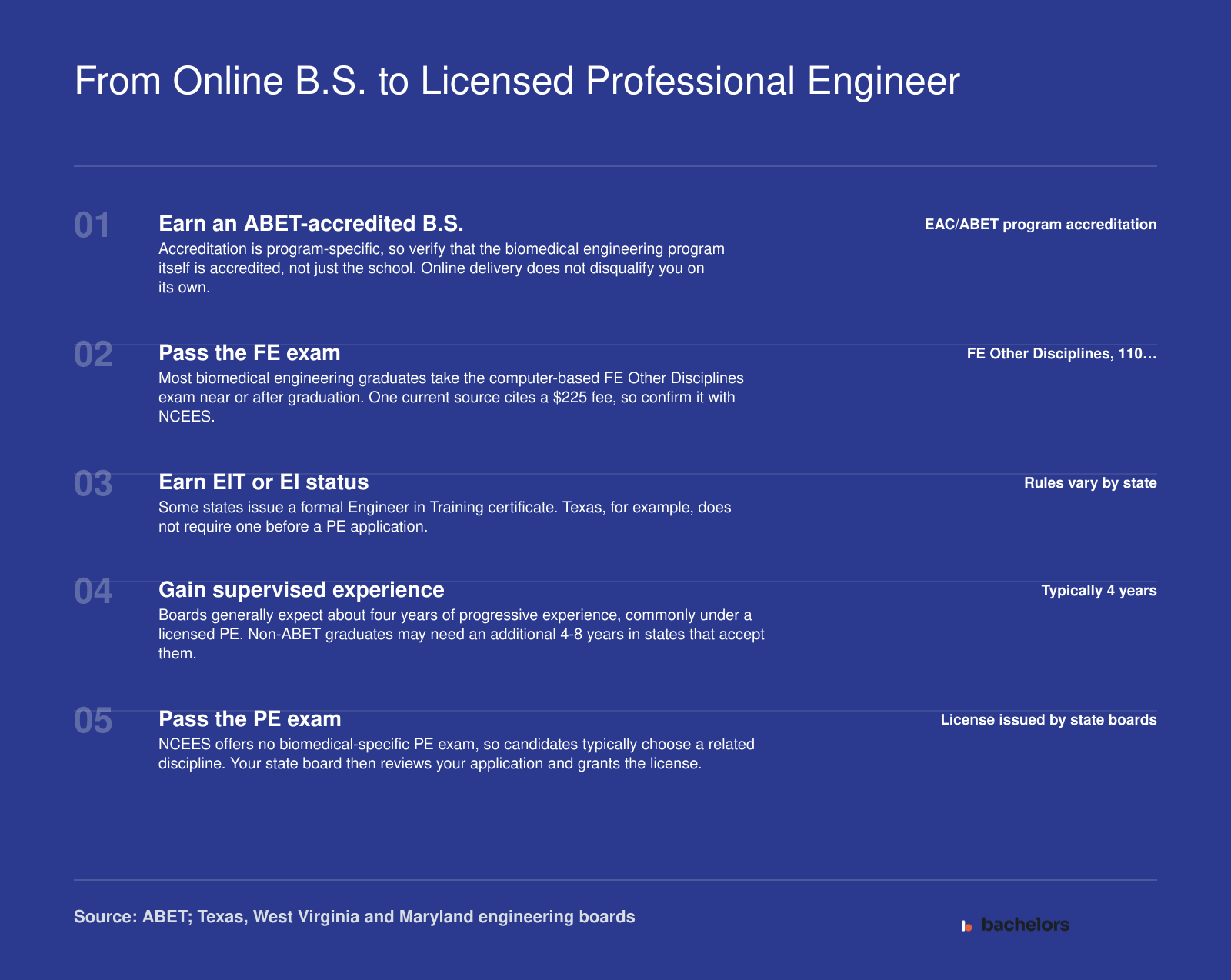
From Online B.S. to Licensed Professional Engineer
Many biomedical engineering roles in medical devices do not require a Professional Engineer (PE) license, but finishing an ABET-accredited program keeps that door open. The path below shows the typical sequence. State engineering boards set the final rules, so confirm the details with the board where you plan to work.
Related Articles
Online Biomedical Engineering Degree Cost: Tuition, Net Price and Fees
The table below shows each school's published undergraduate tuition and fees and its institution-wide average net price after aid, drawn from federal IPEDS and College Scorecard data, so treat these as campus-wide benchmarks rather than program-specific quotes. Online pricing can follow its own rules. ASU Online charges $580 per credit for 2026-27, and residents and nonresidents pay that same rate through 10 credits a semester. For Fall 2026, a 12-credit term costs $6,089 in tuition for Arizona residents and $6,960 for nonresidents, or $6,531 to $7,077 and $7,402 to $7,678 with listed fees, so its 120-credit B.S. works out to roughly $69,600 in tuition alone before program fees, transfer credit or aid. The University of North Dakota charges every online biomedical engineering student the same tuition regardless of residency, a structure that can leave out-of-state online students paying less than nonresident campus rates. UND has not posted a 2026-27 dollar figure for its 128-credit program, and that program requires 1 to 2 weeks of summer labs in Grand Forks, so budget for travel and lodging. Neither school's published cost materials list a separate lab kit fee. To lower the bill, online students at eligible accredited schools can file the FAFSA for federal grants and loans, and many can add employer tuition assistance or military and VA education benefits, which UND confirms it accepts.
| School | Published undergraduate tuition and fees (in-state) | Published undergraduate tuition and fees (out-of-state) | Institution-wide average net price after aid | Median debt for the school's biomedical engineering graduates (College Scorecard program data) |
|---|---|---|---|---|
| University of Michigan-Dearborn | $15,640 | $32,896 | $9,492 | $26,750 (about $284 per month on a 10-year repayment plan) |
| Polytechnic University of Puerto Rico-Orlando | $14,547 | $14,547 | $16,577 | N/A |
| University of North Dakota | $10,951 | $15,570 | $18,551 | N/A |
What Biomedical Engineers Earn Nationally
A bachelor's degree in biomedical engineering is the standard entry point for this occupation. Federal wage data shows strong earning potential once graduates move into the field.
Questions to Ask Yourself
Do you plan to sit for the FE exam, and does that make ABET accreditation non-negotiable for you?
How many of your existing calculus, physics and chemistry credits will actually transfer?
Would you rather pay a flat online rate or chase in-state tuition at a hybrid program you commute to?
Is your goal industry work right after graduation, or a later pivot to medical school or graduate research?
How to Choose an Online Biomedical Engineering Program: Admissions Checklist
Work through these five checks before you submit an application. Each one can change your cost, your timeline or whether you can enroll at all.
- Verify ABET accreditation yourselfSearch the program on abet.org and confirm it is accredited by the Engineering Accreditation Commission (EAC). A school's marketing page is not proof.
- Match the admission benchmarksExpect to submit transcripts and show strong math and science preparation. ASU Online lists benchmarks including a 3.00 GPA, top 25% class rank, a 1210 SAT or a 24 ACT, and it allows no high school math or lab-science deficiencies for biomedical engineering. Ask each school whether test scores are required or are one option among several.
- Read the transfer-credit policy closelyASU generally accepts up to 64 transfer credits and offers the MyPath2ASU community college pathway. Applicants with fewer than 24 credits need a 3.00 transfer GPA and must also meet first-year criteria. At UND, students with fewer than 24 transferable credits must also meet first-year criteria. Request a course-by-course review of your calculus, chemistry, biology and physics credits.
- Check start dates and pacingASU admits on a rolling basis, and its next listed start is January 11, 2027. UND sets deadlines of August 15 for fall, December 15 for spring and May 1 for summer. Ask about session length and part-time options.
- Plan for lab logisticsUND requires 1–2 weeks in Grand Forks each summer for lab work, so budget for travel. At every school, ask about lab kit and software fees. Note that ASU charges a $75 application fee.
Biomedical Engineering programs by state
Compare Biomedical Engineering programs on the data that matters
Explore more Science & Engineering majors or browse every field of study.
All Science & Engineering programs Browse every field of study