Best Criminology Schools in Minnesota
Compare 3 accredited Criminology programs in Minnesota, with net price after aid, graduation rates, earnings and debt from IPEDS and the U.S. College Scorecard.
A bachelor's degree in criminology in Minnesota is not a standardized credential. Schools award a Bachelor of Science (B.S.) or a Bachelor of Arts (B.A.) in Criminology, and the major sits in sociology on one campus and criminology on another. All meet the degree requirement for a Minnesota peace officer license; the POST-approved peace officer education sequence is the add-on.
Costs diverge: in-state tuition at the public options starts at $14,610, and median earnings for graduates run $41,204 to $42,562 one year after completion, rising to $59,022 to $60,757 four years out.
The best criminology school in Minnesota depends on the setting you want.
Key Points
- University of Minnesota-Duluth has the lowest in-state tuition, at $14,610.
- After aid, University of Minnesota-Twin Cities costs least: $16,778 average net price.
- Criminology graduates' median earnings reach $59,022 to $60,757 four years out.
Best Schools for a Bachelor's Degree in Criminology in Minnesota
Three Minnesota schools award a bachelor's degree in criminology, or a degree carrying a closely related name, in an on-campus format. They differ sharply in setting and structure: a large public research university with a broad sociology department, a mid-sized public campus with an internship built into the major, and a private university in Saint Paul with a justice-studies center behind it. The profiles below describe what each school is like for a criminology major, not just its course list.
University of Minnesota-Twin Cities
#1Minneapolis, MN · ~$17,000/yr (est.)
Best for: Researcher-minded students at a large public university
The University of Minnesota-Twin Cities is the state's largest public research university, and its sociology department houses the Sociology of Law, Criminology, and Justice major on the Minneapolis campus. The major was renamed in 2021 and is deliberately narrower than the general sociology degree, with coursework on courts, prisons, human rights commissions, and the social construction of crime. Students train in interviews, statistical analysis, survey research, and ethnography rather than a single method. A large faculty and a full research university setting give majors room to add related work in law, public policy, or statistics.
- Bachelor of Arts and Bachelor of Science tracks available
- Major renamed in 2021 from Law, Criminology and Deviance
- Coursework covers courts, prisons, and human rights commissions
- Studies the causes and social construction of crime
- Methods include interviews, survey research, and ethnography
- Also uses statistical analysis and historical comparison
- Tighter focus than the generalist Sociology major
University of Minnesota-Duluth
#2Duluth, MN · $15,000 – $20,000/yr (est.)
The University of Minnesota-Duluth is a mid-sized public campus on Lake Superior, and its criminology bachelor's degree sits in an interdisciplinary department spanning justice, culture, and social change. Every major completes an internship with a community agency, and recent placements include the Sixth Judicial District Board of Public Defense and First Witness Child Advocacy Center. Faculty interests include cybercrime and fear of crime, and a student-run Criminology Club gives majors a peer network with a faculty sponsor. Cross-over courses let students connect criminology to related fields before they graduate.
- Bachelor of Arts in the Department of Studies in Justice, Culture, & Social Change
- Required internship with community agencies for all majors
- Placements include the Sixth Judicial District Board of Public Defense
- Also places interns at First Witness Child Advocacy Center
- Faculty research covers cybercrime and fear of crime
- Interdisciplinary department with cross-over courses
- Student-run Criminology Club with a faculty sponsor
- Prepares graduates for law school or graduate study
Hamline University
#3Saint Paul, MN · ~$21,000/yr (est.)
Best for: Pre-law students drawn to forensic psychology
Hamline University is a private university in Saint Paul with a long-standing focus on law, justice, and public service. Its Center for Justice and Law connects students with partners including the Minnesota Innocence Project, the Minnesota Justice Foundation, and Inside-Out Prison Exchange, which extends learning well beyond the classroom. Criminology and criminal justice majors can add a forensic psychology or public policy concentration, or take the peace officer training track. Undergraduates can join faculty research as early as their first year and present at regional and national conferences.
- Bachelor of Arts in criminology and criminal justice
- Forensic psychology concentration available
- Public policy concentration available
- Peace officer standards and training major option
- Senior capstone built around an internship
- Students may join faculty research in the first year
- Past internships include Saint Paul Police and the Minnesota Bureau of Criminal Apprehension
- Coursework covers victimization, juvenile delinquency, and courts
Cost & outcomes by school
Federal data for the highest-earning Criminology programs, independent of the ranking above. Earnings are this field's bachelor's graduates four years after completing where the Scorecard reports them, else the school's undergraduate median.
| School | Net price / yr | Grad rate | Earnings | Debt | Grads/yr | Format |
|---|---|---|---|---|---|---|
| Hamline University MN | $20,744 | 61% | $60,757 | $25,000 | 33 | Campus |
| University of Minnesota-Duluth MN | $18,743 | 65% | $59,754 | $22,885 | 56 | Campus |
| University of Minnesota-Twin Cities MN | $16,778 | 85% | $59,022 | $19,500 | 139 | Campus |
Sources: U.S. Department of Education. Net price, graduation rate, earnings and debt: College Scorecard (earnings and debt for this field's bachelor's graduates where reported, else school-wide); graduates: IPEDS. A dash means no figure is reported.
Cost, debt & payoff
Median earnings of this field's bachelor's graduates (4 yrs after completing, else the school's undergraduate median) vs. their median federal loan debt · U.S. College Scorecard
Across these programs the median graduate earns about $59,754 and finishes with roughly $22,885 in debt — a ratio that clears a common rule of thumb (keep debt below first-year salary). Net price and debt vary widely school to school, so check the per-school figures in the table above before you shortlist.
How We Ranked Minnesota Criminology Schools
This ranking compares Minnesota bachelor's degree programs in criminology using federal College Scorecard data from the U.S. Department of Education. The figures come from the most recent release available as of November 2026.
What We Looked At
- Net price: What a year typically costs once grants and scholarships come off the full price of attendance. It is usually lower than the sticker price.
- Graduation rate: The proportion of students at the school who complete their degree.
- Program-level earnings: What graduates of the specific criminology-related program earn after leaving school, where the federal data reports it.
- Program-level debt: The typical federal loan debt graduates of that program carry.
Caveats Worth Knowing
Graduation rates and net prices are institution-wide figures, not criminology-specific ones. A school with a strong overall graduation rate may still see different results in its criminology major. Net price is also approximate. It reflects averages across many students, so your own cost will depend on your family income, aid package and housing choices.
Earnings and debt figures are tied to the program, but they cover past graduates and can shift as new data is released. Treat them as a guide to what is typical, not a promise.
What Is Included
Only Minnesota bachelor's programs in the federal dataset are ranked, whether they are taught on campus or online. A program that does not appear in the dataset is not ranked here, which says nothing about its quality. Use the ranking to narrow your options, then confirm current costs, requirements and outcomes with each school before you apply.
Criminology vs. Criminal Justice: Which Bachelor's Degree Fits You?
Criminology studies why crime happens, drawing on theory, research methods, and sociology. Criminal justice studies how the system responds, including policing, courts, and corrections. In Minnesota, criminology is often housed in a sociology or criminal justice department, so read the actual course list before you commit. Hamline University pairs the two in a single Criminology and Criminal Justice major, while the University of Minnesota-Twin Cities program is titled Sociology of Law, Criminology, and Justice and the University of Minnesota-Duluth offers a Criminology B.A.
| Factor | Bachelor's Degree in Criminology | Bachelor's Degree in Criminal Justice |
|---|---|---|
| Core focus | Causes of crime, criminal behavior, and society's response | Organization and processes of the justice system |
| Typical coursework | Criminological theory, research methods, statistics, sociology of deviance | Policing, courts, corrections, criminal law, agency operations |
| Career orientation | Crime analysis, research, policy, social services, plus law enforcement and corrections | Law enforcement, courts, corrections, investigation, and public safety |
| Graduate-school fit | Often a strong base for graduate study in sociology, criminology, public policy, or law, thanks to the research emphasis | Suits graduate study in criminal justice, public administration, or law; leadership tracks in agencies |
| Typical department home | Often sociology or a combined criminology and criminal justice department | Often a standalone criminal justice or public safety department |
| Median pay, police and detectives (May 2025) | $77,310 per year | $74,910 per year |
| Median pay, probation officers and correctional treatment specialists | $66,270 per year (May 2025) | $61,800 per year (2022) |
Online and Hybrid Criminology Bachelor's Options at Minnesota Schools
Can you earn a criminology bachelor's degree online in Minnesota? At the schools ranked here, no, not in the criminology major itself. Each of the criminology programs here is listed as a campus program.
What the ranked programs actually list
- University of Minnesota-Twin Cities: The criminology track sits inside the Sociology of Law, Criminology, and Justice program, taught in Minneapolis.
- University of Minnesota-Duluth: The Criminology B.A. is a Duluth campus degree, with coursework in an interdisciplinary department.
- Hamline University: The Criminology and Criminal Justice major is a St. Paul campus program.
None of the three publishes a fully online or asynchronous version of the criminology major on its program page. If you want this specific field of study at one of these schools, plan on attending in person.
Where online study fits in Minnesota
Fully online criminal justice bachelor's degrees, a related but distinct field, are more common in Minnesota than online criminology degrees. Some Minnesota schools describe those programs as "100% online" and asynchronous, meaning you complete coursework on your own schedule with no set class meeting times.1 Others mix on-campus and online classes without committing to a fully online finish.
Delivery labels are not applied consistently, so read the exact wording on the program page. "Available online" does not always mean every required course can be finished remotely, and it says nothing about whether classes meet live.
In-person requirements to plan for
Even where coursework is flexible, field experience usually is not. UMN Duluth requires an internship with local agencies, and Hamline builds a senior capstone internship into the major, with placements such as the St. Paul Police. Those hours happen at a site, in person, during business or shift hours.
The short answer: yes, you can study criminal justice online in Minnesota, but a criminology bachelor's degree at the schools ranked here is a campus commitment.2
Cost of a Criminology Bachelor's Degree in Minnesota
University of Minnesota-Duluth has the lowest in-state tuition and fees at $14,610, but University of Minnesota-Twin Cities has the lowest average net price after aid at $16,778. Private Hamline University charges $50,004 to every student, yet its average net price falls to $20,744 once grants are counted. Net price is an average for students receiving aid, not a personal quote, so run each school's net price calculator; Minnesota residents with financial need may also qualify for the need-based Minnesota State Grant, which requires students to cover at least half their cost through savings, work, loans or other aid.
| School | Sector | In-State Tuition & Fees | Out-of-State Tuition & Fees | Average Net Price After Aid | Median Graduate Debt |
|---|---|---|---|---|---|
| University of Minnesota-Twin Cities | Public | $17,214 | $38,362 | $16,778 | $19,500 |
| University of Minnesota-Duluth | Public | $14,610 | $20,130 | $18,743 | $22,024 |
| Hamline University | Private nonprofit | $50,004 | $50,004 | $20,744 | $23,770 |
What Do Criminology Graduates Earn After Finishing a Minnesota Program?
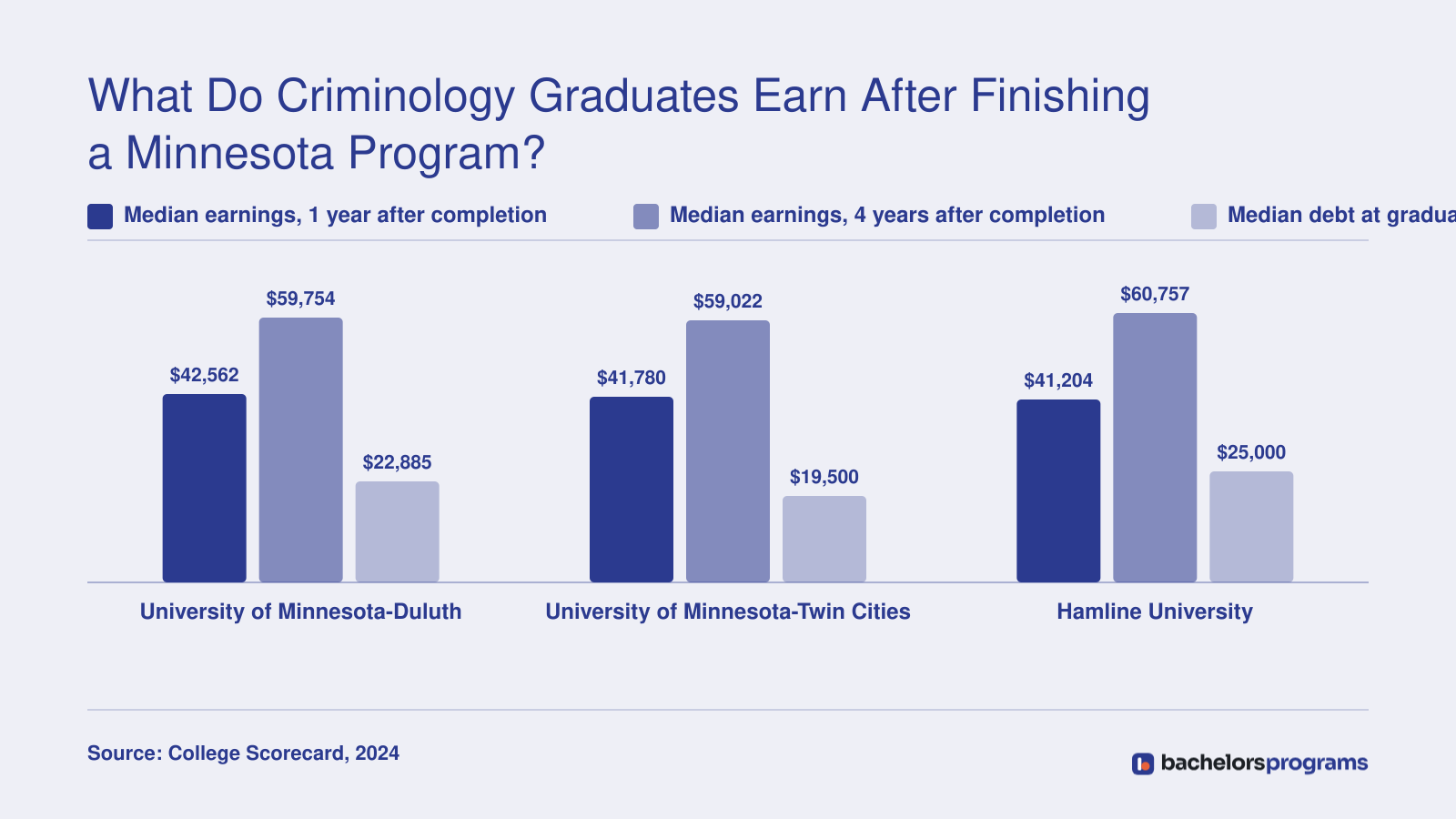
Federal program-level data tracks criminology bachelor's graduates, not each university as a whole. Median earnings run from $41,204 to $42,562 one year after completion and climb to $59,022-$60,757 four years out. Median debt for the same programs ranges from $19,500 at University of Minnesota-Twin Cities to $25,000 at Hamline University, so weigh both bars together.
Related Articles
Minnesota Peace Officer Licensing Through the POST Board
Questions to Ask Yourself
Do you want research and theory, or hands-on work inside the justice system?
Do you need a fully online, asynchronous program, or can you attend classes on campus in Minnesota?
Are you aiming for law school, graduate study or Minnesota POST eligibility?
Minnesota Criminology Degree FAQs
These answers cover the questions prospective students ask most often about criminology bachelor's degrees in Minnesota. Confirm current details with each school before you apply.
What is the cheapest criminology program in Minnesota?
Can you get a bachelor's degree in criminology online in Minnesota?
Do you need a bachelor's degree to become a police officer in Minnesota?
Can you go to law school with a criminology degree?
Compare Criminology programs on the data that matters
Explore more Criminal Justice & Law majors or browse every field of study.
All Criminal Justice & Law programs Browse every field of study